A boutique owner opens a chat window and types the same sentence thousands of buyers type every week: “Hi, how much for 500 girls dresses?” The factory on the other end cannot answer it. Not because the request is rude, but because the sentence does not describe a product. Two honest suppliers can read it and return prices far apart, because each is quietly picturing a different garment. One prices a single-layer cotton sundress with an elastic back. The other prices a lined, multi-layer tulle dress with a hand-attached sash. Same sentence, two products, and the buyer will spend the next two weeks comparing quotes that were never comparable.
Before a number means anything, you have to define three things. What you are actually buying, in construction terms rather than mood terms. How much customization you really need, because that decides your minimum and your calendar. And when the goods have to be on your market, which is the only date that lets anyone backwards-plan production. Define those three clearly and a qualified factory can usually prepare a far more meaningful quotation with far fewer clarification rounds. Leave them open and you will collect prices that look precise and mean nothing. This guide follows how to source wholesale kids dresses from China the way a purchase actually moves, from a reference image on your phone to cartons leaving the floor.
Which Sourcing Route Fits Your Order?
Most sourcing problems start with the wrong route rather than the wrong supplier. The route decides your minimum, your development cost and where the order sits on the calendar, so it is worth naming before you talk to anyone.
| What you need | Best route | Where it changes your planning |
|---|---|---|
| Test demand quickly, or cover a window that has already moved | Ready stock | No development or sampling gate; you are choosing from what exists, not from what could be made |
| Sell a proven style under your own name | Private label | Adds labelling and packaging to the critical path, but no pattern work |
| Change fabric, colour or trim on a shape that already works | Modified existing style | Fabric approval moves onto the critical path and can gate cutting |
| Own the construction so no competitor can repeat it | Custom OEM | Development, sampling and at least one fit round sit ahead of production |
| Build a full branded programme across a season | OEM/ODM development | The whole reverse-count chain applies, season by season |
If two rows look plausible, the deciding question is usually the calendar rather than the price. A custom construction that cannot clear development and sampling before your window opens is not a slower version of the right answer. It is the wrong route for that order.
How the Rest of This Library Fits Together
This article is the routing page for the sourcing cluster. Each of the stages below has its own guide, and reading them in this order follows the order a purchase actually moves:
- Verifying a kids dress manufacturer in China — the five layers that separate a real factory from a catalogue
- Building a kidswear RFQ — the twelve variables behind every quotation, and a template you can send
- The custom manufacturing process — what happens to your order after the deposit clears
- Girls dress size grading — why two dresses both labelled Size 6 fit differently
- Fabric approval before bulk production — taking a swatch to a signed bulk lot
- Fifteen girls dress defects — what to name, prevent and verify before shipment
- Children’s clothing compliance by market — routing U.S. and EU requirements before you order
- The kidswear buying calendar — the season planning that sits behind every date above
What You Are Actually Sourcing
Most sourcing conversations go wrong in the first minute because buyers name a product while factories need a route. “A flower girl dress” describes an occasion. It does not tell anyone whether you are buying existing inventory, adding your brand to someone else’s design, or building a garment from nothing. Five routes exist, and each one carries a different minimum, a different calendar, and a different amount of control over what ends up on the hanger.
Ready stock: you are buying inventory, not a design
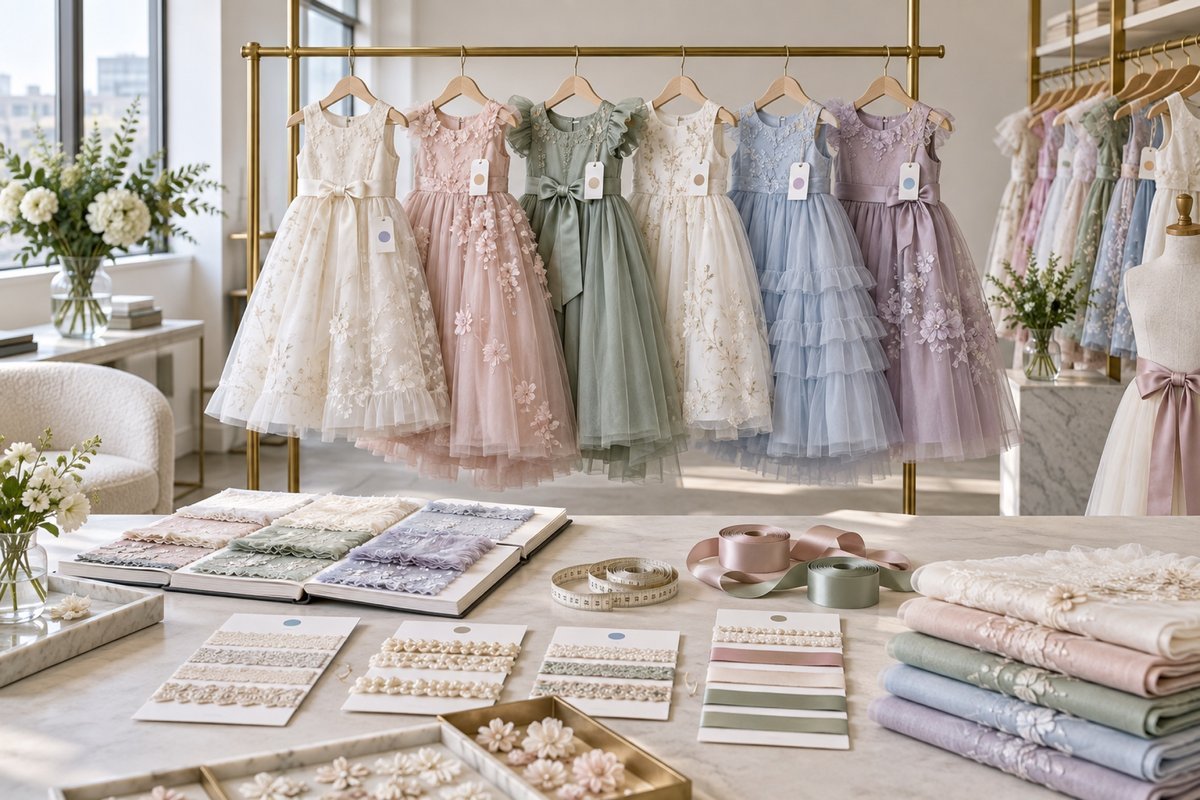
The garment exists, it is engineered, it is sitting in a warehouse. You pick from what is there and nothing about the product changes. Selected styles start from 6 pieces, and on some styles a single piece is possible. This is the route for testing a price point you have never sold at, filling a gap in a season, or covering a sudden event order when there is no time to develop anything. What you can change is limited by definition. You may be able to specify packaging, but you are not choosing the cloth or moving a seam. Our ready stock girls dresses range shows what this route looks like in practice.
Use ready stock when the goal is information. You learn what your customers reach for. You learn your own size curve. You do not learn anything about your design instincts, and that is fine, because that is not the job this route does.
Private label: the same dress, your name on it
Private label is a branding change, not a product change. The dress can come from ready stock or from a style you already run, and full private label means your own woven label, hang tag and packaging applied to it. Nothing about construction moves. Buyers overreach here constantly: they ask for a new pattern when all they actually wanted was their name on the neck and their logo on the bag. If that is genuinely all you need, stay in this lane. It keeps your minimum low and your calendar short, and it lets you spend the money you saved on the thing that will actually differentiate you later.
Modified existing design: the pattern is proven, the surface is yours
Here you take a silhouette the factory has already engineered and change what sits on top of it: fabric, colour, print, trim, or embellishment. The base fit is settled, so grading does not start from zero and the odds of a structural surprise drop sharply. This is the most common route for a boutique that saw a shape it liked and wants it in its own palette and its own fabric weight. It is also the fastest route to something that looks proprietary without paying for full development.
ODM: the factory’s development work, pointed at your market
Under ODM you select from designs the factory has already developed and then adapt them to your customer. You are working on the factory’s technical foundation rather than your own, which is why the calendar is shorter and the minimum is lower than a from-scratch build. This is where you belong when you have a direction but no specification: a season, an occasion, a colour story, no measurements. The boundary between this and building from your own design is worth understanding before you commit either way, and our comparison of OEM and ODM routes for girls dresses lays out exactly where it falls.
Full OEM: your design, built from your specification
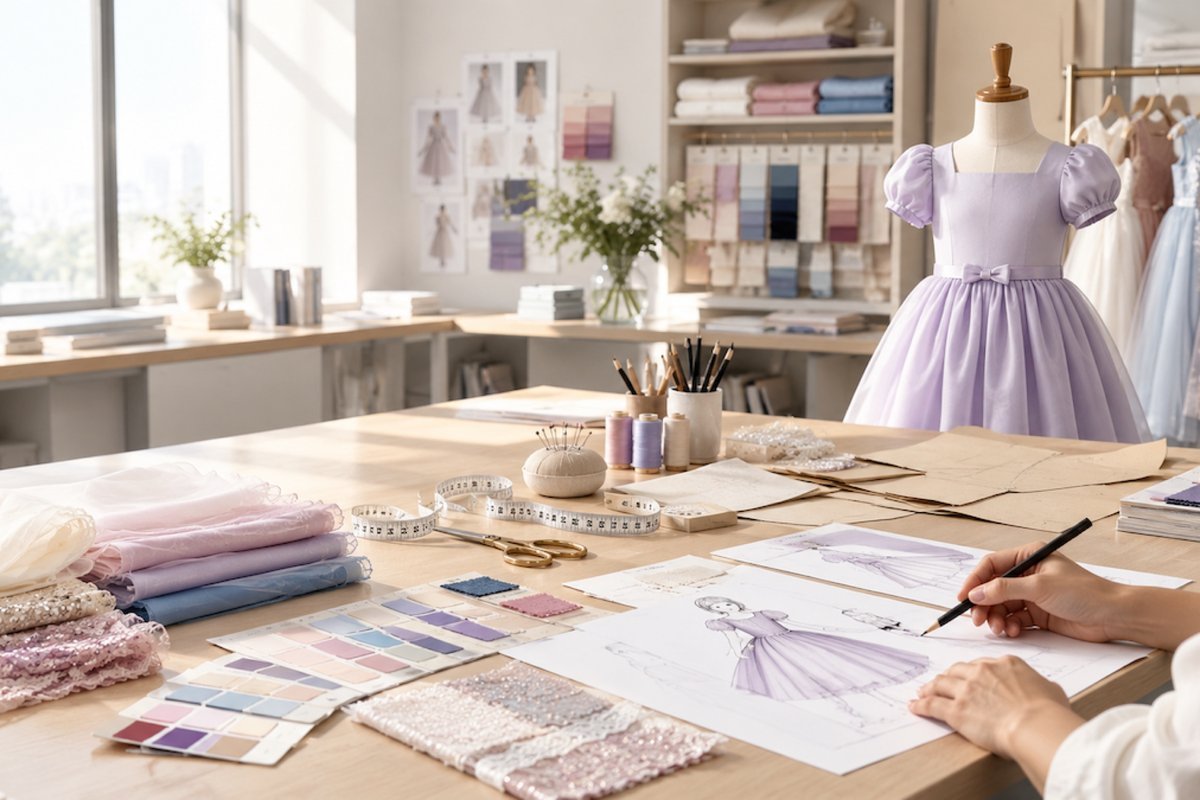
You arrive with the design. In the best case that arrives as a complete tech pack: measurements, construction, stitch types, trims, closures and packing method. In a common case it arrives as a reference image plus a list of requirements, and the factory develops the pattern from there. Full OEM starts from 200 pieces per style. Sample development runs 5 to 7 days. Bulk production follows 25 to 40 days after sample approval. When there is no pattern and no physical sample to work from at all, pattern and sample development is quoted at USD 80 to 150.
This is the route to a garment your competitors cannot buy from the same warehouse. It is also the slowest and the most demanding, because every open question in your brief becomes a decision you have to answer. If the goal is a dress that is unmistakably yours, start from the custom girls dresses service.
Now apply the judgment test, because this is where buyers misclassify themselves.
You have a Pinterest screenshot and nothing else. You are not ready for full OEM unless you accept that the factory will develop the pattern and will then ask you for decisions you have not made: fabric weight, lining, closure type, size range, hem finish. Start at modified existing design or ODM and grow into OEM once one style proves itself.
You only want your own neck label. You are in private label. You do not need a new pattern, and asking for one will cost you a minimum you did not need to pay.
You have a tech pack with measurements and construction. You are ready for OEM, and you will get the cleanest quotes of any buyer in the factory’s inbox, because nothing about your product is ambiguous.
You want to test three styles in small numbers before committing. You are in ready stock. Stay there until a style sells through twice.
The document that separates a guess from a specification is the tech pack. If you do not have one, someone has to build it, and that someone will be billing you for the thinking time either as development fees or as a price buffer. Submitting a proper girls dress tech pack shortens every conversation that follows it.
Where the Factories Are, and What Each Channel Actually Finds You
Every discovery channel returns a different kind of supplier, and the differences are not about quality. They are about how close you get to the people who actually cut and sew, how much you can see before you commit, and how quickly a technical question gets a technical answer. Search engines and marketplaces feel like the same pool. They are not, and treating them as one is how buyers end up negotiating with a company that will later place their order somewhere else.
Supplier Discovery Channel Matrix
| Channel | Supplier depth | Direct factory likelihood | Verification difficulty | MOQ visibility | Communication efficiency | Best use |
|---|---|---|---|---|---|---|
| Google search | Wide but unfiltered | Medium: factories, traders and agencies all rank | High: ranking is bought or gamed | Low: rarely stated upfront | Slow: form submissions, time zones, no shared context | Early reconnaissance and finding narrow specialists |
| B2B marketplace | Very wide | Low to medium: many trading companies | Medium: profiles are self-declared | High: usually listed per style | Medium to high: built-in chat and response norms | Building a first longlist fast; small trial orders |
| Trade shows | Narrow but pre-qualified | Medium to high | Low to medium: you meet people and hold samples | Medium: negotiable on the stand | High: face to face, samples in hand | Judging construction quality; building a shortlist |
| Peer referral | Narrow, already filtered | High | Low: someone has shipped with them | Low to medium | High: you skip the credibility phase | Replacing a failed supplier; trust-first sourcing |
| Sourcing agent | Depends entirely on the agent’s book | Low: you sit one step removed | High: hard to verify what you cannot see | Medium | High for you, slower to reach the factory | Multi-supplier programs; on-the-ground inspection |
| Manufacturer’s own website | Narrow, self-selected | Highest | Medium: still verify independently | Variable, often absent | Variable, usually direct to technical staff | Confirming a candidate; asking detailed questions |
Read that table by column rather than by row. Direct factory likelihood and verification difficulty are the two that decide how much of your time a channel will cost. A marketplace listing gives you enormous breadth and an honest look at minimums, which is genuinely useful, but the profile tells you almost nothing about whether the entity you are chatting with owns a cutting table. A manufacturer’s own site gives you the opposite: narrow, self-selected, difficult to find, but when you land on the right one you are usually talking to someone who can answer a question about seam allowance.
A few things follow from this that are worth saying plainly.
Marketplace volume is not supplier quality. A long catalogue often means a trading company with relationships across many factories, which has real value for buyers who need variety across categories and small quantities per style. It means less when you need a factory to hold a specific construction capability, because the person you are talking to will have to go and find that capability each time you ask.
Trade shows are underrated by first-time buyers and overrated by veterans. What you gain is not a better price. It is the ability to turn a garment inside out in front of the person who made it, which settles questions about lining, finishing and hand feel in about thirty seconds that would take two weeks of emails.
Peer referral is the highest-signal channel and the hardest to get. Ask other boutique owners who are not your direct competitors, in adjacent markets or different countries. One name from someone who has shipped three seasons with a supplier is worth more than twenty directory listings.
Screen Suppliers Out Before Price Ever Comes Up
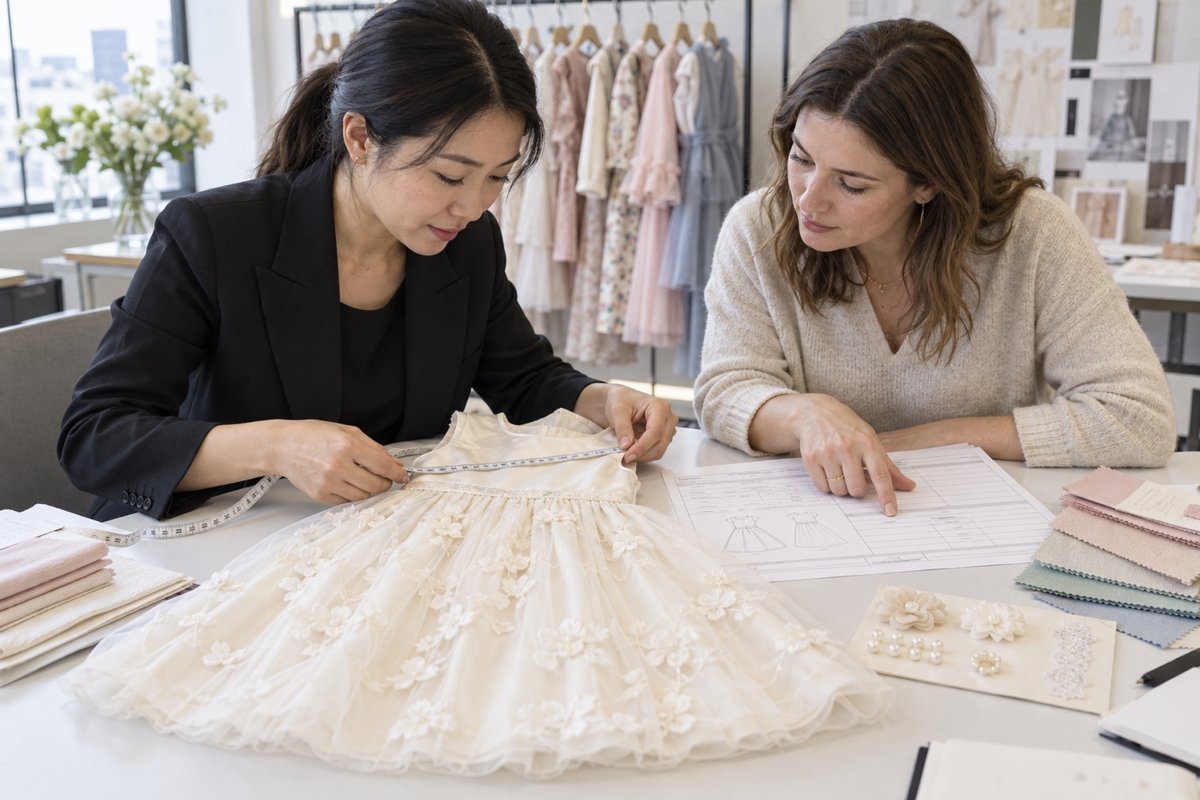
The instinct is to collect five quotes and sort ascending. Reverse the order. A cheap quote from the wrong supplier costs more than a dearer quote from the right one, because you pay the difference in rework, missed launch windows and refunds, none of which appear on the quotation. Screening is not about finding the best supplier in one pass. It is about removing the ones who cannot do your specific job, so that the price comparison at the end is between suppliers who can.
Work through these checks in this order, because each one eliminates a category faster than the next.
Do they actually specialise in kids clothing. A supplier whose catalogue spans babywear, denim, swimwear, evening gowns and outerwear is not lying to you, but you should keep looking. Childrenswear is its own discipline: smaller tolerances, different safety thinking around trims and closures, grading on bodies that change fast, and fabric choices driven by how children move and by how often a garment gets washed. A dedicated girls dress supplier will have opinions about hem finishes and zipper choices. A generalist will say yes to everything.
Have they made this construction before. Not this style, this construction. A multi-layer tulle skirt with a lined bodice is a different production problem from a gathered cotton dress, and hand-applied embellishment is a different one again. Ask what they have made that shares the structure of what you want. The answer tells you whether sampling will be a refinement or an experiment.
What size range they cover, and how they grade. Confirm they can run the full span you need, from your smallest to your largest, and ask how they set grade rules. Suppliers who only quote a narrow range will create a gap you discover when you are already committed. If you are unsure about the span itself, our guide to planning a size run for wholesale buyers covers how to think about depth per size.
Fabric capability and sourcing reach. Can they get the fabric you want, or only what is on their shelf. Ask which fabrics they hold in greige and dyed form, how they handle matching linings, and whether they can source a specific weight. This is where a supplier’s upstream network either helps you or quietly substitutes something cheaper that you will not notice until the sample arrives.
Embroidery, tulle and beading capability, in-house or bought in. Ask directly, and ask what happens when a decoration step is outsourced. Outsourced embellishment is normal and often excellent, but it adds a dependency you need to know about, because it affects both your calendar and who is accountable when something goes wrong. Our overview of girls dress embellishment options helps you ask this question with the right vocabulary.
Sampling capability and who does the pattern. Ask whether patterns are made in-house. A supplier who cuts patterns internally can respond to fit comments in days. One who sends out for pattern work will be slower, and slower gets expensive when you are iterating toward a launch date.
How QC is structured. Not whether they have QC. Everyone says they have QC. Ask where the inspection points sit, whether there is in-line checking during sewing or only a final table check, what happens to a rejected piece, and whether you or your agent can inspect before shipment. A clear answer here is one of the strongest signals you will get.
Compliance support, and what is actually your job. This is the one buyers most often get wrong. A factory can support testing, provide test reports from recognised laboratories, and supply the documentation that sits with the shipment. The Children’s Product Certificate is a different matter: it is issued by the importer, based on third-party laboratory testing, and it is not something a factory can hand you. If a supplier offers to “provide” it, treat that as a signal to ask more questions. Since 8 July 2026, importers have also been filing certificate data electronically with U.S. Customs, and from 8 January 2027 that requirement extends to goods entering from a foreign trade zone. Both are importer obligations, so budget for them on your side. Laboratory reports from bodies such as SGS, along with ISO 9001 certification or Sedex membership, are reasonable things to ask to see, and a long-standing marketplace track record can add another layer of context.
Export experience to your market. Ask which markets they ship to and what they know about the documentation those markets require. A supplier who ships regularly to your region will already understand your labelling expectations and freight documentation. One who has never shipped there will learn on your order.
Screening is the fast filter, and it is designed to remove the wrong suppliers quickly. Choosing between the ones who survive is a slower judgment, and the criteria for selecting a reliable kids dress manufacturer are worth reading alongside this list.
Two Inquiries, Two Completely Different Outcomes
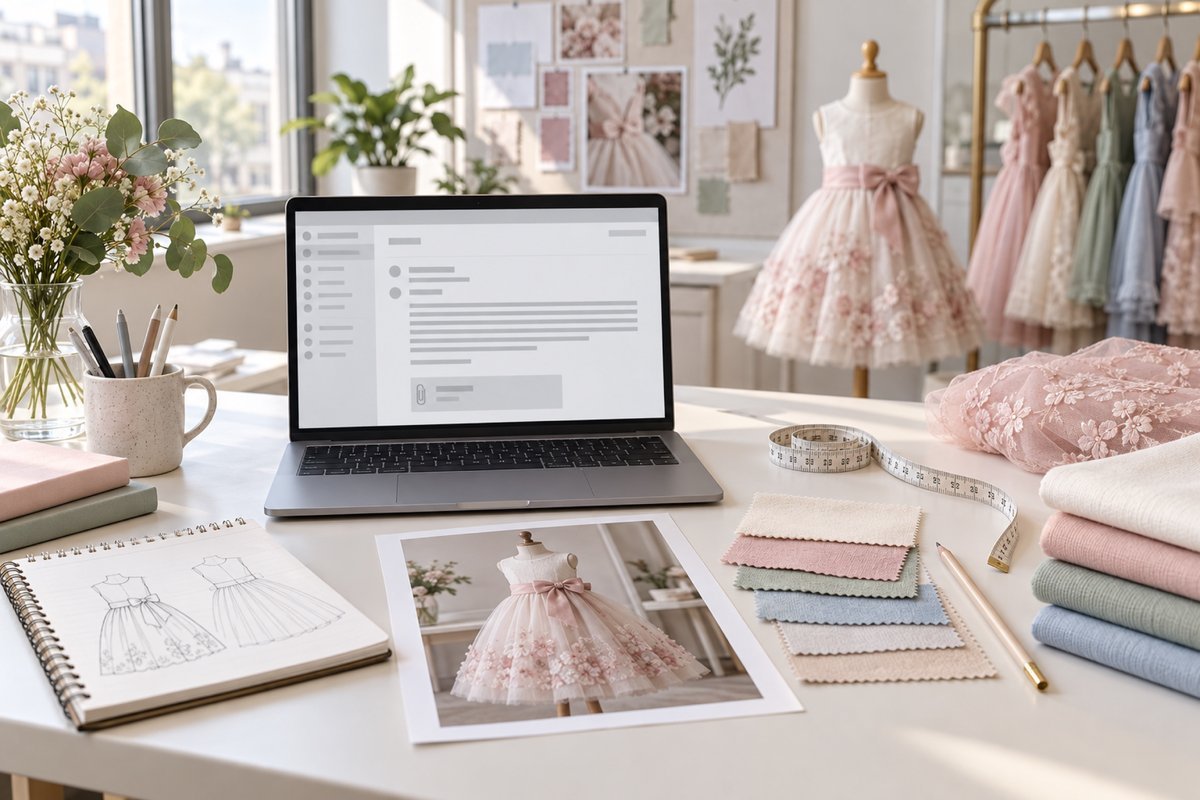
Here is the message that arrives in our inbox constantly, and in every factory inbox in the industry. It is not a bad message. It is an unanswerable one.
Hi, how much for this dress? Please send your best price. I need 500 pieces. We are a boutique in Europe and we need good quality. Please quote including shipping. Looking forward to your reply.
Notice what the factory now has to guess. Fabric is unspecified, so the merchaniser picks a middle option and prices it, or asks and waits. Construction is unspecified, so lining is a coin flip. Size range is unknown, so grading and marker efficiency cannot be estimated. Colour quantity is unknown, which changes dye lot minimums. Decoration is unknown, and decoration is often the single biggest variable in a dress cost. Packaging is unknown. Destination port is unknown, so “including shipping” cannot be quoted at all. Target date is unknown, so nobody knows whether this is urgent or speculative.
The reply will be a price. It will not be a price for your dress. It will be a placeholder, built on assumptions you did not make and cannot see, and it will move the moment you supply real detail. Buyers read that movement as a supplier trying to raise the price later. Usually it is a supplier finally pricing the actual garment.
Now the version that gets a real answer.
Hello,
We would like a quotation for a girls special-occasion dress, developed from the attached reference images.
Style: sleeveless bodice, gathered tulle skirt, satin sash at the waist, centre-back zip, fully lined.
Fabric: we would like a soft polyester tulle with a cotton-feel lining. Please also quote one alternative if you have something comparable in stock.
Sizes: 2Y through 10Y. We expect the larger sizes to sell fastest but please advise if your grading suggests otherwise.
Quantity: 480 pieces total across 4 colourways, 120 per colourway. Open to your minimum per colourway if it affects price.
Colours: ivory, dusty rose, sage and navy. We can send Pantone references on request.
Decoration: satin sash with a small fabric flower at the waist. No beading.
Target market: European Union, sold through independent boutiques.
Packaging: individual polybag, our own woven label and hang tag, recycled card insert.
Target delivery: goods needed in our warehouse by early March for a spring launch.
Please confirm: your MOQ, sampling time, bulk lead time, and whether you can support third-party testing.
Every line in that message removes a variable, and each variable is a lever on the number you get back.
Fabric and lining are stated, so nobody guesses at material cost. Construction is described, so lining, closure and skirt structure are priced rather than assumed. Size range is given, so grading is known and marker efficiency can be estimated. Quantity is broken out per colourway, which is what actually drives dye and cutting economics, because 480 in one colour and 480 across four are different production problems. Decoration is defined and explicitly bounded, and “no beading” is one of the most valuable sentences in the whole message. Target market is named, so compliance expectations are anchored. Packaging is specified. And the delivery date is there, which is the only thing that lets a factory tell you honestly whether your calendar works.
The final line matters more than buyers expect. Asking the supplier to state their MOQ, sampling time and bulk lead time converts a price quote into a plan. If their answer is 200 pieces per style, 5 to 7 days for sampling, and 25 to 40 days for bulk after approval, you can now work out whether an early March delivery is realistic, and you can do it before you have spent anything.
Sample, Verification, Order: The Chain and What You Decide at Each Link
Once a supplier is quoting seriously, the order moves through a sequence that is fairly standard across the industry. What varies is how much attention you pay at each link. Most problems that buyers describe as “the factory let me down” are actually decisions that were skipped or rushed at one specific link in this chain.
Initial quotation. This is an estimate, not a contract, and you should treat it as a working range. Confirm what it includes: fabric, trims, labour, packing, and whether testing is inside or outside the number. Ask what would move it. A supplier who can tell you which two variables would change the price most is a supplier who understands their own costing.
Fabric confirmation. Before sampling, agree the fabric. Approve a swatch for hand feel, weight and colour, and ask whether the bulk fabric will come from the same dye lot and the same mill as the swatch. This step is where a lot of disappointment is prevented, because a sample made in one fabric and a bulk run made in another produce two garments that look alike in photographs and differ in hand.
First sample. You receive one. Evaluate it as a production proposal rather than as a finished product. Check the silhouette against what you pictured, the construction against what you specified, and the fabric against the swatch you approved. Look at how the inside is finished, because interior finishing tells you more about a factory’s standards than the outside ever will.
Fit comments. This is the link buyers most often under-use. Put the sample on a real child or a proper form, and write specific comments. Where the waist sits. Whether the armhole allows reaching. Whether the zip opens far enough to get the dress on without a struggle. Whether the hem is level when the child stands still. Vague feedback such as “fit looks a bit off” produces another sample that is also a bit off. Specific feedback produces a revised sample that is close.
Revised sample. Confirm that every comment was addressed, and check that addressing one did not disturb another. Shortening a bodice changes where the waist seam falls. Widening an armhole changes how the shoulder sits. Ask what changed and why, and keep the physical samples, because they become your reference if there is ever a dispute about bulk.
PPS, or pre-production sample. This is the sample made in bulk fabric, with bulk trims, on bulk settings, usually in a size from the middle of your range. It exists because a sample approved in substitute materials is not proof that bulk will match. Approve it properly: measurements against your spec, colour against your approved standard, trims against what you specified, and hand feel against the swatch. Sample approval is not the same as bulk readiness, and PPS is the step that closes that gap.
Deposit and bulk. Payment terms should be agreed before you reach this point, along with what happens if bulk is late. Ask for a production schedule you can check against, and ask at what point you or your inspector can see goods in progress. Mid-production visibility is worth requesting, because it is the last point at which a problem is cheap to fix.
QC and inspection. Agree the standard before bulk starts, not after. Written defect definitions and an agreed acceptance level prevent the worst argument in this industry, which is two people looking at the same garment and disagreeing about whether it is acceptable. Our guide to AQL inspection for kids dresses explains how to set that standard. If you are using a third party, book them early, because inspection slots fill up near shipping peaks.
Shipment and the handover to logistics. Once goods pass, packing, documentation and freight take over. This is the point where this article stops and a different job begins. Clearance, duty, freight modes and the paperwork that travels with a shipment are not sourcing decisions. They are covered in full in our guide to importing kids dresses from China, which handles what happens after the goods exist. This article is about getting to a supplier worth importing from, and about placing an order that will not need to be corrected later.
Comparing Suppliers on the Axes That Decide Your Season
By now you may have two or three suppliers who can genuinely do the work. The comparison should not be a price sort. Price is one column, and on its own it is the least informative one, because a low number can come from a thinner fabric, a looser tolerance, an outsourced decoration step, or simply from a supplier who has not understood the brief. Run the comparison across these axes instead.
| Axis | What to compare | Why it decides more than price |
|---|---|---|
| Price | Quoted unit cost, and what is inside it | A price that excludes testing or a specific trim is not comparable to one that includes it |
| MOQ | Per style, and per colourway | A low unit price at a minimum you cannot absorb is worse than a higher price you can actually order |
| Sample quality | Construction, interior finishing, fabric accuracy | The sample is the best available evidence of what bulk will look like |
| Lead time | Sampling days plus bulk days, stated separately | A cheap supplier who misses your launch window has cost you the season |
| Testing support | Familiarity with your market, report handling | Determines whether your compliance paperwork gets done early or becomes a crisis |
| Communication | Technical answers, response speed, honesty about limits | Predicts how problems get handled, and there will be problems |
| Defect policy | What happens to rejects, who pays, how claims work | The only axis that tells you what a supplier does when something goes wrong |
| Restock capability | Whether they hold fabric, can repeat a colour, and how fast | Decides whether a sell-out becomes a reorder or a lost opportunity |
Restock capability deserves more attention than it usually gets. A supplier who has recorded your dye formula, kept your approved fabric source and retained your pattern can repeat an order quickly. One who has not will re-quote, re-sample and re-approve, which is a slow process you discover only when you try to reorder a style that sold out.
Defect policy is the other one buyers skip until they need it. Ask before the first order what happens if goods arrive outside tolerance. Good suppliers have a process, and they can describe it without hesitation. Suppliers who cannot describe it are telling you something just as clearly.
Why the lowest quote is often the most expensive order
A low number is rarely a mystery. Something produced it. It might be a lighter fabric, which you will meet as a garment that hangs differently from the sample. It might be a decoration step moved to a cheaper workshop, which you will meet as inconsistency across pieces. It might be a looser internal tolerance, which you will meet as size variation within the same labelled size. It might be excluded testing, which you will meet as a cost that reappears later, or as a compliance problem at your border.
None of those are visible in the quotation. They are visible in the sample, in the PPS, and in the first bulk shipment, which is the most expensive place to discover them. The right question is not who is cheapest. It is which supplier has priced the garment you actually specified, can hit the date you actually need, and will still be answering the phone when something needs fixing.
Ready to move forward?
Tell us the three things that decide everything else: what you are buying in construction terms, how much of it is yours to change, and the date the goods have to be on your market. With those we can tell you which route fits, what the minimum looks like on that route, and where the calendar gets tight. If you already have a reference image, send it with the size range and the quantity per size — that is enough to start a real conversation rather than a price range. Custom girls dresses is where the route conversation usually lands. Typical figures as of September 2026, for planning only: ready stock on selected styles from 6 pieces, custom orders from 200 pcs per style, sampling 5–7 days per round, bulk production 25–40 days after sample approval, and pattern or sample development USD 80–150 where no pattern exists. Exact MOQ, development cost and lead time depend on style, fabric, quantity and season.
- Product: a reference image, a sketch, or a tech pack, plus a note on what must not change about it
- Fabric and lining: what you want, and whether you are open to a factory alternative
- Size range: your smallest and largest size, and roughly how you expect to split quantities
- Quantity: total pieces, and how that breaks down across styles and colourways
- Decoration: what is applied, and just as importantly what is not
- Target market: which country the goods will be sold in, since this drives testing and labelling
- Packaging: polybag, label, hang tag, and whether you need your own branding
- Delivery window: the date goods need to be in your warehouse, not the date you would like them shipped
- Budget: a range you can state, because it lets a supplier propose materials that fit instead of guessing
That last item is the one buyers withhold, and withholding it is a mistake. A factory that knows your target price can tell you honestly whether it is achievable, and can propose a construction or a fabric route that gets you there. A factory kept in the dark will quote, wait, and revise.
If you already have reference images, a target quantity, a size range and a delivery window, send all four together. That combination is what lets a factory judge whether ready stock, a modification of an existing design, or a full OEM build is the realistic route for your order, and it is the difference between a quotation you can act on and a number you have to spend two more weeks clarifying. Send what you have, even if it is incomplete, and say plainly which parts are still open. An honest gap in a brief is far easier to work with than a confident guess.