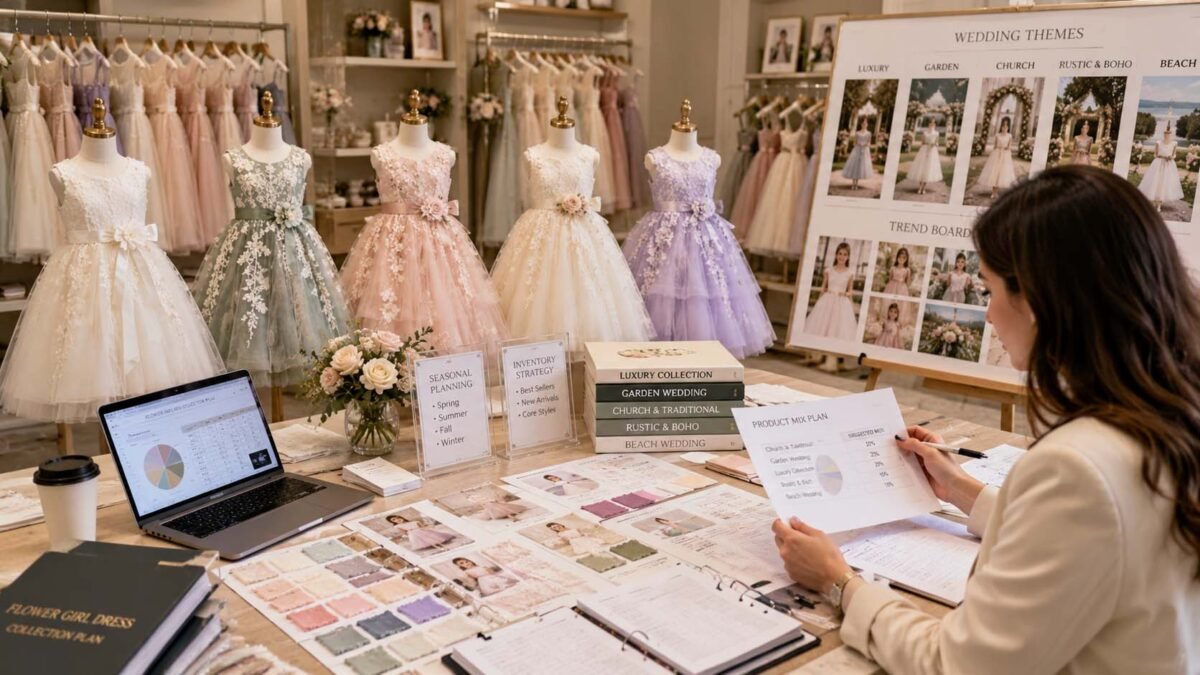
Importing kids’ dresses from China is the fastest route to a deep, price-competitive range — but only when the process is done in the right order. Buyers who rush straight to “who has the cheapest price” usually discover later that freight, compliance, sizing or reorder consistency eats the savings. This complete 2026 guide walks through the import journey step by step — defining your range, vetting suppliers, sampling, pricing, Incoterms, shipping and customs — so you can import with confidence instead of guesswork.
Start With a Low-Minimum Test Order
Before you commit to a bulk run, test a supplier with ready-stock styles — mixed styles and colours from 6 pieces, so you can judge fabric, stitching and sizing firsthand.
Every year, thousands of boutique owners and importers bring children’s dresses from China to markets in North America, Europe, Australia and the Middle East. The reason is simple: China’s childrenswear factories combine deep fabric supply chains, skilled sewing, fast sampling and flexible minimums in a way few other sourcing hubs match. The differences between successful importers and frustrated ones rarely come down to luck — they come down to process. This guide is that process, written for buyers who want repeatable results, not one-off gambles.
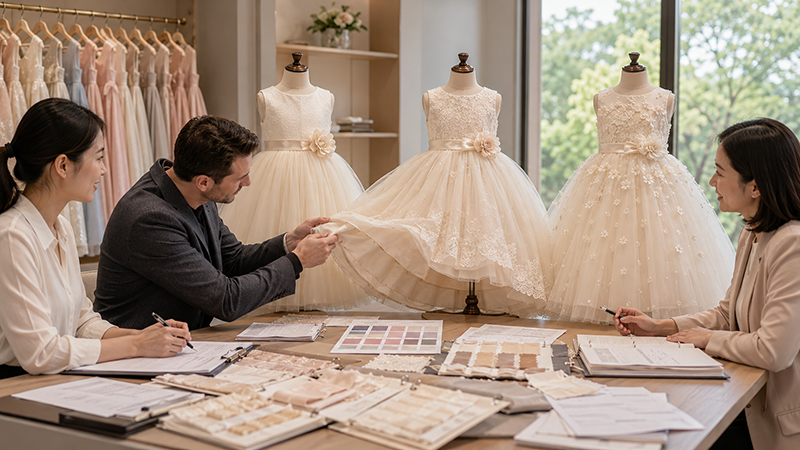
A wholesale buyer reviewing dress samples with a factory representative — the starting point of any kids dress import relationship.
The single biggest mistake new importers make is looking for a supplier before they know what they are buying. Without a defined range, every supplier looks equally good and equally bad, and you end up choosing on price alone.
Define Your Category Mix
Kids’ dresses are not one category. A flower girl dress, a birthday party dress, a school-event dress and a summer casual dress target different customers, price points, sizes and buying seasons. Decide your mix before you contact anyone:
- Flower girl and wedding — formal, pastel, sizes 100–140 cm, strong seasonal peaks around wedding season.
- Party and birthday — tulle, satin, bows, sequins; year-round demand with birthday spikes.
- Communion and ceremony — white, elegant, lace and satin; a focused regional market with clear timing.
- Summer and casual — light fabrics, comfortable cuts; higher volume, lower price point.
Set Your Price Ladder
Write down the retail prices your customers will pay, then work backwards to the maximum landed cost you can afford. A common structure for children’s formalwear leaves room for a retail margin of at least 50% after all costs. If your target retail is $60, your landed cost — product, freight, duties, fees — needs to sit comfortably below $30. That number filters suppliers faster than any catalog.
Define the Size Run and Fit Standard
Chinese children’s sizing is height-based (100 cm through 160 cm covers roughly ages 2–14), which is easier to communicate than age labels and reduces fit disputes. Decide your full size run and stick to it across styles so reorders stay simple. Also decide how “generous” or “slim” the fit should be for your market — North American buyers often prefer a slightly roomier fit than Asian-standard sizing.
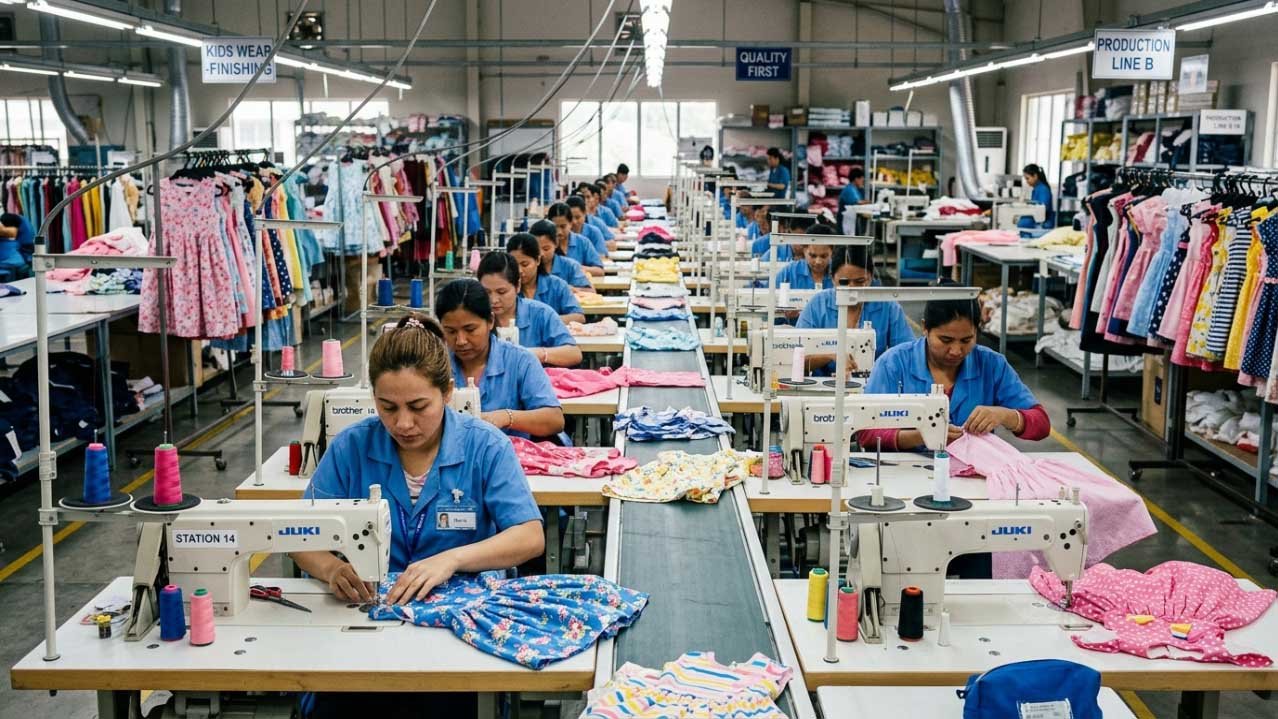
Inside a direct factory production floor — one of the three supplier types in the kids dress import chain.
Not all suppliers are created equal, and the differences between them change what you can expect from sampling, quality and pricing. Know which type you are dealing with before you negotiate.
| Supplier type | What they do | Best for | Watch out for |
|---|---|---|---|
| Factory (direct) | Owns the production line; controls fabric, sewing, QC | Custom OEM/ODM, repeat bulk, quality control | Higher minimums; slower small orders |
| Trading company | Sources from multiple factories; handles export logistics | Small mixed orders, quick market testing | Less direct control over production |
| Wholesale / ready-stock supplier | Stocks finished styles in standard sizes | Low-MOQ starts, fast dispatch, seasonal testing | Limited customization on existing styles |
| Sourcing agent | Represents you; coordinates factories, QC, freight | Buyers managing many products or markets | Added fees; quality varies by agent |
Get a Sourcing Quote
Send us your target styles, size run and quantity. We reply with MOQ, unit pricing and sample lead time — no obligation.
How to Vet a Supplier in One Working Day
You do not need a week-long audit to shortlist suppliers — you need five targeted checks:
- Category focus: does the supplier specialise in girls’ dresses, or are dresses a side product? A specialist usually wins on fabric knowledge and fit consistency.
- Factory credentials: request business license, factory photos and any certifications. Recognised certifications in the childrenswear trade include ISO 9001 (quality management), Sedex (ethical trade audit) and SGS inspection reports.
- Sample speed: ask for a stock sample quote and lead time. Fast, organised sampling is a strong predictor of organised production.
- Communication: send one detailed question and time the reply. A supplier who answers clearly within a working day will communicate well through production, which is where most import problems actually get solved.
- References: ask for two buyers in markets similar to yours. Follow up with at least one.
3. Sample First — Always
No matter how good the catalog photos look, never place a bulk order on the basis of images alone. Sampling is the cheapest insurance you will ever buy.
Stock Samples vs Custom Samples
Ready-stock styles usually allow you to order 1–2 pieces as samples quickly — often dispatched within 3 days. Custom OEM styles (your design or modifications) take longer, typically 5–10 days for a development sample plus shipping. Plan your calendar around these lead times.
What to Check on the Sample
- Fabric hand feel: does it match the weight and texture you expected? Rub it, stretch it, hold it up to the light.
- Colour: compare against your target swatch in daylight, not under a desk lamp.
- Fit: try the sample on a child in the target size range, or measure it flat against the spec sheet — chest, waist, length, sleeve.
- Construction: seams straight, hems even, trims secure, no loose threads, zippers smooth.
- Comfort and safety: no scratchy seams against the neck, no small parts that could detach, no drawstring hazards.
Approve in Writing
Send the supplier a written approval listing exactly what was approved (fabric, colour, measurements, trims) and what, if anything, must change. Keep one approved sample as the physical reference — it becomes your strongest tool if bulk delivery drifts from spec.
4. Pricing, MOQ and Payment Terms
Price negotiation is where import relationships are made or broken. Go in with the full cost picture, not just the unit price.
What Actually Drives the Unit Price
- Fabric: composition, weight and quality — tulle, satin, organza, chiffon, velvet and cotton all price differently.
- Embellishment: embroidery, sequins, pearls, lace, appliqué add labour and materials.
- Quantity: larger orders spread fixed costs; expect better unit pricing at higher volumes.
- Complexity: linings, layers, multiple sizes and prints add production time.
Know the MOQ Before You Ask for a Price
Minimum order quantity shapes everything. Ready stock in girls’ dresses commonly starts from as low as 6 pieces with mix-and-match styles and colours. Custom OEM/ODM production typically requires a higher minimum — often from 200 pieces per style — because production lines need volume to justify setup, pattern and fabric purchasing. Ask the supplier for both numbers so you can plan a test phase (ready stock) and a scaling phase (custom) around the same range.
Payment Terms That Protect Both Sides
The standard sequence in the trade is: a deposit to confirm production (commonly 30%), balance before shipment or against shipping documents. For first orders, some suppliers accept a lower deposit with an approved sample as evidence of seriousness. Never pay the full amount before seeing production photos or inspection results on a first order.
5. Incoterms: Who Pays for What
Incoterms define where your responsibility begins and ends. The right choice depends on how much logistics control you want and how much you trust your freight forwarder.
| Incoterm | What it means | Buyer pays for | Supplier pays for |
|---|---|---|---|
| EXW | Goods handed over at the factory gate | Everything from the factory door onward | Production and factory pickup point only |
| FOB | Goods loaded onto the vessel at origin port | Ocean freight, insurance, destination costs | Factory-to-port transport, export clearance, loading |
| CIF | Cost, insurance and freight to destination port | Destination costs, customs, local delivery | Freight and marine insurance to arrival port |
| DDP | Delivered duty paid to your door | Almost nothing at origin — receives at door | Everything, including duties and delivery |
Which to Choose as a New Importer
If you are new to importing, DDP looks attractive because the supplier handles everything — but the supplier will build their logistics margin into the price, and you still need a local customs broker or clear communication about import documents. Many experienced buyers prefer FOB and work with their own freight forwarder, which gives visibility over freight costs and transit times. For small test orders, express courier (DHL, FedEx, UPS) with door-to-door service is often the simplest starting point, especially when the supplier can quote a total landed cost per carton.
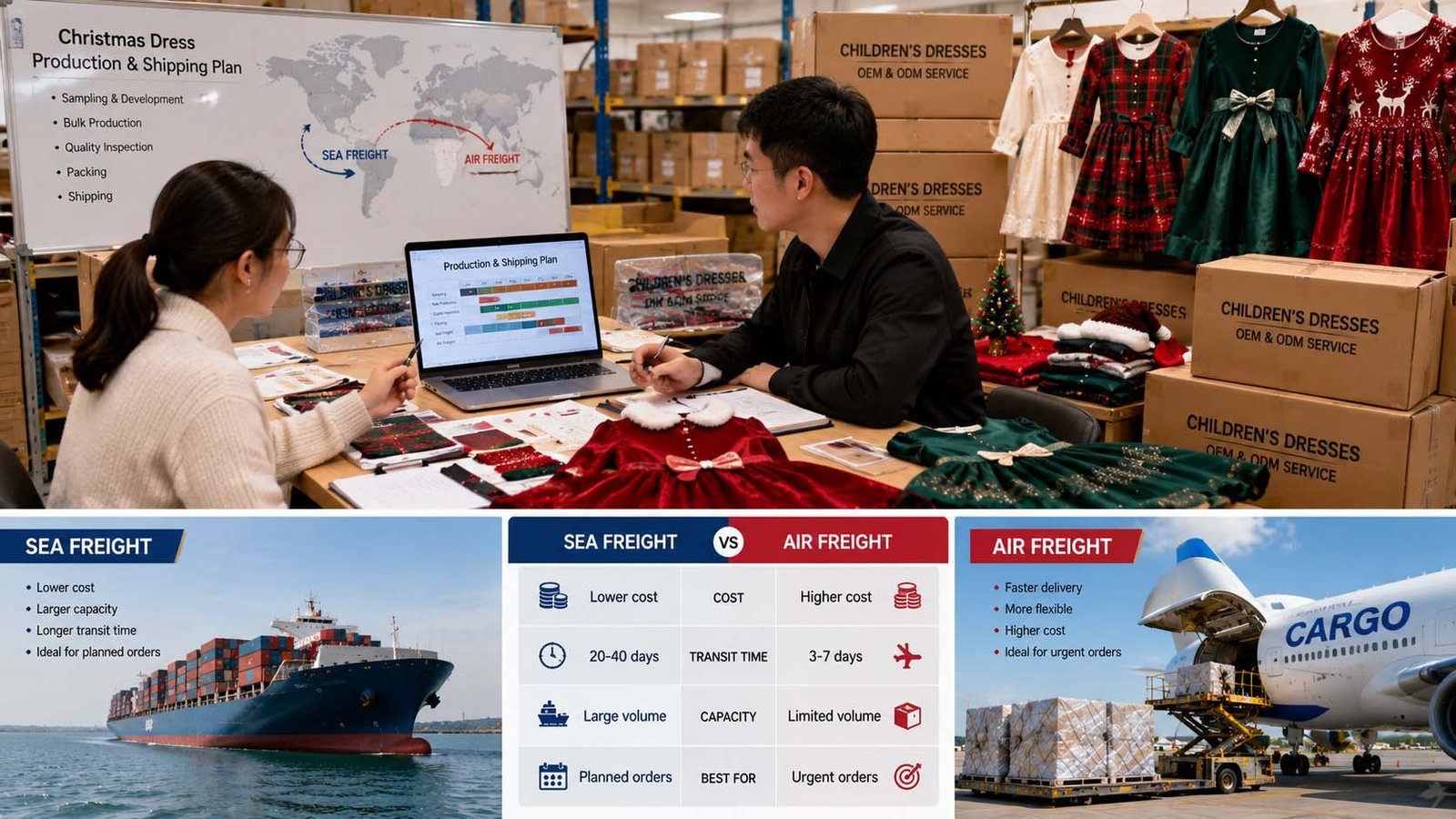
Sea freight or air freight? The shipping leg shapes your cost and your season.
The shipment leg is where timelines stretch and costs surprise. Plan it as carefully as production.
Choose the Shipping Mode by Order Size and Urgency
| Mode | Transit time | Best for | Cost level |
|---|---|---|---|
| Express courier | 3–7 days door-to-door | Samples, urgent small orders | Highest per unit |
| Air freight | 5–10 days | Medium orders, seasonal deadlines | Medium-high |
| Sea freight (LCL) | 25–35 days | Volume orders, cost-sensitive buyers | Lowest per unit |
| Sea freight (FCL) | Same transit, full container | Very large orders, regular volume | Lowest per unit at scale |
The Documents You Must Have
- Commercial invoice — description, quantity, unit price, total value.
- Packing list — carton contents, weights, dimensions, carton count.
- Bill of lading / airway bill — proof of shipment and ownership.
- Certificate of origin — may affect duties under trade agreements.
- Compliance records — for children’s clothing, keep documentation on safety requirements relevant to your market (small parts, drawstrings, flammability where applicable, labelling).
Customs: Know Your Market’s Rules
Children’s clothing has specific rules in most major markets — from product safety requirements to labelling and fibre content rules. The importer of record is responsible for compliance, not the factory. Ask your supplier for supporting documentation, and confirm with a customs broker or your market’s guidance which checks apply to your product before you ship, not after.
7. The Common Mistakes That Cost Importers Money
These are the pitfalls we see repeat across new importers. Each one is avoidable with planning:
- Buying on photos only — skipping the physical sample is the most expensive shortcut in importing.
- Ignoring freight until the end — bulky tulle dresses can surprise you on cubic-meter freight. Factor freight into margin from day one.
- One supplier, no backup — develop a second source before you need it, not during a crisis.
- No size-run standard — inconsistent sizing across styles creates returns. Lock one standard.
- No written approvals — verbal agreements vanish at inspection time. Write everything.
- Ordering too deep too fast — test with ready stock, confirm sell-through, then scale with bulk or custom orders.
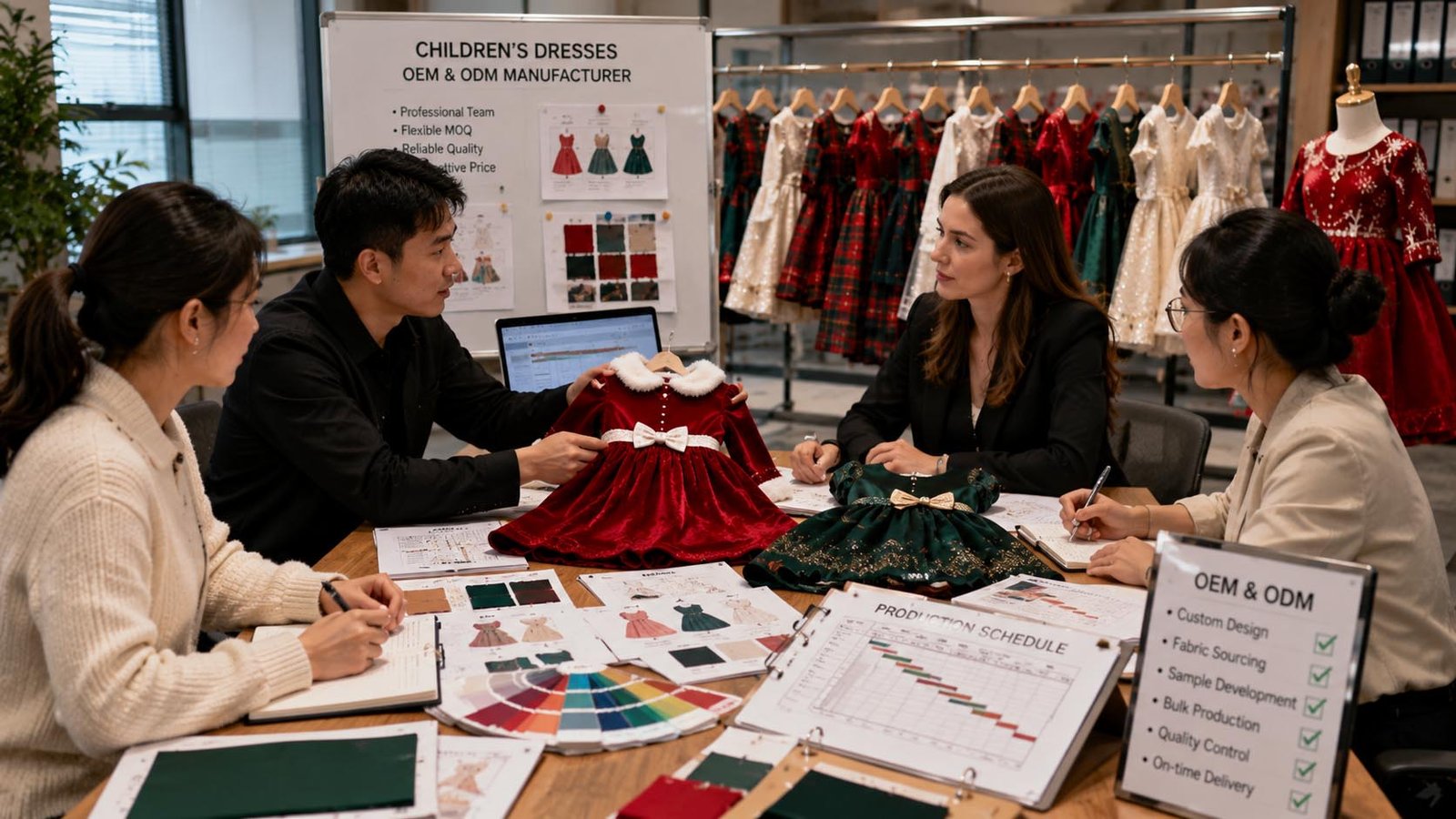
Repeat orders start with shared planning, not just repeat purchase.
The goal of your first import is not the first order — it is the second one. A repeatable relationship is built on small, consistent wins:
- Keep a spec sheet per style — fabric, measurements, trims, packaging. It makes reorders identical and fast.
- Track sell-through per style — your next order should be led by data, not feelings.
- Communicate in writing — confirm every change in email or chat so both sides share the same record.
- Pay on time — reliable payment earns priority production slots and better terms over time.
Importers who treat suppliers as partners — sharing forecasts, approving samples properly, paying reliably — consistently get better prices, faster sampling and priority during peak seasons. The relationship is the real competitive advantage; the dresses are the output.
9. Frequently Asked Questions About Importing Kids’ Dresses
How Much Should I Budget for a First Order?
It depends on your range and volume, but a practical first order for a boutique testing the market might cover 6–10 styles at ready-stock minimums (from about 6 pieces per style, mix and match), plus sample shipping and courier costs for the test itself. Keep the first order small enough that you can learn without risk, and big enough that freight per piece stays reasonable. Plan your budget as landed cost per piece — product, freight, duties and fees — not just the factory price.
How Long Does the Whole Process Take?
As a rule of thumb: ready-stock orders can be dispatched within days of confirmation and reach you in about a week by express courier. Custom OEM/ODM production typically runs 30–45 days from sample approval, plus shipping time (5–10 days by air, 25–35 days by sea). Add 1–2 weeks of buffer for customs and holidays — Chinese New Year and National Day are the two big factory closures that shift every calendar.
Do I Need to Visit the Factory?
For small first orders, no — a video call, factory photos and a solid sampling process are usually enough. For larger or repeat orders, a visit or a third-party inspection before shipment is worth the money. Many suppliers can also arrange live video of the production line and pre-shipment photos, which is the next best thing to being there.
What if the Bulk Order Doesn’t Match the Sample?
This is exactly why you approved the sample in writing and kept a physical reference. Ask for production photos before shipment, and if something is wrong, request rework or replacement before the goods leave the factory — fixing it at origin is always cheaper than dealing with it after arrival. A supplier with a written quality commitment will correct issues; one without it will argue.
Can I Import Just a Few Pieces to Test?
Yes — this is the smart way to start. Ready-stock suppliers in girls’ dresses typically offer low minimums (from about 6 pieces) with mix-and-match styles and colours, so you can build a small test basket across several styles and sizes. Test, measure sell-through, then scale what works with larger orders or custom development.
Ready to import girls’ dresses?
Tell us your category mix, sizes and target price points — we reply within 6 hours with a sourcing plan, MOQ and sample lead time. WhatsApp us or email luxudress@gmail.com.
Leave a Reply