
An inquiry arrived last week with one number in it and no product. Need 300 dresses. Please quote. We did not quote it, and not because the quantity is small. A kidswear RFQ built on a quantity alone is not a request for a quotation; it is a request for a guess. The number tells us how many. It does not tell us what. Any factory that answers that email will either guess low and revise upward later, or guess high and lose your order to someone who was guessing too.
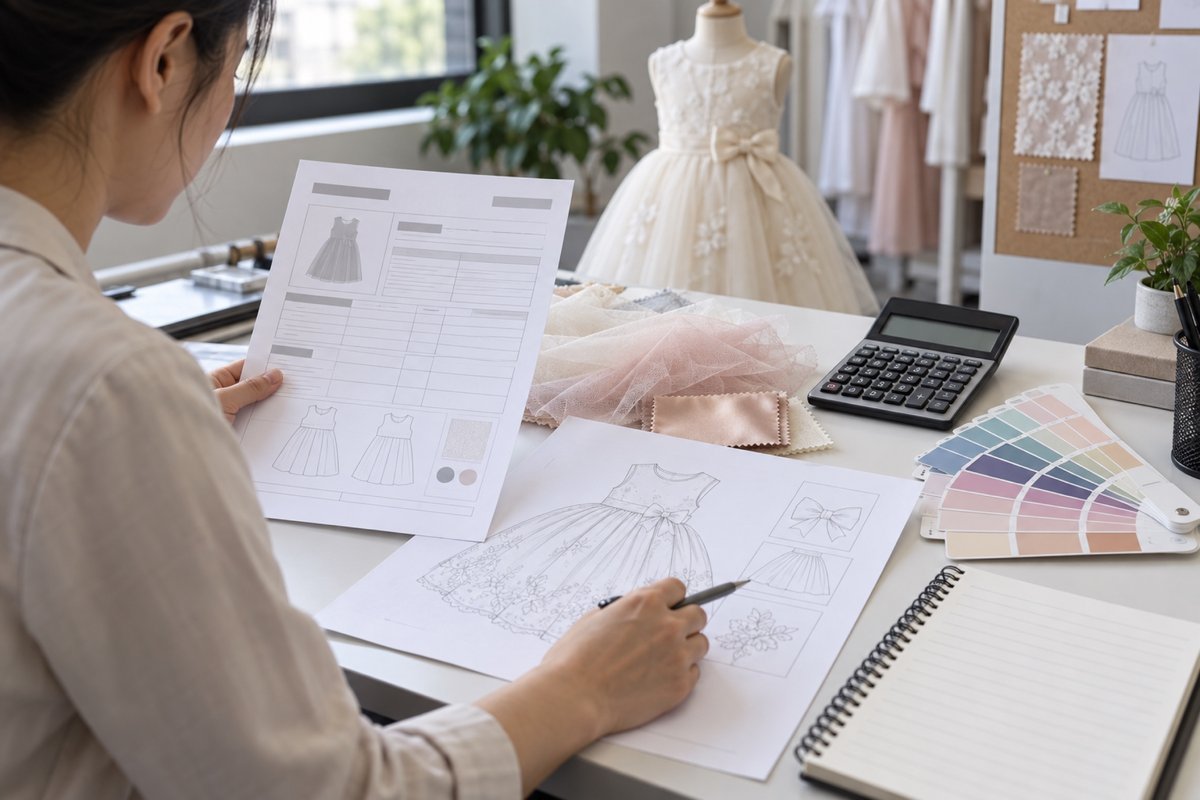
This article is a teardown of that message. We take the same inquiry through three versions — the one line, the half-filled one, and the quote-ready one — and show what changes at each step from the factory’s side of the desk. Then we walk the twelve variables that move a kidswear price, in the order they appear on a quotation sheet, so you can see which lines of your own inquiry drive the number.
What an RFQ Is, and What It Is Not
RFQ stands for request for quotation. In garment sourcing it is the document that gives a factory enough information to calculate material, labor and overhead for one specific product, and to commit to a price and a delivery window for one specific quantity. That is the entire definition. It is not a negotiation opener with a number attached.
You know what you want to sell. The factory knows what things cost to make, and every field you leave blank is a field it fills with an assumption. Assumptions are not neutral. When a supplier cannot tell whether your satin dress has one layer or five, the safe move on its end is to price the heavier version and add margin for the unknown. Fill in the fields and that padding disappears.
RFQ Version 1: One Number, No Product
Here is the message as it was actually sent. Nothing has been removed.
Hello, we are interested in your dresses. Need 300 dresses. Please quote. Thanks.
Read it as a factory reads it. There is a customer, a quantity and an intention, but no product. What follows is every field the estimating desk needed and did not have.
Fabric. No fiber content, no weight, no weave, no finish. Cotton poplin, satin, chiffon, tulle and sequin mesh sit at very different price points per meter, and they behave differently under a needle, which changes labor too. “Nice quality” is not a fabric specification. “Soft fabric” is not one either.
Construction. No silhouette, no layers, no lining, no closure. Is this a single-layer sundress with an elastic back, or a lined bodice with a multi-tier skirt and an invisible zipper? Those two garments can share a size label and share nothing else. Construction decides the operation list, and the operation list is where labor hours live.
Size range. No sizes, no size spread, no breakdown of how many units per size. Three sizes and seven sizes are different pattern sets, different marker plans and different grading work. How the quantity splits across sizes also changes how efficiently fabric can be nested on the cutting table.
Decoration. No mention of embroidery, appliqué, 3D flowers, beading, sequins, lace overlay or ribbon work. Decoration is the single most volatile line in a kidswear quotation because it converts factory time into hand work. Omitting it does not make it free. It makes it invisible until the sample arrives with a different price attached.
Packaging. No poly bag, no hang tag, no size sticker, no carton configuration. Packaging is quoted as its own line, and if you sell under your own brand the label and tag work has to be counted.
Testing. No destination market, no test scope, no decision about who arranges the lab and who pays for it. Testing affects the unit price, the sample quantity needed and the delivery date.
Destination market and port. No country, no port of discharge, no Incoterm. A price with no destination attached is not a price. It is a starting figure.
Colour breakdown. No colours, no Pantone references, no quantity per colour. Colour affects fabric minimums, dyeing lots and how many production runs the order becomes.
Delivery date. No target on-shelf date. Without it, nobody can tell you whether your order fits the calendar or whether you are asking for something the booking desk cannot promise.
A factory that replies with a confident per-unit number is doing one of two things: quoting the cheapest dress it can imagine and planning to raise the figure later, or quoting something generic and hoping you never ask why the sample costs more. Both answers waste your time.
RFQ Version 2: The Useful Inquiry
Now the same buyer fills in about half of what was missing. Notice how much more this message already accomplishes without a tech pack, a drawing or a single measurement.
Subject: Quotation request - girls dresses - approx. 300 pcs

Quantity: approx. 300 pcs total (final quantity depends on your price
and minimums)
Product: girls party dress, knee length, sleeveless
Fabric: satin outer, full lining, plus a tulle layer in the skirt
Size range: 4, 6, 8, 10, 12 - roughly even spread across sizes
Decoration: some flowers at the waist, open to suggestions
Colour: ivory and dusty pink, split roughly 60/40
Packaging: poly bag, plus our own hang tag and size sticker
Testing: we sell in the United States
Delivery: needed on our market in roughly three months
Destination: shipped to the United States, please advise the port term
This inquiry earns a real response. The factory can identify a product family, estimate consumption within a workable range, count the operations, and tell you where the calendar is tight. You will get an indicative price band with the unknowns flagged, and those flags tell you which decisions carry money.
But the number is still not firm. “Some flowers at the waist” has no method attached, so it could be a flat appliqué or an assembled 3D floral cluster hand-sewn to the bodice, and those two outcomes are not close in cost. “Satin outer” has no weight or composition, so the fabric line is an estimate rather than a calculation. The size spread is even, which may not match how the sizes actually sell. Testing is named by market but not by scope. The colour references are words, not numbers, and words do not survive a dye lot.
So Version 2 gets you a reference price, a rough lead time, a list of open points, and a supplier who is now engaged. It does not get you a number you can build a retail price on. That is the difference between a quote you can think with and a quote you can sign.
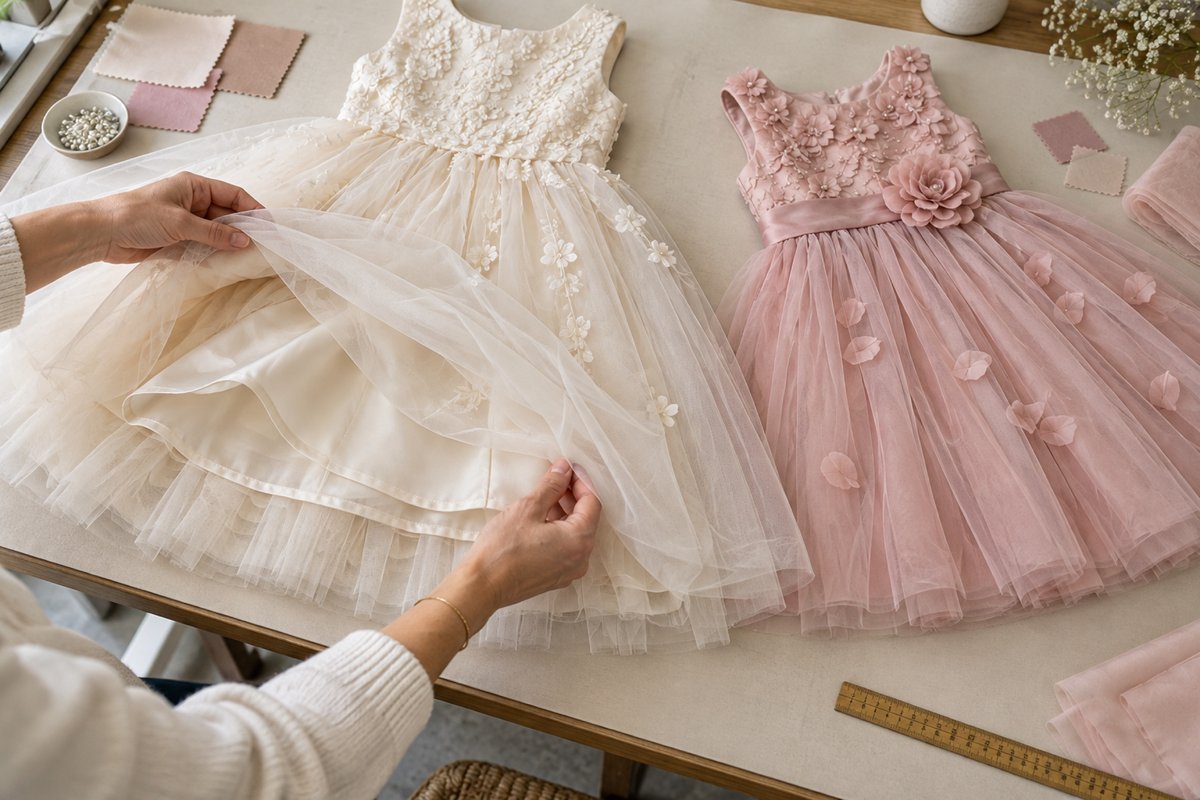
RFQ Version 3: The Quote-Ready RFQ
This is the version the estimating desk can turn into a firm quotation. It is not longer because someone likes paperwork. Every added line removes an assumption that the factory would otherwise price defensively.
Subject: RFQ - girls party dress - 300 pcs - USP - target delivery June

1. PRODUCT
   Garment type: girls party dress, knee length, sleeveless
   Age group: girls, not infant
   Reference: sketch attached, plus two reference photos
   Tech pack: attached (flat drawings, measurement spec, construction notes)

2. FABRIC
   Shell: satin, 100% polyester, specify GSM and confirm against attached
   swatch; if you propose an alternative, quote both options
   Lining: full bodice and skirt lining, breathable, colour matched to shell
   Skirt layer: soft tulle, number of layers per our tech pack
   Interfacing: as required for the bodice

3. CONSTRUCTION
   Bodice: fitted, lined, princess seams
   Closure: invisible zipper at centre back
   Waist: defined waist seam with attached decorative element
   Hem: finished hem, no raw edges exposed
   Any deviation from the tech pack to be listed in your quote

4. SIZE RANGE
   Sizes: 4, 6, 8, 10, 12
   Quantity per size: (to be confirmed with the size run breakdown)
   Measurement spec and tolerances: as attached

5. DECORATION
   Method: 3D floral appliqué, hand attached at the waist
   Placement: exactly as per sketch, front only
   Quantity of elements: per sketch
   Thread colour: matched to shell

6. COLOUR
   Ivory - Pantone reference to be confirmed on lab dip
   Dusty pink - Pantone reference to be confirmed on lab dip
   Approval: lab dip required before bulk
   Colour split: approximately 60% ivory, 40% dusty pink

7. PACKAGING
   Poly bag per piece, individual
   Our hang tag, our size sticker, ours woven brand label
   Carton configuration: advise pieces per carton and carton dimensions

8. TESTING
   Destination: United States
   Buyer/importer arranges certification and test bookings
   Advise in your quote which tests are required for this construction and
   what sample quantity the lab will need

9. COMMERCIAL
   Quantity: 300 pcs
   Incoterm and port: please quote FOB, port to be confirmed
   Currency: USD
   Payment terms: please state your standard terms
   Price validity: please state how long the quoted price holds

10. SCHEDULE
    Target market delivery: June
    Sample required by: as early as possible
    Please state your sampling time and bulk production time against this date

11. WHAT WE NEED IN YOUR REPLY
    Unit price by size, or a single unit price with size surcharges listed
    Fabric consumption per piece
    Sampling cost and time
    Bulk production time after sample approval
    Anything in this RFQ that you cannot confirm
Download the Kidswear RFQ Template
A two-page version of the Version 3 structure above, with every field and the guidance for filling it in. Print it, complete it, and send it with your reference images — a quotation built from a complete sheet needs far fewer clarification rounds than one built from a paragraph.
Two things matter more than the document’s length. The first is item 11: naming what you need back prevents the classic outcome where the factory sends one number and you spend three emails pulling out the pieces you actually needed. The second is the closing field of that same item, inviting the supplier to flag what they cannot confirm. A factory that answers “everything is fine” to a brief this detailed is not being confident. It is being careless.
Notice also that Version 3 does not demand a firm number in return, only a firm basis: price by size, consumption per piece, sample cost and time, bulk time, and a validity period. Those five things let you plan a margin instead of holding your breath.
The Twelve Variables Behind Every Quotation
A kidswear quotation is built from the same lines regardless of the dress. Once you understand what each line responds to, you stop writing inquiries that accidentally ask for the most expensive version of your own idea.
1. Material
The material line responds to fiber content, weight, weave or knit, finish and width. Change the shell from a cotton poplin to a satin with a similar look and you change two things at once: the cost per meter and the way the fabric behaves under the needle. Satin frays, slips and holds pin marks, so operators slow down and seam finishing gets more attention. That is why two dresses with identical silhouettes can differ in price purely because the shell changed. When you write your RFQ, give composition and weight. If you do not know the weight, send a swatch and ask the factory to confirm what it is, because two people can describe the same cloth in words that do not match.
2. Consumption
Consumption is how many meters of fabric one garment actually uses, and it is often the largest single number in the quote. It is not fixed by the fabric price. It moves with the number of pattern pieces, skirt fullness, fabric width, how efficiently the pieces nest on the cutting table, and whether the fabric has a direction that prevents pieces from being flipped to save space. A skirt built from several gathered tiers consumes more than a single circle skirt at the same finished length. Increase the size range and the largest sizes often consume disproportionately more.
This is why vague references are expensive. When you say “a fuller skirt like the photo,” the factory cannot tell whether that means one extra layer or three, so the estimate goes up to cover the risk. Describe layer count, tier count and finished length instead. The cost drivers behind custom orders overlap with this variable more than most buyers expect.
3. Construction
Construction is the operation list: how many seams, how many layers, whether the bodice is lined, whether the skirt carries a separate tulle layer, whether the closure is a zipper or an elastic casing, whether the waist is seamed or gathered. Every added layer is another cut, another join and another stage of handling.
Change a simple gathered waist into a fitted seamed waist and the labor line grows even though the fabric line barely moves. Add a full lining and you have effectively doubled the bodice work. This is the variable buyers underestimate most often, because a dress can look minimal and still be built from many operations. If your reference is a photograph, ask the factory to describe the construction they read from it. That reply tells you whether you are about to pay for what you thought you designed.
4. Trim
Trim covers zippers, buttons, snaps, elastic, ribbon, hook-and-eye closures, thread and interlining. Individually these are small numbers. Collectively they are not, and their real influence is on the schedule rather than the price. A standard zipper in a stocked colour ships immediately. A custom-dyed zipper matched to your shell can add days to the calendar before cutting even starts. The same is true of a specific brand of elastic or a particular width of grosgrain.
So specify trim early, and specify the colour source. If you approve a shade by eye on screen, expect the zipper and the shell to disagree in daylight. Trims are also where substitutions get quietly made, which is why the trim list belongs in the signed sample comments and not only in the original inquiry.
5. Decoration
Decoration is the variable that most often turns a reasonable price into a startling one, because decoration is where a garment stops being fabric and becomes hand work. A flat appliqué stitched by machine and a 3D floral cluster that is assembled off the line and then hand-sewn to the bodice are different products on the cost sheet even when they read as similar in a photo. Beading density works the same way: “some beading” is impossible to price, while “a beaded band of this sketch, this width, on the front waist only” can be counted.
Change the method, not just the amount, and the labor line moves hard. Moving from a printed motif to a hand-applied one can multiply the time on that section, so name the technique in your inquiry rather than the effect you are hoping for.
6. Print
Print splits into allover print and placement print, and they behave differently. An allover print has a repeat and a minimum length for the print run, and if your order is small the print minimum may set your real quantity floor regardless of what the sewing floor can handle. A placement print needs a defined panel size and position, and it may need to be engineered so the motif lands where you intended after sewing.
The process matters too. At small volumes, a digital print avoids the setup of a screen or rotary print but costs more per meter; at larger volumes that balance flips. Print direction also feeds back into consumption, because a directional print prevents flipping pieces to save fabric. Colour control across print and fabric is the same discipline as Pantone color matching for kids dresses, and it is far easier when the requirement is stated before the fabric is ordered rather than after it is printed.
7. Size range
Size range is not one field but three: how many sizes, how far apart they are, and how the quantity splits across them. Each additional size brings grading work, an extra pattern set, an extra marker, an extra size label and usually an extra sample size. A wider range raises cost per unit even when the total quantity is unchanged.
The split matters as much as the count. An order spread evenly across five sizes cuts differently from an order weighted toward the middle sizes, because fabric nests more efficiently when similar piece sizes are cut together. If you know your size curve from previous seasons, share it, and tell the factory which sizes carry the volume.
8. Minimum order quantity
MOQ and unit price do not move along a straight line. Setup is fixed per style: the pattern, the marker, the first sample, any machine programming, and the minimum lengths your fabric and trim suppliers will sell. Spread that fixed cost over more pieces and the per-unit figure falls. Halve your quantity and you have not halved the setup, which is why a smaller order is often worse than proportionally more expensive.
The floor is usually not set by the sewing line at all. It is set by fabric and trim minimums, which is why a supplier may accept a small order in one fabric and refuse to quote the same quantity in another. Custom OEM work starts from 200 pieces per style, while selected ready stock styles start from 6 pieces and some can go to a single piece. Going larger is not automatically cheaper either: past a certain point you are paying for extra lines or overtime, so quantity breaks behave like steps rather than a slope. Ask what your break points are instead of assuming more is always better.
9. Packaging
Packaging is always a separate line because it is fabricated, not sewn. Poly bag or none, individual bagging or bulk, hang tag, size sticker, woven brand label, tissue, folded or boxed presentation. If you are building your own brand, this is where the visible parts of that brand get attached, and the labor is real even when the materials are cheap.
Carton configuration belongs here too, and it is the most overlooked field in a kidswear RFQ. How many pieces per carton, and what the carton dimensions are, affect how the goods palletize and how many cartons move through freight. A buyer who specifies nothing here often discovers later that the carton count made shipping costlier than expected. Full private label programs hand this entire layer to the factory.
10. Testing
Testing requirements come from the destination market and from the importer, not from the factory’s preference, and the scope changes what the item costs and what the calendar allows. Fiber content labeling, colourfastness, physical safety of small components for the relevant age grade, and restricted substances on accessible parts all have different sample and documentation needs. If testing is specified after the fabric is cut, you are paying for rework rather than prevention.
In the United States, the Children’s Product Certificate is issued by the importer based on third-party laboratory testing, so the compliance obligation sits on your side of the transaction and not on the sewing floor. As of July 8, 2026, importers must file that certificate data electronically with CBP for general imports and domestic manufacturing; from January 8, 2027 the same applies to goods entered from a foreign trade zone. Whether the factory books the lab or you do, the RFQ should name the market and the age group so the test scope can be set correctly. If the item is intended to be sold as sleepwear, different flammability requirements apply and that is a separate conversation from this one.
11. Sampling
Sampling is the variable with the longest shadow, because sample rounds consume the resource that cannot be bought back: development time. Each round uses pattern room hours, fabric and fitting review, and moves the bulk start later. Development without an existing pattern or physical sample is quoted at USD 80 to 150, with sampling time typically 5 to 7 days. Bulk production follows 25 to 40 days after sample approval.
The cost is not really the sample fee. It is the accumulated delay and the risk of repeating rounds. Buyers who send a complete brief with a clear tech pack usually converge in fewer rounds than buyers who send a reference photo and refine their opinion through samples. If you have never built a specification sheet, start with the tech pack checklist used before sampling and then look at how the sampling process actually runs so you know what you are approving and when.
12. Shipping term
The shipping term decides what is inside the number. Ex works means the price stops at the factory door. Free on board means it includes inland transport and export clearance to a named port, and the port name is part of the definition. Cost and insurance adds freight to the destination. Delivered duty paid puts duty and final delivery on the seller, which is why DDP quotes look far higher and are not comparable to FOB quotes at all.
Two consequences follow. An RFQ that does not name an Incoterm and a port cannot produce a comparable quote, because every supplier will assume something different. And the Incoterm changes who controls the booking calendar. If the delivery window is your tightest constraint, decide early who owns the container booking and say so in the inquiry.
How the Variables Interact
Reading the twelve in isolation is misleading, because they push against each other. Add a tulle layer and consumption rises. Swap a plain hem for a shaped one and construction time rises. Move decoration from machine to hand work and labor rises while material falls. Widen the size range and grading rises even if total quantity holds. Take a lower quantity and the fixed setup spreads over fewer pieces.
This is why the same buyer can receive three quotes for one dress and find them far apart. The suppliers are not always competing on margin; sometimes they are pricing genuinely different garments because the brief left the differences open. When you compare replies, compare the assumptions line by line before you compare the totals. If two suppliers disagree about what your inquiry said, the problem is upstream of the price.
The practical shortcut: write Version 3, then ask yourself one question before sending it. If a stranger read this, could they draw the dress? If not, the factory cannot price it either.
Ready to move forward?
If you would rather have your RFQ reviewed before it goes out, send the completed sheet with your reference images and we will mark the fields that pull a defensive price: an unnamed colour, a quantity with no size breakdown, a decoration with no attachment method. That review costs nothing and it usually removes at least one clarification round. Kids dress tech pack checklist covers the specification side of the same conversation. Typical figures as of September 2026, for planning only: ready stock on selected styles from 6 pieces, custom orders from 200 pcs per style, sampling 5–7 days per round, bulk production 25–40 days after sample approval, and pattern or sample development USD 80–150 where no pattern exists. Exact MOQ, development cost and lead time depend on style, fabric, quantity and season.
KIDSWEAR RFQ TEMPLATE

PRODUCT
Garment type:
Silhouette / length / sleeve:
Age group:
Reference material attached (sketch / photo / tech pack):

FABRIC
Shell - composition, weight, swatch attached:
Lining:
Layers in skirt:
Interfacing:

CONSTRUCTION
Bodice:
Closure:
Waist:
Hem finish:
Deviations you are open to:

SIZE RANGE
Sizes:
Quantity per size:
Measurement spec attached (yes / no):

DECORATION
Method (print / appliqué / embroidery / 3D / beading / lace):
Placement:
Approximate quantity of elements per garment:
Thread colour:

COLOUR
Colour 1 - Pantone reference:
Colour 2 - Pantone reference:
Quantity split by colour:
Lab dip required (yes / no):

PACKAGING
Poly bag (individual / bulk / none):
Hang tag / size sticker / brand label:
Pieces per carton (or ask factory to advise):

TESTING
Destination market:
Age group for compliance purposes:
Who arranges the lab:
Tests you require:

COMMERCIAL
Total quantity:
Incoterm and port:
Currency:
Payment terms you prefer:
Price validity period required:

SCHEDULE
Target market delivery date:
Sample needed by:
Latest acceptable bulk start:

WHAT YOU NEED IN THE REPLY
Unit price (by size, or single price with surcharges):
Fabric consumption per piece:
Sampling cost and sampling time:
Bulk production time after approval:
Any point you cannot confirm:
Attach your reference images or tech pack to the completed form and send it for production assessment. When the factory can draw your dress from the document, the price that comes back is one you can plan on, because material, consumption, labor, decoration, testing and freight all rest on the same assumptions instead of on six separate guesses. If the specification side is still thin, start with the team that handles tech packs for girls dresses and send the RFQ alongside the custom girls dresses brief you are building toward. Then send it complete.