
A dress that arrives after its selling window is worth less than a dress you never ordered. That is the part of wholesale buying nobody photographs. The silhouette was right, the fabric sampled well, the price worked. Then the carton cleared customs in the second week of April, and the Easter rail had already been taken down.
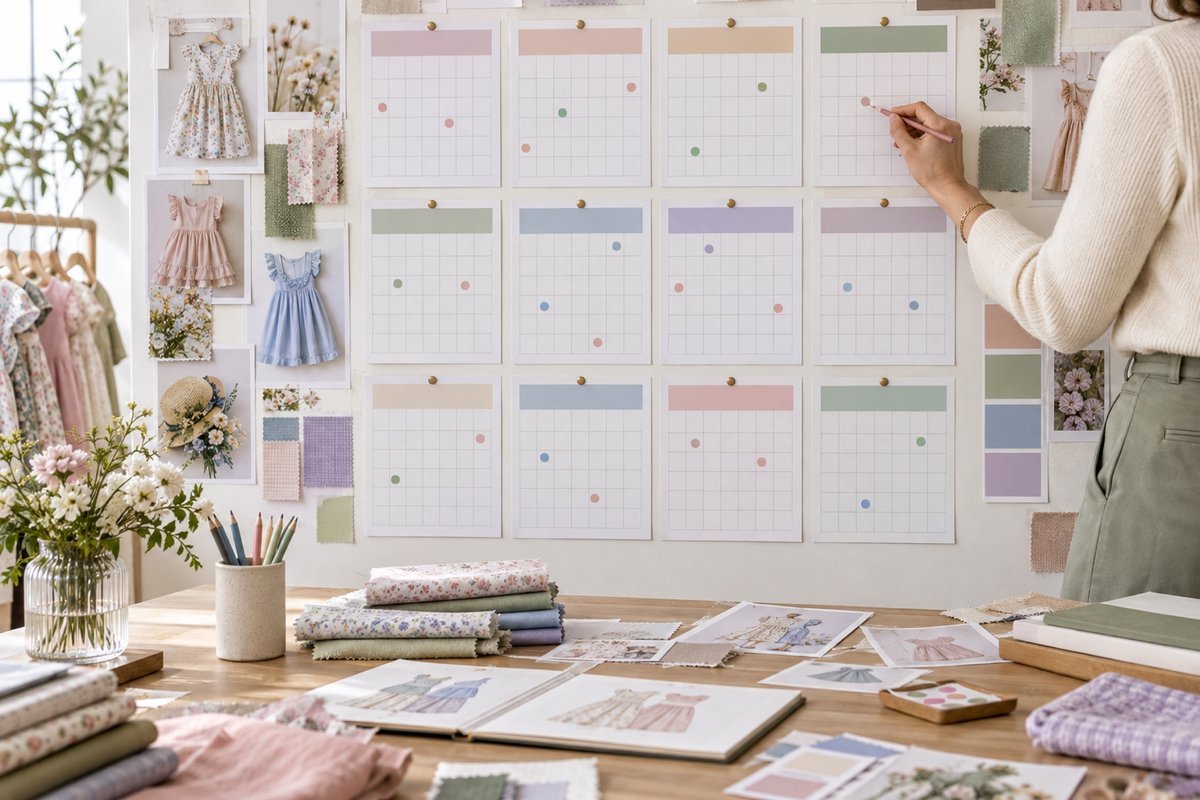
A kidswear buying calendar 2027 is worth building for exactly that failure. Not a trend forecast, not a colour report, but a sequence of decision dates, each tied to a retail moment that will arrive whether or not your inventory is ready for it.
Three things make girls’ occasion wear unforgiving on timing. Demand is date-driven: Easter Sunday, a wedding date, a first communion, a portrait session are appointments, and a customer who misses the date does not buy late, she buys elsewhere. The product is season-coded by colour and silhouette, so surplus does not fold into the next season the way a plain basic does. A leftover red velvet dress stays a leftover red velvet dress. And the buying decision usually sits with a different person from the production calendar, so the gap between those two people belongs to nobody.
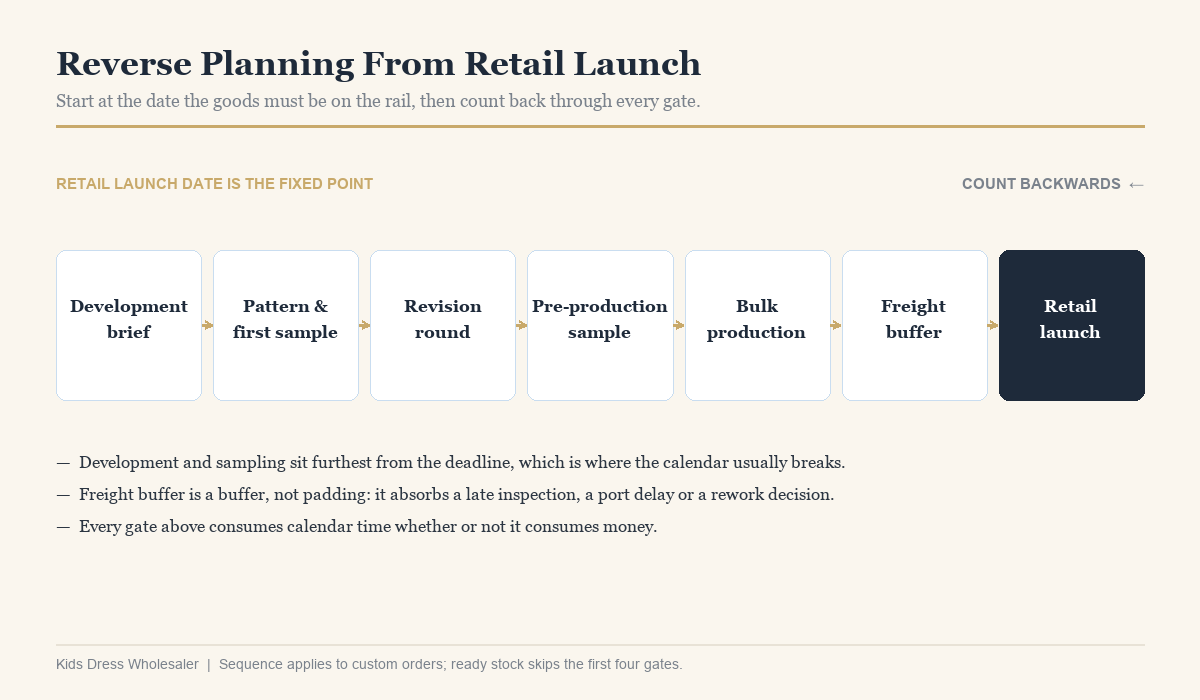
For each window below you get the occasion it serves, the decisions to close before it opens, and the timing risk that wrecks the plan. The centre of the article is a countdown chain that takes a launch date and walks backwards until it hands you the week you have to brief a factory. If you buy ready stock only, the chain collapses, because most of its blocks are already behind you. If you develop your own styles, the chain is your season.
Reading the Calendar Backwards
Every late delivery in this category began as a calendar read in the wrong direction. Read forwards, the chain looks harmless: you approve a sample, production runs, goods ship, the dress lands. Read backwards from the day the rail has to be full, the same chain becomes a list of deadlines, and the first one sits much earlier than most buyers expect. Six blocks start when you decide they start. One, freight, mostly does not.
Development. If no pattern exists for the style you have in mind, pattern and sample development opens the chain. We quote no-pattern development at USD 80–150 depending on the engineering, and the time depends more on your input than on the pattern table. Typical figures as of September 2026, for planning only; exact MOQ, development cost and lead time depend on style, fabric, quantity and season. A tech pack with construction detail and a named colour standard moves through in a straight line. A screenshot annotated “like this but nicer” moves through in loops.
First sample. With a pattern in place, a first sample comes back in 5–7 days, assuming the fabric and any trim are in stock or identified. If a beaded trim has to be sourced, the sample date moves with the trim rather than with the sewing floor.
The revision round. Nobody can quote this block, because it depends on how many measurement points change and whether a fabric or trim has to be re-sourced. The hidden cost is rarely the factory’s time; it is your own review time. A sample sitting on a desk for a week waiting to be measured against the fit specification consumed a week of the chain without producing anything sellable.
The pre-production sample. The PPS confirms the approved sample can be repeated with bulk fabric, bulk trims and the line that will actually run the order. A passed fit sample is not a production-ready style, which is why the PPS holds its own position instead of being treated as a formality on the way to cutting.
Bulk production. Once the PPS is approved and bulk fabric is in the building, production runs 25–40 days. Those days begin after approval and after fabric arrival, not after the purchase order. A style with a pending approval and no fabric in house is not in production, whatever the order confirmation says.
The freight buffer. No honest day count belongs here. Transit depends on your routing, your incoterm, port congestion, how the booking calendar looks when you book, and customs at your end. A number copied from an article rather than quoted by your own forwarder is a guess wearing a plan’s clothing. Ask your forwarder for a door-to-door transit range, then add a buffer you choose deliberately, sized to what missing the date would cost rather than to what the freight costs. For a date-driven product those are different numbers.
Retail launch. The date the rail has to be full. Buyers get this block wrong more often than any other, not by choosing a bad date but by choosing one they never counted back from.
| Position | Block | What it consumes | What you control | Where delay usually starts |
|---|---|---|---|---|
| 7 | Retail launch | The date the rail must be full | The date, and whether it is realistic | Choosing a date without counting back from it |
| 6 | Freight buffer | Transit, customs, receiving | Routing, incoterm, the buffer you hold | Peak-season booking, port and customs queueing |
| 5 | Bulk production | Quoted bulk lead time, counted after PPS approval and fabric arrival | Approving the PPS quickly, keeping fabric on schedule | An unapproved PPS, or fabric that slipped |
| 4 | Pre-production sample | Review and adjustments | How fast your own sign-off moves | Treating the PPS as a formality |
| 3 | Revision round | Depends on how many points change | How precisely you write fit comments first time | Vague comments that force a second round |
| 2 | First sample | 5–7 days | The quality of the brief you send | Incomplete reference material and unnamed colour |
| 1 | Development | Whether a pattern already exists | Whether you supply a tech pack or a screenshot | Starting from an image with no construction detail |
Two blocks carry most of the variation, development and the revision round, and both are yours to compress. Neither compresses because you asked the factory to hurry.
A Worked Reverse Count from a Mid-March Launch
Take a buyer who wants spring occasion dresses on the shop floor in mid-March. Build the chain downwards from that date.
Write mid-March at the top as the launch. Under it, subtract the transit range your forwarder gave you door to door, plus the buffer you decided to hold. Under that, subtract your bulk production lead time. Under that, subtract the time you will actually spend reviewing the pre-production sample, and be honest; if the answer is “about a week, because the person who signs off is travelling”, write a week. Under that, subtract one revision round, then a sample round for the first sample, then development, short if a pattern exists and a development block if it does not.
Whatever sits at the bottom of that list is the week you have to brief the factory. For a mid-March launch it almost never lands in the same calendar year as the launch. It lands in the previous autumn, and for a brand developing a new silhouette from nothing it can land earlier still.
That arithmetic explains most of the frustration in spring buying. A buyer who opens the supplier conversation in January is not early. She arrives after development, sampling, bulk production and transit have been spent by someone else’s schedule, and the only blocks left to occupy are the ones she cannot control. Every fix sits outside the conversation: a finished tech pack, a named colour standard, a decision-maker who can approve a sample inside a day, and a launch date chosen after the count rather than before it.
If the arithmetic says you cannot make the window, four moves remain. Take the opening delivery from ready stock in the styles closest to your direction and let the developed styles arrive for the back half of the season; you lose cohesion on the rail and you keep the window. Move the launch later inside the same window instead of missing it, because a dress that lands partway into a two-month season still sells and one that lands after it does not. Change less: adapting an existing pattern with a new fabric, colour or simpler decoration removes the development block and shortens the revision round, because the silhouette is known to fit. Or run a pilot, buying a small quantity of one style and putting depth behind it next season, which works only if you accept the pilot is a test rather than a launch.
Replenishment follows the same arithmetic, though buyers treat it as instant. A reorder runs the back half of the chain again: a full bulk cycle after the PPS, then the freight buffer. Development and the first sample are behind you only if the pattern and the fabric are both still available. If the fabric was a mill’s seasonal lot and it has sold through, the reorder is not a reorder; it is a new development with a familiar face. Write the replenishment trigger before the season opens, while the fabric question can still be answered.
January and February: Clearing One Season While Funding the Next
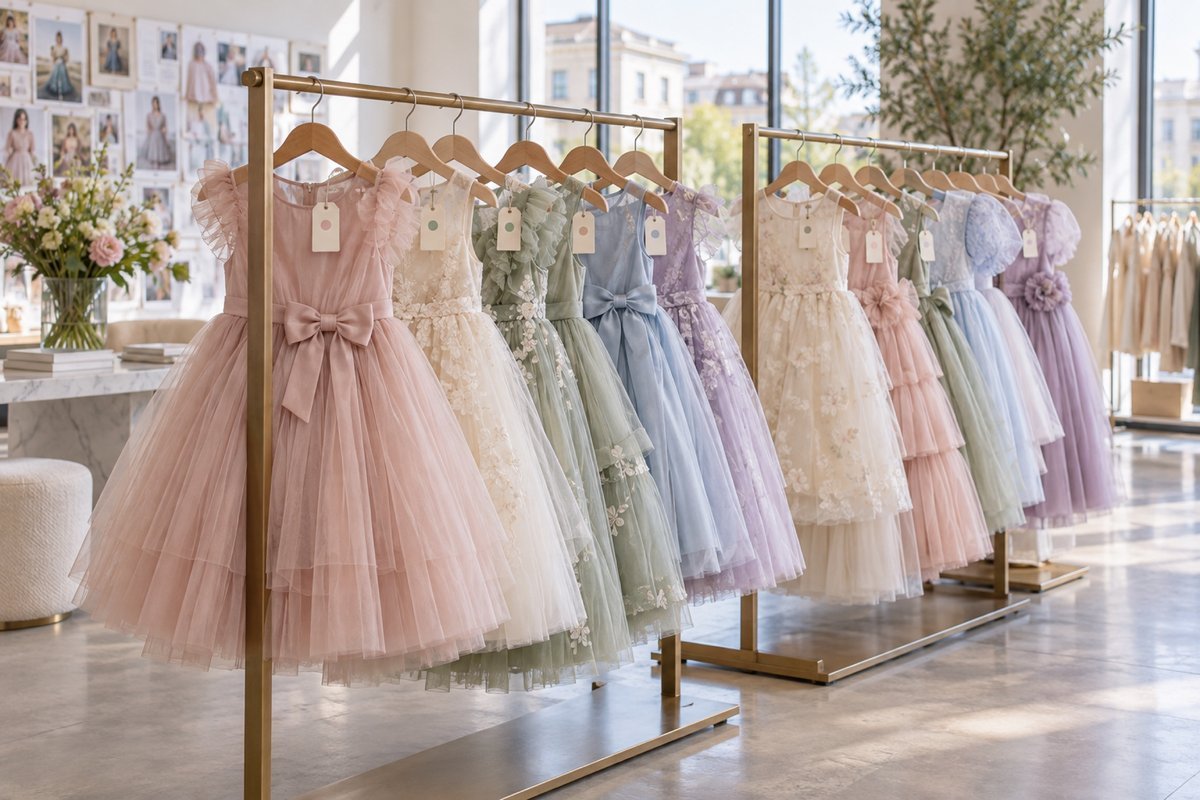
Retail is doing two things at once here. Holiday stock is being marked down and moved off the floor, and the first spring deliveries are being received. That second half is misleading, because the dresses arriving in January were ordered long before the calendar turned. For a custom spring programme, January is often already a receiving and replenishment month rather than the ideal point to start development, and the orders placed now are usually working towards summer and autumn.
Easter shapes this window more than most buyers realise. In 2027 Easter falls in late March, which pulls the spring selling period forward and compresses the gap between January receipts and the Easter rail. A buyer who plans spring by month rather than by weeks before Easter will find less room than last year.
Buyer should finalize, in this window, the summer and early-autumn development brief, plus the spring replenishment call on anything already selling.
Style. The brief going in covers summer and early autumn, not spring, because spring is either in transit or already late. Summer takes the dressy-casual shapes and lighter party silhouettes; early autumn takes the formal pieces that need to be on a rail before the holiday season opens. If you are developing anything genuinely new, this is the only window in the year where the chain has room in it.
Colour. Lock colour to a physical standard rather than a screen reference, and lock it now, because a colour that arrives as a digital file during development becomes an argument during the revision round. Spring and Easter colour should already be finished when this window opens; what is decided here is the summer and autumn palette, in a form a mill can match.
Size depth. Depth is where a shallow spring buy fails, and the fix is a better read of your own numbers rather than a bigger order. Look at which sizes you actually sold out of in the last comparable season, and weight the opening order towards those, because a size that sells out mid-window cannot be refilled inside that window.
Opening quantity. The summer opening order has to carry your core sizes and core colour through the first full selling month without a reorder, because the reorder spends the back half of the chain again. On the custom side we work from 200 pieces per style, which is the point at which a style can hold real size depth without the colour being split thinly across six sizes.
Replenishment strategy. Write the trigger now, in numbers you will honour later. “Reorder when a size reaches a defined sell-through point” works. “Reorder when it looks low” does not, because by the time it looks low the fabric may be gone.
The timing risk most buyers miss here is not production. It is that the factory’s upstream suppliers and the sample room both stop for the Lunar New Year period, and the mills and trim suppliers stop earlier and restart later than the sewing floor does. Anything not already in production before that break behaves like a post-break order, and that includes development and sampling. A sampling request sent in the last days before the break does not come back faster because it was sent early. It comes back after the break, in a queue.
March and April: Easter, Spring Ceremony and First Communion
This is the window where the year’s planning becomes visible on the rail. Easter lands late in March in 2027, and around it sit the first spring weddings, the start of flower girl bookings for the season ahead, and first communion, which for many families is the most formal garment a girl will wear that year.
Operationally, March and April are a delivery and replenishment window, not a development window. Almost everything that should be selling was decided months ago, and the decisions still open are narrower and more consequential than they look.
Buyer should finalize, in this window, the top-up on anything still moving, the white and ivory consistency check across deliveries, and the autumn brief that must already be in a factory’s hands.
Style. If you are adding to the spring range in March, you are not adding a new silhouette. You are adding depth to a shape already proven on your floor, or bringing in a closely related shape on an existing pattern. Both are fast, and neither requires a fit round.
Colour. The colour decision here is a consistency decision. First communion and spring formal wear concentrate demand into white, ivory and pale neutrals, and those are the shades where a supplement from a different dye lot shows up immediately on a rail. If you have approved a bulk shade, match your supplement against it rather than against the original standard, or the two deliveries will look like two different products side by side.
Size depth. Spring occasion wear sells across a wider age span than a party dress programme does, because it includes the very young flower girl and the older communion and wedding-guest age. That spread is why a flat allocation leaves holes. Depth goes to the sizes your own spring history says turn fastest.
Opening quantity. There is little opening quantity left to set. What remains is the quantity you commit to for autumn and holiday development, and that commitment is due now, not in summer.
Replenishment strategy. Set a hard cut-off for spring reorders, chosen on how long the last reorder took rather than how long you would like it to take. After that date the only honest supply option for the rest of the window is ready stock.
The timing risk most buyers miss is Easter’s mobility. Because the date moves, “we bought the same month as last year” is not a plan; it is a coincidence that worked once. Count backwards from Easter itself, not from March. The quieter risk is that first communion and small wedding orders look too small to plan for, so they are quoted casually, run late, and land in April when the ceremony was in early spring. A twenty-piece order that misses a date costs more than the margin it carries.
May Through August: Peak Flower Girl Season and the Quiet Order Window
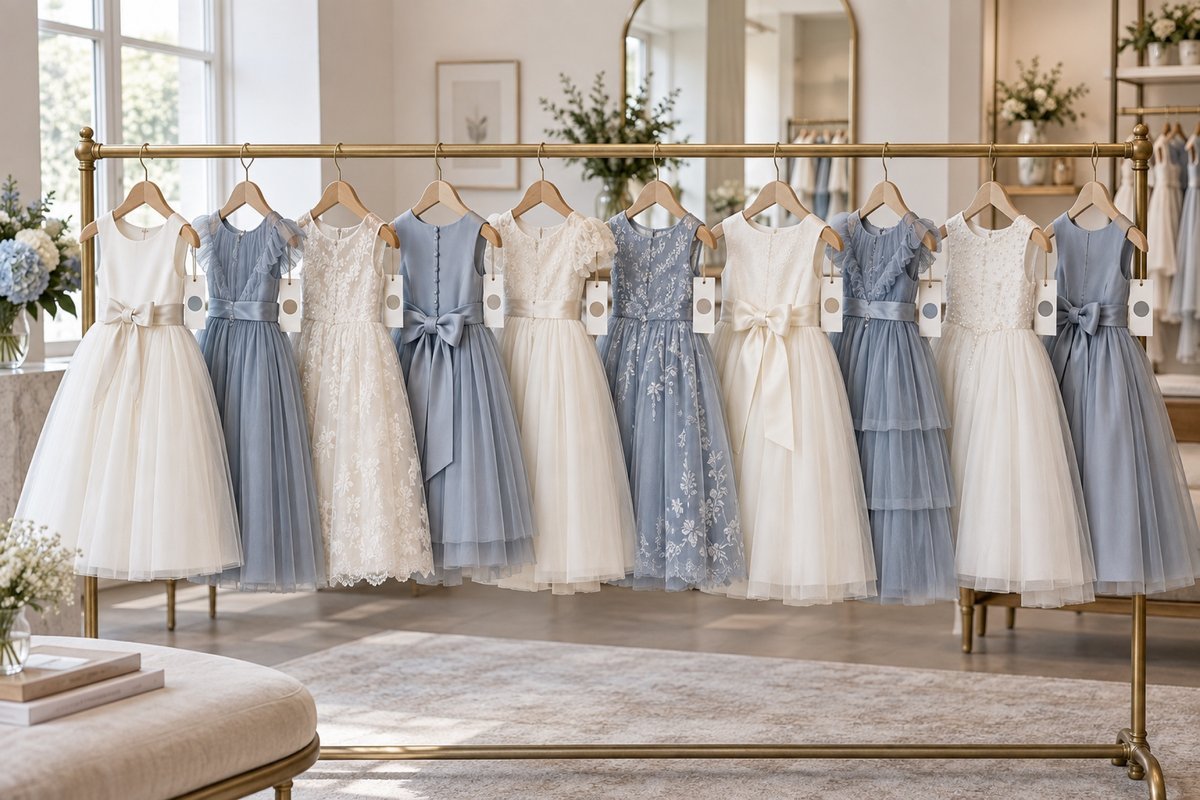
Retail is at its most distracting here. Ceremony and wedding demand peaks through these months across many Northern Hemisphere boutique markets, while markets whose ceremony calendar runs differently will see the same quiet window at another point in the year. Weddings fill the calendar, summer parties and portrait sessions occupy families, and dress-up spend is light between the spring ceremonies and the holiday season. For an occasion wear buyer this is the least interesting window on the selling side and the most valuable one on the ordering side.
Two things make it valuable. Factories are less congested than they are in the autumn, and the holiday programme is still a blank page. Every year some buyers spend this window waiting for inspiration, then spend October trying to compress a chain with no slack left in it.
Flower girl is the exception to the quiet, because it is an active buying period rather than a planning one. Wedding dates are set long before the dress is ordered, so a conversation with the planners and photographers you already work with gives you visibility most buyers never collect. If you know which weekends are booked, you know when the demand lands.
Buyer should finalize, in this window, the entire holiday programme in development, the flower girl replenishment rhythm, and the autumn colour lock.
Style. The style decisions due here are the holiday ones: the portrait dress, the Christmas occasion dress, the formal piece for New Year. They have to enter development now, because the holiday window is short and every block of the chain has to be paid for before it opens. A brief issued in this window arrives on the rail with time to spare, and time to spare is what lets you sell a second colour.
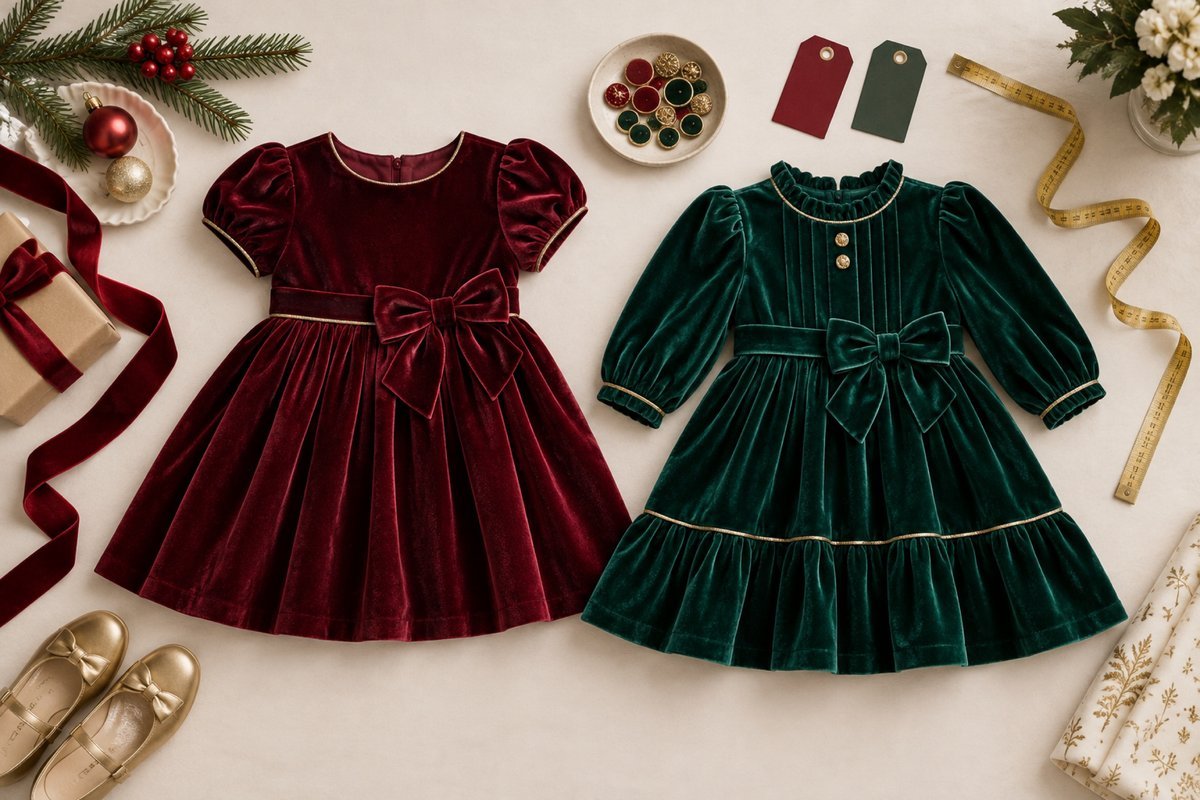
Colour. Autumn and holiday colour gets locked here. Deep reds, forest and emerald tones, burgundy, ivory and metallic accents all need a physical standard before the mills start their seasonal lots, because those lots are finite and the second delivery is the one that gets stranded.
Size depth. Flower girl sizing has the widest age spread of anything you will buy. Depth has to be allocated knowing that a family group will order several sizes at once, and that a missing middle size does not lose you one dress, it can lose the set.
Opening quantity. The holiday opening order should carry the core sizes and lead colour through the peak weeks without a reorder. This is the one season where being short is close to unrecoverable, because a reorder runs a full bulk cycle plus transit, and the window will not wait.
Replenishment strategy. Plan holiday replenishment now, not in November, and decide in advance which styles you will refill and which you will let sell out. A deliberate decision to let a style sell out is a strategy. Discovering on 10 December that you cannot refill it is not.
The timing risk most buyers miss is treating this period as dead time. The mirror-image risk sits on the flower girl side: one shallow order across the full size range, followed by the discovery that the size you needed most is gone with no realistic path to a refill before the wedding date.
September Through December: Portraits, Christmas and the Hard Deadline
This window has the least forgiveness in it. Christmas is a fixed date, the selling period for occasion wear ends with it rather than tapering after it, and every buyer in every market moves through the same freight channels at the same time. What you can still change here is small. What you can still break is large.
Halloween sits at the front as a short, concentrated burst of dress-up demand. It is worth planning, but it is not the centre of the season. The centre is holiday portraiture and Christmas itself, and portraits deserve more attention than dress buyers usually give them. Family photo sessions are booked into a compressed period before the holiday, and the dress has to be in the customer’s hands before the session, not before the holiday. A delivery that lands in time for the twenty-fourth may already be too late for the photographs driving much of the demand.
Buyer should finalize, in this window, the replenishment triggers, the allocation between online and physical stock, the markdown plan for anything that will not clear, and the following spring’s development brief.
Style. Almost no new style decisions belong here. The ones that do belong are next spring’s, briefed before the year-end factory break if you want sampling to happen at the start of the new year rather than after it.
Colour. Colour work here protects the holiday palette rather than inventing one. A replenishment has to match the bulk shade already on your rail, and the standard to check against is the approved bulk lot, not the original lab dip.
Size depth. Holiday programmes are won or lost on this. Holiday demand concentrates into fewer sizes than a spring programme does, and spreading depth evenly across a full range produces stockouts in the middle and leftovers at the edges. Weight depth towards your own holiday history, and accept that the outer sizes may sell out and stay sold out.
Opening quantity. None is left. This window runs on what was decided earlier. The quantity decision that remains is the markdown threshold, written down before the season rather than negotiated during it.
Replenishment strategy. Replenishment now is a freight decision more than a production one, because port queueing and booking pressure are working against you and the buffer you chose in the summer is either adequate or it is not. Size reorders against the time genuinely left, not the volume you would like.
The timing risk most buyers miss is that Christmas offers no second chance and no follow-on season. Holiday-specific dresses that do not sell become the least flexible inventory you will hold all year, which is why the markdown decision deserves to be made early and applied honestly. The second risk is a date that moves backwards without anyone noticing: the photograph session, not the holiday, is often the real deadline, and it sits earlier than the plan.
Buy Deep or Buy Wide
Once the calendar is in place, the remaining question is how to spread the money across it. Three groups of styles behave differently, and treating them the same turns a season into either empty rails or a full stockroom and no cash.
Core styles are the shapes that sell every season with modest changes. They earn depth. If a silhouette has cleared for you across more than one season, the risk in it is not whether it will sell but whether you will have enough of the sizes that sell. Depth also buys something operational: a deeper order on one style is what makes custom production practical at 200 pieces per style, and what makes a fabric lot worth reserving rather than hoping for.
Trend styles earn width. A trend shape, a specific colour moment, an embellishment having a season: shorter life, sharper downside. Buy them shallow across more styles and accept a lower ceiling on each, because being wrong on a shallow buy costs you a markdown and being wrong on a deep buy costs you a season’s cash.
Event-specific styles are not a depth question at all. A first communion dress, a flower girl dress in a colour chosen for one wedding party, a portrait dress in an unusual silhouette: these are scheduled to a demand window rather than planned to a season. The right time to buy them is a function of the calendar above, and the right depth is usually modest, because the window closes cleanly.
The reason so many independent retailers now work on more styles at lower quantities each is not fashion. It is arithmetic they can see in their own stockroom. Cash spent on depth in a style that misses is unavailable for the styles that would have sold. Storage is finite, and a boutique floor has fewer slots than a warehouse. A trend that turns mid-season cannot be reordered at a useful speed once bulk production sits weeks away plus transit. And where a single well-photographed dress can move demand inside a fortnight, a shallow buy across several directions keeps you in the conversation without betting the season on one guess.
The counterweight matters just as much. Width costs you MOQ. Custom production from 200 pieces per style pushes you towards fewer styles with more depth, and the only way around that trade is to mix routes. Ready stock is what makes a wide test possible at small scale, because it removes development, sampling and bulk production from the equation entirely. A sensible programme uses both: ready stock to test several directions cheaply, custom production to go deep on whatever survives.
One refinement is worth building into the plan. Depth belongs to a colour, not only to a style. A shape that is genuinely core may still be a shallow buy in one colourway, because colour moves faster than silhouette does. Splitting the depth call by colour makes a wide programme affordable without hollowing out the styles that carry your cash.
The Three Deep Dives Beneath This Calendar
This article is the year. Three companion guides go deeper into the blocks that make it up, and it is worth knowing which to open depending on where your problem sits.
If your season is the holiday one, the Christmas dress buying schedule for wholesale buyers takes the September to December block and works it in detail, including how the port and booking pressure of that period changes what a safe shipping date looks like and how to sequence the portrait, Christmas and formal pieces inside one short window.
If your concern is the spring and summer assortment itself, the spring summer 2027 girls dress buying guide covers the product side: which silhouettes, fabrics and colour directions the season supports, and how that assortment should be built. Read it after you have set your dates rather than before, because a beautiful range that arrives late is a beautiful range in a stockroom.
If Easter is the window you are planning around, the Easter girls dress wholesale guide for 2027 handles that window on its own terms, including the date movement that makes Easter a moving target in a way Christmas is not.
Two further pieces are useful where the calendar meets a decision. When you are setting the size and depth of a first order, the opening order quantity framework for boutique owners turns depth into a calculation you can repeat each season. When you are deciding whether a style earned more depth or should be dropped, sell through rate as a buying signal explains how to read what your own floor is telling you instead of guessing from the season’s mood.
And when the countdown chain says you are already too late for a custom run, ready stock girls dresses is the block that removes development, sampling and bulk production from the timeline. Selected styles start from 6 pieces, which is what makes it a planning tool rather than only a rescue.
The Purchasing Rhythm on One Printable Page
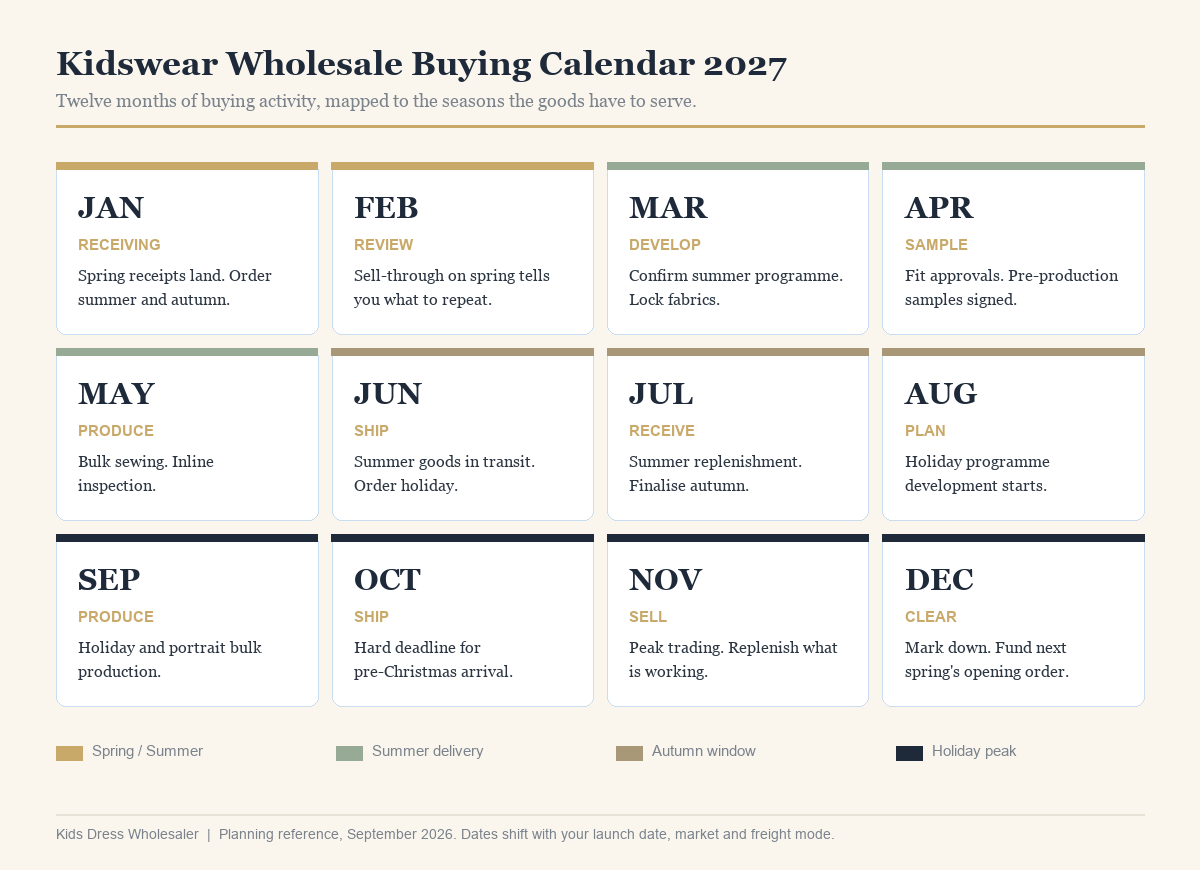
Everything above compresses into a single table. If you keep one page from this article, keep this one.
| Window | Retail occasion | Decisions that should be closed | Route that fits the window | Timing risk to watch |
|---|---|---|---|---|
| January to February | Holiday clearance, first spring receipts, early spring wedding enquiries | Summer and early-autumn development brief; spring replenishment call; autumn colour direction | Custom or adapted development, placed before the year-end production break | Mills, trims and the sample room stop for the Lunar New Year period; sampling sent late returns after the break |
| March to April | Easter, first communion, spring flower girl bookings, spring weddings | Spring top-up on proven shapes; white and ivory shade consistency; autumn brief already with the factory | Ready stock for top-up; no new silhouettes | Easter moves each year, so month-based planning slips; small ceremony orders look unworthy of planning and arrive late |
| May to August | Flower girl season peak, summer parties and portraits, light dress-up retail | Holiday programme in development; holiday colour lock; flower girl replenishment rhythm | Custom development for the holiday range; ready stock for flower girl gaps | The window is treated as dead time, and the holiday chain loses the one period where it had slack |
| September to December | Halloween dress-up, holiday portraits, Christmas and New Year formal wear | Replenishment triggers; channel allocation; markdown thresholds; next spring’s development brief | Ready stock only for anything not already in production | Christmas sells out and stops; portrait sessions pull the real deadline earlier; the whole market ships at once |
Print it, put your own dates in the margin, and next year’s calendar builds itself. The chain does not change between seasons. Only the launch dates do, and they are the one part of the schedule you actually choose.
Download the Kidswear Buying Calendar 2027
A one-page planning sheet with the twelve-month rhythm and the reverse-count sequence, sized to print. Shift every band to your own launch date, market and freight mode before you brief a supplier.
Ready to move forward?
Send us your launch date and the market you are selling into, and we will count the chain backwards with you and tell you which routes the calendar still allows. If the date is closer than the development chain permits, that answer is worth having early rather than after a sample round. Questions about the individual gates are easier to answer with your season, your size range and your quantity per style in hand. Typical figures as of September 2026, for planning only: ready stock on selected styles from 6 pieces, custom orders from 200 pcs per style, sampling 5–7 days per round, bulk production 25–40 days after sample approval, and pattern or sample development USD 80–150 where no pattern exists. Exact MOQ, development cost and lead time depend on style, fabric, quantity and season.