
Kidswear fabric approval is not the moment you nod at a color card. It is the moment you accept responsibility for how that cloth behaves once it leaves the sample room — under a cutting blade, inside a wash drum, on a child who sits, climbs, and gets lifted by adults. A swatch card is a promise made under generous conditions. One piece of goods, flat on a table, in clean light, handled by people who are not running a machine. Bulk fabric keeps none of those conditions. It arrives in rolls, it is spread under tension, it is cut into hundreds of panels, it passes under a needle dozens of times per garment, and it may be washed, pressed or steamed before it ever reaches a hanger.
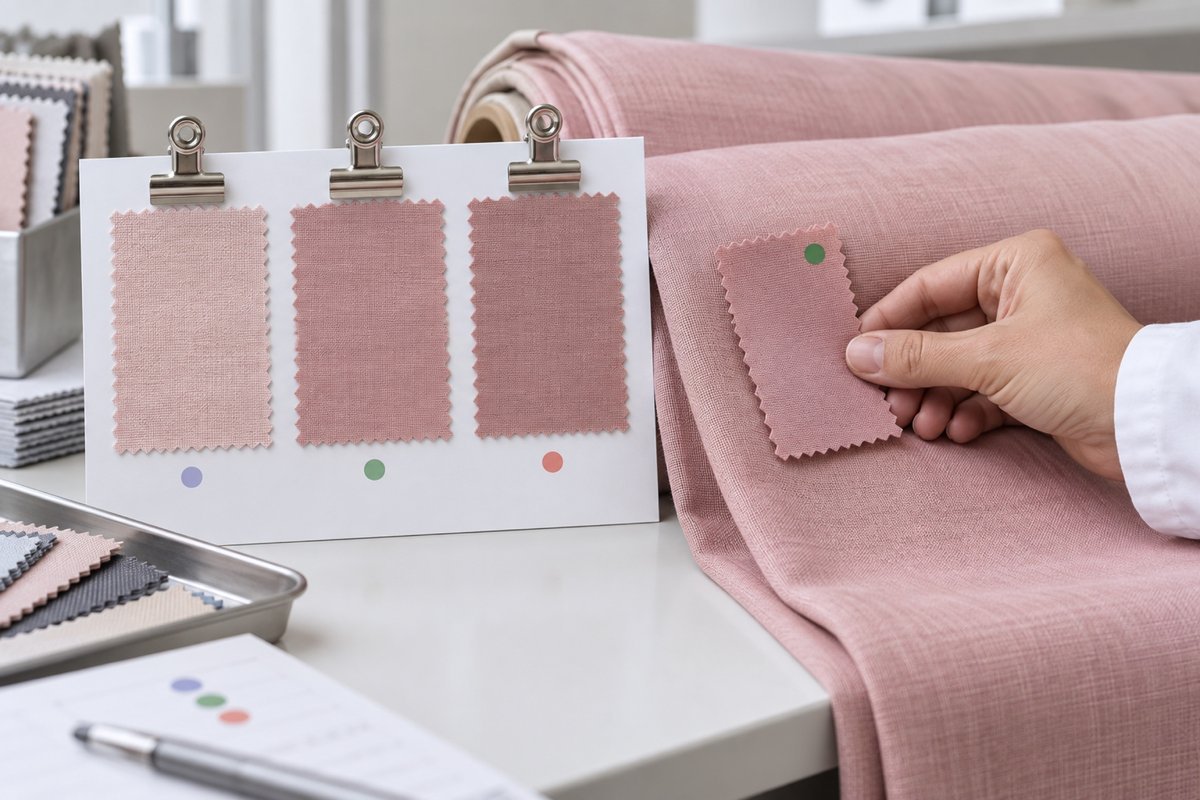
The rule this article rests on is short. A fabric that looks right on a swatch can still fail after it is cut, washed, or dyed in bulk. Nearly every fabric dispute that surfaces after production has started comes back to some version of that sentence: someone approved one piece, and everyone downstream treated the approval as covering a different lot, a different finish, or a different process.
What follows is a protocol, not a fabric lecture. Five stages, A through E, each with a fixed set of questions and a fixed set of records. If you are still choosing between fabric families — cotton against a synthetic blend, tulle against organza — that comparison lives in our overview of girls dress fabrics for wholesale buyers and is not repeated here. This article assumes you already have a candidate fabric in hand and need to move it from interesting to approved, without discovering its limits once the cutting room has committed.
What Fabric Approval Is Really Deciding
Three conditions change between the swatch on your desk and the cloth on the cutting table.
The first is tension. A swatch is a relaxed piece of goods. A roll is wound under tension, spread under tension on a cutting table, and sewn under presser-foot pressure. Fabrics that behave perfectly flat can distort the moment they are pulled. Lightweight satin, soft knits and fine tulle are the usual suspects, and the distortion often disappears in the piece but returns after washing or after a few hours of wear.
The second is moisture and heat. Finishing agents, softeners and calendar pressure are applied at the mill, and they change how a fabric feels. Bulk goods that sit in a humid container or pass through a factory steamer can read differently from the same fabric in a dry sample room. Hand feel is not a fixed property of a fiber; it is a property of the fiber plus everything that was done to it.
The third is scale. A lab dip is typically dyed in a small vessel, while bulk is dyed in a machine holding hundreds of metres and sometimes thousands, depending on the dyeing method and the mill’s equipment. Liquor ratio, substrate lot and cycle length may all differ from the sample run. A print strike-off is usually produced on a small press or a flat-bed sample printer, and bulk print then runs on a production screen or digital line with its own registration behaviour. The exact gap depends on the dyeing or printing method rather than on a single industry rule, but the principle holds: nothing about the small process guarantees the large one.
An approval, properly done, produces three physical things you can hold:
- A retained fabric standard, sealed, signed and dated, with one copy with you and one copy at the factory. This is the reference that settles arguments later.
- A test record for the specific colorway and lot, matched to the care instruction you intend to print on the garment.
- A shade or print reference approved under agreed viewing conditions, not from a phone photo.
It also produces one decision: whether this fabric, from this mill, in this lot, is allowed to be cut. On a custom program with a minimum of 200 pcs per style, sample making usually takes 5–7 days and bulk takes 25–40 days after sample approval. Fabric approval sits on that critical path. A late rejection does not delay a day; it delays a production slot, because fabric must be in house before cutting can be planned against a shipping date.
Stage A: Hand, Surface and Appearance
What you check
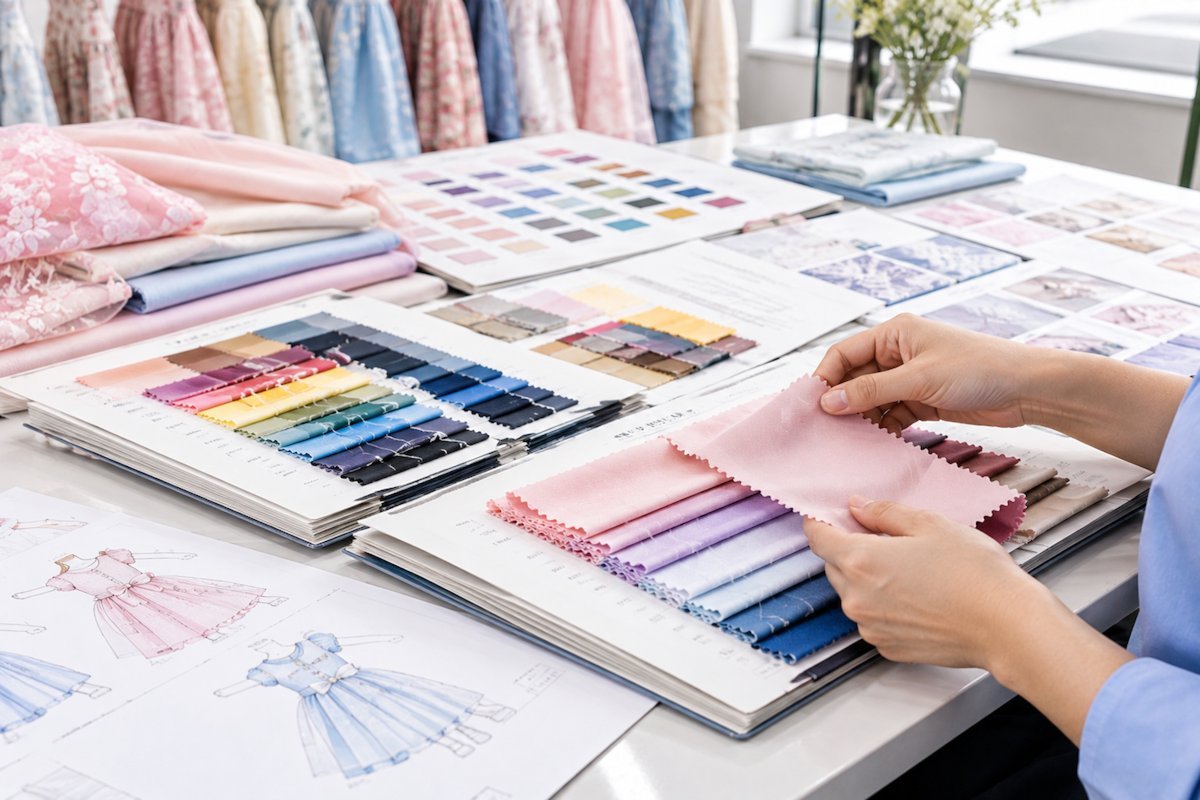
Look at the fabric the way the finished dress will be seen, which is rarely flat. Drape it over a dress form or over your forearm and watch how it falls: does it break into soft folds, stand in stiff angles, or collapse into nothing? Pin a panel across a bodice shape and check opacity where the fabric is stretched over a curve, not where it lies flat, because the same cloth that hides a lining on a table can become transparent as soon as it is pulled over a chest. Check surface character — weave density, slubs, sheen direction, any brush or nap. Check stretch and recovery in both directions, especially recovery, which is the part that fails first: pull a section, hold it, release it, and see whether the fabric returns to its original width or retains a slight growth. Then check softness against skin, because a girls dress touches a neck, shoulders and arms with no extra layer in between. Our deeper walkthrough of how to evaluate fabric swatches for kids dresses covers the physical tests you can run on a table in a hotel room before you commit to anything.
How it fails
A swatch feels soft and the roll feels wiry, because the mill applied a different finish or a heavier sizing to the production lot. A sheen fabric looks even on a card and then shows visible panel-to-panel difference on the garment, because the pieces were cut with the nap or shine running in opposite directions and the light catches them differently. A tulle that looks substantial as a flat piece reads as a bare net once it is gathered into a skirt over a colored underskirt. A knit with good stretch and poor recovery gives you a hem that grows longer over a day of wear and a waistband that stops holding the bodice in place. A fabric with a stiff hand that photographs beautifully in a flat lay can make a ruffle stand out like a flange instead of falling open, and no amount of pressing fixes it permanently.
What to record
Write the hand in words a second person can reproduce — soft, dry, slightly crisp, with a faint sheen — and photograph the fabric on a form, not flat. Retain the exact swatch you judged, sealed and identified. Note the direction of any surface sheen so the marker can keep all panels aligned. Note stretch direction and whether the style depends on recovery. Note whether a lining, interlining or backing is required to reach the opacity and body you approved. Note the name of the person who approved it and the date. An approval with no retained standard is an opinion, not a record.
Stage B: Does the Fabric Suit the Construction?
What you check
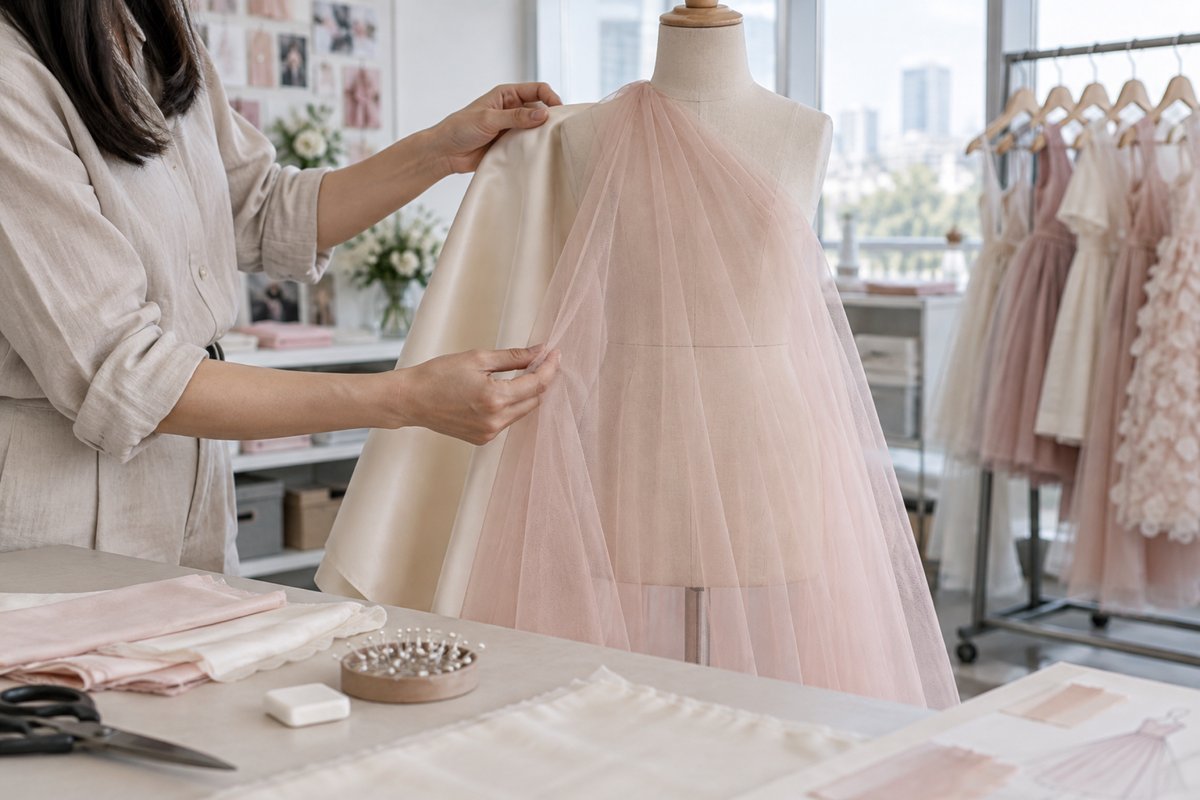
Match the fabric to the operations the style actually performs on it. Tulle and net will be gathered, and gathering concentrates stress along a thread line. Satin and charmeuse will be seamed on a curve and pressed, and both behaviors affect whether the seam stays closed. Chiffon and other fine wovens will be cut and handled with raw edges exposed for part of the process. Cotton and cotton blends will shrink, and the amount of shrink that matters is the difference between the shell and whatever is sewn inside it. Stretch fabric will be overlocked, and overlocking eats width. Fabric that will carry decoration has an extra question: does it hold the weight of beads, appliqué or embroidery without sagging, and does it recover from hoop marks after embroidery? Fabric that will take an invisible zipper needs enough body that the zipper tape does not show through a seam, and enough stability that the seam does not wave. The honest way to check all of this is a sew-off: take the candidate fabric and actually sew the operations the style needs, at production settings, on a real machine.
How it fails
Tulle tears at the gather line when gather tension is set high, and the tear often appears after the dress has been handled rather than during sewing. Satin and other loose-weave smooth fabrics slip at the seam — the yarns slide and the stitch line opens under stress, which is why these fabrics usually need a seam treatment rather than a standard stitch. Chiffon frays during transport between stations, so the finished edges end up uneven and the seam allowance is inconsistent from panel to panel. Cotton that shrinks pulls its lining, its hem and its placket upward after the first wash, and the shell can end up shorter than the lining it was cut to match. Heavy beadwork on a light ground causes the fabric to sag between bead rows over a few weeks of hanging, and the sag does not recover on its own. A stretch knit overlocked at the side seam loses width, and a dress cut exactly to spec finishes narrower than the sample.
What to record
Record the construction decision per fabric: seam type, edge finish, needle and feed settings for the sew-off, and whether a stay tape, stabilizer or fusible is required at the zipper, the waist seam or the shoulder. Keep the sewn test panel with the fabric standard. It is the single most useful record in this whole protocol, because it shows a future production team exactly what the approved fabric looked like after it had been sewn and finished on the machines that will make the order. Note who signed off and when, and note explicitly which operations are excluded from the approval, so nobody assumes stitch work was covered when it was not.
Stage C: Testing That Fits Your Garment
What you check
The most common error in fabric testing is treating one list as universal. It is not. The tests a fabric needs follow four things: the product type, the construction, the destination market, and the standard your own brand sets. A single-layer cotton summer dress, a beaded tulle flower girl gown and a knit play dress do not share a test list, and a factory that hands every buyer the same report has stopped thinking about your garment. What belongs in the request is a decision you make with your supplier and, where relevant, your laboratory:
- Weight and construction. Grams per square meter and a description of the build tell you what the fabric can carry. Heavier is not automatically better; a dress fabric that is too heavy will not drape and a lining that is too light will show through. Our primer on GSM in kids dress fabrics explains what the number does and does not tell you.
- Dimensional stability. How much the fabric moves after the wash routine you intend to print on the care label. Test the way the garment will actually be laundered, not a generic cycle, and read length and width separately.
- Colorfastness. Resistance to washing, to rubbing in both dry and wet conditions, to light, and to perspiration. Some products also call for testing against water or saliva where trims and prints sit near a mouth or against skin.
- Pilling and abrasion. Mostly a concern for knits, blends and brushed surfaces, and it decides how the garment looks after a season rather than after one wear.
- Strength. Tensile, tear and seam strength, and burst strength for knits. This is where a light fabric that photographs well is revealed as unable to hold a gathered skirt or a heavy trim.
- Stretch and recovery. For fabrics with elastane or mechanical stretch, recovery matters more than stretch.
- Surface behavior. Snagging, needle damage, and whether the fabric marks permanently when pressed.
- Flammability. Several markets set requirements for children’s daywear, and where a garment is sold into a category with its own separate flammability rules, that route sits outside the scope of this article. Test what your market asks for and record which route you took.
How it fails
Testing the wrong sample is the classic failure: a swatch submitted to a lab that was finished, washed or pressed differently from the bulk goods. Testing against the wrong care instruction is the second: the fabric passes for a gentle wash and the label says something stronger. The third is misreading a report. A fabric test report states the method and the result; it does not usually declare a garment compliant, because compliance depends on the whole finished product, not one component. Our guide to reading a kids dress fabric test report walks through how to pull the useful information out of the sheet instead of looking only for a pass stamp. The fourth is timing. When a test is ordered after cutting, a failure is no longer a delay; it is a quantity of unusable panels and a reorder of fabric, which resets the timeline you had already promised your customers.
What to record
Keep the test request itself — fabric, colorway, lot, intended care instruction and the list of methods requested — alongside the report. Record the decision that followed, including any method you chose not to test and why. Retain the tested sample, because a later dispute about which piece was evaluated is unwinnable without it. Note the lot and colorway on every document, since a test result is only valid for the goods it came from.
Stage D: Lab Dip, Strike-Off and Bulk Shade
These three words get used interchangeably in buyer conversations and they are not the same thing. Getting them straight prevents a specific and expensive misunderstanding.
A lab dip is a small dyeing. The dyehouse takes the base fabric or yarn and dyes a small piece to a target color, using a formula and a sample machine. Its purpose is to agree on a color direction before anyone commits a production batch of fabric to a dye bath. It is a recipe test, not a piece of your order.
A strike-off is a small print. It is not a dyeing at all. A piece of base cloth is printed with the artwork, on a small press or a sample printer, to check print color, registration, detail, and the scale of the repeat against the cloth. If your dress has a print — an all-over floral, a placement graphic on a bodice — you approve the print through a strike-off, and a lab dip does not cover it. If the dress has both a dyed ground and a print over it, you approve both, and you approve them in that order.
Bulk shade is the color of the actual production lot as it comes off the dyeing machine. It is not a point; it is a range. Every dye lot varies slightly, and the question is never whether the bulk lot is identical to the reference. The question is whether the variation sits inside the tolerance you agreed, and whether it is visually acceptable next to the approved reference and next to the other components of the same garment.
A lab dip can only ever approximate bulk shade, because the small vessel and the production machine differ in liquor ratio, substrate lot, time and temperature. A strike-off can only approximate bulk print, because the press and the production screen behave differently. Buyers who understand this approve a direction at dip stage and then approve an actual production lot at bulk stage, instead of expecting the dip to be the final answer.
What you check
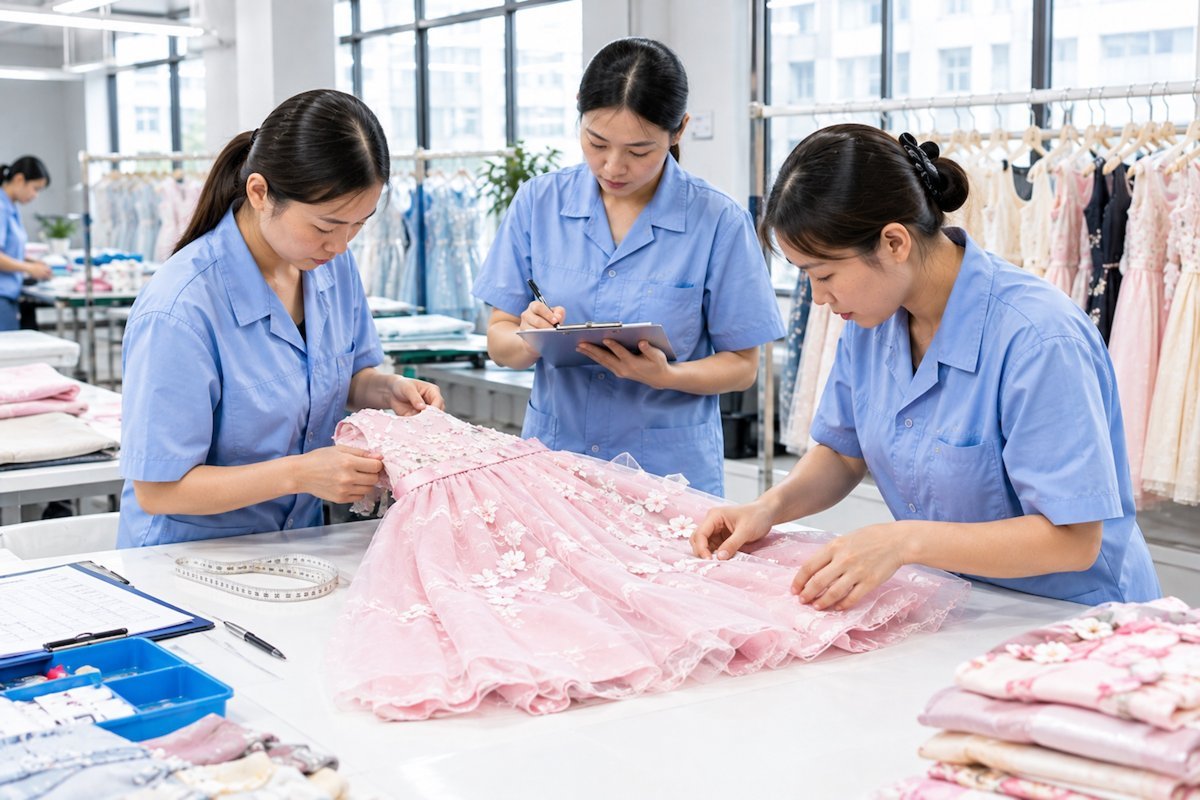
View color under more than one light source: daylight, a store-type light, and a warm indoor light. Two pieces can match under one source and separate under another, which is why buying decisions made under a phone camera or a desk lamp end badly. Use a light booth where one is available, mask both samples so only the fabric shows, and butt them against each other rather than holding them a few centimeters apart. Check the fabric as a garment will be seen: shell against lining, bodice against skirt, dress against its trim, because color agreement between two pieces of the same dress matters more to the customer than agreement to a card. Check the print’s scale on the actual cloth, since a repeat that worked on paper can look oversized or lost once it is printed on a bodice panel. And check repeatability: ask whether the dyehouse can produce the approved dip again on a different substrate lot, because an unreproducible formula produces a bulk lot nobody intended.
How it fails
A lab dip is approved that the dyehouse cannot reproduce in production. A strike-off is approved, and then the print scale or the screen count changes before bulk for cost or capacity reasons. Color is approved from a phone photo taken in a factory corridor, and the garment that arrives is technically inside the mill’s own tolerance and visually wrong to the buyer. Shell and lining are dyed in separate lots, match on the day of approval, and separate visibly once the dress is assembled. Bulk rolls within one shipment carry two different lot numbers because the mill ran short, and the difference shows up on a rack of identical dresses. None of these are exotic failures; they are the normal consequences of approving a small piece and calling it a bulk approval.
What to record
Retain the physical approved dip and the approved strike-off, signed and dated, with the same piece held by the factory. Record the light source you used, since a shade that looks right in one booth and wrong in another is a real and common disagreement. Record lot numbers for every roll you receive against the approved reference. State the shade tolerance in your own documents rather than assuming the mill’s house tolerance is the one you want, and keep a physical reference for it — no universal number exists for this, which is exactly why the retained standard matters. Our notes on Pantone color matching for kids dresses go further into the mechanics of communicating a color target across a language gap.
Stage E: Approving the Bulk Lot Before Cutting
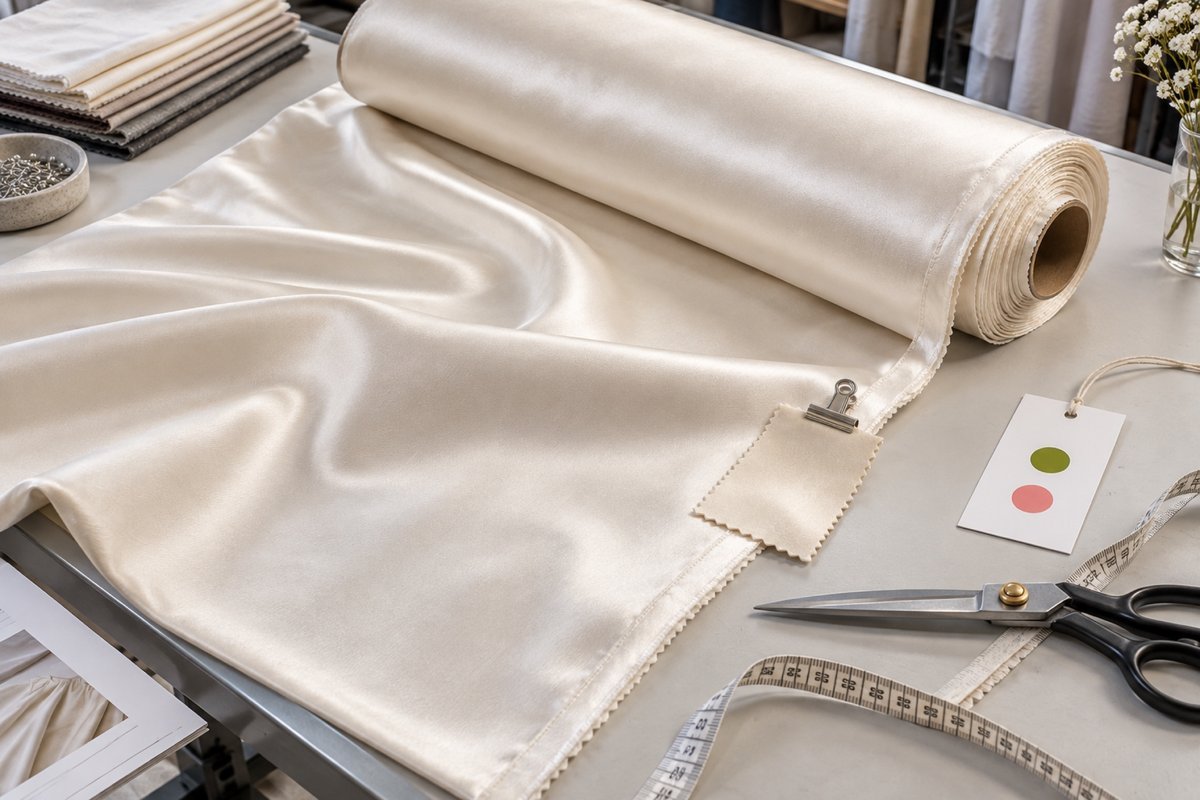
What you check
When bulk fabric arrives, check it against the approved standard, not against memory. Open the rolls and look at the goods under agreed light next to the retained swatch. Compare hand, surface, sheen direction and shade. Check roll-to-roll consistency inside the same shipment, and check whether all rolls carry the same lot number, because a single order can contain more than one lot when the mill runs short. Check usable width after trimming edges, since the marker was planned against a width and a shortfall costs cut pieces. Inspect for fabric defects that affect yield — slubs, holes, crease lines, needle lines, uneven dye streaks, skew. Check the finishing, because a different softener or calendar setting changes hand without changing fiber content. And confirm the care instruction you will print matches the fabric you are holding, since a substitution made on the mill side can quietly invalidate a test that was done on an earlier lot.
How it fails
The fiber content matches and the hand does not, which is the single most common bulk fabric surprise and usually comes from finishing rather than substitution. Shade drifts between rolls in one shipment and the factory cuts panels from more than one roll into the same dress. Width comes in shorter than the marker assumed, so the factory either requests more fabric or reduces panel sizes. Skew in the roll shows up as a twisted side seam after a wash, which is a garment defect that looks like a sewing fault and is actually a fabric fault. And timing failures compound: with bulk production running a full cycle after sample approval on a custom order, a rejected lot late in that window can push a buyer past a retail on-shelf date even when the factory does everything right afterward.
What to record
Cut the approved bulk swatch from the bulk roll itself, not from the sample room, and keep it beside the original standard with a lot number and a date. Record the rolls inspected, the ones rejected, and the reason in the factory’s words as well as yours. Record who holds authority to reject a lot, and what happens next when a lot is rejected: re-dye, a substitute lot, or an explicit written acceptance with the difference noted. That last document matters more than it seems. A buyer who accepts a visible shade or hand deviation in writing, before cutting, keeps control of the decision. A buyer who accepts it silently inherits a defect they will be asked to pay to fix later. If you are still assembling the technical side of a custom style, our overview of what we build under custom girls’ dress development shows where the fabric standard sits in the file.
Fabric Approval Record
Every stage above produces information. A record is what turns that information into something you can put in front of a mill, a factory or a buyer four months later, when a replacement lot arrives and nobody remembers which light source the shade was approved under.
| Field | What belongs in it |
|---|---|
| Fabric code | Internal reference, used consistently across orders |
| Mill and composition | Supplier name, fibre content, weight in GSM, usable width |
| Bulk lot number | The lot actually approved, plus how many rolls arrived |
| Colour standard | Pantone reference or retained physical standard, and where it is stored |
| Light source | The viewing condition the shade was approved under |
| Shrinkage | Tested result and the care instruction it was tested against |
| Colourfastness | Which methods were run and what the result was |
| Hand and surface | Judged against the retained original, not from memory |
| Wash result | Whether a sewn sample was washed, and what happened to it |
| Decision | PASS, HOLD or REJECT, with the date and the person who signed it |
Download the Fabric Approval Record
The same fields as a one-page sheet you can print and complete per fabric, per lot. Keep it with the retained standard and the test record — the three together are what make a bulk approval reviewable later.
An Illustrative Scenario: The Ivory Satin That Turned Firm
The following is an illustrative scenario, assembled from the kind of situation that recurs in fabric approval work. It is not a record of a specific customer order, and no figures are attached to it.
A boutique brand approves a soft ivory satin for a flower girl dress. The swatch is genuinely soft, with a fluid fall and a low sheen that reads expensive in photographs. The sample is made from that piece, the buyer reviews it on a child-sized form, and the hand is exactly what the brand wanted. Sample approved. The swatch is sealed, signed and dates are noted on both sides.
Bulk fabric then arrives at the factory. The composition on the mill’s document matches. The shade matches the approved reference closely enough that nobody questions color. But when the first roll is opened and a panel is draped across the bodice form, the hand is noticeably firmer. The fabric still moves, but it has a papery quality, and it does not fall into the same folds as the sample. On the skirt, the difference is subtle. On the bodice, where the satin is fitted and the shape depends on drape, it is obvious.
The useful response starts with refusing to guess. Fiber substitution is possible, but it is not the first explanation and not the most likely one. Finishing is. A heavier softener application, a different calendar pressure, a different lot carrying more sizing, or simply a different production mill on the same recipe can all produce a firmer hand from identical fiber content. So the sequence is diagnostic, not accusatory.
First, ask the mill for the finishing record of the production lot and compare it with the finishing used for the sample piece. Second, test the bulk fabric’s actual behavior rather than its description: take a panel of the bulk lot and the retained sample swatch, run both through the care routine printed on the label, dry them together, and compare hand and drape after relaxing. Third, if the bulk relaxes to match the standard, the problem is a temporary finishing condition and the appropriate response is a written note with the lot, not a rejection. Fourth, if it does not relax to match, the buyer has three real options and should choose consciously.
Option one is to use the lot where the firmer hand does not hurt the design — a structured or heavily lined shape can absorb a slightly firmer satin, while a fluid bias-cut drape cannot. That is not a compromise if the style genuinely suits it. Option two is to send the lot back for re-finishing or re-dyeing, accepting the production delay and confirming who carries the cost. Option three is to reject the lot and source elsewhere, which is the cleanest outcome for the garment and the most expensive for the calendar. A fourth path exists and should be documented rather than assumed: accept the lot, state in writing that the hand deviates from the approved standard, and confirm that the finished garment was checked on a sewn panel before the buyer agreed to it.
What decided the outcome in this scenario was not opinion. It was the retained swatch, the sewn test panel, and the relaxed comparison run under the same conditions. A buyer who had kept only a photograph of the approved satin has nothing to compare against, and the conversation turns into a memory test between two parties who both believe they are right.
The prevention point is one sentence long. Approve bulk against a swatch cut from the actual production lot, not against the sample-room piece, and cut the bulk approval swatch from the roll rather than from a mill-supplied cutting that may have been prepared specially for the approval.
Ready to move forward?
Send the fabric specification you intend to approve — composition, weight, finish and the colour reference — and we will tell you which of the five stages is most likely to be your risk point on that fabric, and what the record should capture. If you approve fabric internally already, the record above is worth copying into your own format; the fields matter more than the layout. Girls dress embellishments is the companion article when decoration is part of the fabric decision. Typical figures as of September 2026, for planning only: ready stock on selected styles from 6 pieces, custom orders from 200 pcs per style, sampling 5–7 days per round, bulk production 25–40 days after sample approval, and pattern or sample development USD 80–150 where no pattern exists. Exact MOQ, development cost and lead time depend on style, fabric, quantity and season.