
A junior bridesmaid is a role and a fit problem, not a larger flower girl size. That single sentence decides how a wholesale junior bridesmaid dresses programme should be bought, because almost every failure in this category is a measurement failure rather than a design failure. The girl is old enough to walk in with the adult bridesmaids and be photographed beside them, but she is still moving through the transition from children’s sizing into teen fit. Buy the dress as a scaled-up child’s garment and the bodice runs short, the shoulder line spreads, the waist sits in the wrong place, and the shop absorbs the cost as a rushed alteration before the wedding.
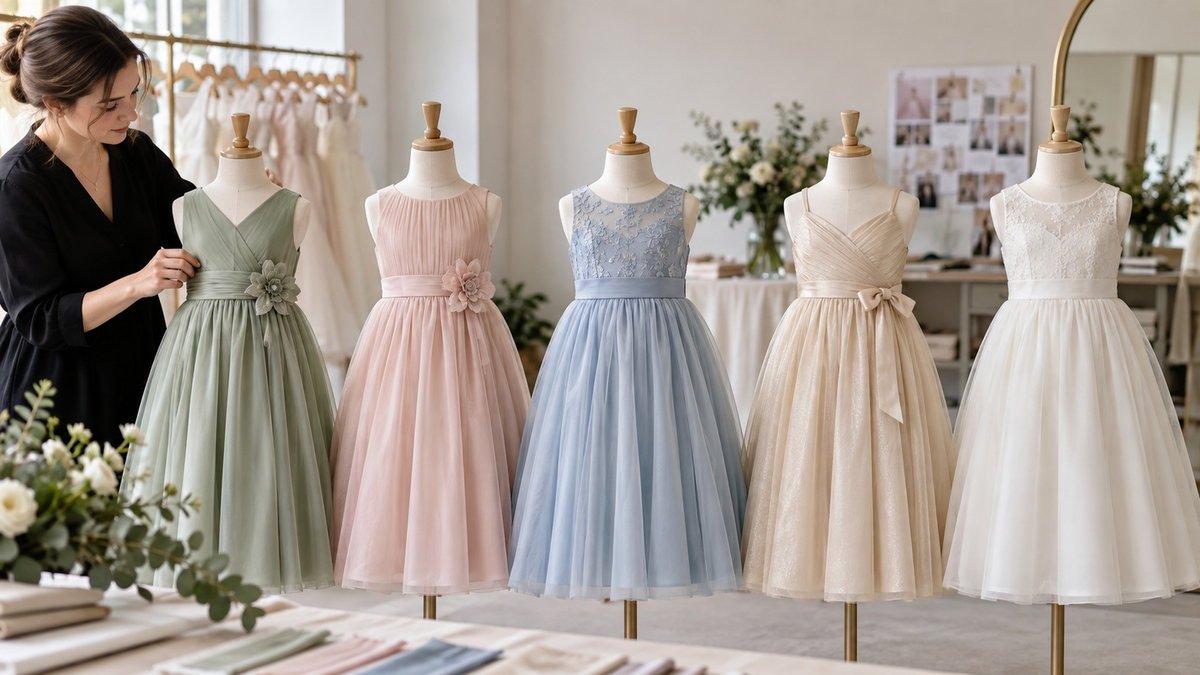
This guide is written for boutiques, retailers, online stores, private-label brands, importers and professional kidswear buyers. It stays on the junior role: proportion, graded measurements, finished length and coordination with the adult bridal party. It is not a flower girl styling page, and every measurement point below is meant to be copied onto a line sheet rather than read as a general principle. No forecast or illustrative number in this guide should be treated as a guaranteed market result.
Read the tape before you read the sample
The first thing a buyer should do with a junior bridesmaid sample is not look at it. It is to put a tape on it, in a fixed sequence, and write the numbers down next to the size label.
Visual review answers whether a dress is attractive. Measurement review answers whether it can be sold to a party that contains more than one age. A sample that photographs beautifully on a form can still fail the moment it is tried on a taller girl, because the eye forgives proportion errors that a tape measure exposes immediately. When a supplier sends a single sample in a single size with no graded chart, you are being shown half the product.
Work in a fixed order each time: chest, waist, shoulder, bodice length, finished length. Measure the same points on the sample every time, on more than one size, and record the results in one table you keep across suppliers. That habit makes comparisons possible months later, when nobody remembers which sample was which.
The grading table a junior programme has to publish
A junior bridesmaid programme is only as good as its graded measurement chart. Ask for the chart before you ask for a price, and read it as a document in its own right. The table below sets out the fields a usable chart must contain and what each one settles.
| Field on the chart | What it should define | The buying question it answers |
|---|---|---|
| Measurement point | Where the tape is placed for each dimension | Can two suppliers be compared fairly |
| Grade increment | The step from one size to the next, per dimension | Does the range serve two girls of different ages |
| Chest and bust shaping | How the front is shaped as the girl develops | Does the dress read as an older girl’s dress |
| Waist placement | Where the waist seam sits, per size | Will the dress look short-waisted at the top of the range |
| Shoulder breadth | The across-shoulder measure, per size | Does the top of the range fit a girl, not a form |
| Bodice length | Shoulder or high point to waist seam | Is there room for growth before the wedding |
| Finished length | Total length and the point it is measured from | Will the hem fall where the buyer intends |
| Tolerance | How much variation is accepted in bulk | What happens when the bulk lot arrives |
Two things matter more than the numbers themselves. The first is that the increments are proportioned for older girls rather than copied from a child’s block, because when a flower girl block is enlarged uniformly, shoulder breadth, bodice length and waist placement stop looking proportional. The second is that the chart describes the whole range, not the base size. A chart that stops at one size tells you nothing about the size the party actually needs.
Chest, waist and shoulder decide different parts of the sale
These three measurements are often treated as one number. They behave differently at the till.
Chest governs whether the bodice closes and sits cleanly, and whether the girl can be photographed without adjusting herself all day. It is also the measurement that moves fastest through the transition, which is why a dress bought on a child’s grade often looks tight across the chest on an older junior while still fitting at the waist.
Waist placement controls the visual proportion of the whole garment. A waist seam that sits too high reads as juvenile on a tall girl; too low and the skirt looks short. Because it is a placement rather than a circumference, it is the measurement most often discussed in styling language and least often written into a specification.
Shoulder breadth controls whether the top of the range fits a real girl or only a dress form. A narrow armhole is a frequent cause of rushed alterations, and it is invisible in a supplier photograph. When you test the largest proposed size, the armhole is the first place to check.
Bodice length is the quiet failure
If one measurement deserves its own passage, it is bodice length, measured from the shoulder or high point down to the waist seam.
An older junior is longer through the bodice than any child’s block assumes. When the bodice is short, the dress pulls upward, the waist seam rides high, and the girl looks as if she has outgrown the garment even on the day it was delivered. Alterations cannot fix it cheaply, because correcting the bodice usually means opening the waist and resetting the skirt.
Two habits reduce the risk. First, require the bodice length to appear on the graded chart as its own line, with the age band each size is cut for. Second, allow for growth between fitting and the wedding: order a sample in the smallest and the largest proposed size, and where possible fit the largest on a girl of the intended age rather than only on a form. A bodice that allows no growth between fitting and the ceremony will always need a late alteration.
Knee, tea, midi and ankle are not production instructions
Length in this category is a venue and mobility decision as much as a styling one. Tea length, falling around the calf, is the most forgiving across indoor and outdoor venues and across a girl who grows before the day. Midi reads closer to the adult bridesmaid line. Ankle or floor length suits a formal ceremony but demands more attention to steps, shoes and alteration.
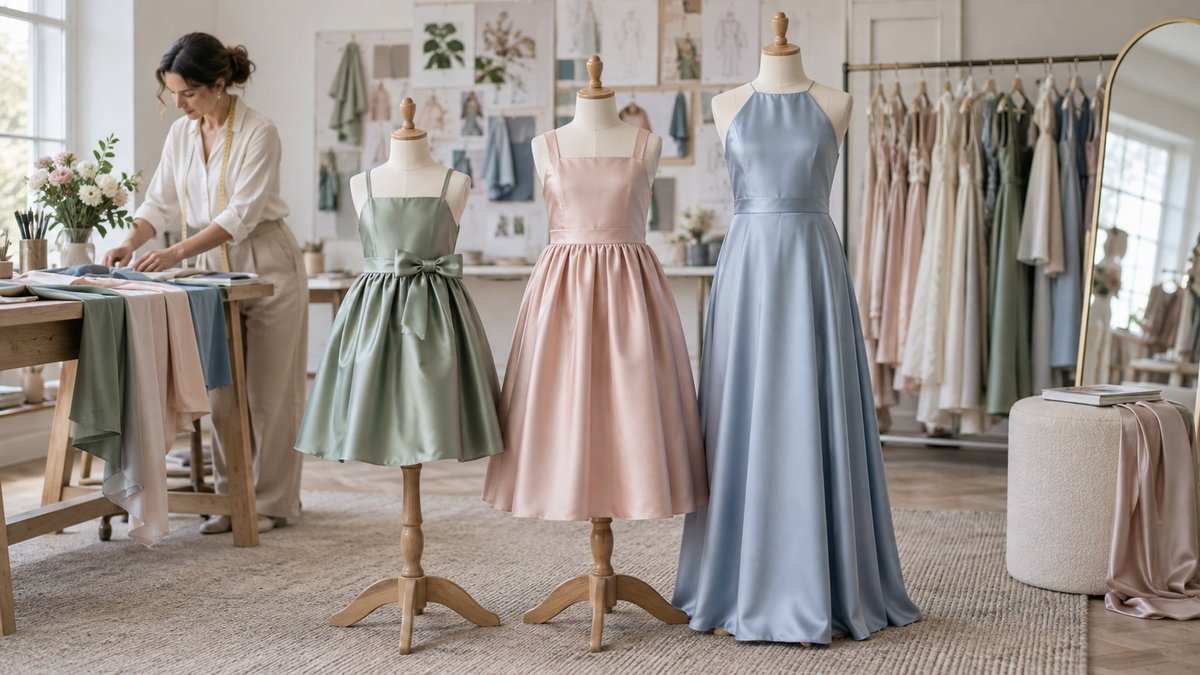
None of those words belong on a production document. “Tea” is not a specification; a finished length, the point it is measured from — shoulder to hem or waist to hem — and the intended position of the hem on the wearer together are. Settle three things alongside the number: the venue surface, the shoes she will wear, and who arranges alterations if she grows before the date.
Show the options side by side rather than describing them, so the bride chooses between legs of the same dress rather than between interpretations. If a store sells one length only, say which and why; a bride who is offered everything usually commits to nothing.
Colour is approved on the substrate, not on the name
Sage, blush, powder blue, champagne and ivory all render differently across satin, chiffon, tulle and lining, so one dye target can appear as two colours in a single party photograph. The comparison that counts is made on the production fabric the girl will actually wear, which is why substrate-level detail belongs in the buying conversation and not only in the styling conversation — the girls dress fabrics wholesale guide is the right place to study how each material behaves before a shade is frozen.
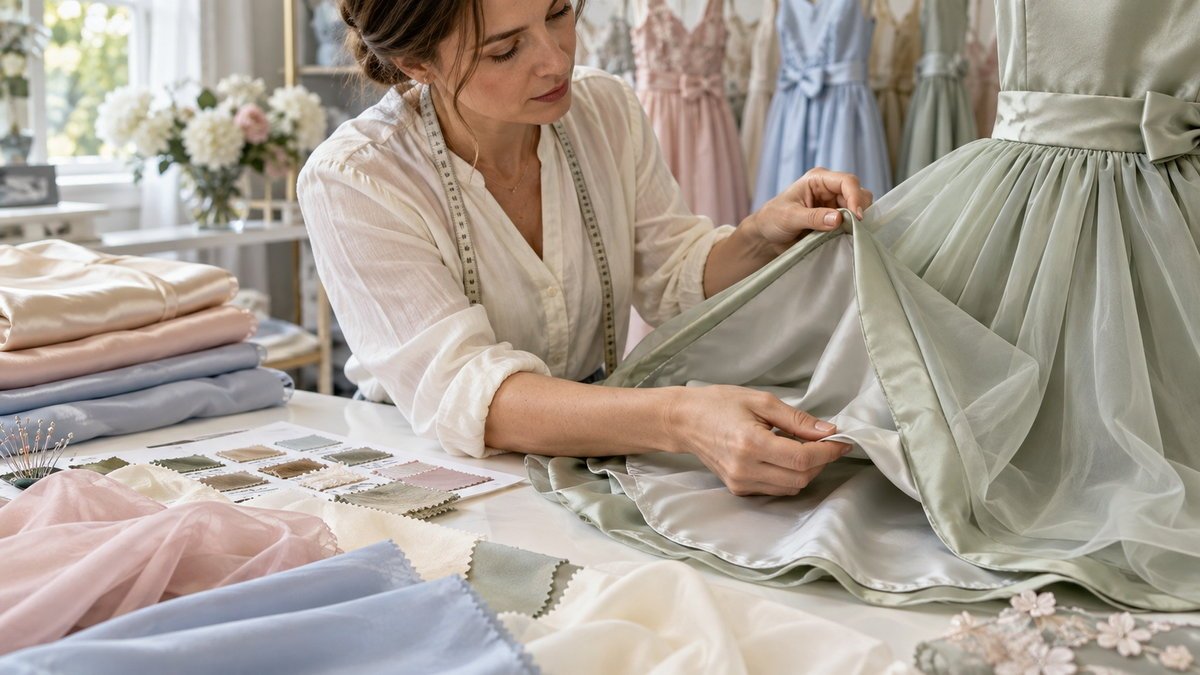
Where the adult dresses come from another supplier, obtain a physical swatch and agree the tolerance before the junior order is placed. Write down which reference is master, the lighting used for the comparison, and whether the standard is coordinated or identical. For group and family orders, record the dye lot and keep an approved swatch on file, because a mismatch shows up in the wedding photographs long before it becomes a complaint. A shop-window comparison in daylight is not an approved standard.
Test both ends of the graded range
A junior order is rarely one dress. It is more often two or three girls in one colour, and the scarce resource is not depth in one size but availability in the sizes that sit next to each other. That makes end-to-end testing the most valuable hour a buyer spends.
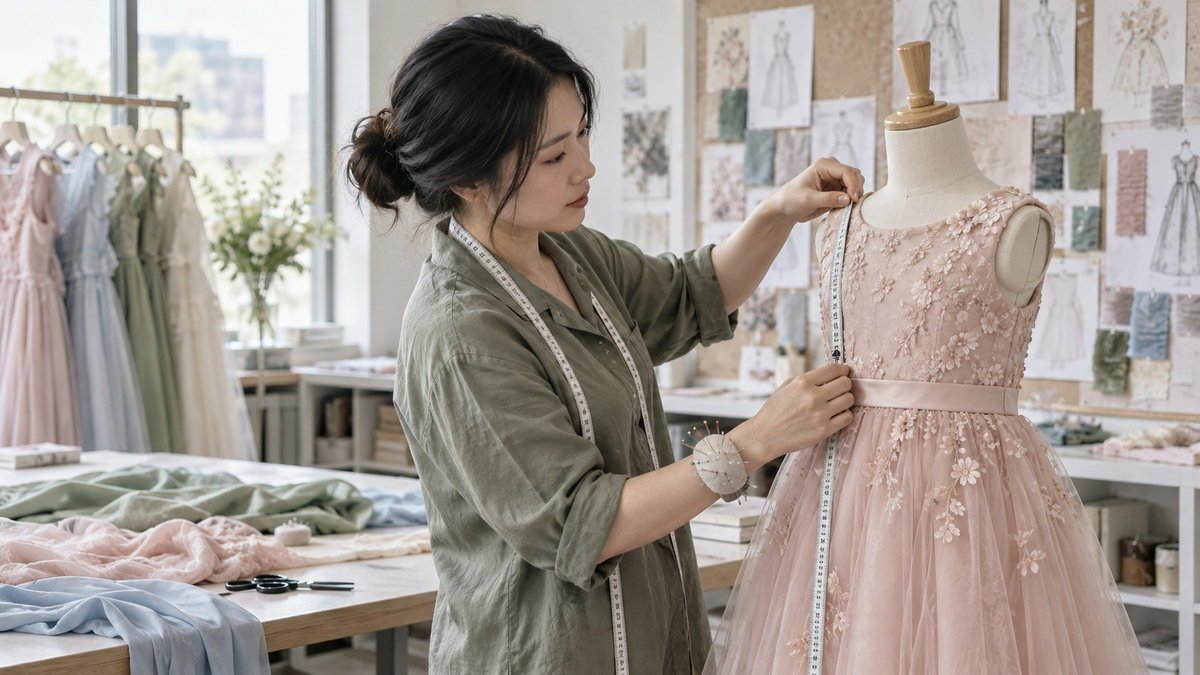
Order a sample in the smallest and the largest proposed size, then compare them against each other rather than against the chart alone. Look for these specific things: whether the bodice length still works at the top of the range, whether the waist placement stays proportionate, whether the armhole allows comfort, and whether the shoulder seam sits where a shoulder actually is. Fit the largest on a girl of the intended age whenever a fitting can be arranged, and note the growth expected between fitting and event.
Keep the notes attached to the style record. When a party books months later, the store team needs to know which sizes were tested, which were assumed, and where the exchange or alteration policy stands.
Where a junior programme stops being a child’s pattern
Junior sizing fails most often in the grading rather than in the base pattern, and the reason is architectural. As girls grow, shoulder breadth, bodice length, bust shaping, waist placement and preferred skirt volume all change at different rates. A silhouette that looks balanced on a young child can appear short-waisted or overly juvenile on an older girl.
The practical answer is to build two related silhouettes rather than one scaled pattern: a softer A-line with restrained detail for the younger junior, and a cleaner satin or chiffon shape with a defined waist for the older junior, closer to the adult styling without imitating it. Coordination means related, not copied. An adult gown with a strapless neckline, a deep back or a plunging front does not translate onto a junior body or into a family ceremony; the fabric family, colour direction and level of formality can be shared while the neckline, sleeve and back are adapted to something a girl can carry for a full day.
Where a family also dresses a younger child, offer related rather than identical looks and be explicit about the boundary of this page: this programme covers the junior role, while flower-girl styling lives in the wholesale flower girl dresses pillar and its forward view in flower girl dress trends 2027. Give the bride a one-page sheet showing flower girl, younger junior and older junior together so the relationship is agreed before commitment.
Four questions a fit-led order has to settle
A fit-led article does not need a long interrogation. It needs four answers written into the order.
1. Which sample and swatch control the order? Name the physical sample, the specification version and the master colour reference, not the style number alone.
2. How do chest, waist, shoulder and bodice length grade across the range? The answer should be a chart with increments, not a sentence about generous sizing.
3. What finished length is quoted, measured from which point, and on which size is it verified? Ambiguity here reappears as an alteration.
4. Which sizes can be supplied in the same colour, and which adjacent sizes are at risk? A party that can be dressed in one colour except for one missing size usually becomes a lost order, a colour substitution or a rushed alteration.
The brief that decides quotations
Replace vague wording with something measurable before you ask for prices. “Junior size” is not a specification; the graded chest, waist, shoulder and bodice length for each size is. “Match the bridesmaids” is not a colour; a physical swatch and the substrate it must match on is.
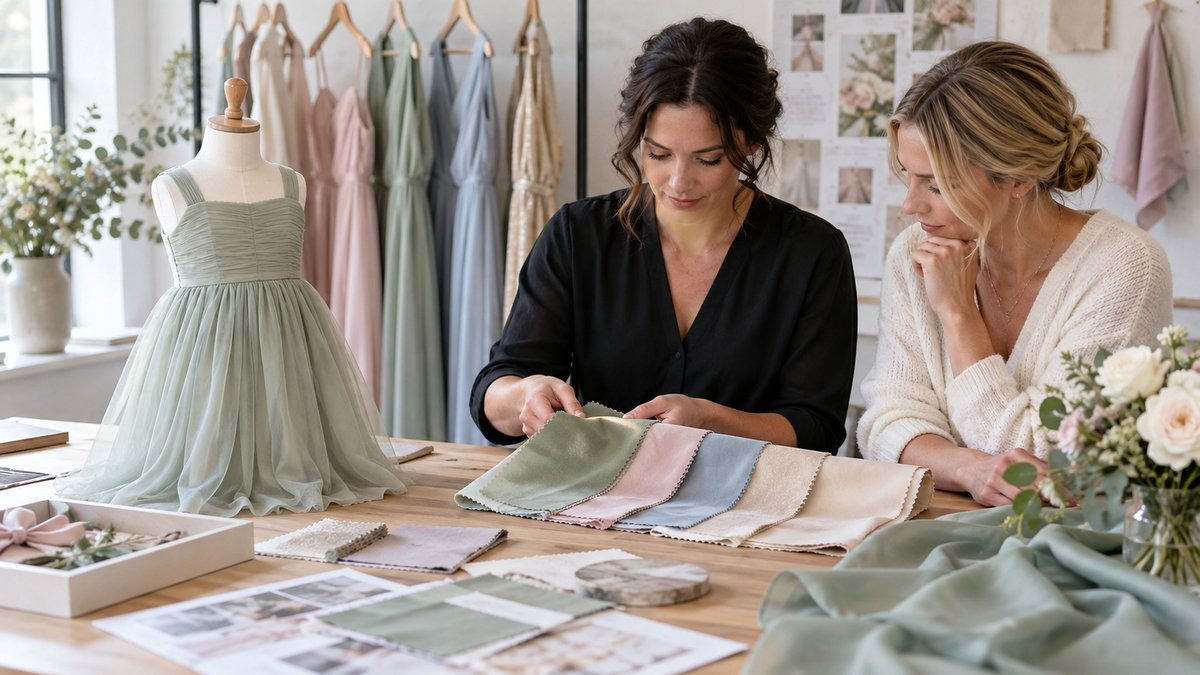
A junior bridesmaid brief should be built around a date, because weddings are date-locked. Include the wedding date and how much flexibility it allows, the ceremony role and age band, the palette and the reference taken from the adult bridesmaid dress, the length and its measured point, the graded measurements, quantity per colour, destination and the buying route you want.
That route follows the time available. Ready-stock girls dresses wholesale is workable when the colours are close enough, the sizes exist and the date is near, and it teaches a boutique which silhouettes and lengths its customers actually request. ODM adaptation is the middle route: an existing junior base reworked into the bride’s palette or a preferred length, using fit and grading that have already been proved. Custom girls dresses OEM and ODM is justified when the palette, neckline, bodice proportion, labels or packaging must be exact, and only if the date leaves room for a sample round and a colour approval. When the date is tight, offer a related stock option rather than a custom promise.
Build landed cost before the price, with attention to the costs that behave badly in small group orders: per-size and per-colour minimums, colour-matching work, packaging, inspection, payment costs, inbound freight, insurance, duty where applicable, brokerage and destination charges. Model the planned party order, a smaller order that still triggers the same minimums, and a case where a colour or size has to be reworked close to the wedding.
Reading the delivery against the chart
Junior orders arrive as a group, so receiving should be organised around the party rather than the carton. Open representative packages while the shipment reference is available, and check each size against the graded measurement chart rather than against one sample.
Then check the things that drive alterations: bodice length, waist placement, armhole fit at the top of the range, hem length against the stated measured point, and whether the fabric recovers after folding. Check colour consistency across the sizes the party will wear together, in the same light, and record issues by style, size, colour and carton.
After the wedding season, review paid orders, alteration and return reasons, sizes that could not be met and landed cost. Keep a record of the supplier references that coordinated successfully, because that record is the cheapest input into next season’s grading conversation. A visual check alone cannot prove every safety, composition or attachment requirement; use qualified laboratories or compliance professionals where the market requires them, and treat any labelling or import point in this guide as planning information rather than legal advice.
Send the tape numbers, get a usable answer
Request current junior-size measurements and ready-stock colours, or send the adult bridal-party fabric reference and target size range for OEM review. A brief that arrives with a graded chart and a physical swatch on the way gets a workable quotation far faster than one that asks for “junior bridesmaid dresses in blush”.
- WhatsApp: https://wa.me/8619896855980
- Email Us: mailto:luxudress@gmail.com
Leave a Reply