
A guest dress is the one garment in a wedding wardrobe that nobody plans around. The couple sets the palette, the flower girl is fitted, the bridesmaids are matched, and the child guest is dressed by a parent holding an invitation, a date and a venue. That parent already knows where the wedding is happening, and that single fact settles more of her purchase than any trend report she will read. So this guide is built as a venue tier grid rather than a list of decisions: six tiers, each with its own fabric weight, coverage, skirt volume and price position, and each short enough to read on its own. It is written for boutiques, retailers, online stores, private-label brands, importers and professional kidswear buyers planning wholesale girls wedding guest dresses.
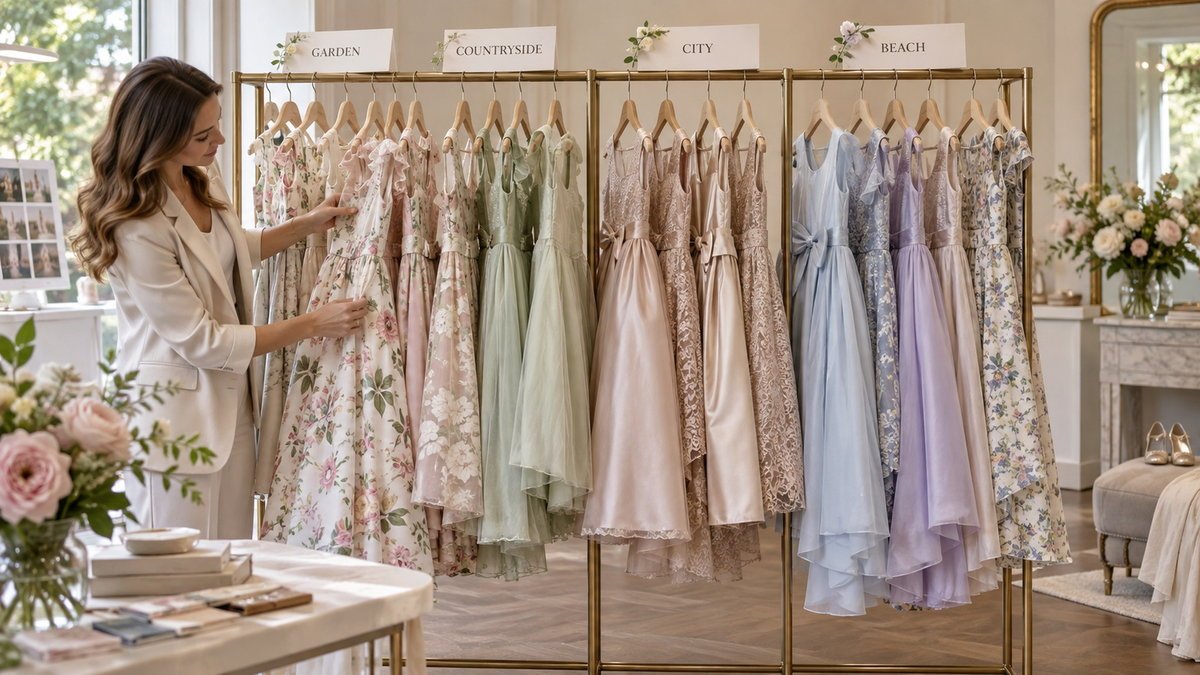
A guest dress is not a smaller flower girl dress
The guest dress is chosen by a parent who is attending, not by the couple hosting. That shifts the question from “does it match the wedding palette?” to “will this child look appropriate and stay comfortable through a long day?” Write the boundary into the brief: guest dresses follow the invitation dress code and the venue, are never coordinated with the bridal party, and are never marketed as a substitute for flower girl duties.
Commercially that boundary removes the dyed-to-match promise, the colourway tied to one wedding and the made-to-order sizing obligation, leaving a wide customer in any family attending any wedding. It also keeps your own pages from cannibalising each other: a guest page should link across to the ceremonial programmes that are chosen by the couple and fitted for a role, such as wholesale flower girl dresses, instead of repeating their content. A junior bridesmaid belongs to that side of the line too — she is matched to the palette and stands in the party, so she is not a guest style with a larger size.
Check the label, the care card and the packaging copy for anything that implies ceremonial-party membership. A printed promise of matching is difficult to withdraw once a customer has bought on the strength of it.
The venue tier grid, in one table
| Tier | Customer and event | Fabric and finish | Coverage and skirt | What to avoid |
|---|---|---|---|---|
| Garden and daytime | Daytime ceremony, relaxed reception | Light printed or floral woven, cotton blend | Short or cap sleeve, moderate skirt | Heavy tulle, floor length |
| Church and daytime formal | Morning service, formal lunch | Refined woven, lace overlay, lined bodice | Short sleeve, defined waist | Strapless shapes, deep colour |
| Hotel, ballroom and evening | Evening dinner, formal venue | Satin, lace, refined texture, heavier lining | Longer sleeve option, fuller skirt | Daytime prints, beachy trim |
| Heat, shade and outdoor summer | Summer outdoor ceremony | Breathable woven, cotton-rich lining | Cap sleeve, low skirt volume | Dark colours, non-breathable lining |
| Older guest | Pre-teen and teen attending | Clean woven, restrained detail | Midi, modest neckline | Scaled-down adult eveningwear |
| Reusable occasion | Wedding plus later family events | Versatile tone, washable fabric | Adjustable, hem that can be let down | Single-occasion prints |
The grid is a planning tool, not a purchase ratio. A new boutique may want breadth to learn; an established specialist may buy deeper into two tiers that already sell. Buy three or four tiers rather than one mood, and give each a distinct fabric weight and finish so that two styles inside the rail are not competing quietly for the same customer.
Where the customer and the price architecture support it, give each tier an entry, a main and a premium option. That structure lets a parent trade up without leaving the tier, and it lets you read whether the tier is selling because of the price point or because of the dress. Where the price architecture does not support three options, one credible style beats three that are almost the same garment.
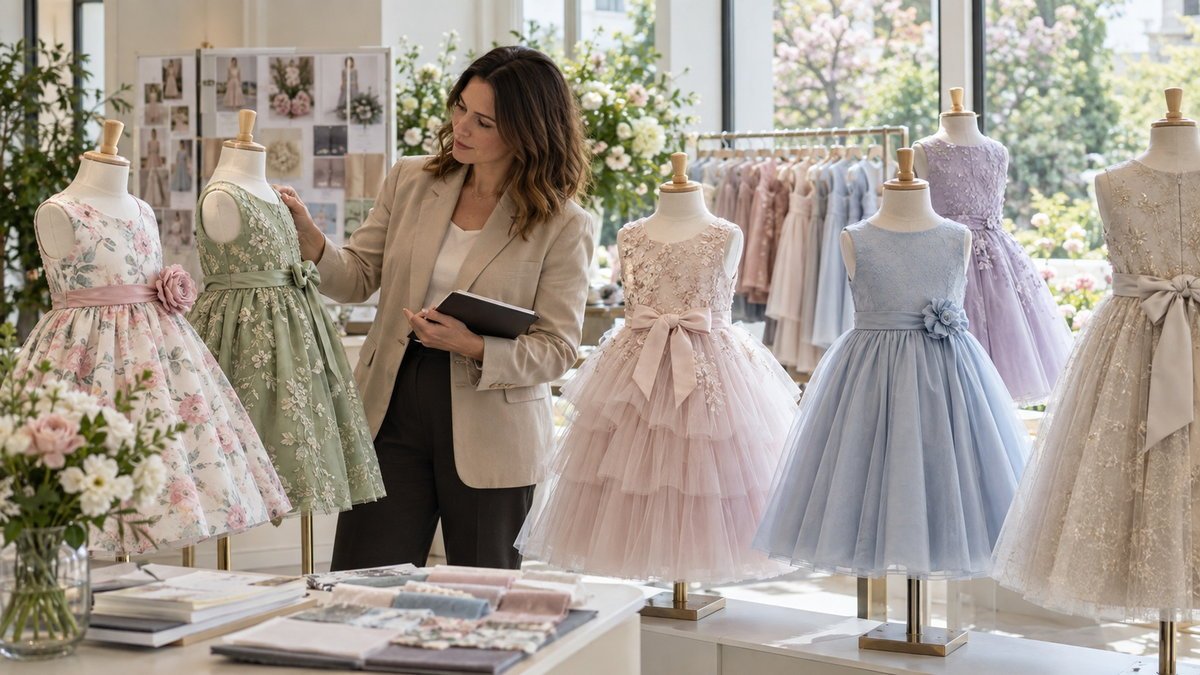
Tier one: garden and daytime ceremonies
This is the most forgiving tier and the one most families buy in. A garden or beach-side ceremony in daylight reads well in a printed or floral woven with a soft hand, and the customer is usually buying comfort first. Light lining, a short or cap sleeve and a skirt that clears the ankle all sell here.
The trap is importing ballroom thinking. Heavy tulle, structured bodice shaping and floor length look impressive on a hanger and read as over-dressed on a lawn. Keep the palette daylight-friendly and the skirt volume modest.
Tier two: church mornings and daytime formality
A morning service followed by a formal lunch asks for polish without evening weight. A refined woven or a lace overlay over a lined bodice answers that brief, and the customer is more likely to accept a deeper colour here than in an outdoor setting.
Coverage rules in this tier are set by the family, not by you, so keep a sleeve option and a neckline that works with a cardigan or shrug. Since the dress is worn seated for a long stretch, check how the waist behaves when the child is sitting still.
Tier three: hotel, ballroom and evening
Evening venues justify satin, lace and a fuller skirt, and this is the tier where a slightly higher price position is defensible. It is also the tier where the guest risks copying the bridal party, so keep white out of it and treat the shine level as a deliberate choice rather than a default.
Because fuller skirts, layered tulle and heavier linings consume more freight cube than a flat day dress, confirm with your supplier whether the quotation assumes folded or hanging cartons before you compare two of them.
Tier four: heat, shade and outdoor summer
Wedding season is not one season. A midsummer outdoor ceremony asks for breathable wovens, cotton-rich linings and short or cap sleeves, and nothing fails faster than a dress bought for a photograph and worn through a hot afternoon.
Plan a separate warm-month construction rather than recolouring the ballroom base. Lining weight and skirt layers change how seasonal a dress feels at very little cost, and both are easier to adjust than the shell.
Tier five: the older guest
An eleven-year-old and a two-year-old do not need the same dress in different sizes. Older girls want a silhouette that reads as grown-up without copying adult eveningwear: a clean midi, a modest neckline and a fit that is not a scaled-down party dress.
For this tier, state the neckline rule and the maximum skirt volume in writing, because the drift towards adult styling happens fastest in the older sizes and is hardest to correct after the bulk run.
Tier six: the reusable occasion dress
A guest dress earns more when it can be worn again. Families weighing a garment they may use once respond to something that also suits a birthday, a family celebration, a religious holiday or a school performance — and that also lets a restrained style sit inside a wider wholesale party dresses for girls range without a second sample.
Give every style a second occasion before you buy it. If a dress can only be described honestly for a wedding, either drop it or accept that it will be marked down. On the product page, say plainly what makes it reusable: a restrained colour, a removable sash, a hem that can be let down, a washable fabric.
Fabric weight, lining and sleeve cover, tier by tier
Sleeve length, lining weight and skirt layers change perceived season more cheaply than anything else on the specification. For warm months ask for breathable wovens, cotton-rich linings and short or cap sleeves; for cooler months consider a longer sleeve, a heavier lining and a layering option such as a cardigan or bolero.
Buying one mid-weight construction and selling it all year leaves the customer to solve the coverage problem herself, and she often solves it by buying elsewhere. Plan two or three distinct constructions rather than recolouring one base, and align them with the season you are actually selling into — the same discipline a seasonal plan needs, as set out in the Spring/Summer 2027 girls dress buying guide.
Approving the fabric is a separate act from approving the colour. Ask for a cut of the actual production lot, keep a dated physical reference, and treat the lining as part of the decision rather than an afterthought.
Colour beyond bridal white
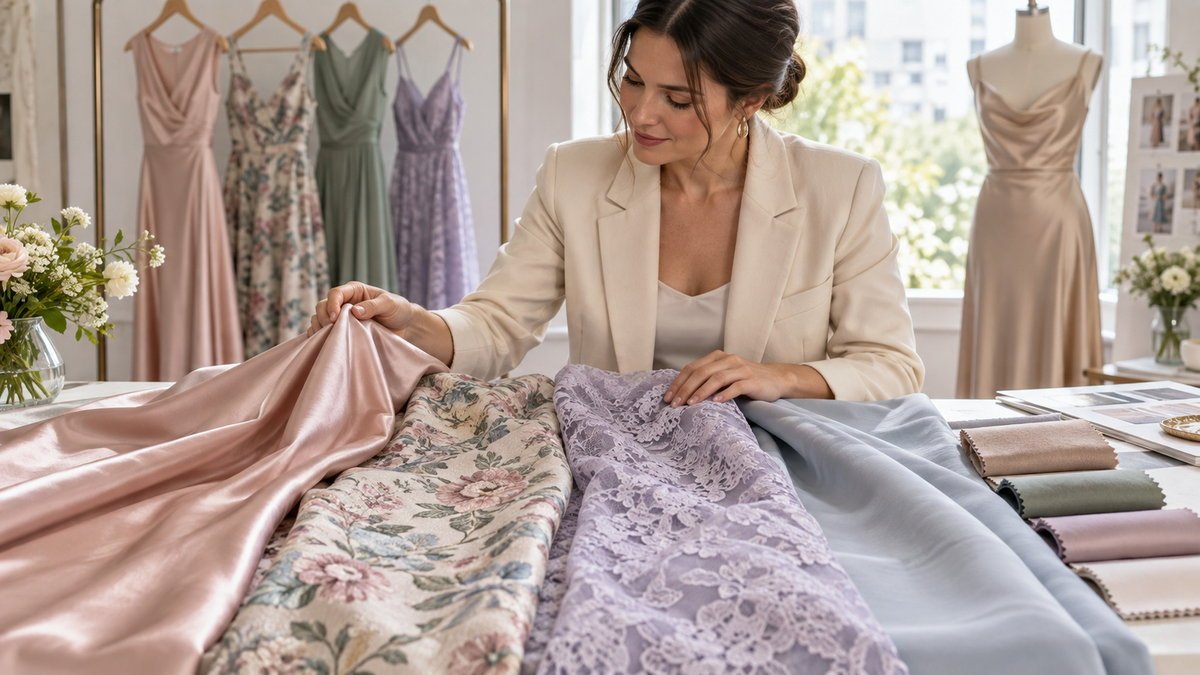
White belongs to the bridal party, and most families avoid dressing a child guest in the bride’s colour. What remains is wide but not unlimited: soft blue, sage and forest green, dusty rose, lavender, champagne, burgundy and seasonally appropriate prints.
The risk is not the palette but buying it as a scatter of unconnected colours that never forms a coherent rail. Choose a small number of colour stories and repeat them across silhouettes, fabrics and price tiers so a customer can find one tone in three dresses. Approve each colour on the actual production fabric rather than a screen, record the physical reference, and keep ceremonial white off the guest rail entirely.
Colour is also where a reorder quietly drifts. A dusty rose or a soft sage can shift noticeably between a screen, a swatch and a finished dress, so the approved physical reference belongs to the tier and stays with the file. When a tier is replenished mid-season, match the new delivery against that reference rather than against the first shipment, and treat any departure as a decision rather than an accident.
Bodices, waistbands and hems that survive a long day
A child guest wears the same dress through travel, a seated ceremony, a meal, photographs, dancing and a second journey home. Details that impress on a hanger can fail in use: rigid bodice shaping, heavy skirt volume, scratchy lace at the armhole, a stiff waistband, or a hem she cannot manage on a folding chair.
Specify for the day rather than the photograph — a lined bodice in a soft fabric, a waistband with some give, a hem that clears the ankle on the stated size, closures she can partly manage herself. Confirm how any decorative embellishment is attached so it does not catch on seating or shed onto other garments, and test the sample on a child who sits, bends and reaches.
Age bands inside every tier
Each tier needs an age architecture, not one silhouette stretched across the size range. Toddler sizes need room for a nappy or pull-up, a soft waist, easy shoulder access and a hem that will not trip a new walker. Core girls sizes can carry more structure, a defined waist and a fuller skirt.
Buy the age bands you actually sell, and inside each tier state the occasion, the neckline and sleeve rule and the maximum skirt volume. Where the age bands meet, watch for a gap that leaves a customer with no size at all — a missing adjacent size is a lost sale in a category with a fixed date.
Because the customer is buying for one event on a fixed date, she will often accept a substitute colour or trim before she accepts a missing size. Adjacent-size availability inside each tier therefore usually matters more than depth in any single size, and the sizes either side of the ones you sell most should be treated as supporting stock rather than leftovers.
What a tier has to prove before it scales
Quality control starts from the approved sample and the written specification for the tier being bought. Define which failures are critical, major and cosmetic for a guest dress: fit through the bodice and waist, hem length and finish, lining coverage, zipper function, trim attachment, colour against the approved reference, labelling, pressing and packing.
A visual check cannot prove colourfastness, composition, care performance or every safety requirement, and the details that decide a guest dress — a waistband that holds shape, a hem that survives a full day, a trim that does not shed onto seating — each need their own pass or fail test. Use qualified laboratories or compliance professionals where the product and the market require them, and keep the inspection record with the sample version that controls production.

Testing a tier on ready stock first
Exclusive capsules consume sampling time and buying commitment, and they answer a question you may not be able to answer yet: which venue tier, age band and price position your customers actually buy. Ready stock places several of those hypotheses on the rail at once, at low risk, and shows what moves before you commit to custom dye lots and printed labels.
Confirm live availability, measurements, colour references, packaging and the top-up route before publishing the offer, because a size that sells out mid-season is a lost sale in a category with a fixed date. If you are sourcing an existing assortment, the practical route is described under ready-stock girls dresses wholesale; ODM or a controlled adaptation suits a proven silhouette whose colour, trim, sleeve or skirt treatment has to change for your market.
Develop an exclusive capsule only for the position that has earned it. Record sell-through by style, size, colour and venue tier, and read returns as evidence about fit and occasion clarity rather than as a cost line alone.
Reading a tier after its first selling season
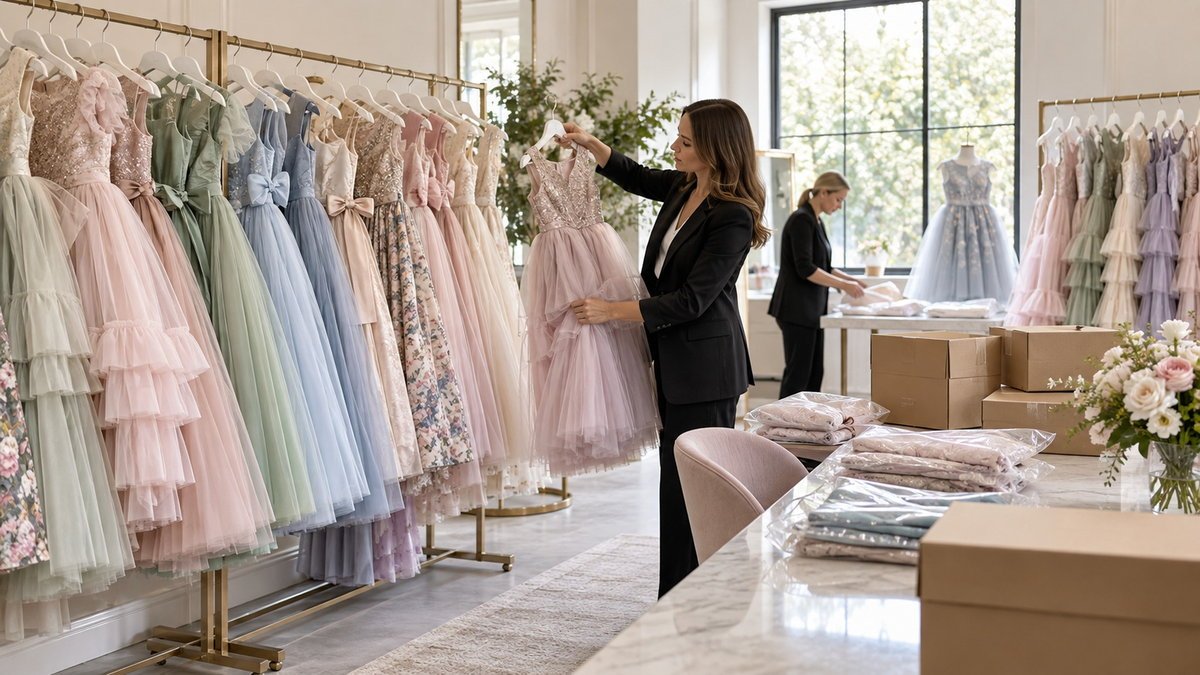
Set the first review before the season is half over, while there is still time to act. Read sell-through by venue tier, age band, size and colour alongside returns, margin and delivery performance, and compare what arrived against the approved sample: fit, waist finish, hem length, lining coverage, colour and trim attachment.
A strong tier supports a reorder of the sizes that sold. A mixed result supports a size, a colour or a copy correction. A weak tier justifies an exit before the markdown period. Brief the retail team on which tier and age band each style serves, and check that the product page, measurements, images, care information and promised availability still match what is on the rail.
A one-page tier brief for quotations
A wedding-guest brief should fit on one page and start from the event, not the garment. State the market and channel, the venue tiers you intend to cover, the age bands you sell, your target price position, the landed-cost range you can accept and the delivery window that matters. Then add the product detail: fabric and lining, formality level, sleeve coverage, skirt volume, colours with approved references, size range, quantity range, destination, labelling and packaging needs, sample expectation, and whether you want ready stock, adaptation, ODM or custom OEM.
Mark every open point. “Supplier to recommend a lining” is acceptable if you also state the performance you need. “Elegant” or “good quality” is not a specification. Replace adjectives with observable requirements: the bodice must be lined to the waist, the waistband must hold shape after packing, the hem must clear the ankle on the stated size, and the colour must match the approved physical reference under agreed lighting. Every number you compare should come from a live quotation and your own sales data.
Leave a Reply