
Quick Answer
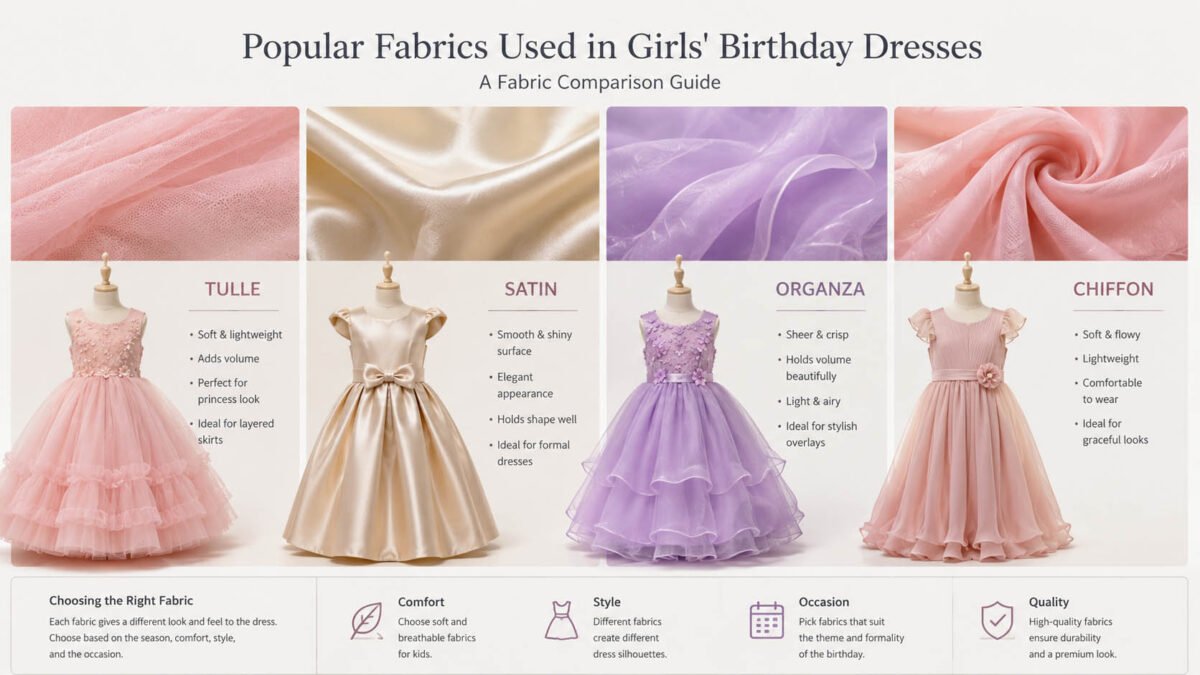
Tulle, satin, organza and chiffon each solve a different wholesale problem. Tulle gives volume and photographs well but is bulky to freight and can scratch sensitive skin. Satin is the most economical per cubic metre, hangs smoothly and holds dye evenly, but creases and shows water marks. Organza gives structured shape at a low weight, and needs a lining to be wearable. Chiffon is the lightest and most breathable, best for warm climates and layered looks, but it needs more sewing skill and a lining. For a first wholesale order, most boutiques do best with a satin or chiffon base and tulle used as an overlay rather than the whole garment.
Compare the Fabrics on a Real Sample
Reading about fabric only takes you so far. Order a ready-stock sample box and handle tulle, satin, organza and chiffon side by side before you commit to a bulk order.
Girls’ party dress fabric — choosing between tulle, satin, organza and chiffon is the single most important decision when buying girls’ party dresses wholesale. The right fabric moves fast and ships economically; the wrong one returns, sits on the rack, or eats your margin in freight. This guide gives wholesale buyers a side-by-side comparison of the four most common girls’ party dress fabrics, with guidance on age, occasion, sampling and bulk consistency.
There is no single “best” fabric for girls’ party dresses — there is only the right fabric for the right silhouette, occasion and price point. Before you approve a wholesale sample, it pays to understand how tulle, satin, organza and chiffon each behave on a child, in photographs and in the wash. This guide walks wholesale buyers through the four fabrics side by side, so you can brief your supplier confidently and avoid the classic mistake of ordering a pretty dress that sells badly.
Every season, boutique owners tell us the same story: a dress that looked perfect in the supplier photo came back with returns, or worse, sat on the rack. In most cases the problem was not the cut — it was a fabric that did not match the customer’s expectation for that occasion. Fabric is the first thing a shopper sees online and the first thing she touches in store, which makes it the single most important purchasing decision in your assortment plan.
1. Why Fabric Choice Decides Your Sell-Through Rate
Wholesale buying is a chain of small decisions, and fabric sits at the top. When you change the fabric of a dress, you change its drape, its volume, its comfort, its care instructions and its landed cost. The right fabric sells itself; the wrong one produces a slow mover even when the design is popular.
Think about the three moments that decide whether a dress sells:
- The scroll: in a thumbnail, fabric creates the “wow” — the sparkle of sequins, the softness of tulle, the sheen of satin.
- The fitting: a child must be comfortable for hours. Stiff or scratchy fabrics produce returns, especially for ages 3–8 where comfort complaints are the number one reason for exchanges.
- The wash: parents rarely read care labels. Fabrics that wrinkle, shrink or lose shape after one wash destroy repeat purchases and generate negative reviews.
For a wholesaler, fabric also drives your storage and freight costs. Tulle dresses are bulky; satin and chiffon pack flat. A tulle tutu dress can take up three times the box space of a satin A-line, which matters when you are pricing sea freight per cubic meter.
2. The Four Fabrics, Defined for Buyers
Before comparing, it helps to agree on what each fabric actually is. Suppliers in China use these terms consistently, so knowing the definitions prevents miscommunication when you negotiate.
What Is Tulle?
Tulle is a fine, open-net mesh fabric, usually made of nylon or polyester. It has no stretch and a dry, crisp hand feel. Its defining job in girls’ fashion is building volume: a tutu skirt is simply layers of tulle gathered at the waist. Tulle ranges from soft baby tulle (used against the skin) to hard bridal tulle (used for structure). It is the fabric most associated with princess and flower girl dresses.
What Is Satin?
Satin is not a fibre but a weave — a lustrous, smooth-faced weave that can be made from polyester, silk or blends. In children’s wholesale, “satin” almost always means polyester satin: shiny on one side, matte on the other, with a heavy, slippery drape. Satin photographs beautifully because it reflects light evenly, which is why it is a staple in birthday and pageant dresses.
What Is Organza?
Organza is a thin, stiff, transparent woven fabric with a crisp finish. It holds its shape better than tulle does, which makes it ideal for sculptural details — structured bows, standing collars, crisp ruffles and overlay skirts that keep a defined silhouette. It is slightly translucent, so organza dresses usually need a lining for everyday wear.
What Is Chiffon?
Chiffon is a lightweight, sheer, plain-weave fabric with a soft, flowing drape and a slightly crinkled texture. Unlike tulle and organza, chiffon does not create volume — it floats. It is the go-to fabric for summer dresses, beach weddings and soft, romantic A-line silhouettes. Because it is thin, chiffon garments are usually layered or lined.
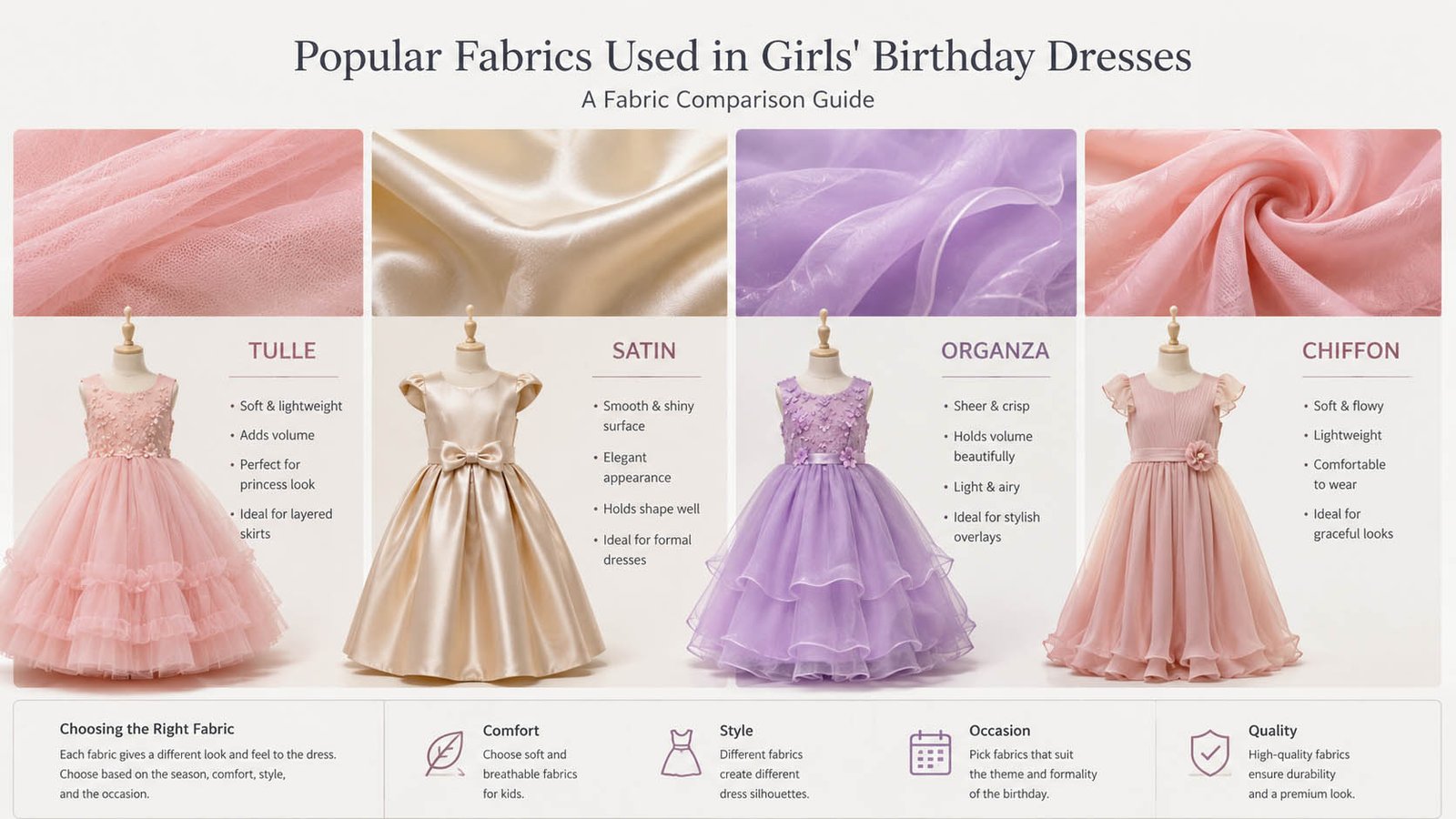
The four fabrics at a glance: tulle builds volume, satin adds sheen, organza holds shape, chiffon floats.
3. Head-to-Head: How the Four Fabrics Compare
The quickest way to brief a supplier is to compare the fabrics across the dimensions that matter to a retail buyer: volume, drape, comfort, care and cost. The table below summarises the differences.
| Attribute | Tulle | Satin | Organza | Chiffon |
|---|---|---|---|---|
| Main role | Volume (tutu, layered skirts) | Sheen and smoothness | Crisp structure and shape-holding | Soft, airy flow |
| Hand feel | Dry, netted; soft to hard grades | Smooth, slippery, cool | Stiff, paper-like | Light, floaty, slightly textured |
| Drape | Stiff; holds air between layers | Heavy, falls straight | Crisp; holds defined folds | Soft; follows the body’s movement |
| Volume | High — the volume comes from layers | Low — flat silhouette | Medium — structural volume | Low — gentle movement |
| Transparency | Transparent netting | Opaque | Translucent | Sheer, translucent |
| Comfort on kids | Soft tulle is fine; hard tulle can scratch | Comfortable but can feel warm | Stiff edges can irritate | Very comfortable, breathable |
| Care | Easy to wash; dries fast; may snag | Wrinkles; needs gentle cycle | Crushable; store with care | Delicate; hand wash recommended |
| Bulk packing | Bulky (volume = cubic cost) | Packs flat | Packs flat if not crushed | Packs very flat |
| Typical use | Princess, flower girl, tutu, party | Birthday, pageant, formal | Overlays, bows, structured details | Summer, garden wedding, soft A-line |
Which Fabric Is Stiffer?
Organza is the stiffest of the four, followed by hard tulle. If your design needs a bow that stands up, a collar that holds its shape or a ruffle with a clean edge, organza is the natural choice. Soft tulle, by contrast, collapses into a gentle cloud — lovely for princess volume, useless for structured details.
Which Fabric Has More Volume?
Tulle wins on volume, but only because of layering. A single layer of tulle is nearly transparent; it takes four to eight layers to build a proper tutu. That layering is exactly what makes tulle dresses bulky to ship and expensive per cubic meter. If you are cost-sensitive on freight, a satin A-line or a chiffon overlay gives a lighter, flatter package.
Which Fabric Is More Comfortable?
For children, chiffon is the most comfortable because it is light and breathable. Soft tulle is a close second when it is lined. Satin feels smooth but traps heat, which matters for summer wear. Hard tulle and organza can scratch sensitive skin, especially around the neckline and armholes — always specify a soft lining when these fabrics touch the skin directly.
Which Fabric Is More Durable?
Satin and polyester tulle are the most durable in everyday use. Chiffon and organza are delicate: chiffon snags easily, and organza crushes and creases. If your customer base is active toddlers (ages 1–4), favour lined tulle or satin; for older girls (ages 8–14) who are more careful, chiffon and organza are safe.
4. Matching Fabric to Occasion
Occasion is the strongest buying signal in children’s formalwear. When a shopper searches “flower girl dress”, she already has a wedding in mind; when she searches “birthday party dress”, she expects a different silhouette and price point. Use this to structure your collection.
Birthday and Party Dresses
Tulle tutu dresses and satin A-lines dominate birthdays. Tulle gives the princess moment parents photograph; satin gives the polished look for older girls. A strong birthday collection carries both: tulle for ages 1–6, satin for ages 7–14, with a mid-range organza option for structured party wear.
Flower Girl and Wedding Dresses
Wedding buyers are the most fabric-sensitive. Chiffon suits garden and beach weddings with soft movement; tulle suits classic church weddings where the dress must hold a full princess silhouette; satin suits formal evening weddings. Offering the same style in two fabrics lets bridal boutiques upsell — the satin version at a lower price point, the tulle version as the “fuller” premium option.
School and Family Events
For school events, graduations and family photos, parents prioritise comfort and washability. Lined tulle, satin or cotton-blend options outperform delicate chiffon here. Keep these styles simple so they pass school dress codes and survive the washing machine.
Holiday and Christmas Dresses
Holiday collections are ordered months in advance (typically May–August for Christmas). Velvet and tulle combinations sell strongly, as do satin party styles in rich colours. Chiffon is a poor holiday fabric — it reads “summer” to shoppers, so reserve it for warm-season catalogues.
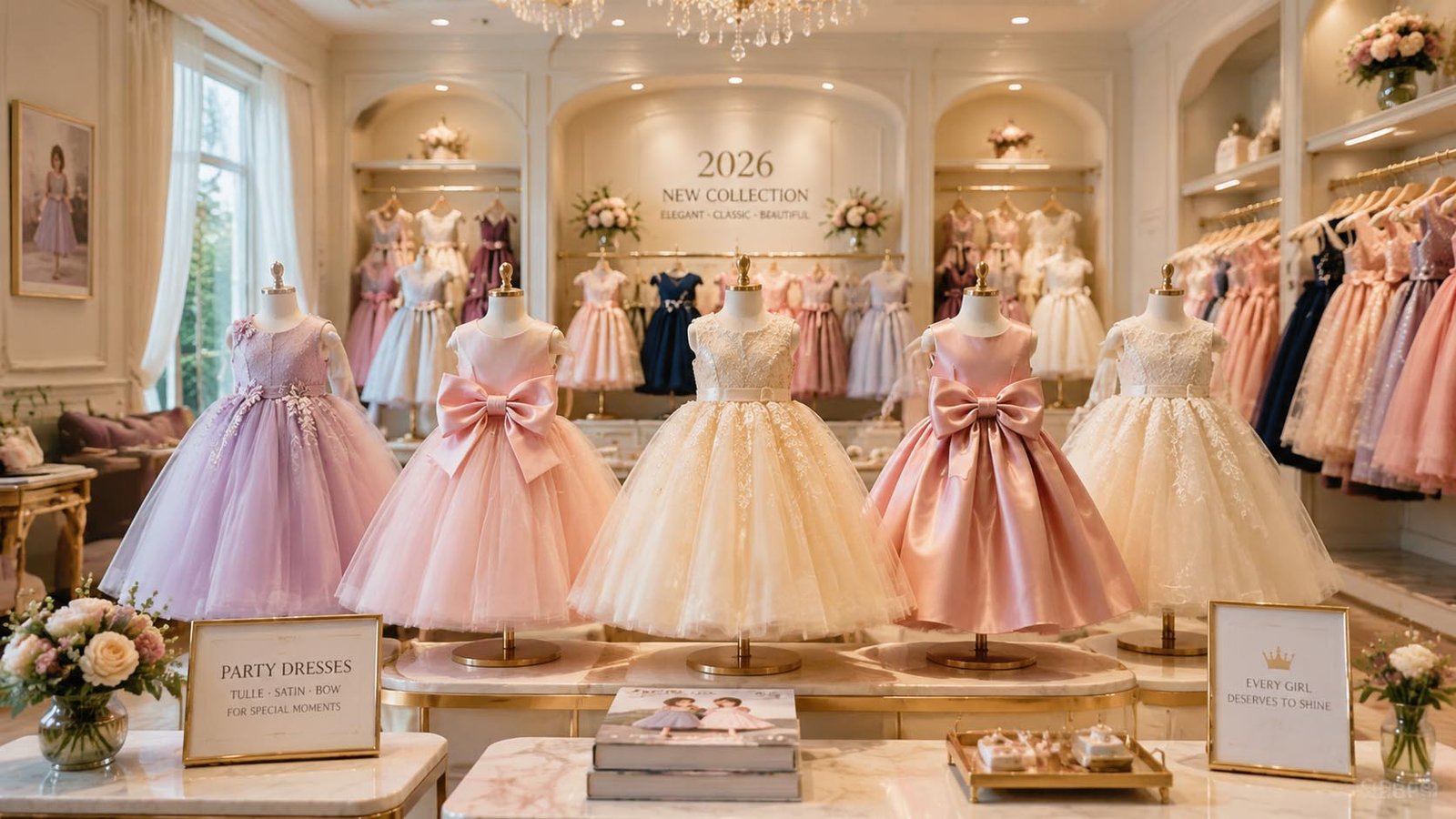
A balanced collection mixes fabrics: tulle for volume, satin for sheen, organza for structure, chiffon for flow.
5. Fabric by Age Group: What to Stock
Age drives both sizing and fabric behaviour. A dress that fits a 2-year-old perfectly may look shapeless on a 12-year-old, purely because the fabric’s drape reads differently at different heights.
Ages 1–4 (Toddler)
Toddlers need softness, easy dressing and machine washability. Choose lined soft tulle, jersey-lined satin or cotton blends. Avoid hard tulle, heavy organza and anything with scratchy trim. Toddler dresses also sell better with adjustable sizing details (elastic backs, adjustable straps) because growth spurts make exact fit impossible.
Ages 5–8 (Young Girls)
This is the sweet spot for tulle and organza — the princess years. Volume sells, and parents accept a little extra care for the “wow”. Keep necklines soft and linings breathable. Sequins are popular at this age but check they are firmly sewn, not glued, to survive wear.
Ages 9–14 (Pre-teen)
Older girls move away from tutu volume towards satin, chiffon and more sophisticated cuts. They care about “looking grown up” — so a satin A-line, a chiffon overlay or a sleek organza bodice performs better than another princess tutu. Sizing must be accurate at this age; returns spike when pre-teen sizing runs small.
Need the Same Fabric Across Several Styles?
If you are building an assortment rather than a single style, tell us the fabric and colourway you want and we will show you which current styles can be produced in it. One fabric across three silhouettes usually means a better price and a shorter lead time than three one-off fabrics.
6. Production, Sampling and Sourcing Considerations
Fabric decisions do not end at the design stage — they follow through sampling, bulk production and quality control. Knowing where each fabric causes trouble helps you write a better order and avoid disputes.
Sampling: Ask for Two Rounds
Always approve a physical sample, not just photos. Fabrics photograph differently — hard tulle can look like soft tulle, and satin sheen varies with lighting. Ask for one sample in the exact bulk fabric and a second in the lining, and confirm the colour against your target swatch before production.
Bulk Consistency
Tulle and organza are consistent across batches because they are machine-netted or woven in standard widths. Satin is where colour and finish can shift between dye lots, especially in bright or pastel shades. When ordering satin in bulk, confirm the supplier holds one dye lot for your full order, or accepts shade-matching before shipping.
Quality Checks That Matter by Fabric
- Tulle: check layers are evenly gathered, netting has no snags or pulls, and the skirt recovers its shape after compression (fold it, then shake it out).
- Satin: check for seam puckering (satin slips during sewing), shiny abrasion marks at stress points, and even colour across panels.
- Organza: check edges are cleanly finished (organza frays easily), creases relax after hanging, and any tucks or pleats are sharp and even.
- Chiffon: check seams are reinforced (chiffon pulls at seams), hems are rolled cleanly, and the fabric does not snag on trims or zippers.
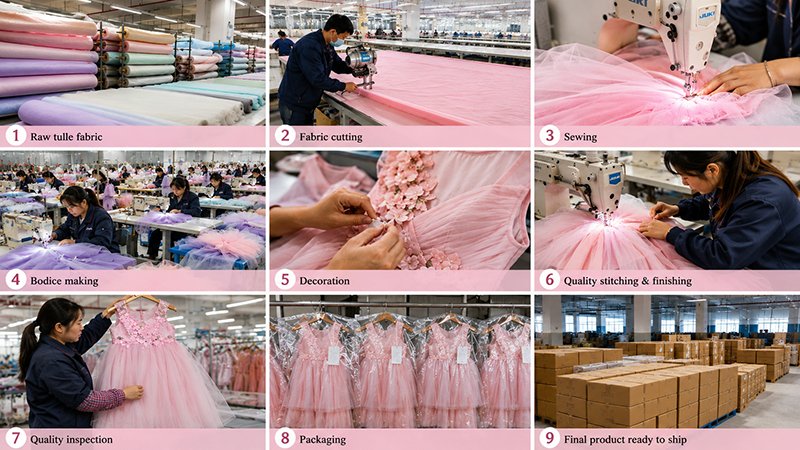
Bulk production consistency matters: tulle is stable across batches, while satin needs dye-lot control.
7. A Buyer’s Decision Framework
When you are standing in front of a new style and cannot decide which fabric to order, work through this short sequence:
- What is the occasion? Wedding = chiffon or tulle. Birthday = tulle or satin. School event = lined tulle or satin. Holiday = velvet-tulle or satin.
- What is the age range? Toddler = soft and washable. 5–8 = volume and wow. 9–14 = sophistication and accurate fit.
- What is the freight profile? Bulk tutus cost more per cubic meter; flat satin and chiffon pack economically. If freight dominates your margin, trim volume.
- What is the care story? Parents buy what they can wash. If the label says “dry clean only” on a child’s dress, expect hesitation.
- What is the price point? Tulle and polyester satin are the value leaders; layered organza and quality chiffon sit mid-range; velvet and embellished pieces carry premium pricing.
The strongest collections do not pick a single fabric — they carry a deliberate mix, so every shopper finds her silhouette. If in doubt, start with lined tulle and satin, the two best-selling fabrics in children’s partywear, then add organza and chiffon as your customers ask for them.
Buyer Checklist: Specifying Fabric Before You Order
- Confirm the fibre content in writing — polyester tulle and nylon tulle behave differently and are priced differently.
- Confirm GSM or denier, not just “tulle” or “satin”. Numbers are the only thing a factory can quote against.
- Ask how many layers the skirt uses, and whether the hem is finished with horsehair braid, rolled or left raw.
- Ask whether the fabric is in the factory’s stock library or has to be sourced — sourced fabric adds lead time and a minimum dye lot.
- Request two rounds of samples: a proto for shape, then a pre-production sample in the actual bulk fabric.
- Request a fabric swatch card from the bulk lot, signed off and kept on file for reorders.
- Confirm the care instructions you will print on the label, and check they match what the fabric can actually take.
- Ask about shade banding between dye lots if you plan to reorder the same colour across seasons.
- Calculate the packed carton size, not just the garment weight — tulle is charged by volume, not kilograms.
- Put the agreed fabric spec into the tech pack as a numbered line item, so the next order matches this one.
Common Mistakes (and What They Cost)
Ordering tulle for a market that buys on comfort
Tulle sells on looks and returns on comfort. In markets where children wear a dress for a full day — school events, family gatherings, religious ceremonies — scratchy tulle against bare arms produces exchanges. The cost is not the return shipping; it is the customer who does not come back.
Judging fabric from a supplier photo
A photograph cannot tell you hand feel, weight or how a fabric moves. Every experienced buyer keeps a reference swatch card. If a supplier will not send swatches before you order, that tells you something about how the bulk order will go.
Ignoring the freight maths
A tulle tutu dress can occupy three times the carton volume of a satin A-line. On sea freight priced by the cubic metre, that difference is often larger than the difference in unit price between the two fabrics.
Specifying the look but not the number
“Soft tulle” is not a specification. “Nylon tulle, 20 denier, four layers, satin binding at the waist” is. The first version guarantees you will not get the same garment twice.
Assuming the sample fabric is the bulk fabric
Sample rooms frequently use whatever is on hand. Insist that the pre-production sample is made in the bulk lot fabric, and keep a cutting from it.
FAQ
Which fabric is best for girls’ party dresses wholesale?
There is no single best fabric. Satin is the most commercially forgiving — it packs flat, holds colour, and works from toddler to pre-teen. Tulle is the best seller for photographic occasions such as birthdays and flower girl duties, provided comfort is managed with a lined bodice.
Is tulle comfortable for children?
Directly against the skin, cheap tulle is not comfortable for long wear. The standard fix is a satin or cotton lining in the bodice and a soft underskirt, with tulle used only as the outer layer. Always check the inside of the armhole and the waist seam.
Which fabric is cheapest?
Per metre, basic polyester tulle is usually the cheapest. Per finished garment, satin is often cheaper because it needs fewer metres and less finishing work. The only reliable comparison is a landed cost per unit including freight.
Which fabric photographs best for online selling?
Tulle and organza create volume and catch light, which is why they dominate thumbnail images. Satin reflects light in a way that can expose wrinkles and fit problems. For product photography on a plain background, a tulle overlay over a satin base is the most reliable combination.
Do these fabrics need special care labelling?
Tulle and organza are generally hand wash or gentle cycle and should not be tumble dried. Satin varies with fibre content. Chiffon usually needs a cool gentle wash and cool iron. Match the printed care label to what the fabric can actually survive, because parents follow the label and blame you when it fails.
Can the same style be produced in a different fabric?
Usually yes, but the pattern may need adjusting — a skirt drafted for stiff organza will collapse in chiffon. Ask the factory to confirm whether the pattern needs re-grading before you commit to a fabric change, and expect one extra sampling round.
How do I keep fabric consistent across reorders?
Keep a signed-off swatch from the bulk lot of the original order, specify the fibre, denier or GSM and the finish on the tech pack, and reference the original order number when you reorder. Without a physical reference, “same as last time” means whatever the mill has available.
Plan your next fabric order
Share your target styles and quantities — we confirm fabric, lining and sampling details before you commit.
We reply within 24 hours.
Leave a Reply