
A label is not artwork. It is the printed output of a set of product records, and it can be factually wrong while looking perfectly finished. This page is written as an operator’s worksheet: numbered steps a brand can work through from the moment a style is selected to the moment cartons are reconciled at receiving. It covers children’s clothing labeling requirements for U.S. children’s apparel — the fibre, origin, identity and care disclosures that sit on the textile side, and the tracking information that sits on the children’s-product side — and it keeps those two sets of duties apart at every step, because they are owned by different regulators, supported by different records and triggered by different facts. Worked examples are given as worksheet entries, not as claims about any particular garment.

How to run this worksheet
Work the steps in order, because each one feeds a field the next one depends on. Step 1 fixes who is named. Steps 2 to 5 build the textile disclosure set. Step 6 builds the tracking system. Steps 7 and 8 turn the collected data into controlled production and a physical approval. Nothing here is finished until a sealed sample has been checked, and nothing here survives a specification change without a review.
Keep one file per style, one controlled worksheet inside it, and one owner for each field. If a field has no evidence behind it, it is not ready — it is a guess with a print run attached.
Two rule sets, two owners — do not merge them
For most textile apparel, the FTC framework addresses fibre content, country of origin and the identity of the manufacturer or another responsible business. The FTC separately enforces the Care Labeling Rule, which requires manufacturers and importers of covered wearing apparel to attach regular care instructions and to have a reasonable basis for them. These are textile and garment-care duties.
Children’s products can also be subject to CPSC requirements. CPSC tracking-label guidance says permanent distinguishing marks on the product, and on the packaging to the extent practicable, must make specified information ascertainable: the manufacturer or private labeler, the production location and date, and detailed batch, run or other source-identifying information. That tracking system supports recalls.
A complete tracking mark does not satisfy a fibre, origin, identity or care disclosure, and a fully compliant care and content label does not create traceability. Treat them as two columns with two owners, and never write them into the brief as one rule.

Step 1 — Name the responsible business before artwork opens
A label names someone. Before any artwork is drawn, decide whose name, city, state and postal code — or whose registered identification number — will appear as the responsible business on the textile disclosure, and agree whether the retailer, the importer or the private-label brand carries that role. The answer changes the entire label set, so it must be fixed before a designer opens a file.
Write the responsible business and the style identity into the specification, then confirm that the factory, the label printer and the retailer all work from the same approved version. When a private-label customer becomes the responsible marketer, agree in writing which name appears on the label and who answers a consumer or agency query.
Step 2 — Build fibre content from the bill of materials
Fibre content is a disclosure about the garment, not a marketing description. The label has to use accepted generic fibre names and state percentages by weight, and those figures must come from the bill of materials for the whole garment: shell, lining, interlining, lace, trim and any decorative component that forms part of the textile product. A supplier’s trade name or invented fabric name cannot stand in for a generic name.
Build the composition from component weights rather than by copying a catalogue line. Where a percentage sits near a reporting threshold or a blend is hard to verify, request fibre analysis from a qualified laboratory and keep the report with the specification. Then confirm that the printed composition matches the fabric actually shipped, because a substituted lining or a changed lace moves the percentages even when the shell is unchanged.
Step 3 — Fix origin from the manufacturing record
Country of origin is a fact about where the product was made or processed, not a preference and not a marketing claim. For a children’s dress the assembly location usually drives the statement, but dyeing, printing, finishing and trim sourcing can all complicate the answer, and the correct wording depends on the operations actually performed in each place.
Decide the origin wording with the factory record in hand, and record which plant performed which step. Keep the origin evidence — production plans, subcontractor records and shipping documents — in the same file as the composition and care support, so the label can be explained later to a customer, a customs officer or a regulator.
Step 4 — Choose one identity string and keep it identical
The business identity on a label has to be recognisable and consistent everywhere it appears: on the permanent label, on a hangtag where one is used, on the packaging, on the product page and on the invoice. A company name with a city, state and postal code, or a registered identification number where one is held and current, are the usual routes.
Mixing a trade name, a website and a registered number across documents creates confusion exactly where clarity matters most. Fix one approved identity string and treat it as a controlled field rather than editable copy, then check the places it appears outside the garment, because an importer of record, a marketplace listing and a customs entry may each name a different entity.
Step 5 — Support the care instruction for the whole garment
Care instructions need a reasonable basis, which in practice means evidence about how the finished garment behaves rather than an assumption carried over from a similar style. The care method must cover the whole product, including lining, lace, trim, prints and appliqué, because a setting chosen for the shell alone can damage a component that was never tested.
Test the garment as assembled, on the actual fabric and trims, and record what the test showed and who reviewed it. Then write instructions a parent can follow: a clear method, temperature or cycle where relevant, and drying and ironing guidance the garment will actually survive. If more than one care option is offered, each option needs its own support. Review the basis whenever fabric, trim or construction changes, because a label that stays perfectly legible can still be quietly wrong.
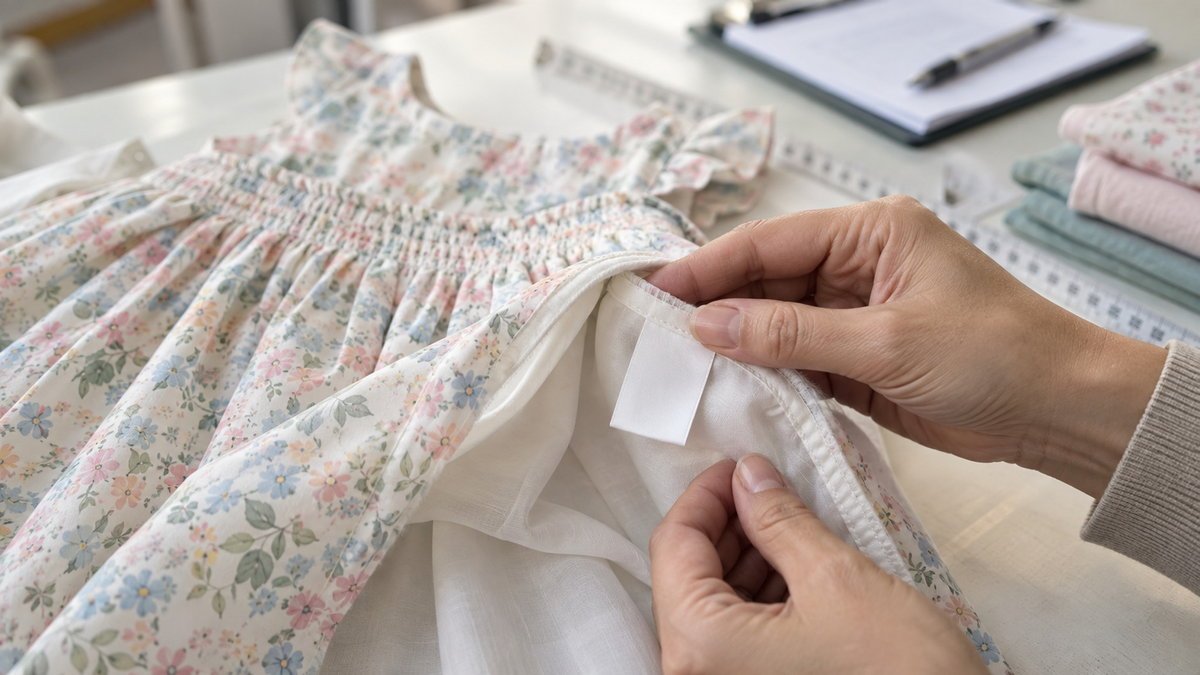
Step 6 — Build the tracking code and the record behind it
Children’s products carry a separate tracking duty, and this step belongs to the CPSC column, not to the disclosures above. Design the code so your own team can decode it: the format, what each segment means, and which record it resolves to. A string of characters that maps to nothing in your system does not create traceability.
Decide the format first, then decide where the code sits on the garment and on the packaging, keeping the mapping between code, purchase order, batch card and shipping record. If traceability, testing and certification questions beyond the mark itself are in scope for your product, take them to the site’s dedicated CPSIA compliance for wholesale kids wear material rather than stretching this worksheet to cover them.

Step 7 — Reconcile the label with the purchase order, test file and batch card
Composition comes from the bill of materials, origin from the manufacturing record, business identity from the responsible-business record, the care method from its support, and the tracking code from the production plan. If those records disagree with the printed label, the label is wrong in a way that no amount of proofreading the artwork will catch.
Point every worksheet field to its evidence, reconcile finished labels against the purchase order and batch record at receiving, and keep the approved artwork version so the version controlling production is never in doubt.
Step 8 — Approve the physical label, not the text
Approving label text is not the same as approving a label. The physical sample has to show that the information is legible at the size actually printed, that a consumer can find it without unwrapping or hunting, that the edges do not fray, and that the print survives the care method being recommended.
Review every label and package mark on a sealed, finished sample: the permanent fibre and origin label, the care label, the business identity, any size and content marking, and the tracking mark on the product and on the packaging. Test legibility after the recommended wash and dry, and require a fresh sample whenever the label material, the placement or the garment construction changes.
The label-data worksheet
Run one controlled worksheet per style, colour and size combination. Every row points to the record that proves it.
| Field | What goes in it | Evidence it must point to |
|---|---|---|
| Style, colour, size | The exact identity of the garment the label describes | Specification and size breakdown |
| Fibre composition | Accepted generic fibre names with percentages by weight, covering shell, lining and trim | Bill of materials, plus fibre analysis where a blend is uncertain |
| Origin | Origin statement wording | Manufacturing record showing which plant performed which operation |
| Business identity | Responsible business name with city, state and postal code, or a current registered number | Responsible-business record |
| Care method | The recommended method, with each option separately supported | Care test on the assembled garment, including trims and prints |
| Tracking data format | Code structure for manufacturer or private labeler, location, date and batch or run | Production plan and batch tracking conventions |
| Production details | Production location, production date or date range, batch or run reference | Factory production record |
| Label build | Dimensions, material, fold, seam allowance, language, placement | Approved artwork version and physical sample |
| Packaging mark | What appears on the packaging and where | Packaging drawing and receiving instructions |
Do not let the graphic file become the source of truth. A label is an output of product records: if the fabric changes, composition and care must be reviewed; if production moves, origin and tracking data must be reviewed; if a private-label customer becomes the responsible marketer, business identity and record ownership must be agreed before bulk labels are ordered.
Checklists to print and tick off
Before artwork is released
- The responsible business is named and the market and channel are confirmed.
- The worksheet version is frozen and every open field is listed.
- Composition, origin, identity, care method, tracking format and placement are all sourced.
- Sample label faults are recorded with an owner, a due date and an approval status.
Before bulk labels are ordered
- Artwork version, label quantity, size breakdown and delivery window are confirmed.
- Composition, origin, care and tracking data are final and sourced, not provisional.
- Labels, packaging marks and inspection scope are approved in writing.
- The change-control route for composition, origin, identity or placement is agreed.
Before shipment
- Bulk labels and garments are matched against the approved artwork and the sealed sample.
- Text, percentages, origin wording, identity, care wording and tracking codes are checked item by item.
- Legibility, edge condition, placement and packaging marks are checked on finished goods.
- Receiving and record-reconciliation instructions have reached the warehouse team.
Change control: what forces a label-impact review
Change control matters after approval, because most label failures are introduced by a decision made somewhere else in the business. A substitute fabric can alter composition and care. A new factory can alter origin and tracking information. A rebranded programme can alter business identity. A new packaging format can hide information consumers must see. A dropped size can leave a printed run of labels that no longer matches the order.
Create a label approval record that shows the final text, typography, language, dimensions, material, fold, seam allowance, placement and artwork version for every label and package mark. Require a label-impact review whenever the specification, supplier, factory, material, market or responsible company changes, and record who signed the review off.
Receiving: how a label is proved
Receiving is where the label is proved or disproved. Match the shipment against the purchase order and the batch record, then compare the finished labels with the approved artwork and the physical sample: text, fibre percentages, origin wording, business identity, care method, tracking code, dimensions, material and placement. Check the packaging mark separately from the garment label, and where a code was assigned to a specific batch, confirm that cartons and garments carry the code belonging to that run rather than an earlier one.
At launch, confirm that the product page, material description, care information and origin statement match the permanent label that arrived, and give the customer-service team a short brief so that a question about fibre content, care or origin is answered from the record rather than from memory. Set the first review before the next label order is placed, using label-related defects, customer questions, returns attributed to care or fit, supplier response time, reprint cost and record completeness together. A clean receipt supports repeating the same label set; a pattern of questions or corrections supports a worksheet revision before the next run. The wider quality habits that make this reconciliation routine are set out under kids dress quality and compliance.
Who owns the data on each sourcing route
The sourcing route changes who owns the label data. With ready stock you receive a garment that already carries a label, so the first job is to read it honestly: confirm fibre content, origin, business identity, care instructions and the tracking mark against the seller’s documents, and decide whether that label set is acceptable for your market and channel before you publish the offer. If it is not acceptable, the style is not ready stock for you, whatever the unit price.
ODM or a controlled adaptation lets you keep a proven garment and change the label set — a different responsible business, a revised care instruction, a new packaging mark — provided the composition and origin evidence supports the change. That route is usually the fastest way to put your own name on a working style, and the arrangements behind it belong with the site’s private-label kids dresses programmes. Custom OEM gives full control over composition, origin, identity, care and tracking data, and it requires the complete worksheet, an approved artwork version and a production commitment; the development route for that is described under custom girls dresses OEM and ODM. A common middle path is to test demand with ready stock, then build a custom label set only for the styles you keep.
Where this worksheet stops
This page does not determine every rule that applies to a particular garment, fabric, trim, state, claim or sales channel. Flammability, lead, phthalates, small parts, certification, state warnings and other requirements can apply depending on the product. This worksheet is not legal advice; verify your position with a qualified adviser or compliance professional before production, and work from current agency guidance rather than from a summary.
The official guidance this worksheet works from is published by the FTC on apparel and labelling, the FTC on complying with the Care Labeling Rule, and the CPSC on tracking labels. Requirements depend on the product, the construction, the claims made, the destination, the operator’s role and current law, so confirm the current text yourself rather than working from a summary.
Four questions operators keep asking
Is one label enough for both columns? No. A textile disclosure set and a tracking mark answer different questions and are supported by different records. Design them together for practicality, but write them into the brief as separate duties with separate owners.
Can supplier photographs replace a sample? No. Photographs cannot show whether a label is legible at its printed size, how it sits at the seam, whether the print survives the recommended wash, or whether the composition, origin and tracking data on the label agree with the supplier’s records.
When is the composition finished? Only when the fabric, lining and trims shipped are the ones the percentages were built from. A change in any component reopens the field, which is why the bill of materials and the care basis are reviewed on the same date.
What should be recorded after launch? Label-related customer questions, returns attributed to care or fit, defects found at receiving, reprint cost, supplier response time, and whether the tracking code on the received goods resolves to the correct purchase order and batch.
Send the specification and the label data
Send the dress specification, the destination, the label artwork and your private-label requirements for a manufacturing feasibility review. We can quote a label-ready programme or work with you on a development route, provided legal and compliance approval for the final label set comes from you and your adviser.
Leave a Reply