
The invoice price you pay a factory is only the beginning. By the time a carton of wholesale girls’ dresses reaches your warehouse, freight, duties, insurance, customs brokerage and a dozen smaller fees have been layered on top. Your landed cost — the total of everything it takes to get one dress onto your shelf — is the number your pricing, and your profit, should be built on.
Browse Ready Stock With Clear Pricing
Unit pricing, size ranges and pack-out details are listed per style, so you can model your margin before you ask for a quote.
Most first-time importers underprice because they compare suppliers on the factory quote alone. A dress that costs $6.00 FOB might land at $9.50 per unit by the time it clears customs, while a “more expensive” $7.00 supplier with a better shipping and duty profile could land at $9.10. The cheaper invoice was never the cheaper dress. This guide shows you how to calculate landed cost properly, so you can compare suppliers, set retail prices and protect your margin on every order.
If you are still deciding how your goods will travel, read our comparison of air freight vs. sea freight for kids dress imports, and see how the choice of FOB, CIF and DDP Incoterms changes who pays for each leg of the journey.
1. What “Landed Cost” Actually Means
Landed cost is the total cost of a product delivered to your door, including the purchase price and every expense required to bring it from the factory floor to your warehouse or store. It is the number you must know before you can set a sustainable wholesale pricing strategy.
Concretely, landed cost is made up of five buckets:
- Product cost — the negotiated unit price, usually quoted as FOB (factory price, goods loaded at the port of export).
- Freight — international shipping, either air or sea, including surcharges and fuel.
- Insurance — cargo insurance covering loss or damage in transit (often a small percentage of the shipment value).
- Duties and taxes — import tariffs and value-added or sales taxes charged by the destination country.
- Logistics and handling — customs brokerage, port and terminal fees, trucking to your warehouse, and any inspection or warehousing charges.
Leave any one of these out and your cost estimate is quietly wrong, usually in the direction that flatters your margin until the real bill arrives.
2. The Five Cost Buckets, in Detail
Each bucket behaves differently, so it helps to understand where the money actually goes. The table below summarises what each line covers and what typically drives it up or down.
| Cost bucket | What it covers | Typical range | What makes it move |
|---|---|---|---|
| Product (FOB) | Unit price, packing, factory loading | 60–75% of landed | Fabric, embellishment, MOQ |
| Freight | Sea/air carriage + surcharges | 5–20% of landed | Mode, volume, route, season |
| Insurance | Cargo coverage in transit | 0.3–1% of value | Value, route risk |
| Duties & taxes | Import tariff, VAT/sales tax | 0–25%+ | HS code, origin, destination |
| Logistics & handling | Brokerage, port, trucking | 3–8% of landed | Port, distance, service level |
Get a Landed Cost Quote
Tell us your destination, quantity and service preference and we will price the whole route — goods, freight and handling — in one figure.
Notice that freight and logistics are heavily influenced by how much you order and how you ship, not by the factory. That is why two suppliers quoting the same FOB price can still deliver very different landed costs — and why the cheapest quote is not automatically the cheapest product.
3. A Worked Example: 500 Flower Girl Dresses
Numbers are clearer than theory. Here is a realistic calculation for a 500-piece order of tulle flower girl dresses, shipped by sea to the United States.

Fabric, skirt volume and decoration all move the product cost — the base your landed cost is built on.
| Line item | Amount (USD) | Per unit (500 pcs) |
|---|---|---|
| Product cost (FOB, $6.80/pc) | $3,400 | $6.80 |
| Sea freight (LCL, shared container) | $450 | $0.90 |
| Insurance (0.5%) | $17 | $0.03 |
| Import duty (say 10.9%) | $371 | $0.74 |
| Brokerage + port + trucking | $380 | $0.76 |
| Total landed | $4,618 | $9.24 |
In this example a $6.80 dress lands at $9.24 — a 36% uplift over the invoice price. If you had budgeted your retail margin on $6.80, you would be quietly losing money on every sale. Run this calculation before you commit to any supplier, and re-run it whenever the freight quote or the exchange rate moves.
4. Air vs. Sea and the Real Trade-Off
The single biggest lever on landed cost is your freight mode. Air freight is dramatically more expensive per kilogram, but it is faster and often cheaper in total for small, urgent or high-value orders, because it cuts weeks of inventory holding and lets you respond to demand instead of guessing. Sea freight wins on cost per unit for large, planned orders.
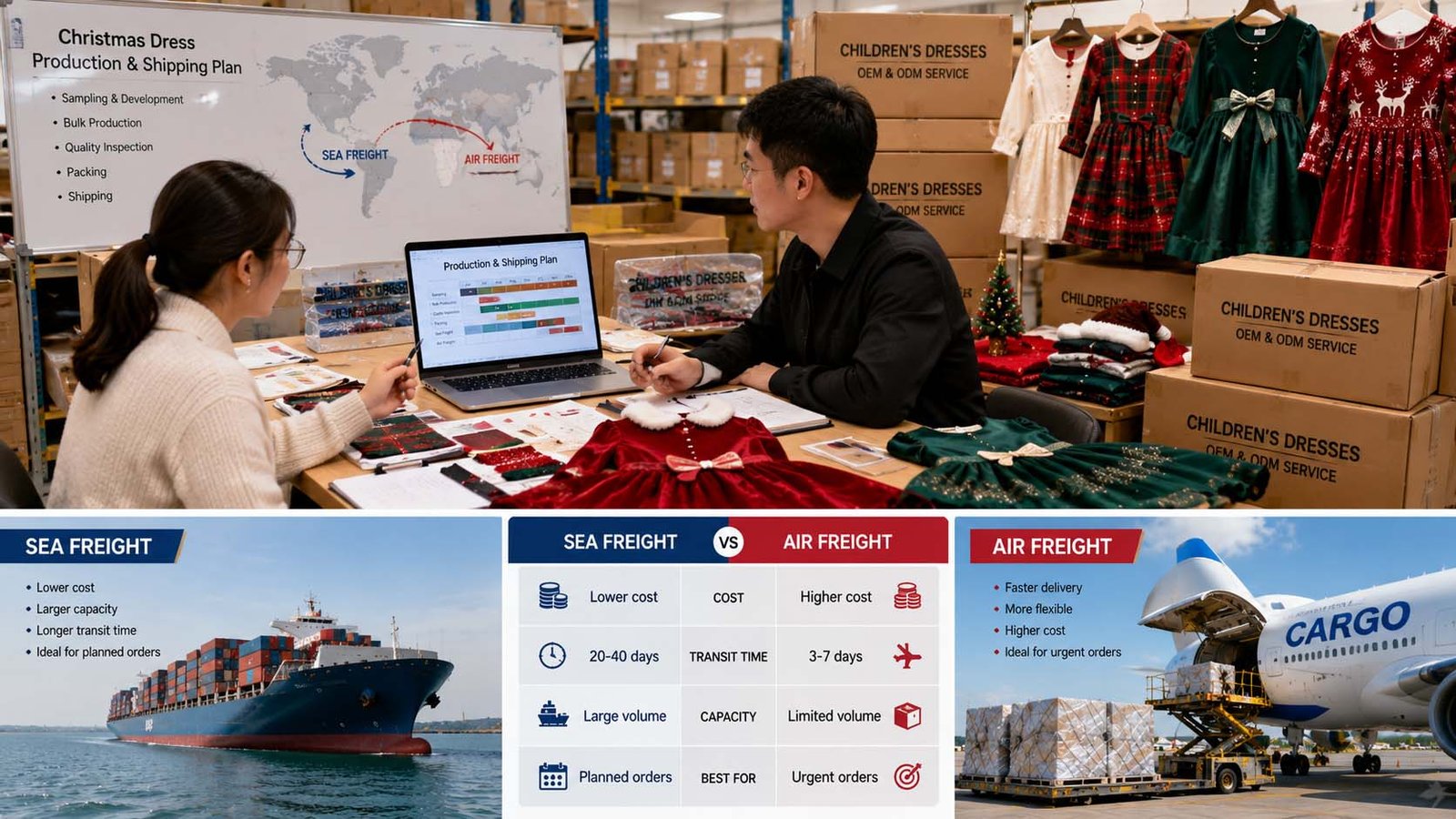
Freight mode is the biggest single lever on landed cost — choose it deliberately, not by default.
The table below captures the essential comparison for a typical seasonal kids dress order.
| Factor | Air freight | Sea freight |
|---|---|---|
| Transit time | 3–10 days | 3–6 weeks |
| Cost per kg | High | Low |
| Best for | Small, urgent, high-value orders | Large, planned, low-margin orders |
| Inventory impact | Less capital tied up | More capital tied up longer |
| Carbon footprint | Higher | Lower |
For a deeper look, see our dedicated guide on choosing between air and sea freight. The key point for landed cost: a mode that looks cheap on the freight line can be expensive once you factor in the working capital and the risk of missing a selling season.
5. Where Hidden Costs Hide
Experienced importers watch for the costs that do not appear on the first quote. These are the ones that surprise first-time buyers:
- Customs brokerage and documentation fees — often quoted separately and easy to forget.
- Destination port and terminal handling charges (THC) — charged by the port, not the carrier.
- Currency conversion — paying a supplier in USD or CNY adds a spread; a moving exchange rate can shift your margin between quote and payment.
- Duty classification surprises — the wrong HS code can mean a higher tariff or, worse, a compliance problem.
- Storage and demurrage — if a container is not collected on time, the port starts charging by the day.
- Inspection and rework — if goods fail inspection, you pay for rework, re-shipment or both.
The antidote to hidden costs is a written quote that itemises every line, from factory gate to your warehouse. A supplier or forwarder who gives you one lump-sum number without breaking it down is asking you to absorb the risk.
6. A Reusable Landed Cost Formula
You do not need accounting software to get this right. The formula is simply the sum of the five buckets:
Landed cost = Product cost + Freight + Insurance + Duties & taxes + Logistics & handling
Divide the total by the number of units to get your per-unit landed cost, then build your retail price on that number using your target margin. This one habit — always pricing off landed cost, never off the invoice — is the difference between an importer who survives a freight spike and one who does not.
If you are importing for the first time, our complete guide to importing kids dresses from China walks through the full process, and our breakdown of FOB, CIF and DDP Incoterms explains who pays for each leg. Together with this article, they give you the full cost picture before you spend a dollar.
Frequently Asked Questions
What is the difference between FOB price and landed cost?
FOB (Free On Board) is only the product price with the goods loaded at the port of export. Landed cost adds freight, insurance, duties, taxes, brokerage and trucking — everything needed to get the goods to your warehouse. Landed cost is the number you should actually price from.
How much does landed cost usually add on top of the FOB price?
It varies widely by product, mode and destination, but a common range is 20–45% on top of FOB. In the worked example in this article, a $6.80 dress landed at $9.24, roughly a 36% uplift. Heavy or bulky goods shipped by air can add far more.
How do I find out the correct duty rate for kids dresses?
Determine the correct HS (harmonized system) code for the garment, then look up the tariff rate for your destination country. A customs broker or freight forwarder can confirm the classification — the wrong code can mean the wrong duty, or a compliance problem.
Is air freight ever cheaper than sea freight in total?
Yes, for small or urgent orders. Air freight costs more per kilogram, but it ties up less capital in inventory and lets you respond to demand instead of forecasting weeks ahead. For small high-value orders, the total cost can favour air.
What is the most common hidden cost first-time importers miss?
Destination charges — customs brokerage, port and terminal handling fees, and trucking to the warehouse — are the most commonly forgotten. Storage and demurrage also add up fast if a container is not collected on time.
How can I get an accurate landed cost before I order?
Ask your forwarder for an itemised door-to-door quote covering freight, insurance, duty estimate, brokerage, port fees and trucking, then add it to your FOB unit price in a simple spreadsheet. Update the freight and duty cells whenever they move. Ask us for an itemized ready-stock quote and we’ll break it down line by line.
Get a clear, itemised quote
Tell us the styles and quantities you are considering, and we’ll break down product cost, MOQ and shipping so you can calculate your landed cost before you commit.
Leave a Reply