
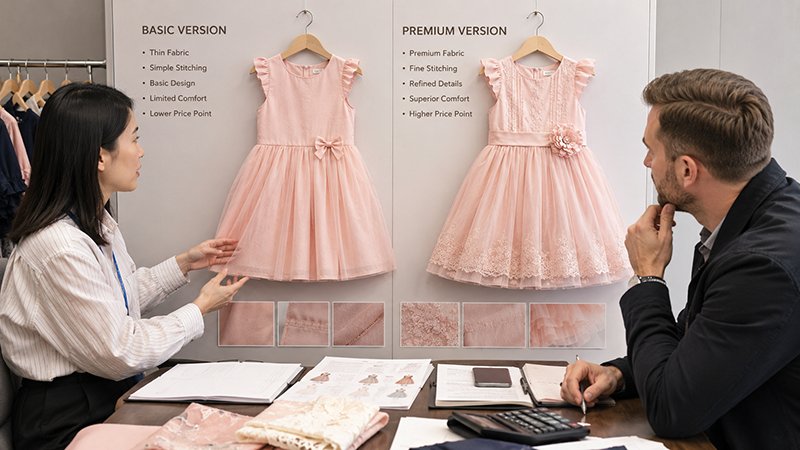
Most boutique buyers of wholesale girls’ dresses price by gut feel — double the factory price and hope. That hope is where profit leaks away. The fix is a simple, repeatable formula: landed cost × markup = your sell price, with a practical starting benchmark of roughly 2.5×–3× for wholesale and 3×–4× for retail — your actual number will depend on your channel, price band and order size. This guide walks you through that formula step by step, so you know your margin on every dress before you ever place an order.
Browse Ready Stock With Clear Pricing
Unit pricing, size ranges and pack-out details are listed per style, so you can model your margin before you ask for a quote.
Pricing is the single highest-leverage decision in a kids’ dress business. Order too high and dead stock eats your cash; price too low and you are working for free after freight, duties, returns and markdowns. Children’s formalwear has one unusual trait that makes pricing even more important than in adult apparel: sizes and seasons change fast, so a dress that does not sell in May is hard to clear in June. Every pricing mistake compounds.
This article gives you a concrete, data-driven pricing system. You will learn how to calculate your true landed cost, how to choose a markup that protects your margin, how fabric and embellishment change what you can charge, and how to build a pricing table you can reuse across your whole dress collection.
Why Kids’ Dresses Are Harder to Price Than Adult Apparel
Three traits make children’s formalwear unusually unforgiving on pricing, and understanding them is what separates a profitable collection from a busy one:
- Fast size turnover. A dress sold in size 5 does not become a size 7. When you buy a size run, the slow-moving sizes (usually the smallest and the largest) sit in your stock while the middle sizes sell out. Your pricing has to carry the sizes that move slowly.
- Compressed seasons. Flower girl and party dress demand peaks sharply around weddings and holidays, then collapses. A dress bought for a May wedding season is nearly impossible to clear in July without a deep markdown. Short selling windows demand a markup with real headroom.
- Expensive freight per dollar of value. Tulle and layered skirts are light but bulky, so freight is high relative to the garment’s price. A USD 8 dress can cost USD 1.20 to sea-freight and USD 9 to express-ship — freight is a far bigger slice of the total than it is on a pair of jeans.
All three point in the same direction: you need a higher markup on kids’ dresses than your gut tells you. The formula in the next sections is built around that reality.
1. Start With Landed Cost, Not Factory Price
The number on a supplier’s quote is not your cost. Your real cost is the landed cost — the total you pay to get one dress onto your shelf or into your warehouse. Ignore it and you will consistently under-price by 20–40%.
The Landed Cost Formula
Landed cost per dress = factory price + freight per unit + duties and taxes + inspection and misc. Here is what each line means in practice:
| Cost component | What it is | Illustrative range |
|---|---|---|
| Factory / FOB price | Price per dress ex-works (before shipping) | 55–70% |
| Freight per unit | Sea or air freight spread across the order | 8–20% |
| Duties & taxes | Import duty + VAT/sales tax on the goods value | 5–15% |
| Inspection & misc | QC, samples, courier, bank/transfer fees | 2–6% |
Get a Landed Cost Quote
Tell us your destination, quantity and service preference and we will price the whole route — goods, freight and handling — in one figure.
Landed cost is always higher than the factory price — an illustrative planning range is 25–50% higher, depending on destination, order quantity, shipping mode, HS code and duty rate.
Get the landed cost right for a few sample styles and you will immediately see which dresses are actually profitable and which are “busywork” — the pieces that look cheap on the quote but expensive by the time they reach your shop. If you do not have sample styles yet, pull a few real price points from our ready-stock collection and run them through the formula above.
2. A Practical Markup Benchmark
Markup is the multiplier you apply to landed cost. It is the oldest rule in boutique retail for a reason: it is the only multiplier that consistently leaves room for a healthy gross margin after every hidden cost.
Keystone and Beyond
Traditional keystone markup is 2× (a 50% gross margin). For children’s dresses, keystone is often too thin as a starting point. Formalwear carries higher returns, higher markdown risk and higher freight per dollar than everyday basics, so many buyers benchmark higher:
| Sales channel | Markup on landed cost | Gross margin | When to use it |
|---|---|---|---|
| Wholesale to boutiques | 2.5× – 3× | 60–67% | B2B volume orders, Faire, distributors |
| Direct retail (Shopify / Etsy) | 3× – 4× | 67–75% | Selling to end customers yourself |
| Clearance / end-of-season | 1.5× – 2× | 33–50% | Dead stock you must move |
Gross margin = (sell price − landed cost) ÷ sell price. A 3× markup on a USD 10.30 landed cost gives a USD 30.90 retail price and a 66.7% gross margin.
Wholesale vs Retail Are Two Different Games
Do not mix the two in one mental model. If you wholesale at 3× and the boutique also needs a 2.5×–3× margin of its own, the final consumer price becomes unsellable. Wholesale pricing must leave room for your customer’s margin, not just yours. That is why wholesale commonly sits near 2.5×–3× while direct-to-consumer sits near 3×–4× — again, a benchmark, not a fixed rule.
A Channel-by-Channel Pricing Matrix
Different channels tolerate different prices, because each carries a different cost and a different buyer expectation. Here is a practical matrix for one dress with a USD 10.30 landed cost:
| Channel | Markup | Sell price | Gross margin | Watch out for |
|---|---|---|---|---|
| Wholesale to boutiques | 2.5× | USD 25.75 | 60% | Buyer needs their own 2.5×–3× |
| Faire / wholesale marketplaces | 2.2×–2.5× | USD 22.70–25.75 | 55–60% | Platform commission 15% |
| Shopify direct | 3×–3.5× | USD 30.90–36.05 | 67–71% | Marketing spend + shipping |
| Etsy | 3×–3.5× | USD 30.90–36.05 | 67–71% | Etsy fees ~12% + ads |
| Amazon | 3.5×–4× | USD 36.05–41.20 | 71–75% | Referral + FBA fees can hit 30% |
One dress, one landed cost — five different sell prices, each matched to the channel’s true cost.
The takeaway: do not use one price everywhere. A price that is right on Shopify undercuts your wholesale buyers on Faire, and a Faire price on Amazon leaves no profit after FBA fees. Price per channel, or pick the one channel you serve best and stay there until you have the volume to diversify.
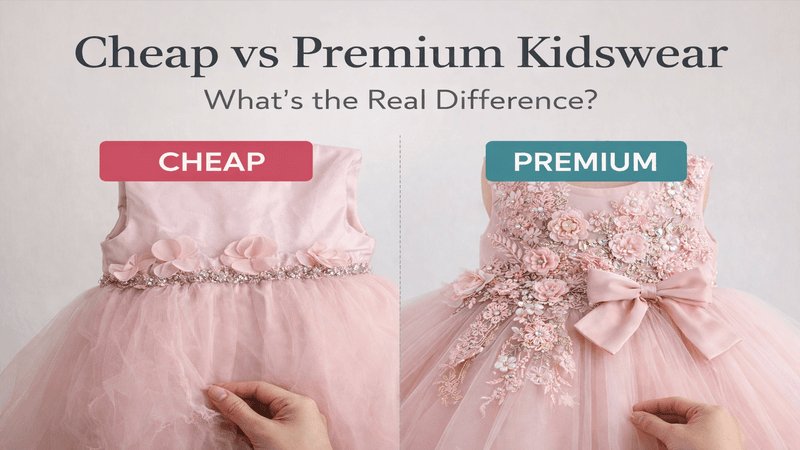
Cheap and premium dresses look different at every price tier — price to the tier your customer is shopping, not to your invoice.
3. How Fabric and Embellishment Set Your Price Ceiling
Two dresses with the same landed cost can command wildly different retail prices, because customers pay for perceived value, and fabric and decoration drive that perception more than anything else.
Fabric Cost vs Perceived Value
Polyester tulle is cheap but reads “princess” to a parent — high perceived value per dollar. Satin reads formal and premium but costs more to produce well. Organza reads structured and bridal. Knowing where each fabric sits lets you price to the customer’s eye, not just to your invoice.
| Fabric | Relative cost | Perceived value | Pricing implication |
|---|---|---|---|
| Polyester tulle | Low | High (volume, “princess”) | Best margin for the price |
| Satin | Mid | High (formal, sheen) | Premium tier justified |
| Organza | Mid-high | High (structured, bridal) | Charge for structure |
| Chiffon | Low-mid | Mid (soft, casual) | Volume play, lower price |
Tulle’s low cost-to-perceived-value ratio is why it dominates the flower girl category.
Embellishment Is Where Premium Lives
Sequins, embroidery, lace, pearls and hand-appliqué are the fastest way to justify a higher price, because they are visible the moment a customer picks the dress up. Each embellishment also adds real production cost, so price them deliberately:
- Machine embroidery — mid cost, high perceived value; good mid-tier premium.
- Sequins and beads — low-to-mid cost but high return risk if they shed; price to cover replacement.
- Hand-appliqué and beading — highest cost, highest premium; reserve for your hero SKUs.
- Lace trim — mid cost, classic bridal value; steady seller at a modest uplift.
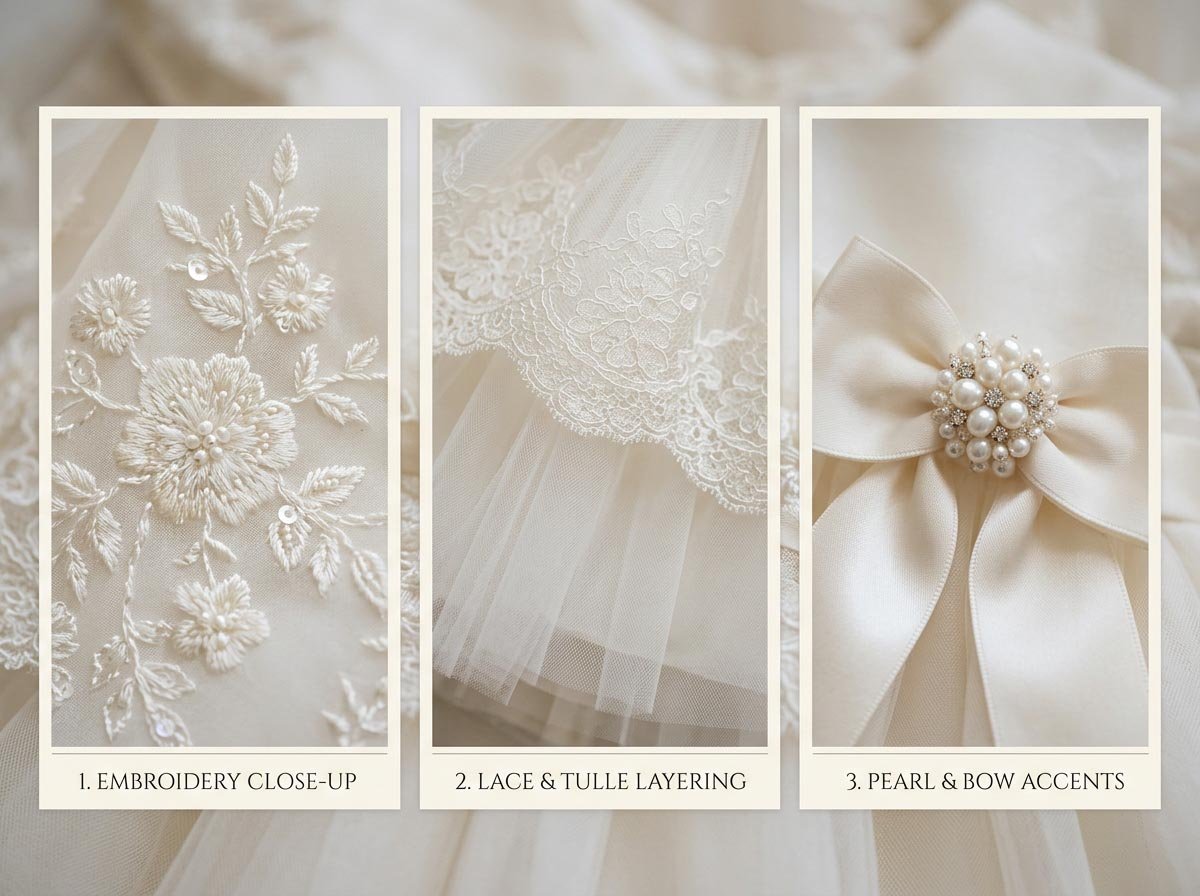
Embroidery and beadwork are the visible value cues that justify a higher price tag.
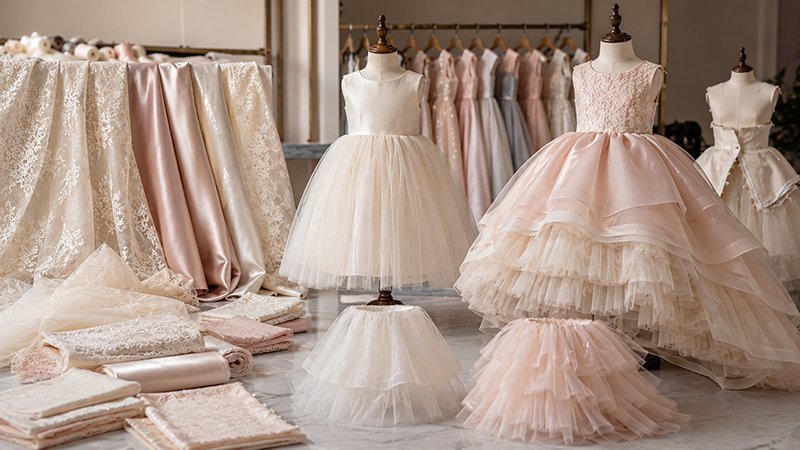
Fabric, volume and embellishment drive the retail price — and the margin.
4. The Hidden Costs That Kill Your Margin
New buyers price for the sale they want, then watch it evaporate in costs they never budgeted. These are the four that quietly destroy kids’ dress margins:
Returns and Exchanges
Children’s formalwear returns run higher than adult apparel because of fit — a “size 5” that measures differently between factories creates returns, and a solid quality-control program catches sizing drift before it reaches your customers. As a planning figure, budget a return allowance of roughly 5–10% of revenue and build it into your price, not your surprise.
Freight on Every Single Order
Tulle is light but bulky. A dress that costs USD 1.20 to sea-freight can cost USD 8–12 to express-ship to a single customer. If you offer free shipping, that expense must live inside your markup or you subsidize every order.
End-of-Season Markdowns
Every collection ends with markdowns. If 20% of your stock clears at 40% off, your blended margin drops well below the headline number. Price the full-price pieces to absorb the inevitable markdowns.
Payment and Platform Fees
Marketplaces take roughly 15–20%, payment processors another 3–4%, and currency conversion another 1–2% — these are illustrative ranges. Platform fees vary by market, seller plan, fulfillment method and advertising spend, so use current platform fee schedules when calculating your actual margin. On a 66% gross margin these costs are survivable; on a keystone 50% margin they can erase your profit entirely.
Freight: The Margin Killer Nobody Calculates
Freight is where most pricing models quietly break, because it shows up twice — once in your landed cost and again in the shipping you offer your customer. Work through a realistic number:
- Inbound sea freight on a mixed carton of 50 tulle dresses weighing roughly 15 kg might add USD 1.00–1.50 per dress. This is cheap and predictable, and it lives inside your landed cost.
- Outbound express to a single customer, by contrast, can cost USD 8–12 per dress because the package is bulky even when it is light. If you advertise free shipping, that USD 8–12 comes straight out of your margin on every order.
The difference between these two numbers is the difference between profit and loss. A USD 30.90 dress with free express shipping is really a USD 20 dress once freight, processing and packaging are subtracted. Either charge for shipping, or bake a realistic outbound freight figure into your retail price — never price as if shipping is free.
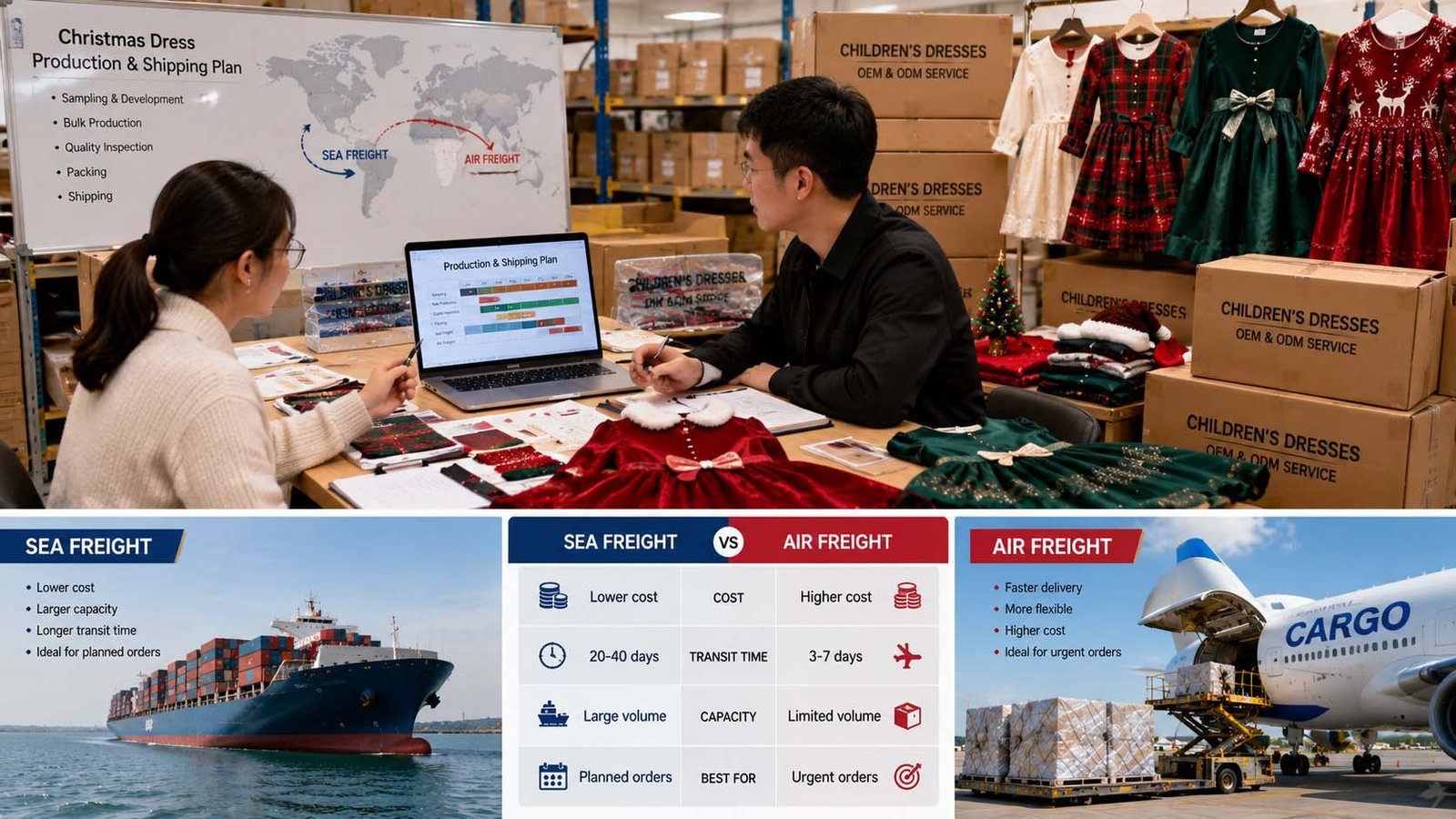
Sea freight keeps inbound cost low; outbound express is where your margin disappears if you do not plan for it.
5. A Reusable Pricing Table for Your Collection
Do not re-derive your pricing on every new style. Build one table and reuse it. The columns below turn the whole system into a five-minute exercise per dress:
| Line | Example (tulle dress) | How to fill it |
|---|---|---|
| 1. Factory price (FOB) | USD 8.00 | From supplier quote |
| 2. Freight per unit | USD 1.20 | Total freight ÷ units |
| 3. Duty & tax per unit | USD 0.70 | Duty rate × customs value |
| 4. Inspection / misc per unit | USD 0.40 | QC + samples + fees ÷ units |
| Landed cost | USD 10.30 | 1 + 2 + 3 + 4 |
| 5. Wholesale price (2.5×) | USD 25.75 | Landed × 2.5 |
| 6. Retail price (3×) | USD 30.90 | Landed × 3 |
Copy these columns into a spreadsheet and every new style becomes a fill-in-the-blank, not a guess.
For your ready-stock test orders, the minimum order quantity is low — from 6 pieces with mix-and-match styles and colours — which lets you test a pricing point with almost no cash tied up. For custom OEM/ODM, the minimum is from 200 pieces per style/colour, and a pattern/sample development fee of USD 80–150 applies when no sample exists. Price these two paths separately: ready stock carries a small test premium, custom carries a scale discount.
6. Competitive and Psychological Pricing
Markup gives you a floor; psychology and competition set the ceiling. Once your landed-cost math is done, use these three levers to land on a number that actually converts.
Anchor High, Then Walk Down
Customers judge a dress by the first price they see. If your tulle dress lands next to a USD 60 competitor at USD 25, it reads “cheap”, not “good value”. If you anchor at USD 39 with a strikethrough USD 55, the same dress reads “premium on sale”. Position your hero SKUs at the top of your price band and let mid-tier pieces sit just below them.
The Price Band, Not a Single Point
Your collection should not be a single price. A healthy kids’ dress range spans three tiers so customers self-select:
| Tier | Example price | Role in the collection |
|---|---|---|
| Entry / tester | USD 24–29 | Low-commitment first purchase, drives volume |
| Core / mid | USD 32–45 | Your margin engine, most SKUs live here |
| Premium / hero | USD 55–80+ | Embroidery, lace, occasion dresses; anchors the brand |
Three tiers turn a price list into a strategy: entry SKUs pull buyers in, core SKUs make the money, hero SKUs lift the perceived value of everything else.
Ending Digits and Rounding
For children’s formalwear, round numbers signal quality while .99 signals discount. A USD 39.00 flower girl dress reads “occasion”, a USD 38.99 dress reads “sale rack”. Save .99 for clearance; use round or .50 endings for your regular collection. It is a small detail that quietly shifts perceived value.
Watch the Competition, Not Just Your Cost
Your markup math tells you the lowest price you can survive on; the market tells you the highest price you can charge. Before you lock a price, search three competitors in your category and note their price band for a comparable fabric and embellishment. If you are 20% above the band with no visible difference, you will not convert; 20% below and you are leaving money on the table. Aim to sit inside the band, then differentiate on fabric, fit and photography rather than on being the cheapest.
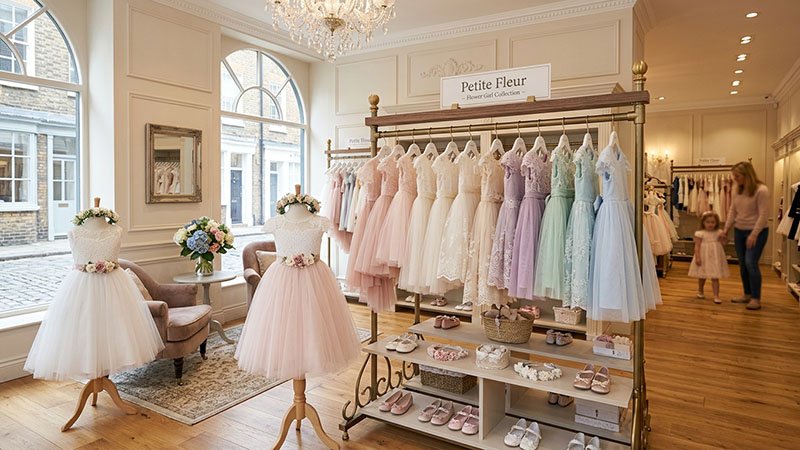
How a collection is presented in-store is the final layer of the pricing strategy — entry, core and hero pieces should sit together so customers self-select.
7. Pricing Your First Collection: A Decision Checklist
Pull the whole system together with a five-question checklist. Answer these before you confirm any order, and your pricing will survive contact with reality.
- Do I know my landed cost, not just the quote? If no, stop and fill the table above first.
- Is my wholesale markup near 2.5× and retail near 3×? If it sits far below that benchmark, check whether returns and freight are quietly subsidizing every order.
- Does fabric/embellishment justify the price to the customer’s eye? Charge for perceived value, not just invoice cost.
- Have I budgeted returns, markdowns and fees? If they are not in the price, they come out of your pocket.
- Does my price leave room for my buyer’s margin too? Wholesale only works if your customer can also make money.
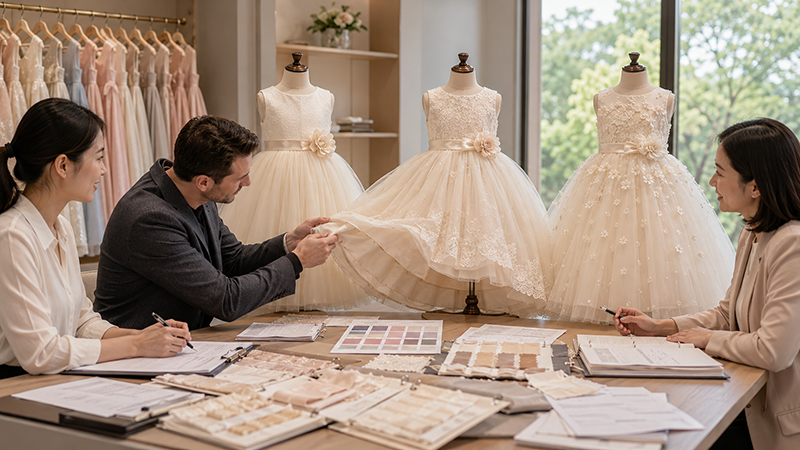
Sampling is the cheapest way to test pricing before committing to bulk — bring your three competitors’ hero dresses into the showroom and price to the comparison.
Frequently Asked Questions
What markup should I use for wholesale kids’ dresses?
A practical starting benchmark is a 2.5×–3× markup on landed cost for wholesale (a 60–67% gross margin) and 3×–4× for direct retail. These are benchmarks, not fixed rules — your number should reflect your channel, price band and order size. Keystone (2×) is often too thin for children’s formalwear because of returns, freight and markdowns.
What is the difference between factory price and landed cost?
Factory price (FOB) is the cost before shipping. Landed cost adds freight, duties, taxes and inspection fees — often 25–50% higher than the factory quote, though the exact figure depends on destination, order quantity, shipping mode and duty rate. Price from landed cost, never from the quote alone.
How much should I budget for returns on kids’ dresses?
Budget roughly 5–10% of revenue for returns and exchanges as a planning range. Children’s sizing varies between factories, so fit-related returns are higher than adult apparel. Build this allowance into your price.
Which fabric gives the best margin?
Polyester tulle generally offers the best margin because its production cost is low while its perceived value (“princess” volume) is high. Satin and organza justify a premium tier but cost more to produce.
What is the minimum order for testing a price point?
Ready-stock orders start from 6 pieces with mix-and-match styles and colours, so you can test a price with minimal cash. Custom OEM/ODM starts from 200 pieces per style/colour.
Should I use different prices on Shopify, Etsy and wholesale?
Yes. Each channel has different costs (Etsy fees, Amazon FBA, marketplace commissions) and different buyer expectations. Price per channel so you do not undercut your wholesale buyers or lose money to platform fees.
How do I price for free shipping without losing money?
Either charge for shipping separately, or bake the outbound express cost (often USD 8–12 per dress) into your retail price. Never price as if shipping is free — that cost comes straight out of your margin on every order.
What is a good gross margin target for kids’ dresses?
A useful planning target is a 60% gross margin or higher on wholesale (a 2.5×–3× markup) and 67%+ on direct retail (3×–4×). These are starting benchmarks; your actual margin depends on your channel and cost structure. If your realized margin lands well below that, returns, freight, markdowns and platform fees are usually what erase it.
Know your margin before you buy
Send us a target style and retail price point — we’ll confirm fabric, landed cost and MOQ so you can price every dress with confidence.
Leave a Reply