
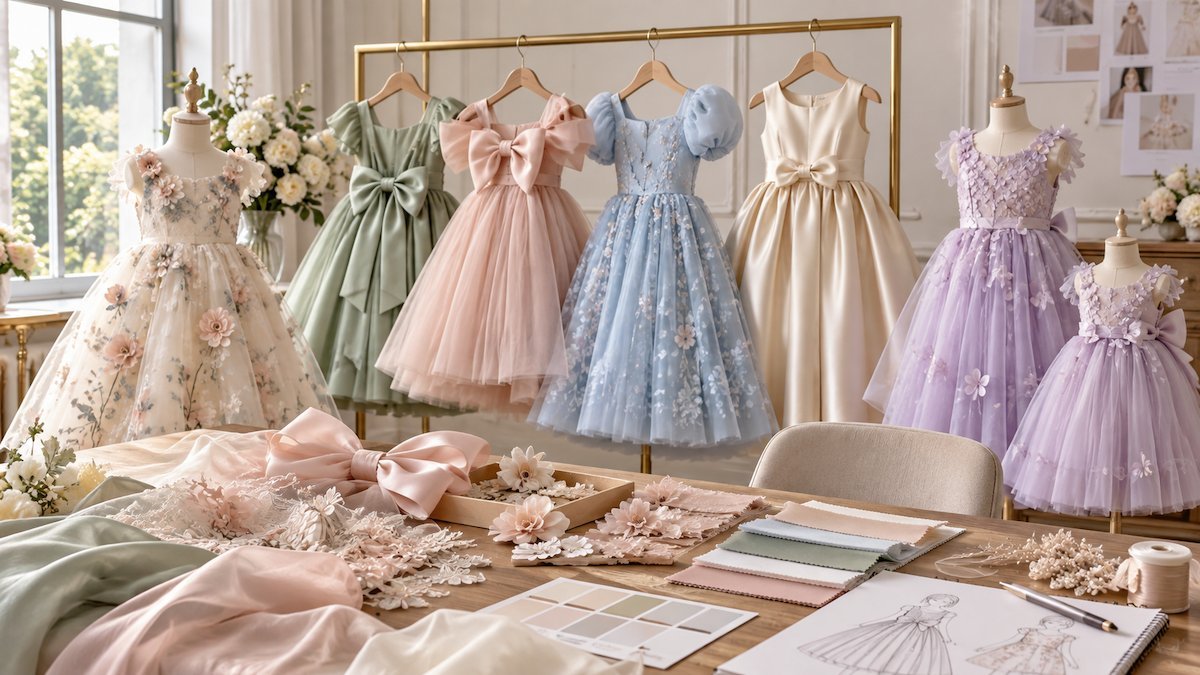
Girls dress trends for 2027 are not just about what looks new. For a wholesale buyer, a trend only matters if it can be sourced at the right cost, stocked in workable size runs, shipped without destroying the margin, and sold before the demand window closes. This guide translates the strongest 2027 design signals into practical decisions for boutiques, children’s fashion brands and importers — fabric choice, colour planning, size depth, quality-control risk, order timing, and when to test a style on ready stock before committing to custom production.
Quick Answer: What Girls Dress Trends Should Boutiques Watch in 2027?
For 2027, boutiques should watch eight girls dress directions: dimensional florals, statement bows, soft-volume skirts, refined satin silhouettes, softened colour stories, tactile surface texture, coordinated occasion dressing, and detachable or convertible details. Rather than treating every trend as a bulk-buy opportunity, buyers should separate proven commercial styles from emerging tests. Fabric behaviour, embellishment security, size depth, freight volume and seasonal timing can affect profitability just as much as the design itself.
See How These Directions Are Built in Production
The clearest way to judge a trend is to hold the garment. Our ready stock range shows how soft volume, satin and textured surfaces actually translate into producible girls dresses at low minimums — so you can test a direction before you commit to a bulk run.
What Is Changing in Girls Dresses for 2027?
Rather than listing what is new, it helps to start with what is actually shifting underneath the design details. The girls dress trends 2027 signals below are grouped by what they ask of a buyer — fabric, construction, colour and timing — rather than by how they look. Three changes matter commercially, and all three affect how a buyer should plan a 2027 assortment.
How We Built This 2027 Trend Guide
This guide is not a runway recap. It was assembled by weighing six inputs against each other, and a direction only reaches this page if it survives all six.
- Broader Spring 2027 fashion signals across womenswear and occasionwear
- Current girls occasionwear sales patterns in boutique and online retail
- Wholesale buyer enquiries and the questions that keep coming back
- Fabric, trim and embellishment feasibility at production scale
- Production and quality-control behaviour, including freight and transit risk
- How buyers actually test a new direction, mostly on ready stock before committing to a run
1. Romantic detail is becoming more dimensional
The floral story is moving away from flat print and toward relief: 3D floral appliqué, embroidered petals, textured lace, structured bows, layered tulle and surface embellishment that can be seen across a shop floor and read instantly in a photograph. Spring 2027 runway and trade coverage continues to show florals, romantic lightweight layers and expressive decoration; the useful interpretation for kids’ occasionwear is that detail you can feel is carrying more weight than detail that is printed on.
2. Occasion dresses need comfort as much as impact
A dress that photographs beautifully and cannot be worn for four hours is a return waiting to happen. Buyers are increasingly asking a second question alongside “is it beautiful?” — can a child sit, eat and move in it? That question points directly to construction: softer linings, lighter tulle, less scratchy trim, better armhole finishing and silhouettes that move with the child rather than holding a shape of their own.
3. Trend testing has to be lower-risk
Trend cycles are faster and colour stories fragment sooner, which makes large single-bet buys riskier than they used to be. The practical response is not to avoid trends, but to stage them: test a direction in a small quantity, watch how it sells in your own customer base, replenish what works, and only then scale into custom production. That sequence is the backbone of everything that follows in this guide.
1. Dimensional Florals Move Beyond Basic Floral Prints
What it looks like
Flowers built from fabric rather than printed onto it: 3D floral appliqué, embroidered flowers, organza petals, shoulder florals, waist corsages and scattered botanical details. Tone-on-tone placements read as the most premium — ivory petals on ivory mesh — while mixed petal sizes keep the surface from looking flat or repetitive.
Why boutiques should watch it
This is the direction that photographs best for flower girl, birthday, wedding and premium partywear, because relief catches light and the customer can see where the money went. It carries perceived value far above its cost, which is exactly the gap a boutique has to defend against mass retail.
Best wholesale applications
Flower girl and first communion first, then birthday and pageant. The most saleable structure is a small group rather than a full floral range: one hero style with a bold placement, one commercial style with a restrained cluster, and one entry-price style that keeps a floral feel at a lower trim cost.
Fabric and construction
Soft tulle, mesh or organza for the petals, over a satin bodice with a tulle skirt. The petal fabric matters more than the base: a firm organza holds a sculpted petal, while soft tulle petals flop and lose definition in transit. If you are comparing base cloths for the dress underneath, our wholesale girls dress fabrics guide covers how tulle, satin, organza and chiffon behave in bulk.
Buying strategy
Do not build an entire collection on 3D florals. Buy the hero style in a shallow size run, the commercial style across the full size curve, and hold the entry-price style as the volume piece. If one direction has to carry the season’s risk, it should be the one with the simplest construction.
QC risk
Attachment security is the whole risk. Establish at sampling whether each flower is sewn, glued, or both; specify a pull-strength test on the first production run; check for petal shedding in the bag and for sharp attachment points behind the petals; and confirm the flowers do not bleed colour onto the bodice when damp. Ask how the garment is packed, because blooms pressed flat under other pieces arrive crushed.
2. Statement Bows Become More Sculptural
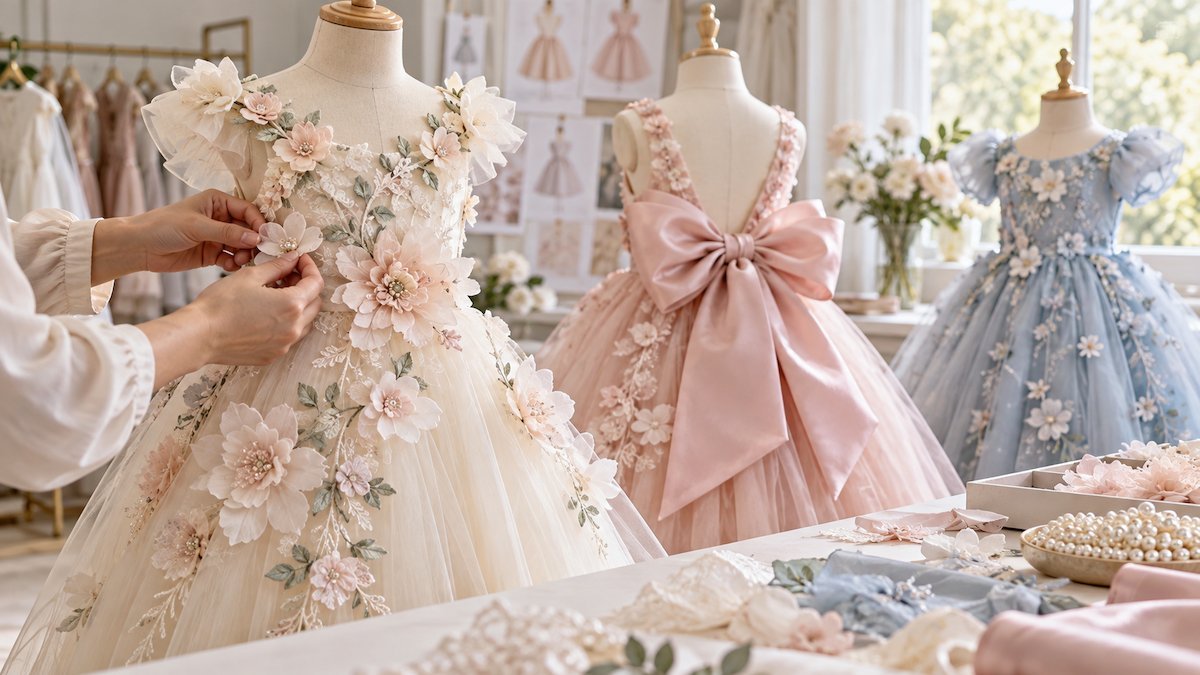
3D appliqué florals and sculpted bows — two directions a buyer can test inside the same order.
What it looks like
One bow doing the visual work of the dress, but built rather than tied: oversized back bows, structured waist bows, shoulder bows, organza bows and detachable bows. The 2027 version is more sculptural and more restrained than the soft trailing bow — fewer bows per garment, more shape in each one.
Why boutiques should watch it
A bow is the cheapest way to add perceived value in the whole dress: metre goods plus a short amount of labour. It is also a rear-view feature, which matters more than it used to, because the second photograph, the twirl shot and the short video all happen from behind.
Best wholesale applications
Party dresses, wedding and holiday formalwear. A large back bow over a clean A-line is the most reliable combination, because the bow is the only decoration and the silhouette underneath is simple to grade. Shoulder bows suit toddler sizes better than floor-length satin tails.
Fabric and construction
Organza holds the most structure and gives a crisp sculpted bow; satin gives a richer surface but needs interlining to keep its shape; soft tulle is the lightest and collapses fastest. The single factor that decides whether the bow survives the season is the interfacing, not the outer fabric.
Buying strategy
Buy bows where the silhouette underneath is already a proven seller, so the trend is an addition rather than a bet. If you are testing a larger bow for the first time, keep it in one or two styles and in the colours you already stock.
QC risk
Shape loss in transit is the main failure. Check left-right symmetry, centre placement on the back seam, stitch reinforcement at the bow knot and at the tail attachment, and recovery after compression — a bow that has been folded in a carton should return to shape after light steaming, and if it does not, the packing method or the interfacing has to change. For detachable bows, see section 8.
3. Soft Volume Replaces Overbuilt Princess Construction
What it looks like
The volume stays, the weight goes: soft multilayer tulle, lighter petticoat construction, less rigid netting, gentle A-line volume and full skirts that move rather than stand. Compared with a classic overbuilt princess dress, the difference is obvious in the hand — the soft version drapes and the rigid version holds a shape of its own.
Why boutiques should watch it
Comfort has become a purchase driver rather than a nice-to-have, and a mother who has watched a child refuse to wear a stiff gown buys differently the next time. The commercial upside is real too: fewer layers means less fabric, a lower unit cost at similar visual impact, and a smaller packed volume.
Best wholesale applications
Flower girl, first communion and travel weddings, where a dress has to survive being folded into a suitcase. Sizes two to ten are the strongest band, and soft tulle photographs particularly well in daylight because it moves with the child instead of holding a rigid line.
Fabric and construction
Ask for the layer count, the tulle specification and the lining composition as separate lines on the quotation, because layer count is the single biggest cost and volume lever and it is also the number most likely to be quoted vaguely. If you need a heavier hand-feel for structure, satin holds shape through transit more reliably than soft tulle — the comparison is set out in satin vs tulle for flower girl dresses.
Buying strategy
Here is the sentence that decides this trend commercially: the dress that performs best on social media is not always the dress that is most efficient to import. A skirt built for maximum volume on camera can consume disproportionate freight cube. Measure the packed volume per piece, not just the weight, and let that number — not the photograph — set the layer count you actually buy. Where weight and drape need to be specified precisely, fabric weight and GSM is the figure to compare.
QC risk
Post-transit shape is the risk to write into the inspection standard rather than assume. Agree what acceptable recovery means — that the skirt returns to fullness after being shaken out and lightly steamed, and that bodice creasing falls below a defined threshold. Pack with tissue between layers and avoid a hard fold across the bodice.
4. Refined Satin Dresses Grow Up With the Customer
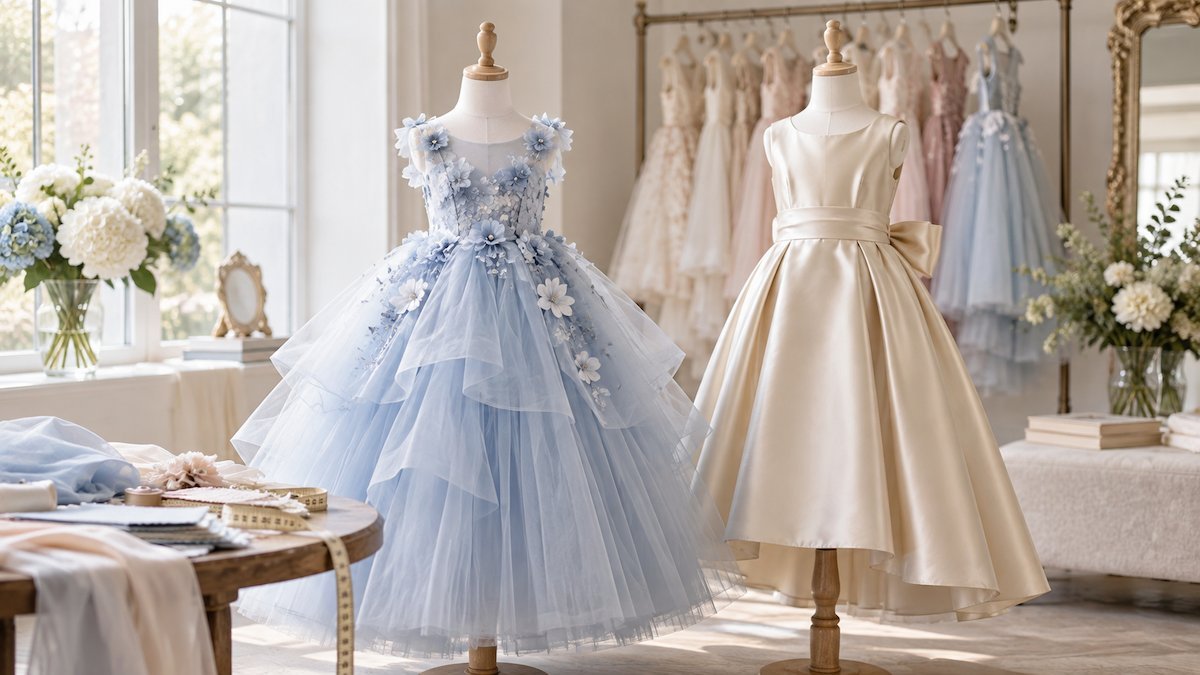
Soft tulle volume and refined satin sit at opposite ends of the same 2027 conversation.
What it looks like
Clean satin A-lines with a minimal bodice, subtle waist shaping, soft sheen rather than high shine, limited embellishment, and mid-calf or ankle-length occasion shapes. Interest comes from the fall of the fabric and the fit, not from trim.
Why boutiques should watch it
Not every older girl wants a princess dress, and this age band — roughly eight to fourteen — is the one most often under-served. Refined satin answers it directly, and it is also easier to produce, easier to reorder and cheaper to decorate than a heavily trimmed ball gown, while supporting a higher price point because the value sits in the fabric and the fit.
Best wholesale applications
First communion, junior bridesmaid, older flower girl and formal family occasions. It is the natural companion piece in a coordinated group, where younger girls wear tulle and older girls wear satin in the same shade.
Fabric and construction
Satin packs flatter than structured tulle, takes colour beautifully and reads as premium — three genuine advantages for an importer. Confirm the fabric weight and finish as specification lines, because two satins at the same price can behave completely differently after a long flight. Lining opacity and neckline depth deserve an explicit check when the customer base expects a modest finish.
Buying strategy
Because there is no embellishment to distract the eye, the fit has to be right, so tighten the measurement tolerance on bust, waist and shoulder seam rather than accepting the standard tolerance used on decorated styles. Buy the colour across the size curve before you buy depth in a single size.
QC risk
Creasing is the signature failure of this trend, followed by seam puckering and shade variation between dye lots. Ask for a crease-recovery check at pre-production sampling, inspect finished garments under neutral light for water marking and pin marks, and reserve the season’s fabric from one dye lot. Where a shade has to be exact, work to a physical reference rather than a screen.
5. Softer Colour Stories Replace Single-Color Trend Chasing
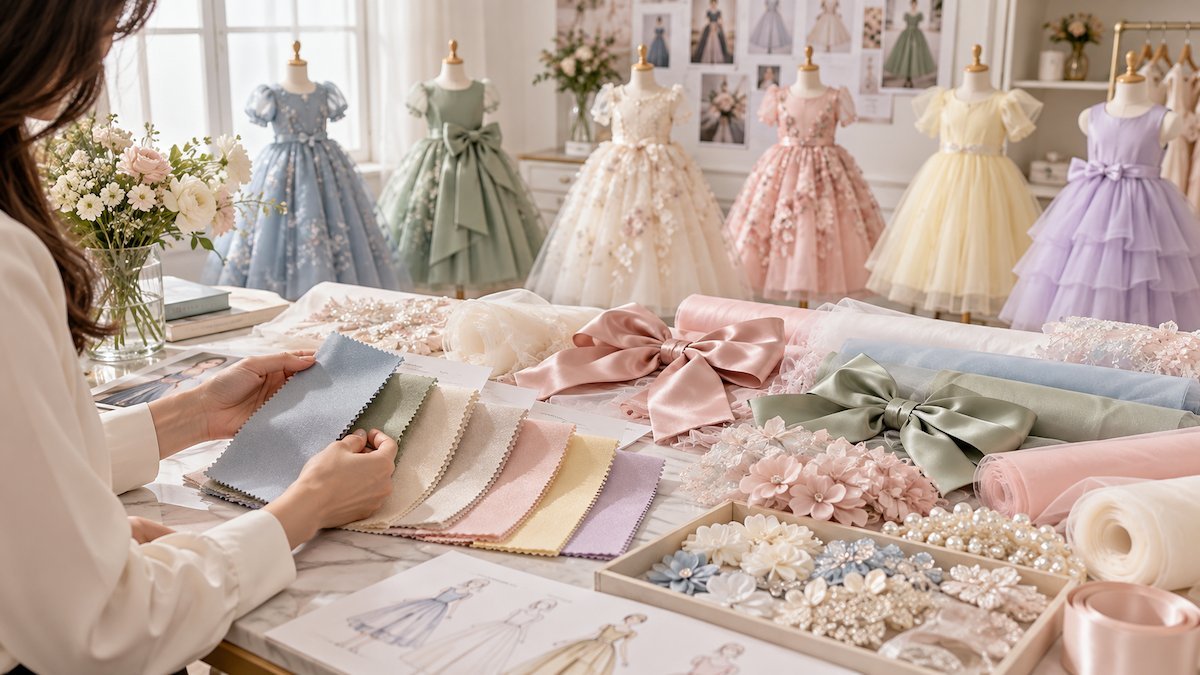
Powder blue, sage, ivory, blush and lilac — the 2027 palette buys as a family, not as a single colour.
What it looks like
A palette rather than a colour of the year: powder and dusty blue, sage and soft green, warm ivory, champagne, blush and dusty rose, with butter yellow and soft lilac as smaller accents. The 2027 characteristic is how these share a collection — cool blue and warm neutral sitting together — not any single shade.
Why boutiques should watch it
Core neutrals photograph consistently, sit comfortably beside wedding palettes, and reorder predictably. Trend colours generate the excitement and the press, but they also generate the markdowns when the season turns. A palette built from a stable core plus a small number of accents protects the assortment from both problems.
Best wholesale applications and buying risk
The table below is the commercial version of this trend: how each colour family is likely to be used, and what can go wrong once you hold stock in it.
| Colour family | KDW interpretation | Best use |
|---|---|---|
| Powder / dusty blue | Soft formal colour with broad appeal | Wedding, party |
| Sage / soft green | Modern wedding neutral | Flower girl |
| Warm ivory | Bridal classic, always in demand | Flower girl |
| Champagne | Premium neutral for older girls | Formal, communion |
| Blush / dusty rose | Proven feminine core | Party, wedding |
| Butter yellow | Small test colour | Spring, birthday |
| Soft lilac | Accent or test colour | Party |
Fabric and construction
The same colour behaves differently on different bases: ivory on tulle reads cooler than ivory on satin, and champagne on a high-shine satin looks warmer than champagne on matte. Approve the shade on the actual fabric you will produce, in the actual lighting, rather than on a swatch card alone.
Buying strategy
The rule that keeps a palette profitable: core colours should carry the volume, and trend colours should earn their inventory through testing. Do not let a forecasting report push thirty per cent of your open-to-buy into a shade your customers have never bought from you. Reserve the dye-lot quantity for the season up front, and if you run two silhouettes under one colour story, reserve both from the same lot. Where exactness matters, work to a Pantone reference as described in Pantone matching for custom kids dresses.
QC risk
Shade consistency between dye lots is the biggest exposure, followed by handling marks: light colours show soil and finger marks far more than saturated ones, so inspection under neutral light with clean gloves belongs in the quality plan, not only in the cutting room.
6. Texture Matters More Than Loud Print
What it looks like
Surface interest instead of all-over print: embroidered mesh, jacquard, lace overlay, flocked tulle, pearls, 3D texture, subtle shimmer and organza layering. Some of these are dimensional, some catch the light, some simply change how the fabric feels in the hand.
Why boutiques should watch it
Texture photographs with depth, which helps a product image stand out without a busy background, and it dates more slowly than a novelty print. For a higher-priced occasion dress, a textured base is a more defensible way to justify the price than a large graphic, and it reduces the markdown risk that comes with short-lived print trends.
Best wholesale applications
Embroidered mesh and lace for flower girl and communion; pearls and subtle shimmer for party and holiday; jacquard for older girls and structured A-lines; flocked or textured tulle as the most versatile option, because it can replace a plain tulle layer at a modest cost increase.
Fabric and construction
Texture raises perceived value and raises three costs at the same time: labour minutes, inspection complexity and unit cost — plus a packing requirement, because textured surfaces snag and crush. Compare embroidery or jacquard against print on the price difference per metre, not on appearance alone, and check hand-feel as well: a stiff embroidery on a children’s dress is a comfort problem regardless of how good it looks.
Buying strategy
Use texture to upgrade a style you already sell rather than to introduce an entirely new silhouette. Swapping a plain tulle layer for a textured one is a low-risk way to raise the price point on a proven shape.
QC risk
Three checks belong in the production plan. Whether the textured fabric shrinks differently from the body fabric, which shows up later as a wavy seam or a puckered bodice. Whether flocked or bonded surface detail stays bonded, since shedding is a common failure on these finishes. And whether pearl or bead accents survive a pull test — where they do not, or where the style sells at toddler sizes, the component needs an explicit safety review.
7. Coordinated Occasion Dressing Expands Beyond Matching Sisters
What it looks like
Deliberately related pieces rather than identical ones: a flower girl dress paired with a junior bridesmaid dress, two sisters in the same colour in different silhouettes, birthday sets, family-photo capsules, and the same fabric used across age groups in one wedding party.
Why boutiques should watch it
Customers often do not want two identical dresses — they want two dresses that clearly belong together. That is a much easier sale to design for, and it is the clearest commercial logic in this entire guide: a family event almost never needs one dress, and the second dress is usually the more profitable of the two because the customer has already decided to spend.
Best wholesale applications
Wedding parties, family photography, milestone birthdays and holiday gatherings. Build it from three or four season colours with two silhouettes per colour — one softer and fuller for younger girls, one cleaner for older girls — so flower girl and junior bridesmaid can both be served from a single colour commitm A boutique can carry the same dusty-blue fabric in two silhouettes at once: a soft tulle flower girl style across ages 3–7 and a cleaner satin A-line for ages 8–14. The colour commitment is one, the size coverage is continuous, and the older girl is no longer the customer you lose at the point where the younger one buys.
Fabric and construction
The two silhouettes must share a dye lot and a trim finish, or the coordination is visible only in the marketing copy. Where the older style uses a different construction, its measurements do not simply scale from the younger one, so ask for a graded spec for both and check the hemline relationship between the two — two sisters photographed side by side will expose an inconsistent length immediately.
Buying strategy
Plan the size curve of the pair together instead of grading each style independently. Adjacent size availability is what makes this trend work, and the conversion between children’s size systems is set out in our kids dress size guide; the depth question is covered in inventory planning for a kids dress wholesale business.
QC risk
Size gaps and colour drift. A coordinated sale collapses when the smaller or the larger dress is out of stock, or when the second delivery of the same shade no longer matches the first — which is why reorder colour consistency has to be agreed with the supplier before the first order, not after it.
8. Detachable Details Give One Dress More Selling Stories
What it looks like
Elements designed to come off or change over: a detachable bow, a removable cape, a detachable floral brooch, a removable sash, removable sleeves or shoulder details. The garment arrives as one product that can be photographed as two.
Why boutiques should watch it
It converts one product into two merchandising looks. A ceremony dress becomes a reception dress, the product page gains a second image set, and a boutique gets an easy before-and-after piece of short-form video from a single style — all without holding two SKUs in the same size and colour.
Best wholesale applications
Party dresses, flower girl and holiday formalwear, and anything worn across a long event day. A detachable cape over a clean satin A-line is the most straightforward execution, because the base dress stays simple to produce while the cape carries the drama.
Fabric and construction
Specify the fastening — snap, hook, loop or pin — and test it as a mechanism rather than visually: attach and detach repeatedly and confirm the fastening has not loosened. Where the removable piece uses a different fabric from the dress, the care labelling has to cover both.
Buying strategy
Treat the detachable component as a stocked part with a replenishment route, because pieces get lost in retail and in the post. Ask how replacement parts can be supplied, and price the hardware uplift against the retail uplift it supports before committ Work the comparison in three steps rather than as a single margin figure: what the fastener and extra component add to your landed cost per piece, what the second look is worth at retail when the dress can be worn and photographed two ways, and how many replacement parts you will realistically have to stock and ship. If the retail uplift cannot absorb the component cost plus that replacement allowance, keep the detail decorative instead of detachable.
QC risk
Safety and security together. Detachable parts on children’s garments fall into small-parts territory, and the applicable requirements depend on your destination market, the age range, component dimensions and the specific design — so this is a point to raise with your own compliance adviser rather than assume. On the production side, write attachment security into the inspection checklist, and specify that the detached piece travels in its own bag inside the polybag.
2027 Girls Dress Wholesale Trend Matrix
This is the one-page planning view. Commercial status is deliberately written as Strong, Growing or Test rather than as a ranking: a Strong direction is one that already has proven demand behind it, Growing means it is gaining ground but not yet dependable in every market, and Test means it should be validated in a small quantity fi The final column is the practical link between this table and the sourcing routes set out further down: it says whether a direction can be proved on ready stock or has to be sampled before it is worth a production commitment.
| Direction | Best category | Fabric | Commercial status | Main buyer risk | Best testing route |
|---|---|---|---|---|---|
| Dimensional florals | Flower girl | Tulle, mesh | Strong | Attachment security | Ready stock or sample |
| Sculptural bows | Party, wedding | Satin, organza | Strong | Shape loss in transit | Ready stock |
| Soft volume | Princess | Soft tulle | Strong | Freight volume | Ready stock |
| Refined satin | Older girls | Satin | Strong | Creasing | Ready stock |
| Softer colour stories | Wedding, party | Mixed | Strong / Test | Shade consistency | Ready stock, then sample |
| Tactile texture | Occasion | Lace, jacquard | Growing | Cost and snagging | Sample first |
| Coordinated dressing | Wedding, family | Mixed | Growing | Size gaps | Sample, then custom |
| Convertible details | Party | Mixed | Test | Attachment, safety | Sample first |
How Much of a 2027 Collection Should Be Trend-Led?
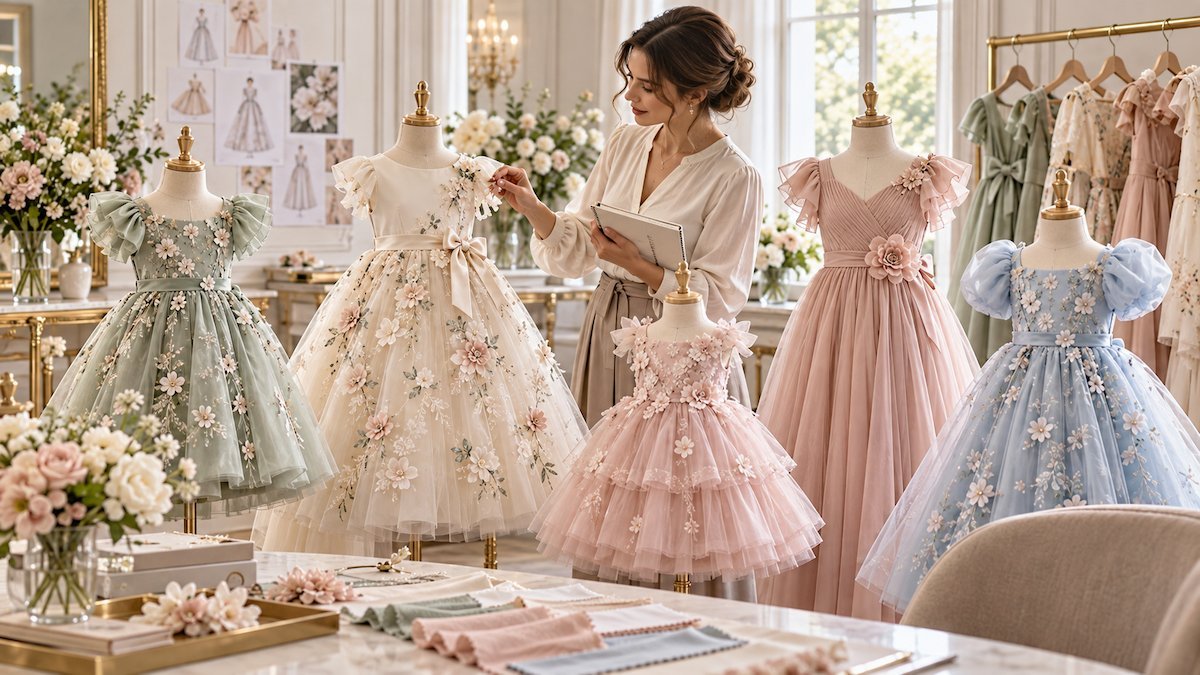
Reviewing the range against the trend matrix before committing to a size run.
Once a buyer has accepted a set of trends, the next decision is how much of the open-to-buy each one deserves. The framework below is an illustrative starting point for planning an occasionwear assortment — it is not a universal rule, and the right split depends on your customer base, how much of your business is repeat, and how quickly you can replenish.
| Collection role | Illustrative share | What belongs here |
|---|---|---|
| Proven core styles | 55–65% | Classic tulle princess, ivory flower girl, satin occasion dress |
| Updated commercial trends | 20–30% | 3D florals, larger bows, dusty blue, textured tulle |
| New and experimental directions | 10–15% | Butter yellow, convertible features, unusual texture |
The logic is straightforward. Core styles pay the bills and can be reordered with confidence. Commercial trends are the styles that make the season feel current and are supported by visible demand in your market. Experimental directions are how a boutique learns what its own customers will accept before the rest of the market does — and they should be sized so that being wrong is affordable.
Two practical rules keep this split honest. First, if an experimental style sells, replenish it as a commercial style rather than congratulating yourself, because sell-through without replenishment is a lost season. Second, if a trend style has to be bought deeply to hit a price break, check that the discount still clears your margin after freight and duty — the arithmetic is set out in our wholesale kids dresses pricing guide.
Ready Stock or Custom Production: How Should Buyers Test a Trend?
Seeing a trend and acting on it are two different problems. The question buyers ask us most often is which route to use for a direction they have not sold before, and the answer depends on what they are actually testing.
| Situation | Better route |
|---|---|
| Testing a new colour | Ready stock |
| Testing a new silhouette or volume level | Ready stock, or a sample first |
| Building an exclusive brand identity | Custom production |
| Needing a specific Pantone colour | Custom production |
| Needing your own label, trims or hangtags | Custom production |
| Needing seasonal inventory immediately | Ready stock |
On our current terms, ready stock styles can be ordered from 6 pieces for selected styles, with some available from a single piece, and sampling is usually not required — which makes ready stock the natural way to put a new trend in front of customers or on a photo shoot in a short window. Custom OEM and ODM runs start from 200 pieces per style depending on fabric and construction, with a pattern and sample development fee of USD 80–150 where you do not already have a pattern or sample, and sampling typically targeted at 5–7 days after the spec is confirmed.
Current sourcing terms
| Term | Current terms |
|---|---|
| Ready stock MOQ | From 6 pieces on selected styles; some styles can be ordered from a single piece |
| Ready stock sampling | Usually not required |
| Custom OEM / ODM MOQ | From 200 pieces per style, depending on fabric and construction |
| Pattern / sample development | USD 80–150 where you do not already have a pattern or sample |
| Sampling lead time | Typically 5–7 days after the spec is confirmed |
These figures sit behind every route on this page, so they are worth confirming at the time of enquiry — MOQ and lead times vary by style, fabric and season, and the same terms apply across our ready stock and custom OEM pages.
The sequence that most boutiques end up using is: prove the direction on ready stock, watch the sell-through, and only move into custom production once the style has earned it — at which point your own label and colour become the differentiation rather than the risk. The ready stock range is at ready stock girls dresses, and custom development is described at custom girls dresses.
When Should Boutiques Buy Girls Dress Trends for 2027?
Timing is where most trend guidance stops being useful. The windows below are planning anchors rather than fixed rules — actual timing depends on your market, shipping method, production lead time and selling season — but the order of operations does not change much from year to year.
| Buying window | Buyer action |
|---|---|
| Sep–Nov 2026 | Research trends, shortlist suppliers, request swatches for the directions you plan to test |
| Nov 2026–Jan 2027 | Sample fabrics, colours and styles; approve shades on the production fabric |
| Jan–Mar 2027 | Build the spring wedding and communion assortment |
| Mar–May 2027 | Replenish proven summer and party styles; reorder what sold |
| Jul–Sep 2027 | Develop the fall and holiday assortment |
| Sep–Nov 2027 | Holiday replenishment, then markdown planning |
The two windows that cannot be recovered are the sample approval window and the replenishment window. Approve colours late and the season is decided for you; fail to reorder a winner and the demand goes to whoever still has stock.
Quality-Control Risks to Check Before You Order
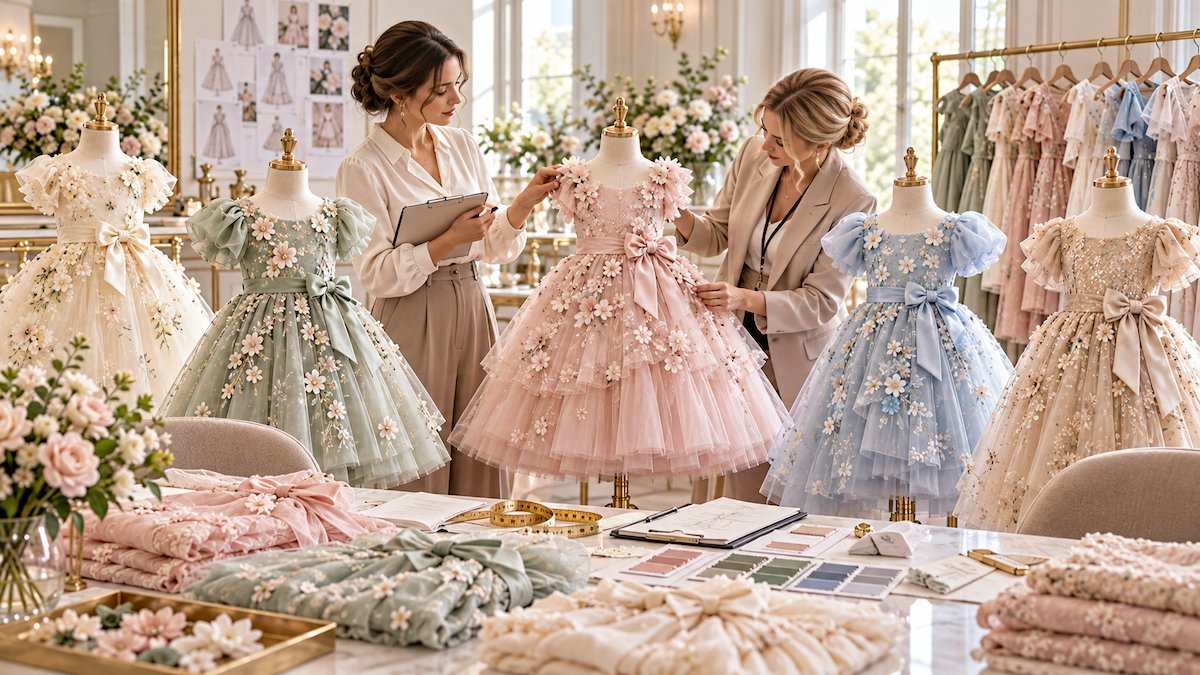
Buyers checking floral trims and construction before the bulk order is signed off.
Across all eight directions, the same small set of failures keeps costing buyers money. These are the ones worth writing into the inspection standard before production rather than discovering on arrival.
Colour and dye-lot consistency. Reserve the season’s quantity from one lot, approve shades on the production fabric, and agree how a reorder will be matched to the original delivery.
Attachment security. Floral appliqué, bows, pearls and detachable components should be pull-tested, not eyeballed, and an acceptable number of loose or deformed elements should be agreed in numbers rather than in adjectives.
Shape retention after transit. Agree a recovery standard for volume skirts and structured bows — what an acceptable garment looks like when it comes out of the carton, after shaking out and light steaming.
Creasing and surface marking on satin. Check crease recovery, seam puckering, water marking and pin marks under neutral light, and pack flat across the bodice.
Shrinkage and bonding on textured fabric. Confirm the textured layer behaves like the body fabric after washing, and that flocked or bonded surfaces do not shed.
Small parts and detachable components. Any component small enough to be a hazard needs review against the requirements of your destination market and the age range you are selling into.
Measurement tolerance on clean silhouettes. The less embellishment a dress has, the more visible a measurement error becomes — tighten tolerances where there is nothing to hide behind, and use the checks in our girls dress quality check checklist.
Packed volume. Measure packed volume per piece, not only weight, and quote freight on the number you actually measured.
2027 Girls Dress Trend Buying Checklist
Use this before committing to any 2027 trend style.
- Does the style fit a real occasion and a specific age group?
- Is the trend visible enough to read in product photography?
- Can the fabric be produced consistently in bulk?
- Will the embellishment survive shipping and wear?
- Does the dress pack efficiently for the freight route you use?
- Are adjacent sizes available for a coordinated or family sale?
- Can the supplier reproduce the same colour on reorder?
- Does the expected retail price hold up against the perceived value?
- Does the design need a specific compliance review before you buy?
- Can you test the style before committing to a larger custom order?
Frequently Asked Questions
What girls dress styles are trending for 2027?
Eight directions are worth watching: dimensional florals, sculptural bows, soft-volume skirts, refined satin silhouettes, softer colour stories, tactile texture, coordinated occasion dressing, and detachable or convertible details. They are not equally commercial — florals, bows, soft volume and refined satin already have proven demand behind them, while convertible details are still a test.
What colours should boutiques consider for girls dresses in 2027?
Think in terms of a core and a test set rather than one trend colour: powder and dusty blue, sage, warm ivory, champagne and blush as the core, with butter yellow and soft lilac bought in small quantity as tests. Core colours should carry the volume; trend colours should earn their inventory.
Are tulle dresses still popular for 2027?
Yes, but the construction is changing. Volume remains in demand for flower girl and princess styles; what buyers should watch is the layer build — softer multilayer tulle, lighter petticoats and breathable linings rather than overbuilt rigid netting, because comfort and freight volume both matter more than they used to.
Are bows still relevant in girls occasionwear?
Yes, and the expression is shifting from soft trailing bows toward more sculptural and more integrated ones: oversized back bows, structured waist bows, organza bows and detachable bows. The commercial question is no longer whether to use a bow, but whether it still holds its shape after carton packing and international shipping.
How should a boutique test a new girls dress trend?
In stages. Start with ready stock or a single sample, put it in front of your own customers, watch sell-through, replenish what works, and only then move into custom production where you can spread the cost of a larger minimum across proven demand.
When should boutiques order 2027 girls dresses?
Sampling normally runs from November 2026 to January 2027, spring wedding and communion stock is built from January to March 2027, summer and party styles are replenished from March to May, and fall and holiday development runs from July to September. Adjust the windows to your own market, shipping method and production lead time.
Planning Your 2027 Girls Dress Collection?
Start with a small group of proven silhouettes, test new colours and details, and scale only the styles that match your customers. Kids Dress Wholesaler supports both ready-stock sourcing and custom girls dress development for boutiques, importers and children’s fashion brands.
Leave a Reply