Custom kids dress manufacturing cost is the number one factor that decides whether a private-label or boutique line actually makes money. This guide breaks down the real cost levers — fabric, pattern efficiency, trims, MOQ, construction, and packaging — so you can brief your factory with numbers instead of guesses.
Quick Answer
Most custom girls dress programs can cut unit cost 15–30% without touching quality by raising the confirmed-repeat MOQ, simplifying construction, and specifying fabric and trims from the factory’s existing library. The biggest single saving is usually MOQ: moving from a 50-piece test run to a 200-piece confirmed reorder typically drops the per-unit price by roughly 20%.
Start With a Costed Tech Pack
A clear tech pack is what lets a factory quote accurately the first time. Send yours over and we will return a line-by-line cost breakdown you can act on.
What Buyers Need to Know
When you ask a factory for a custom kids dress quote, the number you get back is not one cost — it is the sum of at least six separate decisions. Fabric weight, the number of panels in the skirt, the type of closure, the quantity of hand-applied trim, the dye lot size, and how many pieces you confirm all move the price independently. A buyer who only negotiates the “total” almost always leaves money on the table, because the factory has already priced in conservative assumptions on every one of those lines — and those assumptions are stacked in the factory’s favor, not yours.
The practical way to take control is to cost the garment from the inside out. Decide the fabric first, because fabric is usually 35–55% of a dress’s material cost. A 90 GSM lining fabric and a 140 GSM bonded lining are different garments at different prices, and the quote will not tell you which one you got unless you specify it. Then decide construction complexity, because each extra panel, lining layer, or hand-finished detail adds both fabric offcut and labor minutes. A four-tier tulle skirt with a horsehair braid hem costs more to sew than a two-tier knife-pleated skirt of the same length, and the difference shows up only when you compare line by line.
Then decide trims from the factory’s standard library rather than a catalog the factory has to source cold. A stock zipper in a standard color is a line item; a custom-molded clip in a matched shade is a tooling charge plus a lead time. Finally, set the MOQ high enough that the factory can buy cloth by the roll and amortize the pattern and sampling across more units. None of these steps requires a different factory — they require a better brief. The buyer who sends a complete tech pack with GSM, panel count, trim references, and a confirmed reorder quantity gets a tighter, more defensible quote than the buyer who sends a photo and asks “how much?”
For a new private-label program, the order of operations matters as much as the choices. Brief fabric and construction on the first sample so the factory quotes the real garment, not a simplified stand-in. Approve the pre-production sample, then raise the MOQ on the reorder — do not start at the highest volume on an unproven style, because a 200-piece commitment to a dress that does not sell is the most expensive “saving” you can make. This is also where OEM and ODM models diverge: under OEM you own the spec and the cost levers, while under ODM the factory’s existing pattern already bakes in certain choices, so your negotiation shifts to which stock development you adopt. Either way, a line-by-line quote is the only document that lets you compare two offers as the same dress.
The final number that matters is not the ex-works unit cost but the landed cost — the price once fabric, labor, trim, packing, freight, and duties are in. A dress that is cheaper at the factory gate can be more expensive at your warehouse if it ships in many small cartons or needs a higher-duty classification. When you brief a private-label program, ask the factory to quote both the unit and a representative landed cost per carton, so the saving you negotiate is measured where it counts. Our wholesale buying guide covers the freight and duty side in more detail, but the principle is the same: optimize the whole chain, not one line.
Cost Levers Compared
The table ranks the levers a buyer can actually pull, by how much they typically move unit cost and how much they affect the look of the dress. Use it to decide where to trade off.
| Lever | Typical saving | Effort to change | Risk to appearance | Best for |
|---|---|---|---|---|
| Raise confirmed MOQ 50 → 200 | 15–22% | Low | None | Every repeating style |
| Spec fabric from factory library | 5–12% | Low | Low | New collections |
| Simplify skirt panels / remove lining | 6–14% | Medium | Medium | Everyday & budget lines |
| Use stock trims, not custom hardware | 3–9% | Low | Low | Fast-turnaround orders |
| Consolidate dye lots / colors | 2–6% | Low | None | Multi-color programs |
| Standardize size run to grade set | 1–4% | Low | None | All programs |
Read the table top to bottom: MOQ and fabric choice do the heavy lifting, while trim and color consolidation are the easy wins you should take on every order.
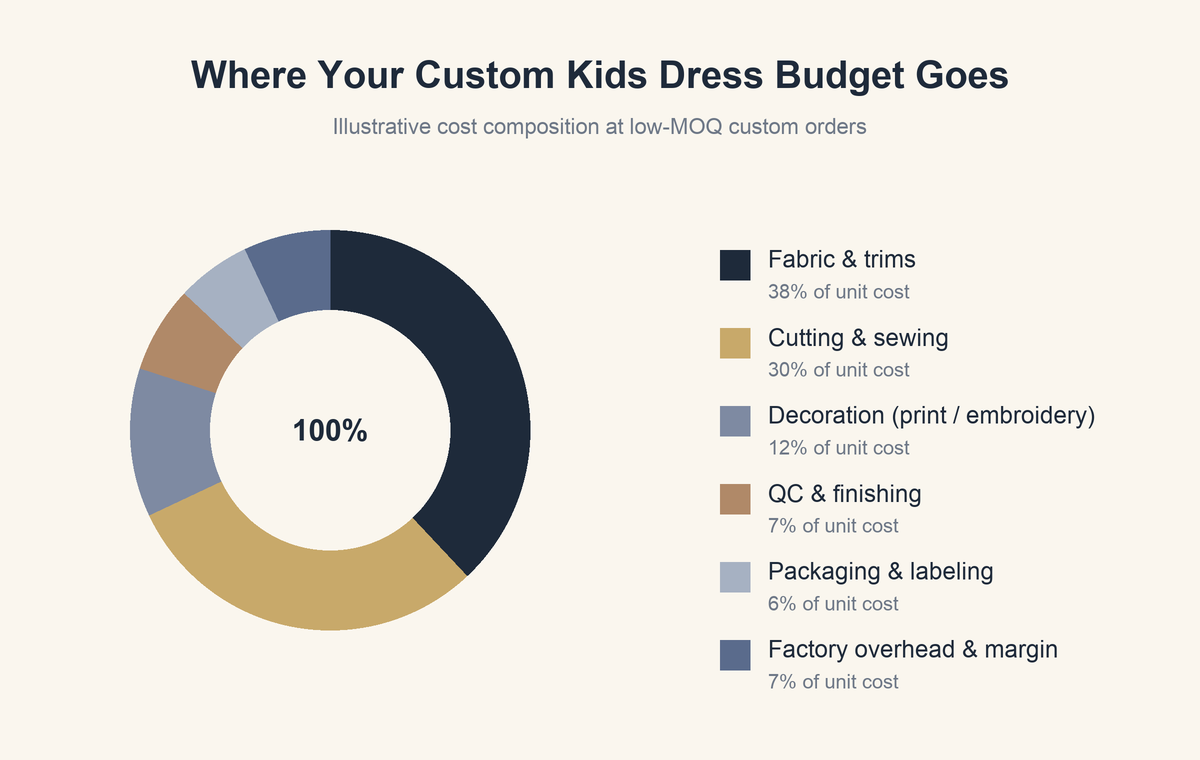
Illustrative cost composition at low-MOQ custom orders — use the levers in order of impact.
Illustrative cost composition at low-MOQ custom orders — use the levers in order of impact.
There is one case where pushing cost down is the wrong move: a premium hero style where the customer is buying the detail, not the dress. A bridal flower girl gown or a first-communion piece sells on fabric hand, clean seams, and a finish that photographs well — and those are exactly the lines a cost cut removes first. On those SKUs, protect the fabric and the construction, and look for savings in packing and MOQ instead. The discipline is to know which dress is a volume play and which is a margin-and-image play, then optimize the right lever on each. A line-by-line quote makes that choice visible instead of forcing the same discount across a mixed collection.
Get a Side-by-Side Quote
Send us two target price points and we will show you exactly which levers hit each one — no obligation, just numbers.
How to Work It Out: A Worked Example
Take a layered tulle flower girl dress quoted at a 50-piece MOQ. The factory quotes the cloth by the cut table, patterns by the hour, and a fixed sampling amortization spread across only 50 units. Now brief the same dress at a 200-piece confirmed reorder, with the tulle taken from the factory’s standard 8-color stock library and the bow changed from a custom molded clip to a sewn self-fabric bow. The fabric line drops because the roll buy is larger and the stock color skips a custom dye lot; the labor line drops because the self-fabric bow removes a hand-applied component; and the amortization line drops because the pattern is spread across four times the volume.
Example: Same dress, two briefs — 50-piece custom-dye run at a unit cost index of 100, versus 200-piece stock-library run at an index of about 78. That is a ~22% reduction from two changes (MOQ + fabric/trim spec) with no change to the silhouette the customer sees.
Buyer Checklist
- Confirm the repeat MOQ before negotiating the unit price — it sets the floor.
- Ask for fabric by weight (GSM) and origin, not just “tulle” or “satin”.
- Request the factory’s standard trim and color library before specifying custom hardware.
- Count the panels and lining layers; ask what each one costs to remove.
- Consolidate colors into as few dye lots as the collection allows.
- Get the quote line-by-line (fabric, labor, trim, amortization, packing) so you can challenge each one.
Common Mistakes (and What They Cost)
Negotiating only the total price
Buyers who accept a single bottom-line cannot tell which line is padded. A factory facing pressure on the total will protects its margin by quietly upgrading fabric or trimming labor in ways you did not approve. Always request a line-by-line breakdown so the negotiation is transparent.
Specifying custom trims on a small first run
A custom molded clip or woven label ordered for 50 pieces carries a tooling or setup charge that vanishes at 200+ pieces. On a test run it can add 8–15% to the unit cost for a detail the end customer barely notices. Use stock trims for the first run, then move to custom once the style is proven.
Changing the tech pack after sampling
Every post-sample change — a different lace, a new closure, a revised hem — reopens pattern and sometimes sampling. That can add one to two weeks and a fresh amortization charge. Lock the tech pack before the pre-production sample and treat later changes as a new cost event, not a free edit.
FAQ
What is a realistic custom MOQ for girls dresses?
For a confirmed style, many factories will run a 50–100 piece first order and a 200+ piece reorder, with the reorder price notably lower. The exact floor depends on fabric width and whether the trim is custom or stock.
Does using stock fabric hurt the “custom” feel?
No. Customization comes from silhouette, color, trim, label, and fit — not from whether the base cloth was dyed to order. Stock-library fabric in your chosen Pantone still reads as a custom dress.
How much can packaging save?
Standard polybag with a care label and a simple hangtag is usually 1–3% of unit cost. Fully custom boxes with inserts can be 4–8%. For most boutique lines the standard option is enough; reserve custom packaging for premium gifting SKUs.
Will a lower cost mean lower quality?
Not if the savings come from MOQ, fabric library, and construction simplicity rather than from thinner fabric or skipped inspection. The levers in this guide protect appearance and safety while removing hidden overhead.
Should I consolidate colors to save money?
Yes, within reason. Fewer dye lots means fewer setup charges and less shade-variation risk between shipments. Keep enough colors to merchandise the line, but avoid one-off shades that will not repeat.
How do I compare two factory quotes fairly?
Put both on the same line-by-line template: fabric (GSM + origin), construction (panels + lining), trims, MOQ, sampling amortization, and packing. Only then are you comparing like for like instead of two different garments.
Leave a Reply