Most problems with an overseas kids’ dress supplier do not appear on the first order — they appear on the third, when you are already dependent on them. The way to avoid them is to spot the warning signs before you commit capital. This guide lists the red flags that experienced wholesale girls’ dress buyers watch for, and what to do instead.
Start With a Low-Minimum Test Order
Before you commit to a bulk run, test a supplier with ready-stock styles — mixed styles and colours from 6 pieces, so you can judge fabric, stitching and sizing firsthand.
Sourcing children’s formalwear from overseas factories can be enormously profitable, but it concentrates risk in a single decision: choosing the supplier. A bad supplier choice costs you in rejected stock, late deliveries, chargebacks and, worst of all, a damaged relationship with your own retail customers. A good supplier choice compounds the other way — consistent quality, on-time reorders and a margin you can plan around.
This article walks through the red flags to avoid when vetting a children’s apparel supplier, grouped into the four areas where problems actually happen: communication, product quality, pricing, and compliance. For a positive counterpart to this list, read our guide on how to choose a reliable kids dress manufacturer.
1. Communication Red Flags
Communication problems are the earliest and most reliable warning sign, because they show up before any money changes hands. A supplier who is vague or evasive in the quoting stage will not become clearer once they have your deposit.
Vague Answers on Fabric and Construction
Ask exactly what a dress is made of and how it is built, and watch how precise the answer is. A real factory answers with specifics — polyester tulle, cotton lining, satin bodice — and can tell you the GSM, the seam type and where the closure sits. A trader who is guessing answers with “good quality fabric” or “same as the picture.” Vague fabric answers are a strong sign the supplier does not control production, which means they cannot guarantee what you receive.
Slow or Disappearing Replies
Everyone is busy, but a supplier who takes a week to answer a simple question during quoting will be unreachable when a shipment is stuck in customs or a batch fails inspection. A reasonable benchmark is a reply within one working day during a negotiation. Slow quoting is not always fatal, but it tells you what “urgent” will feel like later.
Unwillingness to Share References
An established factory can point to other buyers it has served. If a supplier will not share a reference, a factory address or a company registration, treat it as a red flag — not proof of fraud, but a reason to slow down. Legitimate suppliers understand that references are part of due diligence.
2. Product Quality Red Flags
Quality problems are the most expensive to fix, because you often only discover them after the goods arrive. The goal of vetting is to catch the risk early through samples and small test orders.
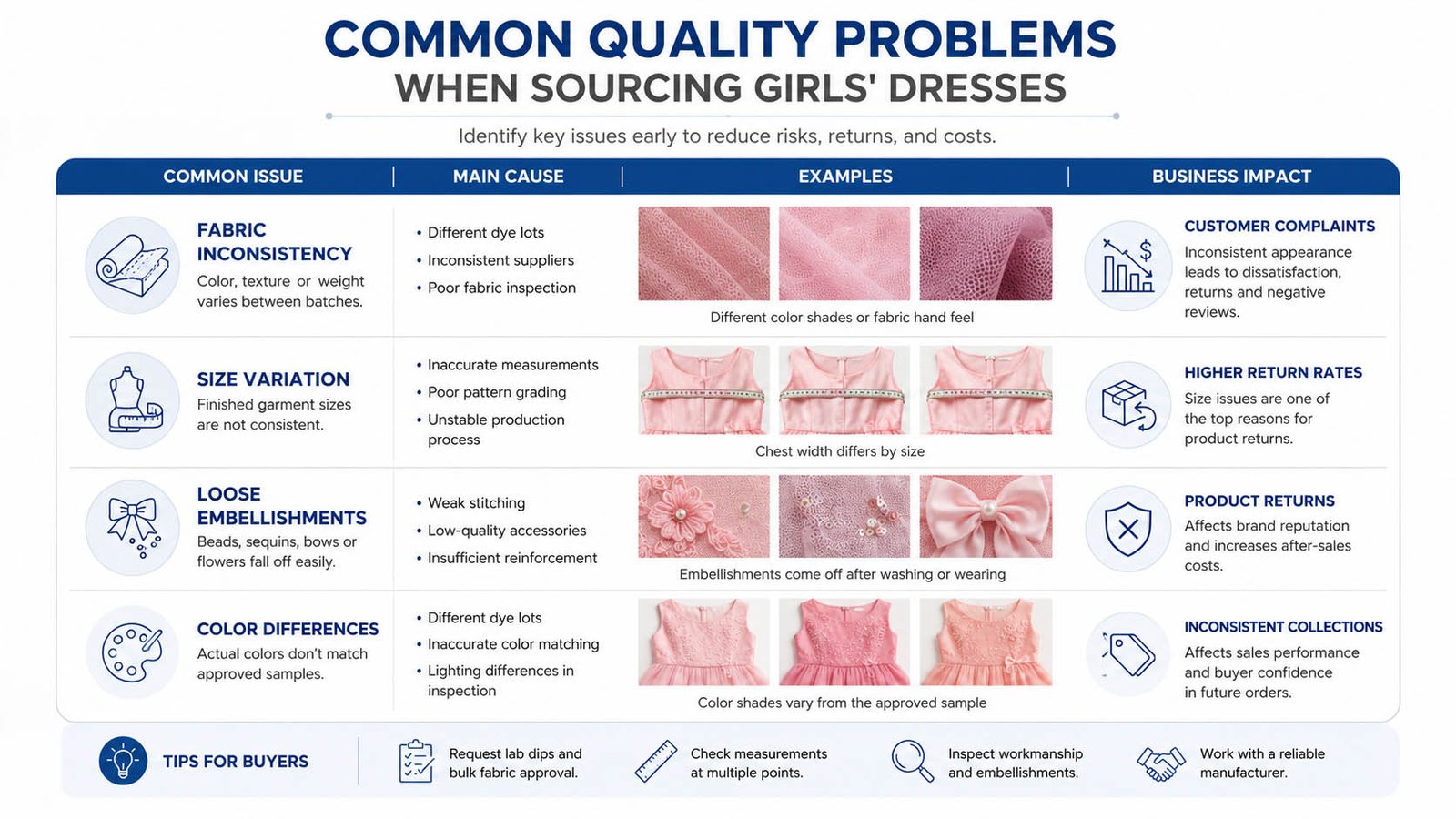
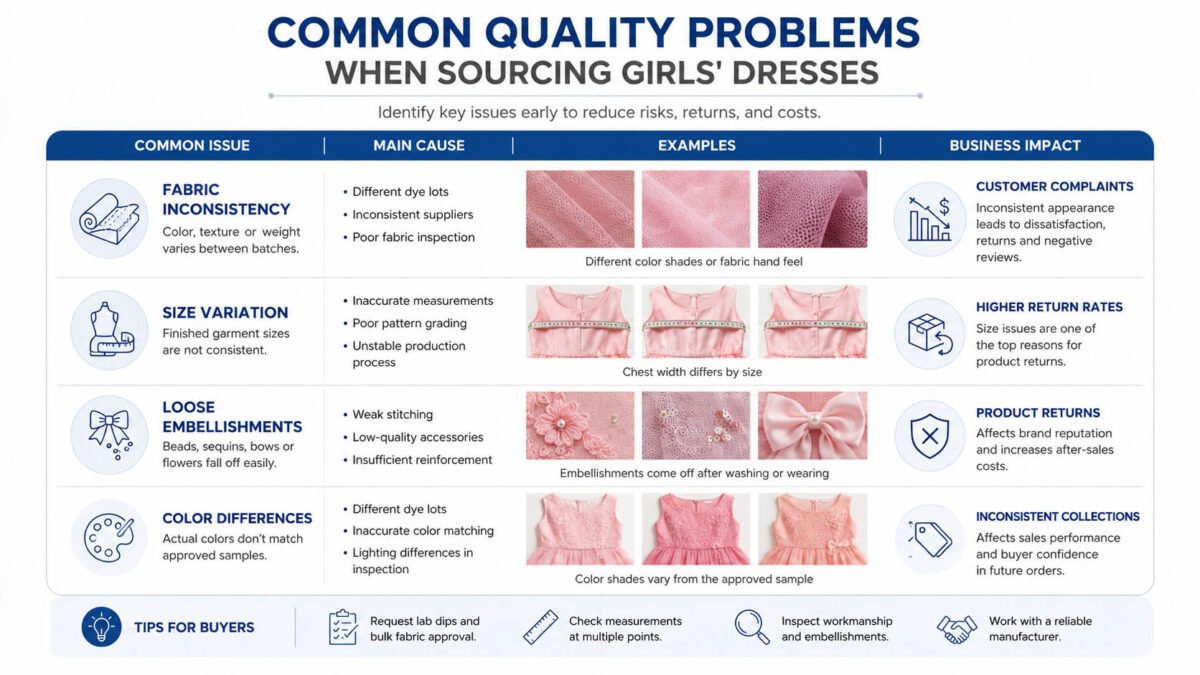
Know the common defects — uneven stitching, loose sequins, wrong measurements — before you place a bulk order.
Refusing to Send a Physical Sample Before Bulk
This is the single biggest red flag in the whole industry. A supplier who insists you buy a bulk order without approving a physical sample is asking you to take the entire risk. The standard sequence is sample → approval → bulk production. For custom OEM/ODM work, a pre-production sample is non-negotiable. If a supplier skips it, walk away.
Inconsistent Sample Quality
One good sample proves very little if the factory cannot repeat it. Order the same sample twice, or a small test batch, and compare them. Real quality is consistency, not a single lucky piece. If the two samples differ in stitching, sizing or fabric, assume the bulk order will differ even more.
No Quality Control Step
Ask how the supplier inspects finished goods before shipping. A factory with no QC step — no in-line inspection, no final check, no third-party inspection option — is gambling with your money. Reputable suppliers will discuss quality control and compliance openly, including how they handle defects and sizing drift.
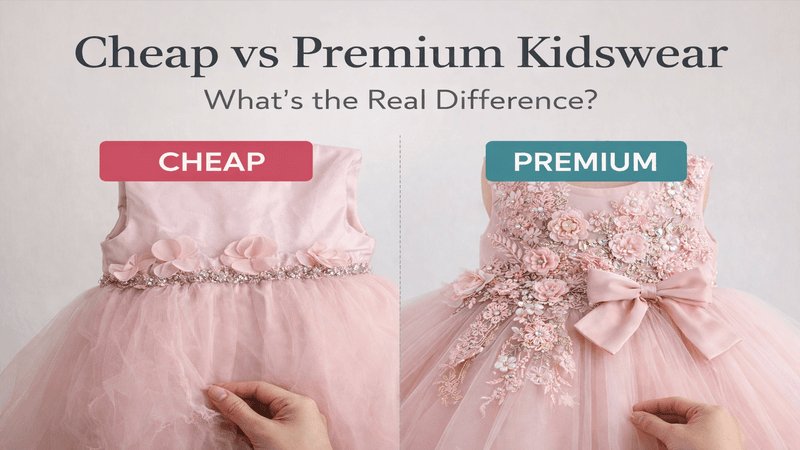
Cheap and premium dresses look different up close — request close-up construction photos, not just styled product shots.
3. Pricing and Payment Red Flags
Price is where scams and shortcuts concentrate, because it is the easiest lever to pull. A suspiciously low price is not a bargain — it is usually a hidden cost waiting to surface.
A Price That Is Too Good to Be True
If a quote is 40–50% below every other supplier for the same fabric and construction, the difference has to come from somewhere: cheaper fabric, thinner lining, skipped embellishment, or worse. Children’s formalwear has real material and labor costs, and those costs do not disappear. A price that is dramatically out of line with the market is a signal to ask what was cut, not to celebrate.
Demanding 100% Upfront Payment
For a first bulk order, a supplier demanding full payment before production starts is taking your leverage away entirely. Common apparel trade terms involve a deposit (often 30%) to start production and the balance before or on shipment, with the exact structure depending on the relationship and order size. Be cautious of any supplier that demands unusual payment terms on a first order and cannot justify them.
Pressure Tactics and “Limited Time” Prices
A legitimate factory is busy but does not need to pressure you into an instant decision. Urgency tactics — “this price is only valid today,” “another buyer is about to take the capacity” — are a classic way to short-circuit your due diligence. Real suppliers quote prices that hold for a reasonable window and let you do your checks.
4. Compliance and Safety Red Flags
For children’s wear, safety compliance is not optional — it is a legal requirement in most markets you will sell into. A supplier who cannot speak to compliance is a liability.
No Knowledge of Import Requirements
Ask about the regulations for the market you are selling into — CPSIA in the United States, REACH in the European Union, and the specific rules around drawstrings, small parts, flammability and lead content. A supplier who has never heard of these, or dismisses them, cannot produce compliant garments. Children’s dresses with buttons, beads or sequins carry specific small-parts and lead requirements, and a factory must understand them.
Unable to Provide Test Documentation
A responsible supplier can provide or arrange test reports for the materials and trims they use, and can tell you which standards the garments meet. Be wary of any supplier that offers “certifications” it cannot document, or that makes vague “100% safe” claims without specifics. Legitimate quality assurance is backed by documentation, not adjectives.
No Traceability of Materials
Ask where the fabric and trims come from. A supplier that cannot trace its materials cannot verify their safety, and in children’s wear that traceability is exactly what regulators and your own customers will ask for. It matters less that a supplier uses a specific mill and more that they can tell you who it is and what it certifies.
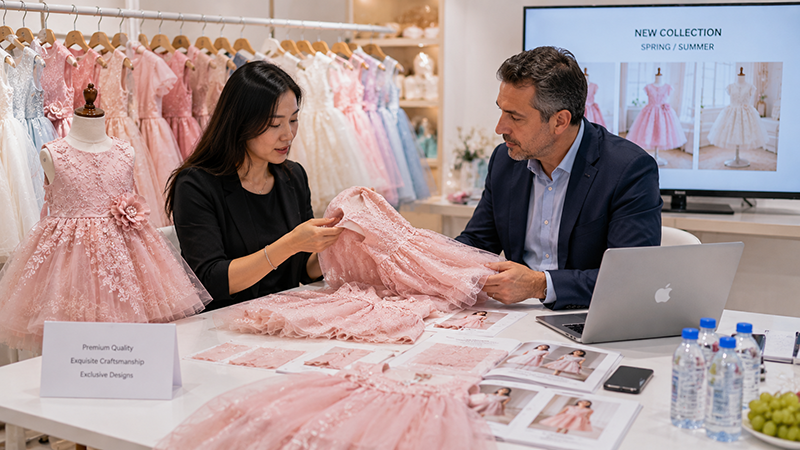
Experienced buyers evaluate quality systematically — fabric, construction, safety and documentation, not just the sample photo.
5. A Practical Vetting Checklist
Pull everything together into a short checklist you can run on any new supplier before committing:
- Factory proof — can they show the production floor on a video call?
- Specific answers — do they name the exact fabric, lining and construction?
- Physical sample — will they send one before bulk, and is it repeatable?
- QC process — do they inspect before shipping, and will they allow third-party inspection?
- References — will they share buyers they have served?
- Payment terms — are they reasonable, or demanding 100% upfront?
- Compliance — do they understand CPSIA/REACH and provide test documentation?
If a supplier clears all seven, you are dealing with a serious operation. If it fails two or more, keep looking — the cost of a bad supplier is always paid in full, usually on the order where it hurts most.
For a low-risk way to start, consider testing the relationship with a small ready-stock order before committing to a full custom run. A modest test order reveals more about a supplier than any questionnaire, and it protects your capital while you learn how they actually perform.
Traditional Suppliers vs. Kids Dress Wholesaler (KDW)
Most of the red flags above trace back to a supplier that is not transparent about pricing, capacity or delivery. Here is how a transparent wholesale partner should compare — the standard every wholesale girls’ dress buyer should hold their supplier to, including us.
| Area | Traditional suppliers | KDW |
|---|---|---|
| Pricing | Vague; hidden costs surface later | Transparent, itemized quote up front |
| Delivery | Unclear; slips without notice | Clear lead times, on-time delivery |
| Quality | No defined QC step | Documented in-line + final QC |
| Communication | Slow, evasive answers | Specific answers, video walk-through on request |
| Sampling | Pushes bulk before sample | Sample → approval → bulk as standard |
Get a Sourcing Quote
Send us your target styles, size run and quantity. We reply with MOQ, unit pricing and sample lead time — no obligation.
Ask us to prove any of it before you commit.
Frequently Asked Questions
What is the biggest red flag when choosing a kids dress supplier?
Refusing to send a physical sample before a bulk order is the single most important red flag. Without an approved sample, you are taking on the entire quality risk. A reputable supplier always works through sample → approval → bulk production.
How do I know if a supplier is a real factory or just a trader?
Ask for the factory address and a live video call from the production floor. A real manufacturer can show you the workshop working; a trader will deflect or show stock photos. Specific fabric and construction answers are another strong signal of production control.
What payment terms should I expect for a first bulk order?
A common structure is a deposit to start production and the balance before or on shipment — often around 30% upfront — though exact terms vary by relationship and order size. Be cautious of demands for 100% upfront on a first order.
Why is a very low price a warning sign?
Children’s formalwear has real material and labor costs that do not disappear. A price far below the market usually means something was cut — cheaper fabric, thinner lining, skipped embellishment. Price the total cost including rejections, not just the invoice.
What compliance should a kids dress supplier understand?
For the US, CPSIA and CPSC rules (drawstrings, small parts, flammability, lead); for the EU, REACH and care-label requirements. A supplier should understand these and be able to provide test documentation for materials and trims.
How can I test a supplier with low risk?
Start with a small ready-stock order before a full custom run. A modest test order reveals a supplier’s true quality and communication far better than any questionnaire, while protecting your capital. You can browse our ready-stock girls’ dresses to test us with a small, low-risk order.
Vet us before you buy
Ask us anything — fabric specs, factory walk-through, samples, QC process and compliance documentation. We’ll answer in writing.
Leave a Reply