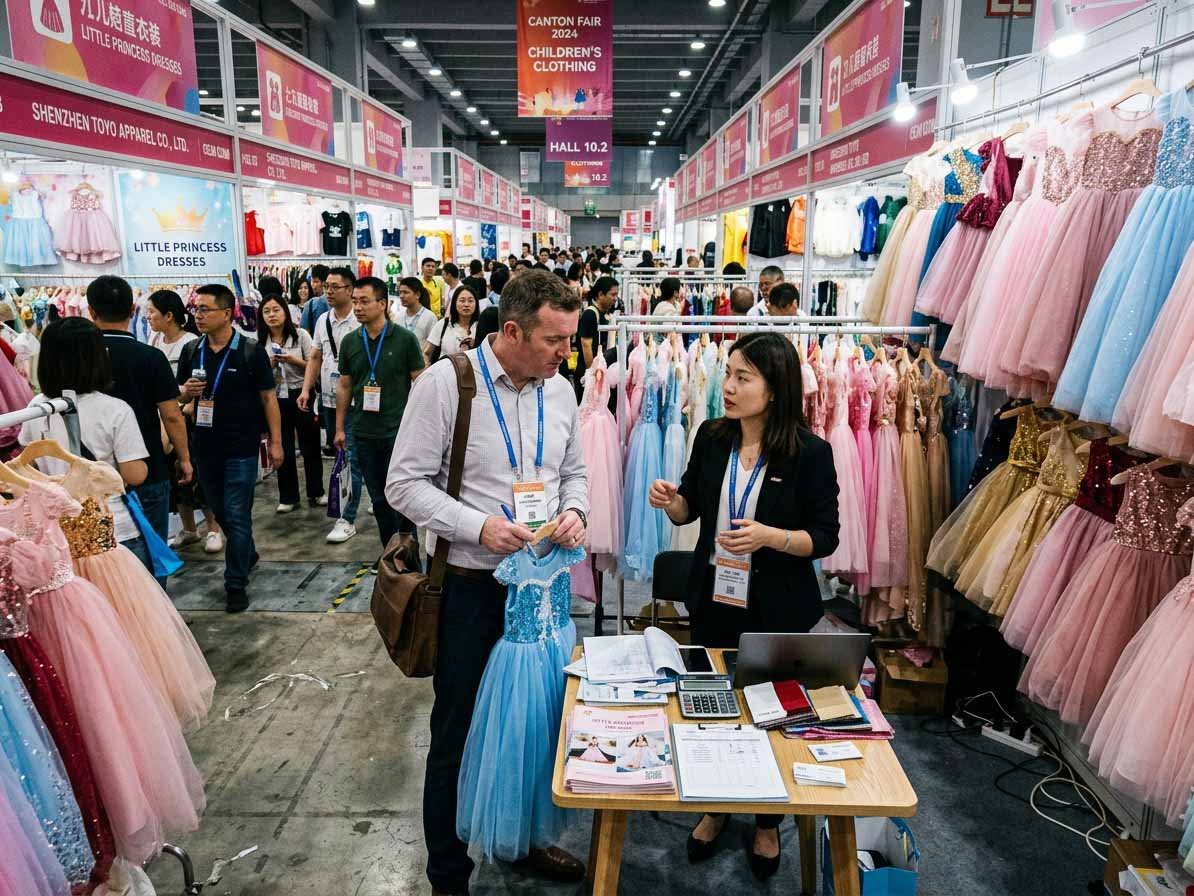
The short answer: Canton Fair is still one of the most efficient ways to meet girls’ dress suppliers face to face — but only if you arrive with a plan. The fair is enormous, the language barrier is real, and the best suppliers are often not the ones with the biggest booths. A first-timer who walks in cold will leave exhausted and confused; a first-timer with a target list, a negotiation range and a factory-visit strategy will leave with real supply relationships. The difference is preparation, not luck.
Start With a Low-Minimum Test Order
Before you commit to a bulk run, test a supplier with ready-stock styles — mixed styles and colours from 6 pieces, so you can judge fabric, stitching and sizing firsthand.
The China Import and Export Fair — universally called Canton Fair — runs in Guangzhou every spring and autumn, and it remains a genuine buying opportunity for wholesale girls’ dresses. This guide walks a first-time buyer through the trip end to end: what to prepare, how to work the floor, how to negotiate, and how to turn a booth conversation into a dependable supply line.
If you cannot make the trip, the same sourcing principles apply when you work with a supplier directly — including across our dress collection.
1. Why Canton Fair Is Still Worth the Trip
In an era of Alibaba and instant messaging, it is fair to ask whether a physical trade fair still earns its cost. For children’s formalwear, it usually does, for reasons that a screen cannot replace:
- You can touch the fabric. Tulle weight, satin sheen, seam finishing — none of these survive a photo. Holding a sample tells you more in seconds than a catalog in an hour.
- You meet the actual decision-maker. The person in the booth is usually from the factory or the trading company, and a face-to-face relationship still gets better service and better terms.
- You see the range, not the listing. A booth shows you a supplier’s real breadth and consistency, which is hard to fake online.
2. Before You Go: Preparation That Pays Off
Get a Sourcing Quote
Send us your target styles, size run and quantity. We reply with MOQ, unit pricing and sample lead time — no obligation.
The fair spans multiple phases and thousands of exhibitors. Garments — including children’s wear — are typically concentrated in specific phases, so confirm the dates and hall layout for the clothing phase before you book anything.
- Register for a buyer badge early. Overseas buyers usually register online in advance; doing it at the gate costs you a morning.
- Build a target list. Research exhibitors beforehand and mark the booths for girls’ formalwear and children’s dresses. Do not rely on wandering.
- Know your numbers. Bring your target retail price, your MOQ tolerance, and your per-dress budget — you will negotiate against them.
- Pack the essentials. Comfortable shoes, a notebook or phone for photos (ask permission first), and business cards are non-negotiable.
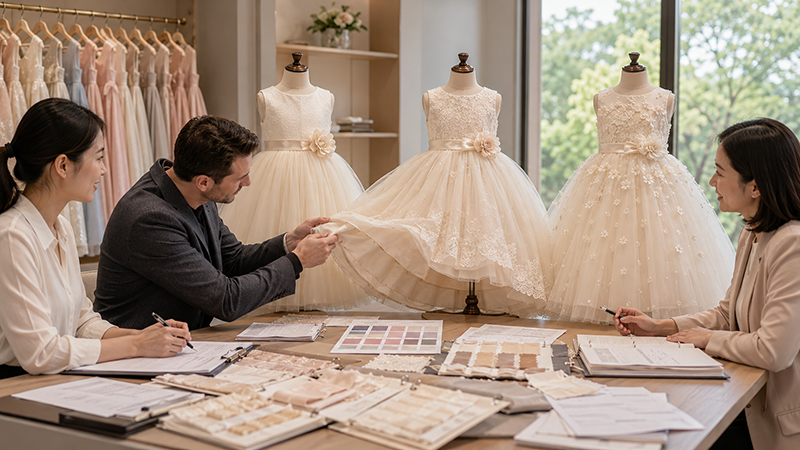
Compare samples side by side — fabric, finish and consistency are the real differentiators between suppliers.
3. Working the Floor: What to Look For
Once you are inside, discipline matters more than stamina. You cannot see everything, so focus on signal over noise:
- Specialization. A supplier whose booth is all girls’ dresses knows the category; a booth selling a bit of everything is a trading company, not a specialist.
- Consistency across samples. Look at whether every dress on the rack shows the same finish quality — a strong sample next to a sloppy one is a warning sign.
- Finishing details. Check seams, lining, hem finish and embellishment security on the samples. These predict what your bulk order will look like.
- Ask about capacity and lead time. A great sample means little if the supplier cannot deliver your volume on schedule.
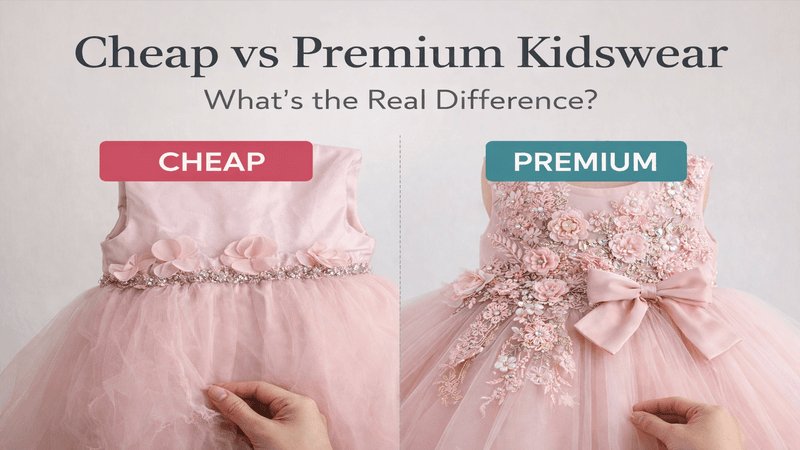
The gap between cheap and premium is in the details — look closely at the samples before you commit.
4. Negotiating MOQ and Price
Negotiation at the fair is a conversation, not a confrontation. Suppliers expect buyers to push on minimums and price, and a reasonable, well-informed ask usually gets a reasonable answer:
- Ask about MOQ first. For girls’ dresses, MOQ varies widely — a useful planning range is from a few dozen pieces for ready stock up to several hundred for custom runs. Know what you can commit to before you ask for a discount.
- Negotiate on mix, not just price. If the minimum is high, ask whether you can meet it with mixed styles and sizes rather than one style in bulk.
- Separate sample cost from unit cost. Confirm whether there is a sampling fee and whether it is credited back against a bulk order.
- Get everything written down. Price, MOQ, lead time, payment terms and sample timeline — on paper or in an email before you leave the booth.
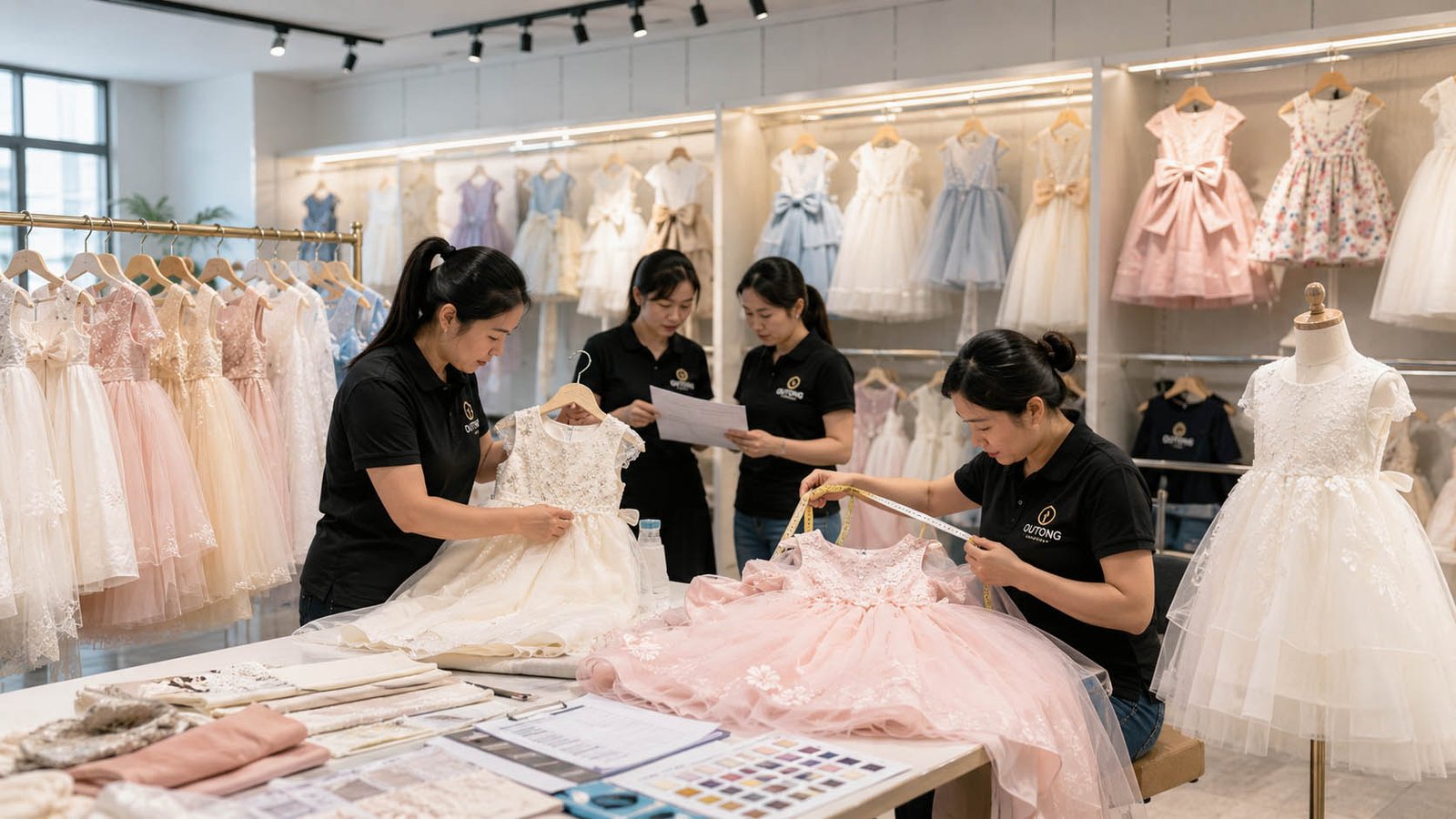
Confirm the pre-production quality check is part of the deal — it is what protects the price you negotiated.
5. Inspecting Booth Samples Like a Buyer
The sample on the rack is the supplier’s best foot forward — which means it is also the standard they hope to hit, not necessarily the one they always deliver. Inspect like a professional:
- Seams and stitching. Pull gently at the seams; check for loose threads, skipped stitches and uneven tension.
- Lining and inner finish. A well-made dress is finished inside, not just outside. Look at the lining and the inside of the bodice.
- Embellishment security. Tug lightly at sequins, beads and embroidery — loose decoration is a return waiting to happen.
- Size accuracy. Compare the sample against the supplier’s size chart; a mismatch here becomes a fit problem for your customers.
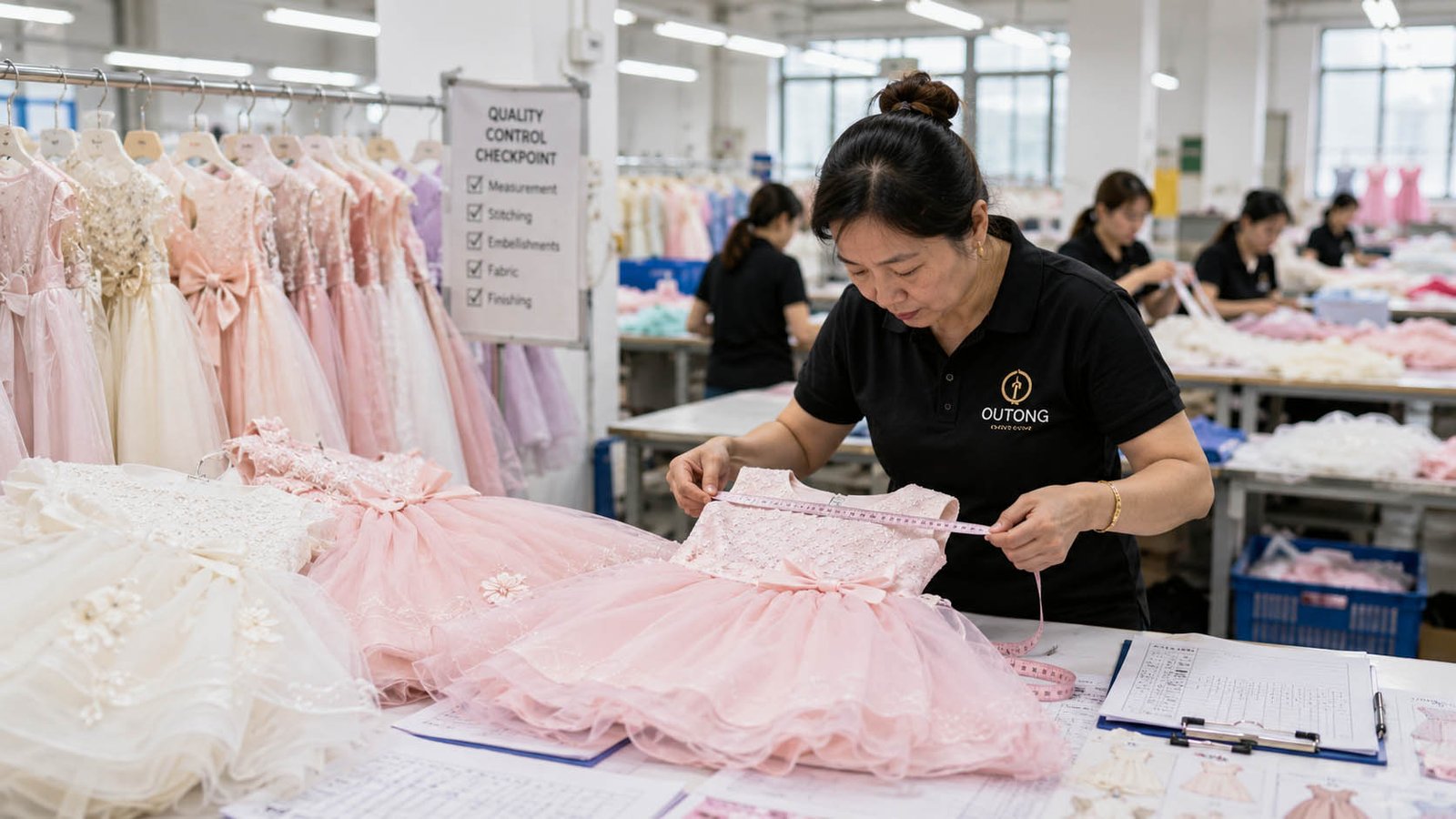
What you inspect at the booth, you should expect to see again in production — ask how QC is enforced at bulk.
6. Visiting the Factory: The Real Test
If a booth conversation goes well, the next step is the factory visit. This is where you verify that the sample was not a one-off and that the operation can actually deliver. For buyers already working with a supplier, the principles are the same:
- Look at the production floor. Organization, cleanliness and the state of the equipment tell you a lot about how your order will be handled.
- Ask about their QC process. A supplier who can walk you through their quality control steps — inspection points, defect handling — is far safer than one who waves it off.
- Check for specialization. A line that makes girls’ dresses every day beats a line that switches product weekly.
- Confirm capacity honestly. Match what you saw at the booth with what the floor can actually produce in your lead time.
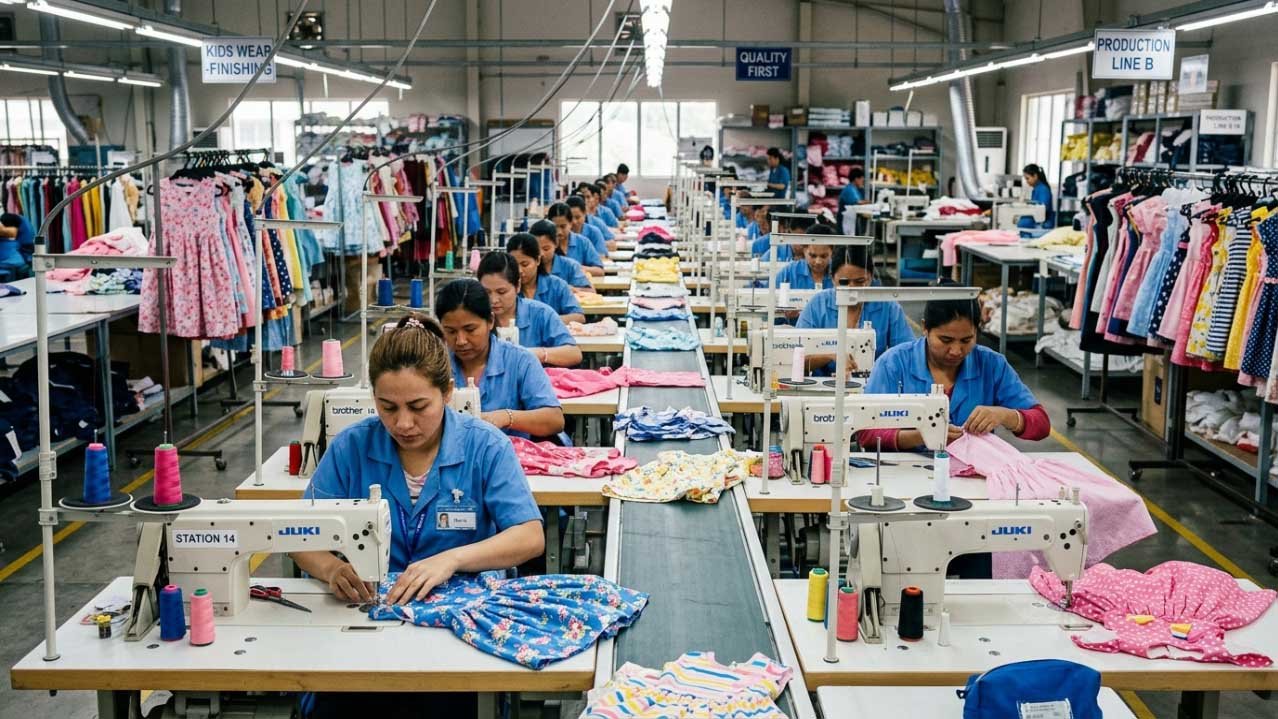
The production floor is the truth test — a clean, organized, specialized line is what reliable delivery looks like.
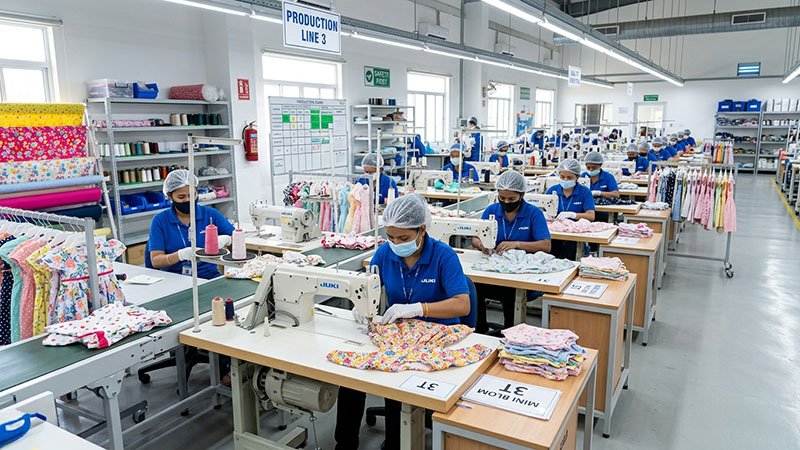
A dedicated sewing line for children’s formalwear signals the consistency your bulk order depends on.
Not every buyer can fly to Guangzhou, and that is fine — the same due diligence applies when you source remotely. Whether you are comparing ready-stock options or planning a custom OEM/ODM line, insist on the same evidence: real samples, a documented QC process, and honest lead times. You can browse a ready-to-ship collection to calibrate what a well-finished girls’ dress should look like before you judge a booth sample.
Frequently Asked Questions
When and where is Canton Fair held?
Canton Fair — the China Import and Export Fair — runs in Guangzhou every spring and autumn. Children’s clothing and formalwear typically appear in specific clothing phases, so confirm the exact dates and hall layout for the garment phase before you travel.
How do I register as a buyer for Canton Fair?
Overseas buyers usually register online in advance to get a buyer badge. Registering early saves you a long wait at the gate, so complete registration before your trip.
What MOQ should I expect for kids’ dresses?
MOQ varies by supplier — a useful planning range is from a few dozen pieces for ready stock up to several hundred for custom runs. Ask about mixed styles and sizes if the minimum feels high, and get the number in writing.
How do I know if a supplier is reliable?
Look for specialization in girls’ dresses, consistent finish quality across all samples, a documented QC process, and a factory visit that confirms real capacity. The booth is the first impression; the factory visit is the verification.
Should I visit the factory after the fair?
If a booth conversation goes well, yes — a factory visit verifies that the sample was not a one-off and that the operation can deliver your volume and lead time. It is the single most valuable due-diligence step.
Skip the flight — source with confidence
Tell us what you’d hunt for at the fair — we’ll show you samples, share our QC process, and quote MOQ and lead time directly.
Leave a Reply