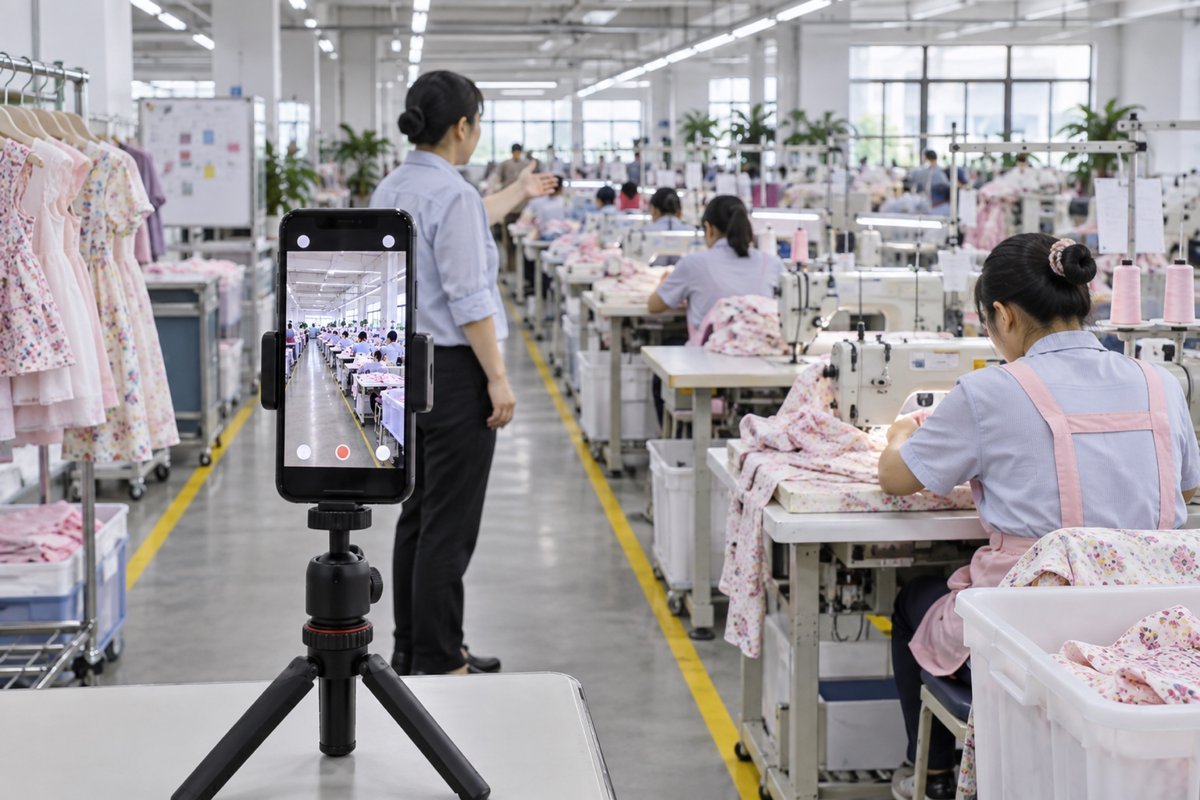
A supplier’s website looks professional. The factory video is shot in daylight, with rows of machines and a long warehouse aisle. The business license is a clean scan with a registration number and a company seal. Buyers read all three as proof, and none of them proves anything except that somebody prepared a presentation. To verify kids dress manufacturer credentials properly, treat every one of those artifacts as a claim rather than evidence.
Here is the gap. The company you chat with, the entity on the invoice, the owner of the bank account you are asked to pay, and the hands that will cut and sew your order can be four different organizations. A trading company can license a factory’s video. A showroom can be borrowed for an afternoon. A license scan can belong to a partner. Nothing in a polished presentation tells you whether those four are the same, and a buyer who assumes they are is exposed from the moment the deposit leaves.
Verification is not the same exercise as choosing. Deciding which supplier fits your product, your quantity and your market is selection, and that is covered in our guide to choosing a kids dress manufacturer in China. Verification asks a narrower and less comfortable question: is what you were told true, and can you prove it before you commit money? Selection narrows the field. Verification decides who gets the order.
What follows is five layers, ordered by cost, each cheap to run and expensive to skip.
The Five Layers, and What Each One Can Actually Prove
Buyers usually verify in one layer and stop. They check a license, or watch a factory video, and then move to price. But each layer answers a different question, and they get closer to the one you care about: whether the supplier can execute your order repeatedly at your specification.
| Layer | What you examine | What it proves | What it still cannot prove |
|---|---|---|---|
| 1. Business identity | Legal name, registration, addresses, bank beneficiary, email domain, document letterhead | Whether the entities you are dealing with are one entity | Whether that entity owns any production capacity |
| 2. Product specialization | Whether the claimed category and the claimed capability agree | Whether the supplier understands this type of garment | Whether they will make your order themselves |
| 3. Live walkthrough | Real-time, unscripted video of the floor | Whether a working production floor exists and is active now | Whether your specific order runs on it |
| 4. Documents | License, test reports, audit records, order paperwork | Whether claims have third-party or transactional backing | Whether each product you buy is compliant |
| 5. Trial production | Sample, then a small order, then bulk | Whether they can execute repeatably at your spec | Strongest execution evidence for that order, but it does not remove the need to re-check the critical points on future orders |
Run them in order, because the cheap layers eliminate the most candidates. Identity inconsistencies remove a supplier in an afternoon at almost no cost. A trial order takes weeks and real money, so it belongs at the end, applied only to survivors.
Two properties matter as much as the layers. Verification expires: a walkthrough is valid for the day you did it, and a test report for the sample it tested. Factories change premises, lines get reconfigured, subcontractors get swapped. Re-run a shortened version on each new order; a good supplier treats that as routine. And verification is not accusation. Almost every inconsistency has an innocent explanation. What you are establishing is whether explanations arrive quickly, in writing, and match each other.
Level 1: Business Identity Is About Consistency, Not Existence
“Do you have a business license?” is the wrong question, and it is the one almost every buyer asks. Every registered company has one. A license confirms legal existence, the lowest possible bar, and a scan of it confirms nothing, because scans are trivially shared and edited.
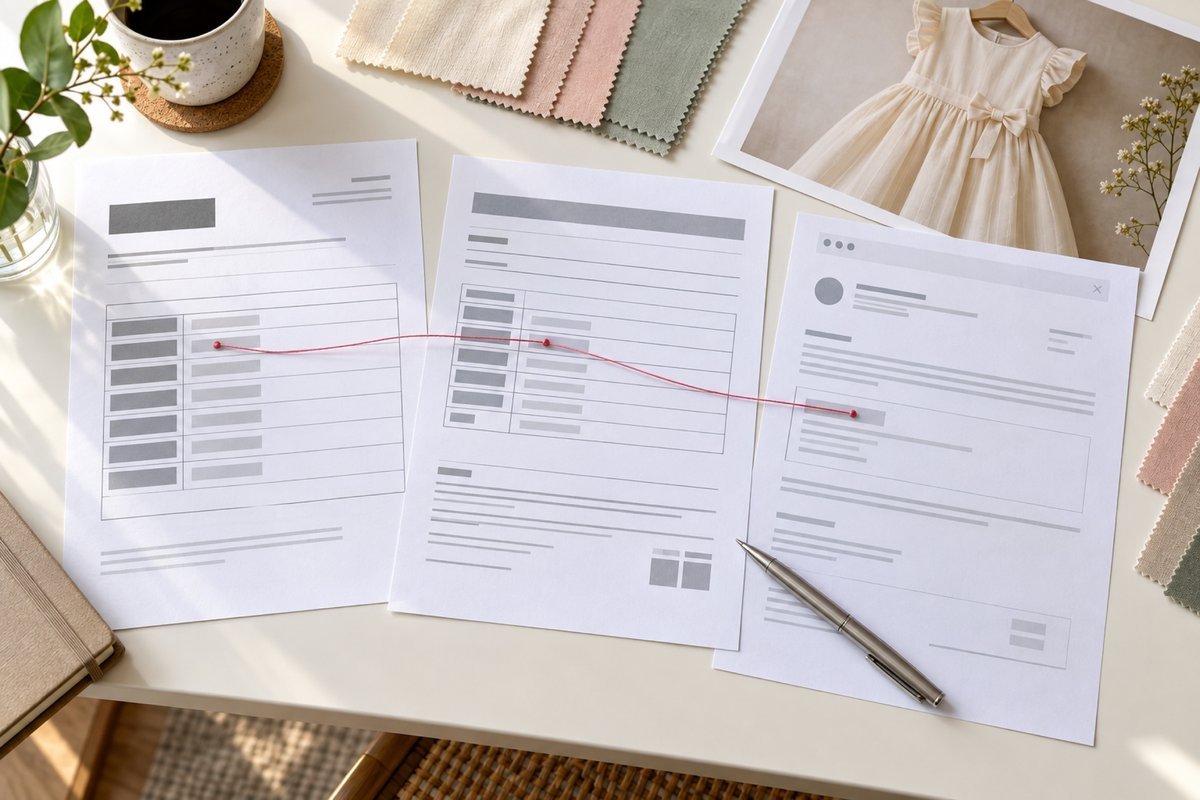
The question that carries information is whether the same name appears everywhere. Build a one-page identity sheet and check each line against the others: the legal name written out in full, the company name on the quotation and proforma invoice, the bank beneficiary, the production address as distinct from the registered address, the email domain, the operating name on the factory gate, and the name and title of whoever signs.
A registered address differing from a production address is normal. A company registers at an office and operates a workshop elsewhere, or holds one registration across more than one premises. That is not a problem by itself. What matters is whether the supplier explains the relationship coherently, the same way twice.
Signals that deserve a follow-up question
A bank beneficiary that is a personal name, or a company you have never been shown, while you contracted with a different entity. This is the most expensive inconsistency in the exercise, because it is the hardest to unwind once money has moved.
Paperwork that changes identity as the deal progresses: the quotation from one company, the proforma invoice from another, the beneficiary a third, each explanation arriving separately.
A registered scope of business that does not include apparel or garment manufacturing, while the supplier describes itself as a producer.
Free webmail against a claim of established export activity. Not proof of anything alone, and plenty of legitimate small suppliers use it. Combined with other mismatches, it suggests a thin operation.
A platform badge indicating a nine-year Gold Supplier history attached to a company registered recently. Registration dates and badge ages are independently checkable.
Signatories who are never named. If nobody will put a name on the document you sign, you cannot hold anyone accountable later.
What to actually do
Get the legal name in writing before you discuss price, and make everything downstream use it. Ask the bank beneficiary to match the contracting entity exactly, and pay nothing to a third party or an individual without a written explanation and a signed authorization.
Work through the danger signals of a kids dress supplier as a separate pass. That article works from behaviour and pattern; this layer works from names and documents. Then keep the identity sheet on file and compare every later document against it. When something does not match, ask once, in writing. The answer tells you more than the mismatch did.
Level 2: Product Specialization, the Signal Buyers Underuse
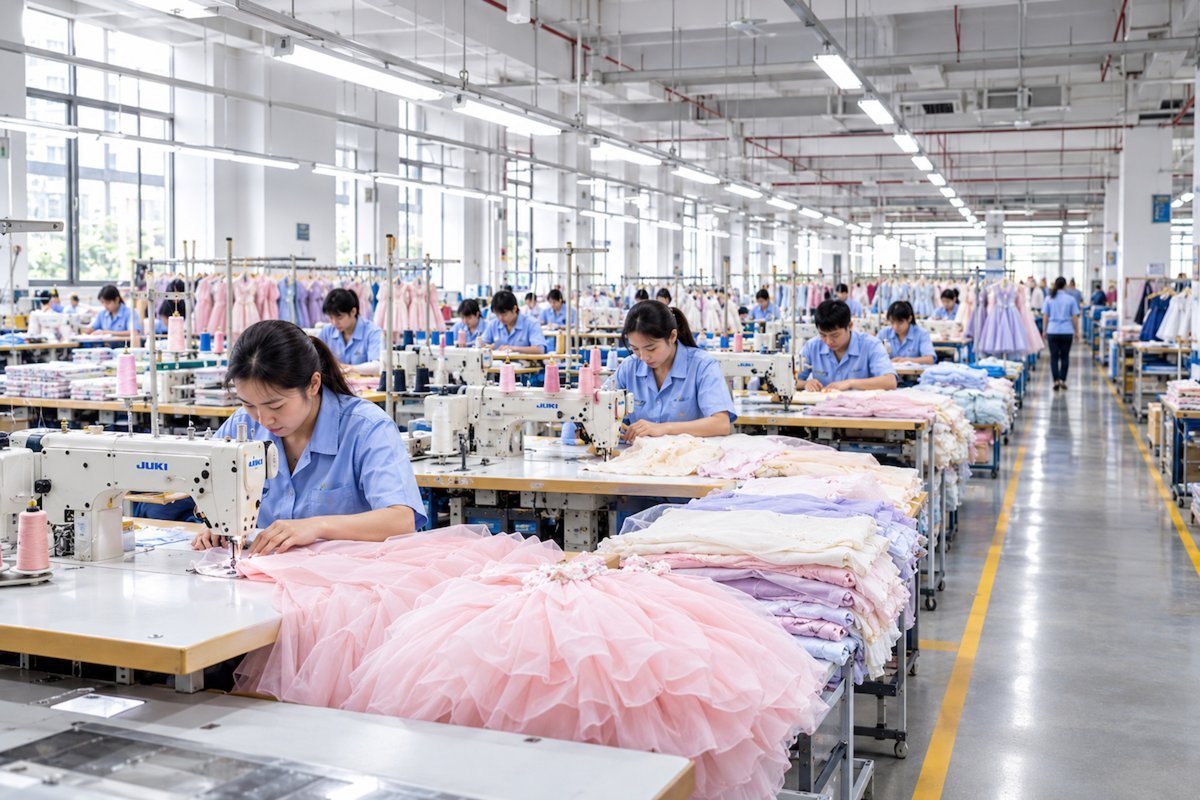
Open a supplier’s catalogue and count the categories. Babywear, denim, swimwear, evening gowns, underwear, outerwear, footwear, and somewhere in the grid, girls dresses. Breadth is not automatically dishonest, but it is a claim that has to be reconciled with how garment production works, and it is the fastest filter available.
A dress factory and a swimwear factory are not the same operation. Swimwear runs on elastane, coverstitch machines and chlorine testing. Denim runs on heavy needle systems, flat-felled seams and enzyme finishing. A multi-layer tulle skirt runs on gathering attachments, careful layer management and a finishing room that does not snag the net. The machines differ, the operators differ, the quality risks differ. A supplier offering all of these either owns several specialized lines, which is unusual, or sources across several factories, which is common.
Neither answer is disqualifying, but it changes what to expect. If you are dealing with an intermediary, the person answering may not be able to answer a construction question about gathering, because gathering is not their work. Know that before assuming their sample reflects their capability. A formal factory audit of a kids dress supplier is built to resolve it.
The questions a real girls dress factory answers without research
Not “do you make girls dresses”, which anyone confirms, but questions whose answers reveal whether someone on the other end has stood next to a machine making this garment. Ask in writing and compare replies.
- On a multi-layer tulle skirt, how is the gathering ratio set on each layer so the layers fall at different lengths, and how do you stop the waist seam turning bulky?
- How is skirt fullness controlled when the bulk net arrives with a different hand from the sample net?
- How are beads, pearls and stones attached, and what stops the thread from cutting through a lightweight fabric over time?
- How do you test that a decoration stays on, pull-testing every piece or spot-checking, and at which point in production?
- Which zipper types do you use on children’s dresses, and how is the zipper guarded so no metal or tape sits against skin?
- Which measurement points in your size range do not scale proportionally, and which one draws the most fit complaints?
- What lining goes against skin, and how is it chosen when the shell is stiff tulle, a coated fabric, or a glitter finish?
- How do you stop glitter and sequin surfaces from shedding onto the lining, and how is shedding assessed before packing?
- How is the hem finished on a curved multi-layer tulle skirt so every layer ends cleanly, and what tolerance do you hold on layer length?
- Which stitch types run at the armhole, the waist seam and the skirt-to-bodice join, and how are those seams finished to survive a wash?
- Do you test the finished garment or only the fabric roll, and who runs the shrinkage and colour-bleed check?
- How does the bodice hold its shape without boning or hardware a child would feel?
- How are appliques and three-dimensional flowers attached so edges do not lift after a few wears?
An honest answer to most of these includes a trade-off. “We set it higher on the outer layer so the top reads longer, but if the net is stiff we reduce that or the hem waves.” A confident answer with no trade-off is not an answer. If you get “high quality” and “we use the best materials”, ask a follow-up that forces a choice: which construction would you avoid, and why.
Three more moves that separate specialists from catalogues
Ask for interior photographs. Manufacturers show the outside because that is what sells. Ask for the inside of a finished garment: how the waist seam is enclosed, how the lining is attached, what the seam allowances look like. The interior is where construction quality is visible or absent.
Ask what they refuse to make. A supplier with a genuine specialization names constructions they turn down or fabrics they will not run. A catalogue accepts everything.
Ask who holds the pattern. Whether the supplier stores a pattern and can repeat a style, or every order starts by borrowing a partner’s pattern, decides what happens when you reorder a dress that sold well.
Level 3: Live Factory Verification, a Walkthrough You Direct
A recorded factory tour is a document. It answers the questions the seller wanted you to ask, in the order the seller chose, on a day when everything looked its best. Live video is different for one reason: the person holding the camera cannot preview the request, and that difference is the entire value of this layer.
Protect it. Ask for a live call, not a video file, and do not accept a recording as a substitute. Announce it at short notice if you can, and if you must schedule it, accept without saying which rooms you want to see. Ask for a time inside their working day; a factory on a morning shift looks very different from one filmed at rest.
The route you should require
Ask for the walkthrough in this order, because the order makes it hard to skip a weak room. Entrance and gate, fabric warehouse, cutting room, sewing floor, finishing and pressing, quality control area, packing area, finished goods warehouse, sample room.
At the gate, look for the operating name and address. This is where Level 1 either holds or falls apart.
In the fabric warehouse, look for identification. Rolls labeled by fabric and by order signal a factory buying against work orders. An unlabeled pile is not necessarily wrong, but ask how they trace a fabric lot back to an order.
In cutting, look for fabric laid out on the table, a marker or cutting plan, and someone actually cutting. Bare tables and covered machines mean nothing is moving today, which may be a scheduling fact, but it should be explained. On the sewing floor, count the lines running and look at the machine types; a dress line needs different attachments from a denim line. Ask what each line is making right now.
In quality control, look for the equipment of inspection: light, a measuring table, records. Then ask what is on the table today. In packing, look at cartons, polybags, labels and size stickers. In the finished goods warehouse, look at shipping marks on cartons, because marks matching a destination market are evidence of real export work rather than staging.
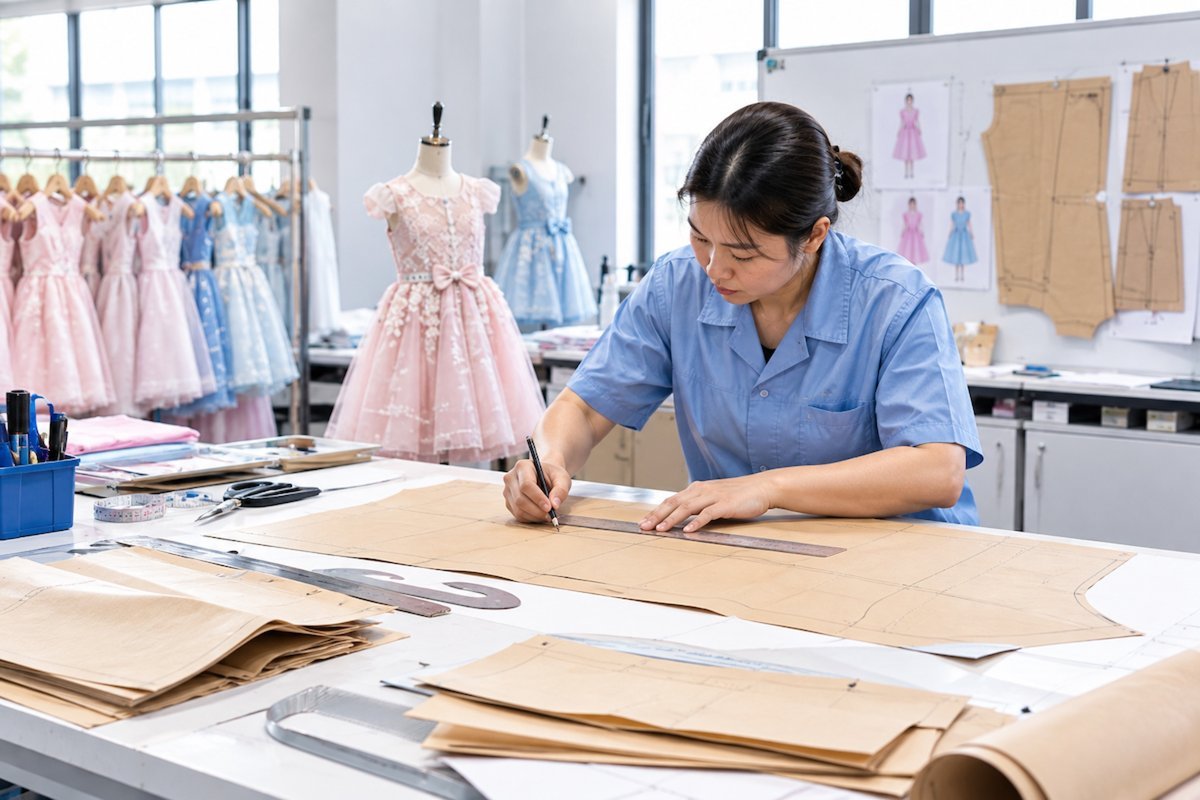
The sample room decides the answer. A pattern table, pattern paper in use, a sample maker working, a rack of samples, a dress form. This room tells you whether the supplier can develop a garment, not merely assemble one they were given.
What to ask for on the spot
Do not only accept a guided tour. Interrupt it with requests for objects a staged visit would not have prepared.
Ask to see the production sheet or work order for whatever is on the cutting table or sewing line right now. A real order sheet carries a style reference, a quantity and a date. Ask them to read the date aloud.
Ask the operator to hold up the bundle ticket attached to the pile in front of them and read the size and quantity on it. Bundle tickets are internal paperwork generated by the factory for its own tracking, worthless to stage and awkward to fabricate live.
Ask to see the size label inside a garment currently being sewn. Ask them to turn a half-finished garment inside out and show the interior, the seam finishing, the lining attachment. Ask them to measure one point of a garment in progress while you watch. Ask what was rejected in quality control today and where the rejects go. Ask to see the trims held for the current order, zippers, buttons and thread, at the point of use rather than in a samples drawer.
Why the spot requests cannot be faked
A prepared video cannot respond. A borrowed showroom has no bundle ticket with today’s date on a bench. Staging a staffed production floor with a live work order and matching internal paperwork costs far more than the visit is worth to a supplier whose business is not production. And the requests compound: each depends on the previous answer.
Add one more test. Ask two questions about the same object at two different moments in the call and compare the answers. Consistency under repetition is difficult to maintain when the answers are fabricated.
What this layer still does not prove
It proves a working floor exists and is active. It does not prove your order will run there. Factories subcontract in peak season, and an intermediary may show you a partner’s floor honestly, which is different from claiming it as their own. Ask directly who will produce your order and where, and put that on the order confirmation. If the answer is “our partner factory”, that is a fact you can plan around, not a scandal.
Level 4: Document Verification, and the Limit of Every Certificate
Documents are the layer buyers trust most and read least carefully. A certificate is not a property of a company. It is a statement about a defined sample, tested by a defined method, at a defined time, for a defined market. Read it that way and it is useful. Read it as a general assurance and it is false comfort.
A business license confirms legal existence and registration scope. It does not confirm capability, capacity or quality. Its value here is identity, which is why it belongs to Level 1.
Test reports carry the most misunderstanding. Ask which sample was tested. Ask whether the report covers a fabric or a finished garment, because a report on fabric says nothing about the trims added afterwards, which are frequently the parts that matter. Read the applicant line: reports are often issued to a mill rather than the factory showing you the file. Then ask the question that resolves most confusion: which report covers this exact construction, with these trims, in this colour?
Audit records, including a Sedex membership or an audit summary, describe a snapshot of a date and a scope. Ask for the date, the site covered, and any findings raised. Findings that were closed properly are more informative than a clean report, because they show how a supplier responds when something is wrong.
Purchase and order records are the most underused set, and you can ask for them with names and prices redacted. A recent order confirmation, proforma invoice, packing list or shipping document for a buyer in your market demonstrates that the supplier actually processes orders of your type. Ask to see the document, not a description of it.
The core limitation applies to all four. A quality management certificate means a system has been audited, not that the beads on the dress in front of you will stay on. A social compliance audit is not a product safety file. A laboratory report is evidence about one sample. For our part, the documentation we can put in front of a buyer is an ISO 9001 certificate, a Sedex membership record, laboratory test reports on specific styles, and an Alibaba Gold Supplier history of nine years. Each is a statement about a defined thing, and each can be checked rather than taken on trust. Read the ISO 9001 certificate for the issuing certification body, the scope wording, the site it covers and the validity dates. Read the Sedex record for the membership status and the registered site, and ask whether you are being shown a membership registration or a completed audit report, because those are different documents. Read a laboratory report for the laboratory, the sample, the method and the date. Read the Alibaba Gold Supplier record for the number of verified years and the business scope attached to it. If a supplier will not show you the document itself with those lines visible, the claim behind it has not been evidenced.
There is a second limitation buyers discover late: a factory’s certificate does not transfer into your compliance file. Depending on your market, the certificate that actually gates your import is issued by you, not the manufacturer. In the United States, the Children’s Product Certificate is the importer’s responsibility, and it rests on third-party testing of the specific product you are importing. It is not a document a factory can hand you to discharge your obligation. The same applies to electronic filing of certificate data with customs, which has applied to covered imports entered since 8 July 2026 and remains the importer’s duty, with a later date for goods entering from a foreign trade zone. Our kids dress quality and compliance support explains what a supplier can and cannot do on your behalf.
The practical rule is short. Ask for the file, read the scope line, identify the sample, check the date, and never accept a certificate as a substitute for a question about your own product.
Level 5: Trial Production, the Only Layer That Tests Execution
Everything above tests existence, capability and honesty. None of it tests execution, which is what you are actually buying.
Step one: the sample
Ask for a sample built against your specification, not a stock style chosen because it looks similar. Sample development runs 5 to 7 days, and where there is no existing pattern to work from, pattern and sample development is quoted at USD 80 to 150.
A sample verifies whether the supplier can read your spec, whether the pattern is sound, whether the trims they described are available, and whether communication closes amendments quickly. It is the best evidence of skill money can buy.
It does not verify consistency, or that the same hands will touch bulk. Watch for the sample that is excellent while the bulk disappoints, because that usually means the sample room made it, staffed with the most experienced people on a relaxed schedule. Ask what portion of the sample is produced by the sample room, and what changes when it goes to a line.
Step two: a small order
A small order tests what a sample never touches: buying fabric at a run quantity, cutting efficiency, line setup, finishing volume, packing, labelling and paperwork.
If the style already exists in the supplier’s range, you can start very low. Selected ready stock styles start from 6 pieces, with a single piece possible on some styles, making an inexpensive test of shipping, packing, labelling and invoicing. Treat that as a logistics test, not a capability test.
For a build against your own design, the commercial threshold is 200 pieces per style, and a trial inside that quantity tests production rather than sampling.
Step three: bulk
Bulk tests repeatability at scale, where most failures live. Shade consistency across fabric lots. Size accuracy across the full range rather than at one point. Decoration attachment across thousands of pieces rather than a few. Packing consistency when the box count is real.
Two things make it reliable. Approve a pre-production sample made from the bulk fabric and bulk trims, not a repeat of the development sample, because that sample is what bulk gets compared against. And define inspection before production starts, with a defect list and an agreed standard, so acceptance is a decision made in advance rather than an argument after arrival. The AQL inspection guide for kids dresses walks through how that standard is set.
Then record what you learned at each step: sample response time, amendment rounds, first-pass defects, packing and paperwork accuracy. That record turns your next order conversation from trust into arithmetic, and it is what makes a move into a custom girls dress build reasonable rather than a leap of faith.
Factory, Trader, or Hybrid: An Honest Comparison
Buyers often treat “trader” as a synonym for “problem”. That framing is wrong, and it causes real losses: a buyer who refuses to work with intermediaries cuts themselves off from the structure that fits a large share of small orders.
| Factory | Trader | Hybrid | |
|---|---|---|---|
| What they directly control | The floor, machines, operators and quality process | The relationship with factories, plus sourcing, sampling follow-up, consolidation and documentation | Some in-house lines and some subcontracted capacity |
| Price structure | Lower headline price, no intermediary margin, and you absorb more coordination work | Carries a margin, often for real services: technical translation, inspection follow-up, consolidation, export paperwork | In between, with margin applied where a step is added |
| MOQ flexibility | Usually firm per style, because line setup is fixed | Often the most flexible, because orders are pooled across factories | Flexible within in-house capability, less so outside it |
| Sampling speed | Sample room is theirs, so 5 to 7 days is normal and changes turn around quickly | Depends on the factory; every amendment is a round trip | Fast for in-house styles, slower for the rest |
| Communication | Direct with the people who make the garment, who are also running a line | Frequently stronger language support, faster replies, more patience with small buyers | Mixed, depending on team structure |
| Principal risk | Capacity risk when the factory is busy; you carry the burden of verifying capability | A defect can surface late because the floor is one step away, and the intermediary’s own stability matters | Both risks, in smaller doses |
| Who it suits best | Buyers with a defined product, a workable quantity, and time to build a direct relationship | Small buyers, multi-category baskets, buyers needing many styles at low quantity each, and anyone who wants one point of contact | Growing brands that need capacity and coordination together |
Read the last two columns rather than the first. A trader who says plainly that they work with a small group of factories, and which one suits your style, is easier to verify than one claiming to own a floor, because a claim you can check is safer than a claim you cannot. The failure mode is not intermediation. It is an intermediary pretending to be something else, which is what the five layers exist to expose.
A trader also does things a single factory often cannot: spreading a small quantity across many styles, absorbing the coordination of a mixed basket, holding one contact who chases several production sites, translating your spec into terms each factory will act on. If your order is a small number of pieces across several styles for one season, a specialist intermediary may serve you better than a factory whose line is built to run one style at a time.
For a hybrid, verify the split instead of the label. Ask which steps are in-house and which are placed outside, then apply Level 3 to the part that will touch your garment.
Ready to move forward?
If you are partway through verifying a supplier, send us the specific point you cannot resolve: a scope line you cannot read, a certificate whose applicant does not match the company name, or a walkthrough you would like to schedule. We will answer that point directly rather than send a brochure. The document set we can put in front of a buyer — ISO 9001, the Sedex membership record, laboratory reports on named styles and the Alibaba Gold Supplier record — is available for inspection with the scope, site and validity lines visible rather than summarised. Typical figures as of September 2026, for planning only: ready stock on selected styles from 6 pieces, custom orders from 200 pcs per style, sampling 5–7 days per round, bulk production 25–40 days after sample approval, and pattern or sample development USD 80–150 where no pattern exists. Exact MOQ, development cost and lead time depend on style, fabric, quantity and season.
Collect them as they arise. A beneficiary name that does not match the company on the invoice. A test report covering a different sample, or a fabric rather than the finished dress. A walkthrough where one room did not match the earlier video. A question about skirt fullness that your contact answered with adjectives instead of a choice.
Send that list, with whatever documents you have, in the state they are in. We will respond point by point against the same five layers: the legal entity and the bank name, the construction questions for your style, the walkthrough you would need to see, the documents that cover the actual product, and the sample and trial order route that fits a quantity you can live with. If part of your brief is still undecided, say so plainly. A stated gap is faster to close than a confident guess.