
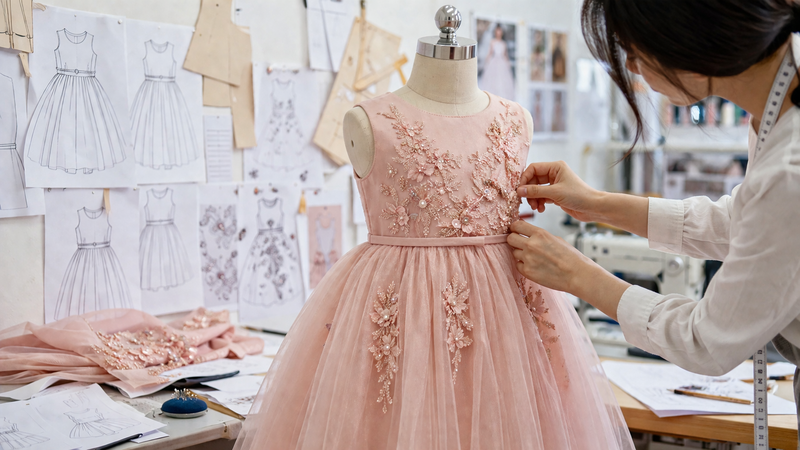
A tech pack is the blueprint of your custom dress — the document that turns your idea into a garment the factory can sew, grade and repeat. A good tech pack saves weeks of revision, prevents costly misunderstandings and makes your brand’s sizes consistent across every order. A weak one produces samples that “look close but are wrong”, endless email chains and a production process driven by guesswork. This guide explains exactly what goes into a kids’ dress tech pack, section by section, so you can brief any OEM supplier with confidence.
See Custom Girls Dress Options
Private label and OEM development starts at 200 pieces per style, with a pre-production sample for approval before bulk cutting begins.
When you ask a factory to make a custom children’s dress, you are handing them a job description. The tech pack is that description, written so precisely that two different factories would produce nearly identical garments from it. In children’s wear this precision matters even more than in adult fashion, because sizing is graded across a wide height range (typically 100–160 cm), and small measurement errors compound from size to size.
1. What a Tech Pack Is (and Isn’t)
A tech pack is a technical specification document, not a design sketch and not a mood board. It translates visual and verbal ideas into numbers, materials, construction details and packaging instructions that a production team can execute without needing you in the room.
- It is: flat sketches, measurement tables, fabric specs, trim specs, construction notes, labelling and packaging requirements.
- It is not: a pretty illustration, a vague description (“a cute pink dress”), or a photo of a competitor’s product with “make this”.
The better your tech pack, the faster your sampling, the fewer revision rounds, and the closer the bulk order matches your approved sample. Factories quote and schedule around the quality of your spec — a clear tech pack signals a professional partner worth prioritising.
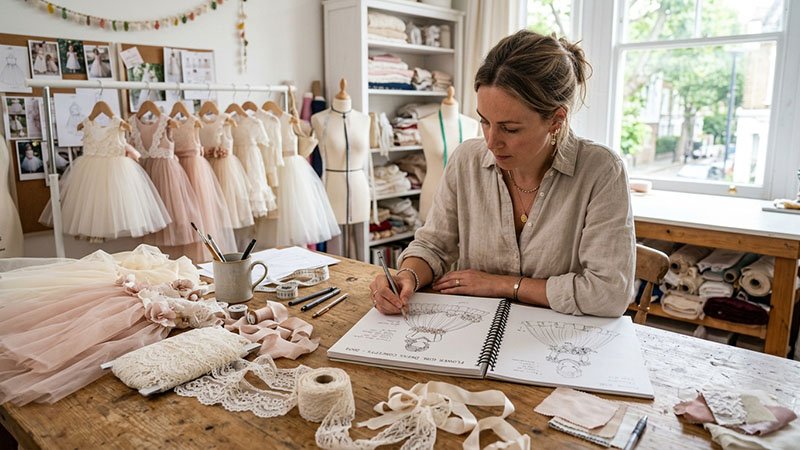
The tech pack is the blueprint: sketches, measurement spec, fabric and trims.
Every tech pack should cover the following sections. You can build your own template once, then reuse it for every style — which is exactly what professional buyers do.
1. Flat Sketches (Front and Back)
Clean line drawings of the dress from the front and back, showing seams, darts, gathers, pleats, pockets, closures and decorative details. Sketches should be flat (not on a model) so measurements can be plotted directly. If you cannot draw, a photo of a similar dress with detailed annotations and callouts works — but a flat sketch is always clearer for the pattern maker.
2. Measurement Spec (Point of Measure)
The single most important page. It lists every key measurement at a defined “point of measure” — chest at 1.5 cm below armhole, waist at the narrowest point, skirt length from waist to hem, sleeve length from shoulder seam, and so on — across the full size run. For kids’ dresses the run is usually height-based: 100, 110, 120, 130, 140, 150, 160 cm. Each measurement needs a tolerance (for example ±1 cm on chest) so the factory knows what is acceptable.
| Size (cm) | Fits height | Chest | Waist | Dress length | Sleeve |
|---|---|---|---|---|---|
| 100 | 95–105 | [spec] | [spec] | [spec] | [spec] |
| 110 | 105–115 | [spec] | [spec] | [spec] | [spec] |
| 120 | 115–125 | [spec] | [spec] | [spec] | [spec] |
| 130 | 125–135 | [spec] | [spec] | [spec] | [spec] |
| 140 | 135–145 | [spec] | [spec] | [spec] | [spec] |
| 150 | 145–155 | [spec] | [spec] | [spec] | [spec] |
| 160 | 155–165 | [spec] | [spec] | [spec] | [spec] |
Send Us Your Tech Pack
Share your sketches, measurements or a reference sample and we will confirm fabric options, trims, sampling time and unit cost.
3. Fabric and Trim Specification
State the exact fabric for each part: main fabric, lining, underskirt layers, waistband. Include composition (for example polyester, or a named blend if confirmed), weight, colour reference (PMS or a swatch number), and any required finishes. List every trim — zippers, buttons, lace, ribbon, sequins, embroidery thread — with colour and size. If you have not confirmed a specific composition percentage, say so and let the supplier propose, rather than guessing on a spec sheet.
4. Construction Notes
Describe how the dress goes together: seam types and allowances, lining construction, closure method (back zipper, buttons, elastic), hem finish, waistband method, and any special handling (for example, sequin application method, embroidery placement). The more specific, the fewer surprises in the sample.
5. Embellishment and Decoration Placement
For lace, embroidery, appliqué, sequins and bows, show placement with callouts and reference photos. State stitching density where it matters (for example, embroidery coverage) and attach a visual reference. Decoration is where most “it doesn’t look right” feedback comes from — because placement was never pinned down.
6. Labelling and Packaging
Define the woven label (brand name, size, fibre content), care label content and placement, hangtags, polybag, folding instructions, and carton requirements. For children’s clothing, care and content labelling matters legally in most markets, so specify the label text in the correct language and format for your destination.
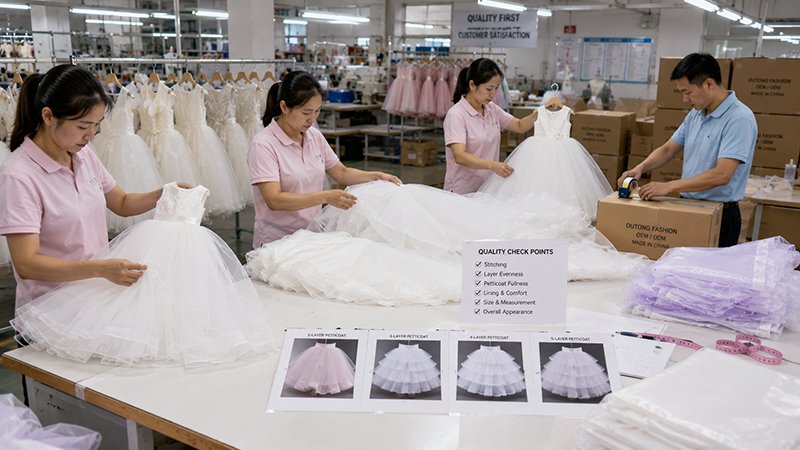
Annotate a reference photo instead of drawing from scratch — the fastest way to a usable spec.
You do not need to be a designer to create an effective tech pack. The most important pages are the measurement spec and the fabric/trim list — both are numbers and words, not drawings. A practical approach:
- Start from an existing dress you like — measure it and photograph it from front, back and side.
- Use the photos as the base — annotate them with measurements and notes instead of drawing from scratch.
- Fill in the measurement table using your size run and the reference garment’s measurements as the starting point.
- List fabrics and trims — state what you know, mark unknowns for the supplier to propose.
- Attach reference images for silhouette, colour and decoration.
Many suppliers will also help you refine a rough spec — a good factory sees your intent and asks the right questions. The goal is a document both sides agree on, not a perfect illustration.
4. Common Tech Pack Mistakes (and How to Avoid Them)
| Mistake | Why it hurts | Fix |
|---|---|---|
| Missing size-run measurements | Factory guesses sizing; sample fits wrong | Always include the full measurement table |
| Vague decoration placement | Embroidery/sequins land in the wrong place | Add callouts and reference photos |
| No fabric composition or weight | Wrong fabric used; hand feel differs | State composition/weight or request proposal |
| No tolerance on measurements | Endless back-and-forth on “acceptable” | Add ± tolerances per measurement |
| Skipping the labelling page | Legal/compliance issues at customs or retail | Specify labels and care text up front |
| No approved sample step | Bulk diverges from expectation | Always require sample approval before bulk |
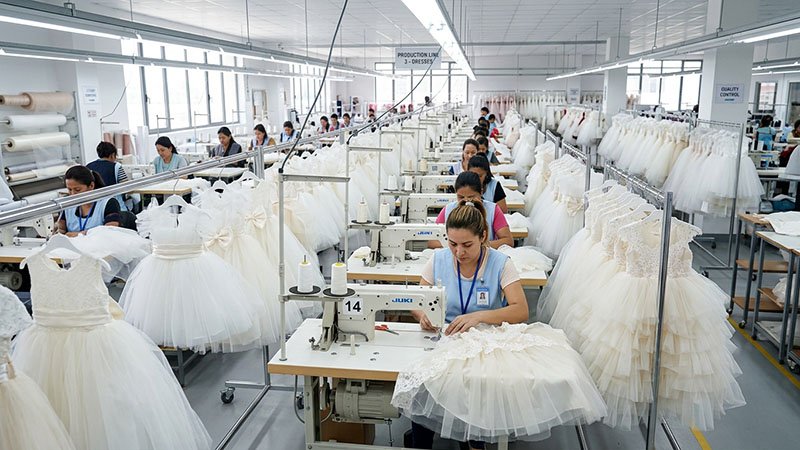
Each tech pack sign-off protects the bulk order against sample drift.
A well-specified tech pack flows through a standard sequence with a competent OEM supplier:
- Feasibility and quotation — the supplier reviews your spec, confirms materials, costs, MOQ and lead time.
- Development sample — the factory makes a first sample from your tech pack (typically 5–10 days for a dress).
- Fit and revision — you review the sample, request changes, and the factory revises until approved.
- Photo/colour approval — colour is confirmed against your swatch; prints or embroidery are approved.
- Pre-production sample — for larger orders, a sample made with bulk fabric and bulk trims, to catch production-specific issues.
- Bulk production and inspection — production runs, inline and pre-shipment inspections confirm conformity to the approved sample.
Each step has a written approval. Keeping this paper trail means the bulk order is measured against the approved sample, not against memory.
6. Tech Pack Checklist for a Kids’ Dress
- Front and back flat sketches with callouts
- Full measurement table (100–160 cm) with tolerances
- Fabric spec: composition, weight, colour ref, lining, underskirt
- Trim list: zippers, buttons, lace, ribbon, sequins, thread
- Construction notes: seams, closures, hem, waistband
- Embellishment placement with photos
- Labelling: woven label, care label text, hangtag
- Packaging: polybag, folding, carton spec
- Colour references (swatch/PMS)
- Approved sample step and sign-off protocol
Work through this checklist once per style and your custom production becomes faster, cleaner and more repeatable — which is the entire point of the exercise.
7. Tech Pack Templates You Can Reuse
You do not need to start from a blank page every time. The smart workflow is to build one master template with all the sections above, then duplicate it per style and change only what is different — measurements, sketches, fabric, decoration. A few practical tips for keeping templates clean:
- Keep a measurement library: once your size run and grade rule are set (for example, how much chest and length grow per size), store it once and reference it instead of retyping tables.
- Standardise fabric names: use consistent naming (“polyester satin”, “soft tulle, 6 layers”) across all tech packs so the factory’s team learns your vocabulary.
- Version everything: label revisions (Tech Pack v2, v3) with dates and change notes. When you are three revisions deep, the version history is what prevents using an outdated spec.
- Attach the approved sample photo: a photo of the approved physical sample inside the tech pack gives the production team a visual anchor alongside the numbers.
Suppliers who ask clarifying questions about your tech pack protect your outcome.
Not every factory gives feedback on your spec — the best ones do. A supplier who asks clarifying questions about fabric weight, fit tolerance or decoration placement is protecting your outcome, not complicating your life. When you brief a factory, expect and welcome these questions:
- “Is the chest measurement at the armhole or 1.5 cm below?” — a fit-defining detail.
- “Do you want a soft or firm waistband?” — changes both feel and grading.
- “Should the lining be the same fabric or a soft cotton?” — comfort and cost differ.
- “What tolerance is acceptable on the dress length?” — sets the pass/fail bar for QC.
If a supplier accepts your tech pack without a single question, be slightly suspicious — it often means they will not follow it closely either. Technical dialogue in sampling is the sign of a partner who will catch issues before they become problems.
9. Frequently Asked Questions About Kids’ Dress Tech Packs
Do I Need a Tech Pack for Ready-Stock Orders?
No. Ready-stock styles are already produced in standard sizes — you choose styles, colours and sizes from the existing range. Tech packs are for custom OEM/ODM work, where you are changing design, fabric, sizing or branding. Many buyers start with ready stock to test the market, then move to custom with a tech pack once they know what sells.
What If I Only Have a Photo of a Dress I Like?
That is a workable starting point. Send the photo with measurements of a similar garment, and the supplier’s development team can reverse-engineer a spec for you to approve. It will not be identical to the photo — fabric and construction differences always appear — but it gets you 80% of the way with less effort than drawing from scratch.
How Much Does a Tech Pack Cost?
For a buyer, a tech pack costs only your time — it is a document you create. Factories may charge for development sampling (commonly a sampling fee per style, often credited against the bulk order). The tech pack itself is free; the mistakes it prevents are what save you money.
How Long Is a Development Sample After I Send the Tech Pack?
For a children’s dress, a first development sample typically takes 5–10 days once the factory confirms feasibility, plus shipping time. Revision rounds add time per round. The cleaner your tech pack, the fewer rounds — which is why the document is worth investing in.
What Sizes Should a Kids’ Dress Tech Pack Cover?
For wholesale girls’ dresses, the standard height-based run is 100, 110, 120, 130, 140, 150 and 160 cm — covering roughly ages 2 to 14. You can shorten the run (for example 110–140) for a focused range, but state it explicitly. Every size in the run needs its own row in the measurement table; do not list “one size” unless the style genuinely is one size.
Can I Use the Same Tech Pack for a Second Factory?
Yes — that is one of the main benefits of a good tech pack. A complete spec lets you get quotes from multiple factories and switch suppliers without re-explaining your design from scratch. Small differences in interpretation may still appear (grading, seam allowances), so always order a development sample from a new factory even if you have an approved spec.
Send us your tech pack
We review specs within 6 hours and reply with feasibility, MOQ and sample lead time — including help refining a rough spec. WhatsApp us or email luxudress@gmail.com.
Leave a Reply