
Fit is the single biggest driver of returns in children’s formalwear, and most of those returns trace back to one thing: buyers converting sizes by label instead of by body measurement. The fix is to price and stock by height in centimetres — the one measure that is consistent across US, UK, EU and Chinese factories — then use a conversion table for everything else. This guide gives you that table and the method to build your own.
Browse the Collection
See how these fabrics, silhouettes and size ranges look on finished styles — filter by occasion, season and size range.
A “size 5” in the US is not a “size 5” in the UK, and a Chinese factory’s “120” is not a label at all — it is a child’s height in centimetres. When an importer reads a size chart wrong, the result is a carton of dresses that fit nobody, a spike in returns, and a markdown pile at the end of the season. For a boutique buying wholesale girls’ dresses, a correct size conversion is not a nicety — it is margin protection.
This guide explains why children’s sizes are so fragmented, gives you a working US/UK/EU/CN conversion, and shows you how to build a size chart your customers actually trust.
1. Why Kids’ Dress Sizes Are So Fragmented
Unlike adult clothing, children’s sizing has no single global standard. Four systems dominate, and they do not line up cleanly:
- US sizes (2T, 3T, 4, 5, 6X…) blend age, weight and height in a way that varies by brand.
- UK sizes follow age (age 3, age 4, age 5…) but run slightly differently from US.
- EU sizes are the most consistent — they map directly to height in centimetres (110, 116, 122…).
- Chinese factory sizes (90, 100, 110…160) also use height in centimetres, which is why they are the most reliable basis for manufacturing.
The practical takeaway: height in centimetres is the anchor. Every other system should be converted to and from height. If you only remember one rule, remember that a Chinese “120” means “fits a child around 120 cm tall” — roughly a US size 6–7 or a UK age 6.
A proper size chart anchors on height first, then chest and waist — never on the label alone.
2. The US / UK / EU / CN Conversion Table
Use this as a practical planning reference. It is an illustrative conversion — individual brands and factories vary, so always confirm against your supplier’s actual spec sheet before ordering.
| Height (cm) | CN factory | US | UK | EU | Approx. age |
|---|---|---|---|---|---|
| 90–100 | 100 | 3T–4T | 2–3 yrs | 98–104 | 2–3 |
| 105–110 | 110 | 4–5 | 4–5 yrs | 110–116 | 4–5 |
| 115–120 | 120 | 6–7 | 6–7 yrs | 122–128 | 6–7 |
| 125–130 | 130 | 8 | 8 yrs | 134–140 | 8–9 |
| 135–140 | 140 | 10 | 10 yrs | 146–152 | 10–11 |
| 145–150 | 150 | 12 | 12 yrs | 158–164 | 12–13 |
| 155–160 | 160 | 14 | 14 yrs | 164–170 | 14 |
Request Fabric Swatches
Feel the fabric before you order. Tell us which styles you are considering and we will send swatches with the weight and composition noted.
Illustrative conversion — exact mappings vary by brand and factory. Confirm against your supplier’s spec sheet.
3. The Measurements That Actually Matter
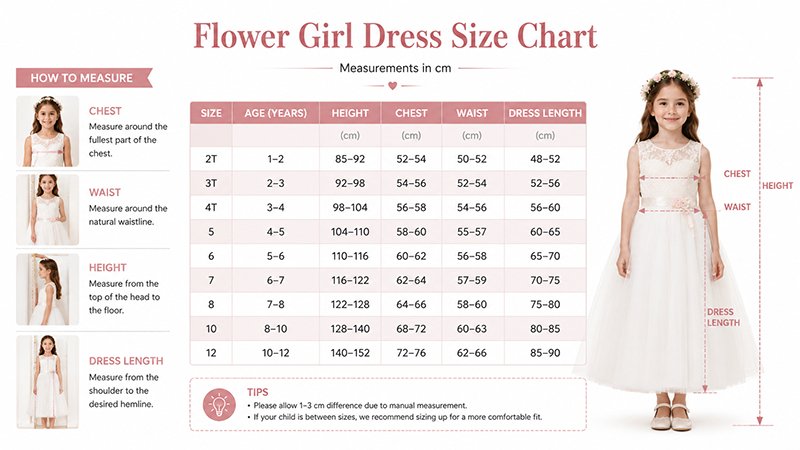
Height is the anchor, but three other measurements determine whether a dress actually fits. If your supplier only gives you a height, ask for these before you commit:
- Chest — the widest point around the chest. The single most important fit measure for bodices.
- Waist — the natural waist. Critical for dresses with a fitted or dropped waist.
- Dress length — shoulder to hem. Determines floor-length, tea-length or knee-length.
For occasionwear, also confirm tolerance. A useful planning tolerance is ±1–2 cm on these measures, depending on the garment’s construction and fabric. Dresses without a defined waist (like a free-flowing tulle skirt) are more forgiving than fitted bodices.
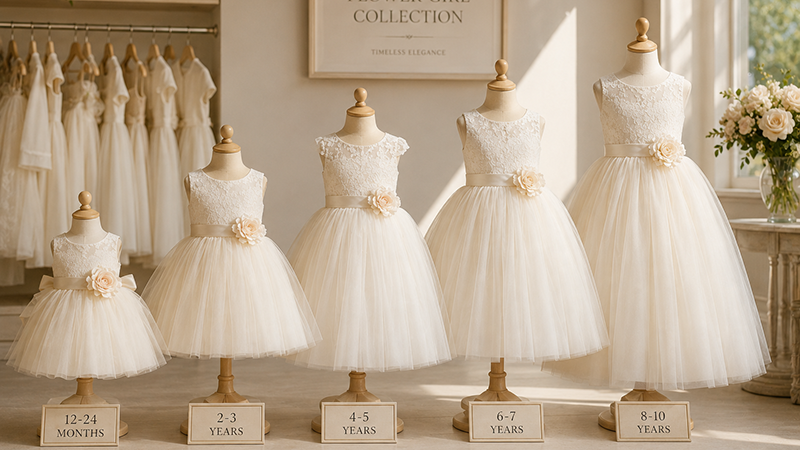
Seeing the full size run side by side makes conversion errors obvious before they become returns.
4. How Fabric Changes the Fit
Two dresses with identical measurements can fit completely differently because fabric behaves differently. This matters when you convert sizes across a dress collection with mixed fabrics:
- Tulle and organza — little stretch, so a size that is slightly small feels very small. Fit generously; err toward the larger size.
- Satin — little stretch but smooth; a close fit is wearable. Match the measurement more precisely.
- Knits / stretch blends — forgiving; a slightly small size still works.
The rule: the less stretch, the more you must get the size exactly right. A tulle flower girl dress with a stiff bodice is the least forgiving piece in your range — that is the one where a conversion error becomes a return.
5. Building a Size Chart Your Customers Trust
Your own size chart is the difference between a confident buyer and a return. Build it once, in this order:
- Anchor on height (cm) as the primary axis.
- Add chest and waist for every size, measured on the actual garment.
- Add a fit note — “if between sizes, size up for tulle; true to size for satin.”
- Add tolerance — a ±1–2 cm note sets the right expectation.
- Translate to your market’s labels (US/UK/EU) using the table above.
Once the chart exists, publish it on every product page and in your order confirmation. The goal is not to eliminate size questions — it is to answer them consistently so the customer commits with confidence.
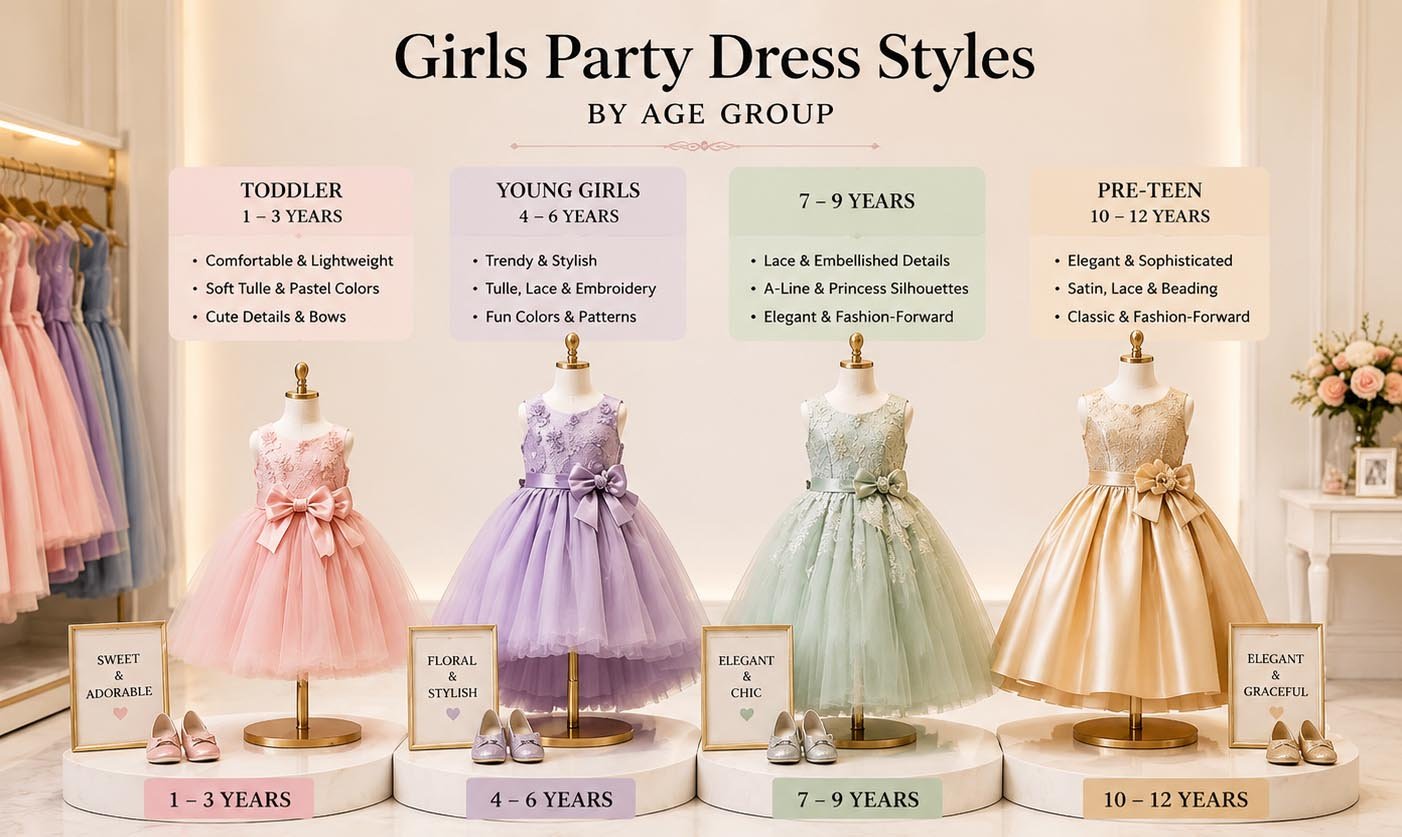
Group styles by age band and height so buyers can self-select the right conversion without guessing.
6. Reducing Returns With Sizing Strategy
A correct size chart is half the battle; the other half is buying the right size mix. Two moves cut returns measurably:
Stock the Full Run, Weight the Middle
Demand clusters in the middle sizes. A useful planning pattern is to weight your order toward the mid range (roughly 110–140 cm in most markets) while keeping the smallest and largest sizes as low-quantity completeness stock. The exact ratio depends on your customer’s age profile.
Publish a “When in Doubt, Size Up” Rule
Children grow, and formalwear is worn for a single event, so a slightly roomy dress is almost always better than a slightly tight one. Publishing an explicit “size up” recommendation for non-stretch fabrics measurably lowers fit returns.
When you buy from our ready-stock program, sizes run from about 110 to 160 cm and you can mix-and-match within the order — which makes it easy to test the size ratio that fits your market before you commit to a custom OEM/ODM run.
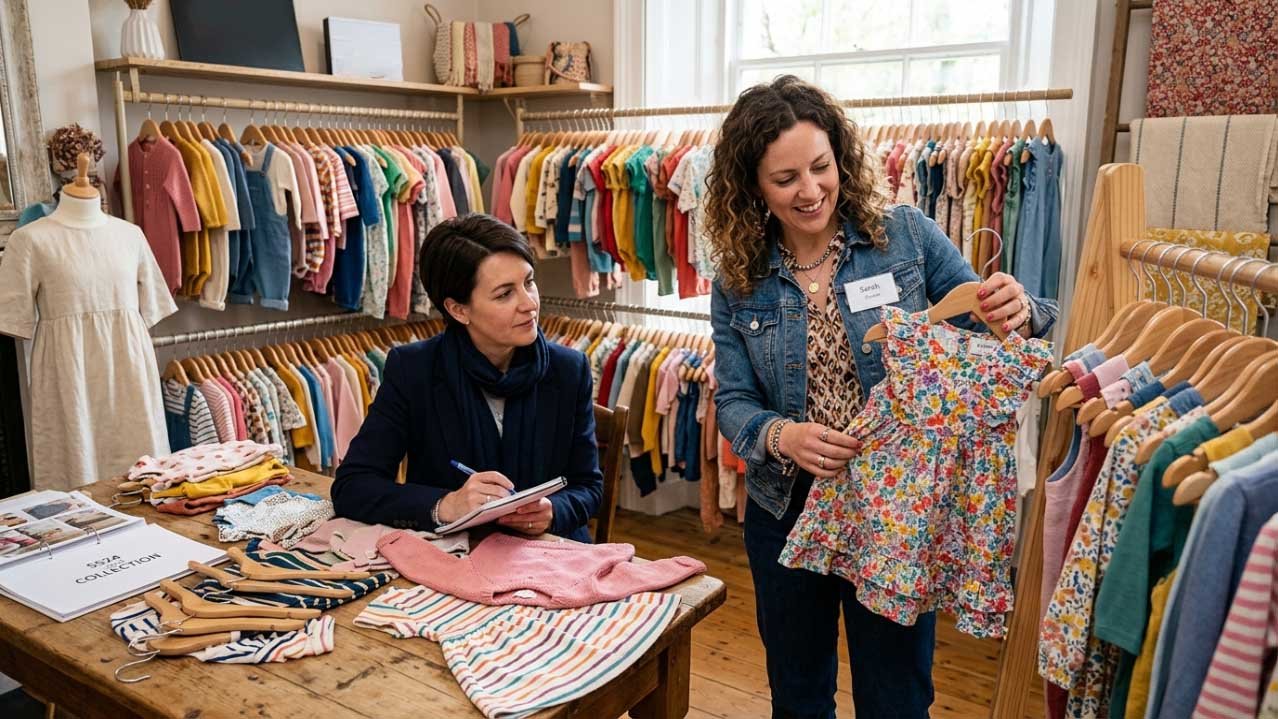
Buy the size run that matches your actual customer — measure your sales, not a generic chart.
7. A Quick Reference You Can Print
Keep these three conversions on a sticky note next to your buying screen:
- 100 cm ≈ US 3T–4T ≈ UK 2–3 ≈ age 2–3
- 120 cm ≈ US 6–7 ≈ UK 6–7 ≈ age 6–7
- 140 cm ≈ US 10 ≈ UK 10 ≈ age 10–11
If you can anchor every conversation on height, and convert labels only at the end, most of the ambiguity that drives returns disappears. Browse the ready-stock collection to see how a full size run reads in practice.
Frequently Asked Questions
What does a Chinese factory size “120” mean?
It means the garment fits a child around 120 cm tall. Chinese factory sizes map directly to height in centimetres, which makes them the most reliable basis for ordering — convert other labels to height, not the other way around.
Which measurement matters most for fit?
Height anchors the size, but chest is the single most important fit measure for bodices. Always confirm chest, waist and dress length from the factory, not just the height label.
How much tolerance should I allow in sizing?
A useful planning tolerance is ±1–2 cm on key measurements, depending on fabric and construction. Non-stretch fabrics like tulle and organza are the least forgiving and need the tightest tolerance.
Should customers size up or down for tulle dresses?
Size up. Tulle and organza have little stretch, and children’s formalwear is worn for a single event, so a slightly roomy dress is safer than a tight one.
Why do US, UK and EU sizes not line up?
They evolved independently — US sizes blend age and weight, UK follows age, and EU maps to height. That is why height in centimetres is the only consistent anchor across all three.
Get the size chart right before you buy
Send us your target market — we’ll confirm the size conversion, chest/waist/length spec and MOQ for your order.
Leave a Reply