
Every boutique owner hits the same fork in the road: order a small batch to stay flexible and test the market, or commit to mass production to drive the unit cost down. The right answer is rarely “always one or the other” — it depends on your stage, your cash flow and how much you already know about what sells. This guide helps you choose, using wholesale girls’ dresses as the working example.
Start With a Low-Minimum Test Order
Before you commit to a bulk run, test a supplier with ready-stock styles — mixed styles and colours from 6 pieces, so you can judge fabric, stitching and sizing firsthand.
The tension is simple. Small batches cost more per unit but carry far less risk; mass production is cheaper per unit but concentrates risk in a single large order. A boutique that scales too early ends up with dead stock; a retailer that stays small forever leaves margin on the table and cannot meet demand. The skill is knowing when to move from one to the other.
Before you decide on volume, make sure you understand your minimum order constraints — see our guide to kids dress MOQ and how to negotiate lower minimums.
1. What “Small Batch” and “Mass Production” Actually Mean
In children’s apparel, the boundary between the two is usually drawn at a few hundred units per style.
- Small batch — typically from a few dozen to a couple of hundred pieces per style, often sourced from ready stock or a short-run custom order. Lower upfront commitment, higher per-unit price.
- Mass production — hundreds to thousands of pieces per style, produced to order against a confirmed forecast. Lower per-unit price, higher upfront commitment and longer lead time.
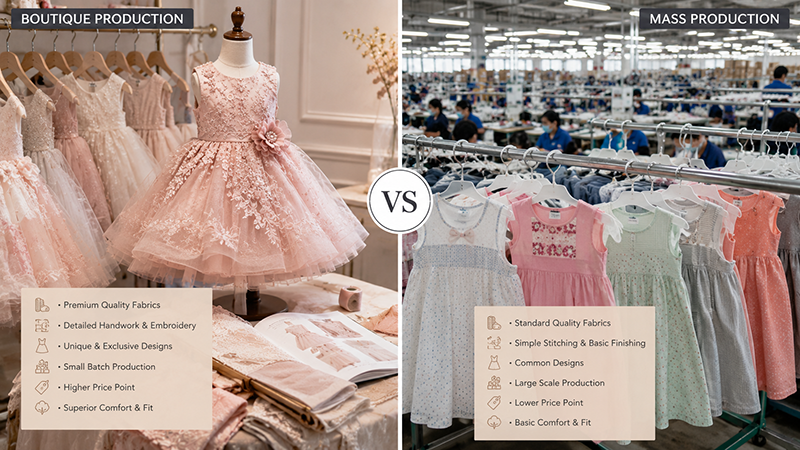
Small-batch and mass-production models differ on cost, risk, lead time and flexibility — the choice is a strategic one.
2. The Trade-Offs, Side by Side
The table below summarises how the two models differ across the dimensions that matter most to a retailer.
| Factor | Small batch | Mass production |
|---|---|---|
| Unit cost | Higher per piece | Lower per piece |
| Upfront capital | Lower | Higher |
| Lead time | Shorter (ready stock is immediate) | Longer (custom production) |
| Inventory risk | Low | High |
| Flexibility | High — easy to pivot | Low — committed to a forecast |
| Customization | Limited (existing designs) | Full (custom/OEM/ODM) |
Get a Sourcing Quote
Send us your target styles, size run and quantity. We reply with MOQ, unit pricing and sample lead time — no obligation.
Notice the pattern: small batch trades cost for flexibility, while mass production trades flexibility for cost. There is no universal winner — only the right model for your current situation.
3. When Small Batch Is the Right Call
Small batch is the right choice when your priority is learning, testing or preserving cash. Specifically, choose small batch when:
- You are testing a new market or a new style and do not yet know what will sell.
- Your cash flow is tight and you cannot afford to tie up capital in a large order.
- You sell seasonally and want to avoid being stuck with last season’s stock.
- You are launching a brand and want to validate demand before scaling — see how to start a kids dress brand with low MOQ.
- You need speed — a ready-stock order ships immediately, while custom production takes weeks.
4. When Mass Production Makes Sense
Mass production becomes the right call once you have proof of demand and want to protect your margin at scale. Move to mass production when:
- A style has proven itself and you are reordering a known best-seller.
- You have a confirmed forecast — for example, a wholesale account or a seasonal event with predictable volume.
- Your margin depends on unit cost and the volume is large enough to move the price meaningfully.
- You need custom work — exclusive designs, private labels and custom colours all require OEM/ODM production, which is a mass-production model by nature.
The key is that mass production should follow evidence, not hope. The most expensive mistake in this business is scaling a style that has not yet proven it sells.
5. A Simple Decision Framework
Pull the decision together with three questions:
- Do I have proof this sells? If not, stay small and test.
- Can I afford the capital and the risk of a large order? If not, stay small.
- Is my margin materially better at scale? If yes and the first two answers allow it, scale up.
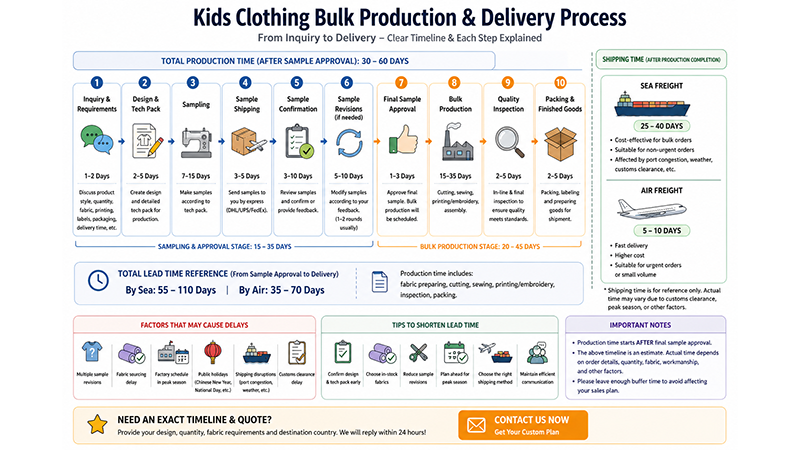
A clear production flow — sample, approve, bulk — helps you move confidently from test orders to full production.
A practical path many boutiques follow is to buy ready stock to test, then commission custom production once a style repeats. Ready stock lets you learn what sells with minimal risk; custom production lets you lock in margin and exclusivity once you know. This staged approach lets you capture the benefits of both models while avoiding the worst cost of either.
6. Hidden Costs to Watch in Each Model
Both models have costs that do not show up on the unit price:
- Small batch: higher per-unit freight, less negotiating power, and the risk of reordering with slight differences between batches.
- Mass production: warehousing and capital tied up in stock, the risk of markdowns on unsold inventory, and the cost of a quality problem across a large run.
Price these into your decision, not just the invoice. A “cheap” mass-production unit that ends up 40% marked down is not cheap. A “expensive” small batch that sells through completely is often the better deal.
Frequently Asked Questions
What is considered a small batch for kids dresses?
In children’s apparel, a small batch is typically a few dozen to a couple of hundred pieces per style, often sourced from ready stock or a short-run custom order. It trades a higher per-unit price for lower risk and faster turnaround.
How much cheaper is mass production per unit?
It depends on the style and volume, but the unit cost can drop noticeably once you move into hundreds or thousands of pieces, because fabric, cutting and setup costs are spread across more units. The exact saving depends on the supplier and order size.
Should a new boutique start with small batches or mass production?
Almost always small batches. A new boutique does not yet know what sells, so a small batch limits inventory risk and frees cash flow. Scale into mass production only after a style proves itself with repeat demand.
Can I do custom designs in small batches?
It depends on the factory’s minimums. Some custom work requires higher volumes because of fabric and setup costs, but many suppliers offer lower-MOQ custom options. Discuss your design with the supplier to see what is achievable at your volume. We run custom OEM from 200 pcs — tell us your design and we’ll confirm what’s achievable.
How do I move from testing to mass production?
Buy ready stock to test the market, track which styles sell through, and commission custom or bulk production once a style repeats. This staged approach captures the flexibility of small batches and the margin of scale.
What is the biggest risk of mass production?
Dead stock — committing capital and warehouse space to inventory that does not sell. That is why mass production should follow evidence of demand, never hope, and why testing with a small batch first is the safer path.
Not sure which volume is right?
Tell us your situation — what you sell, where, and your budget — and we’ll recommend a batch size and MOQ that fits your stage.
Leave a Reply