
Put two girls’ dresses side by side, both carrying a Size 6 label, and hand them to the same child on consecutive days. One closes easily and skims the body. The other pulls across the chest, sits too low at the waist and needs the zipper forced. Neither label is a lie. Neither dress is defective. They were built on different definitions of what Size 6 means, and the buyer who ordered both assumed the label carried a specification when it only carried a word.
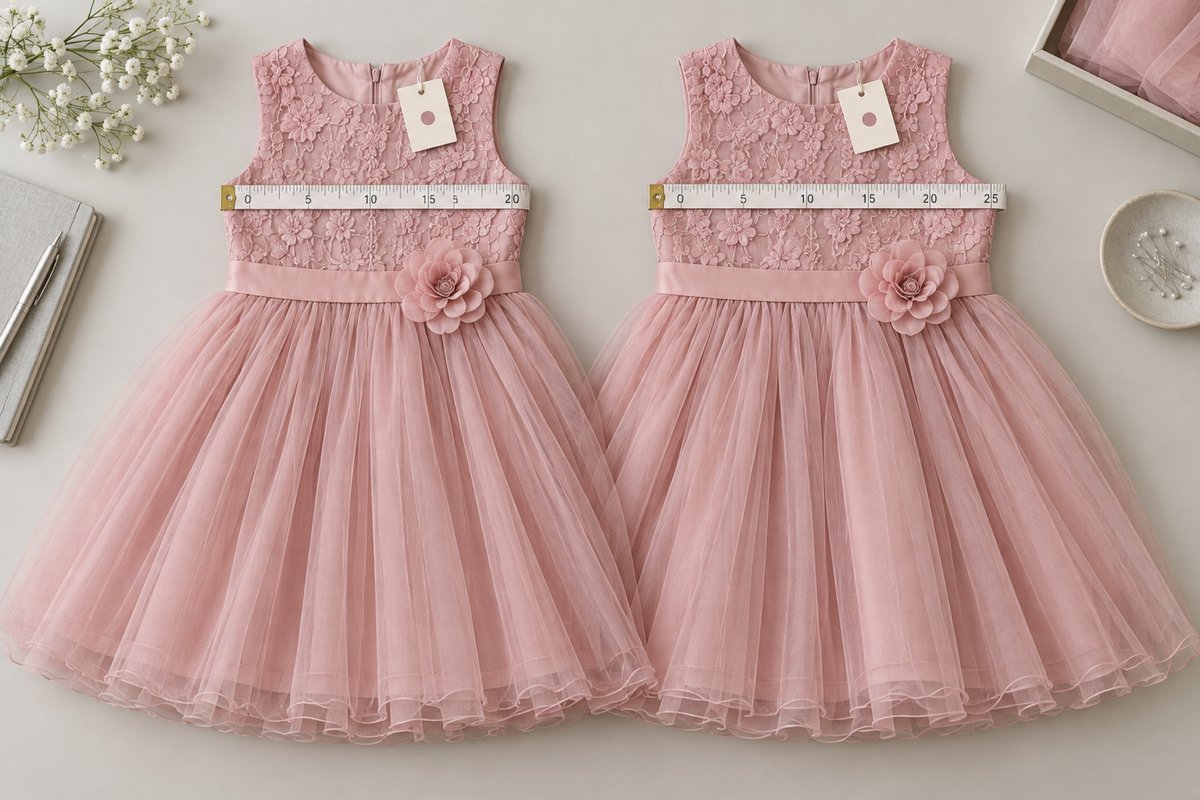
This is the most expensive misunderstanding in kids’ wholesale buying, because it does not show up until goods are in the warehouse. Girls dress size grading is the discipline that prevents it: the work of defining what each size measures, how that measurement changes from one size to the next, and how much variation is acceptable before a garment is wrong.
Most buyers treat grading as a factory task they do not need to understand. That is a mistake, and not a complicated one to fix. The seven ideas below build on each other, from the difference between a label and a measurement up to the rule that tells you which measurements can never be compromised and which ones can move. Read them in order, because the last one only makes sense once the first three are clear.
① A Size Label Is Not a Body Measurement
Three numbers circulate in every size conversation, and buyers routinely use one word for all three.
A size label is a marketing and inventory device. It is a name printed on a tag so that a shop, a marketplace listing and a warehouse can refer to the same thing unambiguously. It has no fixed meaning across brands. A Size 6 from one label and a Size 6 from another label can describe two different garments, and both can be marketed honestly, because the label is not a regulatory measurement.
A body measurement describes a child. Chest circumference, waist circumference, shoulder width, back length and height describe a person, taken at defined points with a tape held in a defined way. Body measurements are the raw material of a size specification.
A garment measurement describes the dress. Chest width measured flat across the front and doubled, waist width, bodice length, skirt length, armhole curve, hem sweep and neck width describe cloth, not a child.
The confusion happens because the same word, Size 6, is used for all three layers. A buyer says “Size 6” and means the body they are targeting. A factory hears “Size 6” and reaches for whichever garment specification it already has on file under that name. If those two things were never compared, the first sample will look plausible and the bulk order will be wrong in a way that is hard to argue about, because nothing was written down.
The fix is not complicated, but it requires one decision from the buyer: state which layer you are specifying. If you specify a body range, the factory must still convert it to garment measurements, and that conversion is where ease and construction get added. If you specify garment measurements, you have handed the factory a fit target to develop a pattern against, instead of a size label it has to interpret. That is a real improvement, and it is also where the common misunderstanding sits: finished garment measurements are not cutting dimensions. Pattern engineering, seam and construction allowances, shrinkage compensation, grading and marker making all still happen between your measurement sheet and the cutting table. If you specify only a label, the factory will supply its own house definition, and you will discover what that definition was when the goods arrive.
Two practical habits follow from this. Ask your supplier for the flat measurement sheet of any style before confirming an order, and check that the sheet states whether each figure is a body measurement or a garment measurement. A sheet that lists numbers without that distinction is not a specification, and it cannot be used to resolve a fit dispute later. If you have never reviewed one of these documents, our guide to the elements of a complete kids dress tech pack shows where the measurement sheet sits inside the full production file.
② Building the Base Size
Grading does not begin with five sizes. It begins with one.
The base size is the size the pattern is drafted and fitted on first, and every other size in the range is generated from it by shifting measurement points. Choose a base that sits in the middle of your range and is the size your customer buys most, because the base carries the most careful drafting and the most thoroughly fitted proportion. A base size at the edge of a range, such as the smallest or the largest, forces every other size to be derived from a garment that is least representative of the whole.
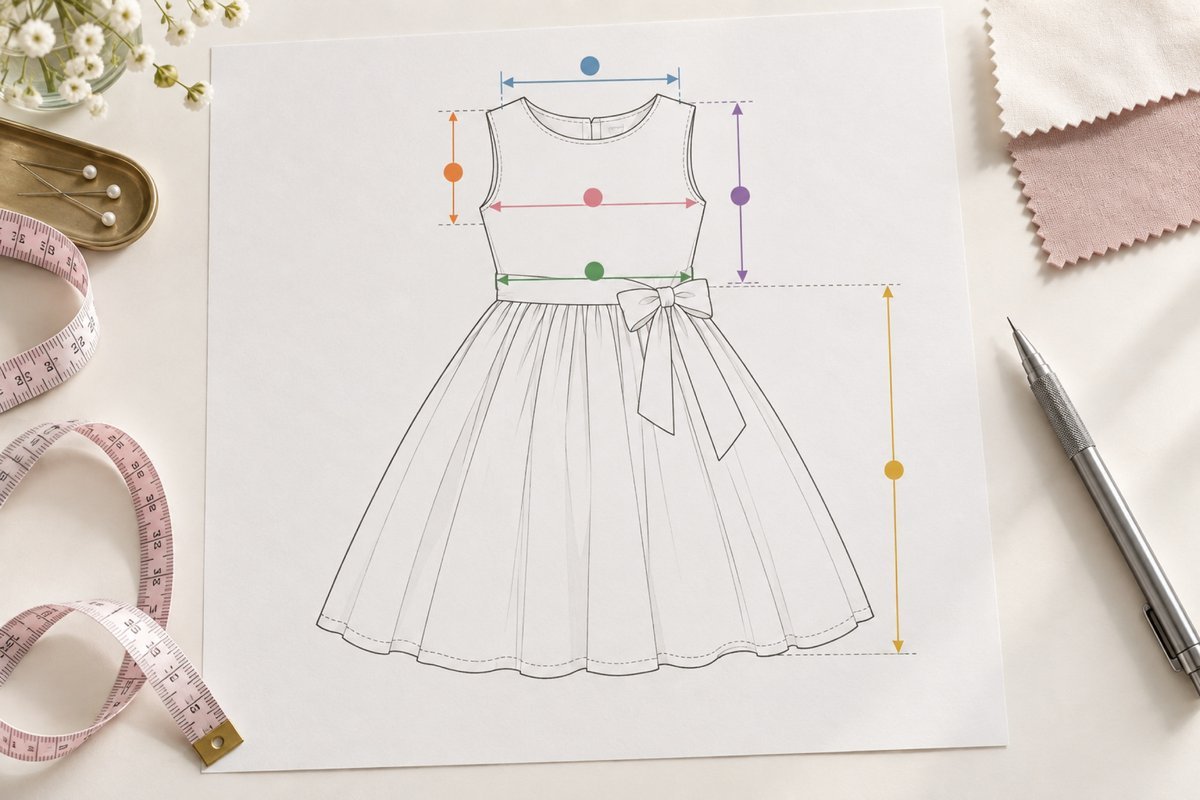
Building a base size means fixing around a dozen garment measurements and deciding, for each one, what it should be. The list below is the working template. Every value is a decision your brand makes with the factory, and none of them should be copied from a competitor’s size chart, because a size chart describes a different garment built on a different pattern.
| Measurement point | Unit | Base size value | Grade rule (per size step) | Tolerance (±) | Critical? |
|---|---|---|---|---|---|
| Chest width (flat, doubled) | cm or inch | ||||
| Waist width (flat, doubled) | |||||
| Shoulder width | |||||
| Armhole curve length | |||||
| Neck width | |||||
| Bodice length (HPS to waist seam) | |||||
| Back length (HPS to hem) | |||||
| Skirt length (waist seam to hem) | |||||
| Sleeve length (if sleeved) | |||||
| Sleeve opening | |||||
| Hem sweep | |||||
| Zipper length |
Six of these points matter more than the rest, and they are worth naming. Chest width controls whether the garment closes. Waist width controls whether it sits where the design intends. Shoulder width controls whether the dress stays on the body at all. Armhole curve length controls whether the child can raise her arms without the fabric biting. Back length controls where the hem lands, which is the measurement a parent notices first because it decides whether the child trips. Skirt length sits directly under it.
Fill the base size column with the values you want for your middle size, then leave the rest blank until the base has been fitted. Grading comes after, and grading decisions made before the base fits are guesses with paperwork attached.
Two habits make this concrete. First, photograph the fit on a real child or a matched fitting model at the base size and keep that photograph with the measurement sheet, because a later disagreement about proportion is easier to settle against an image than against a spreadsheet. Second, write the measuring method beside each point. Chest width measured flat with the garment buttoned and relaxed is a different number from chest width measured with the garment stretched, and if the method is not written down, two people will measure the same dress and report two different results.
③ Grading Is Not Uniform Scaling
This is the idea that separates a workable size range from a run of garments that only some customers can wear.
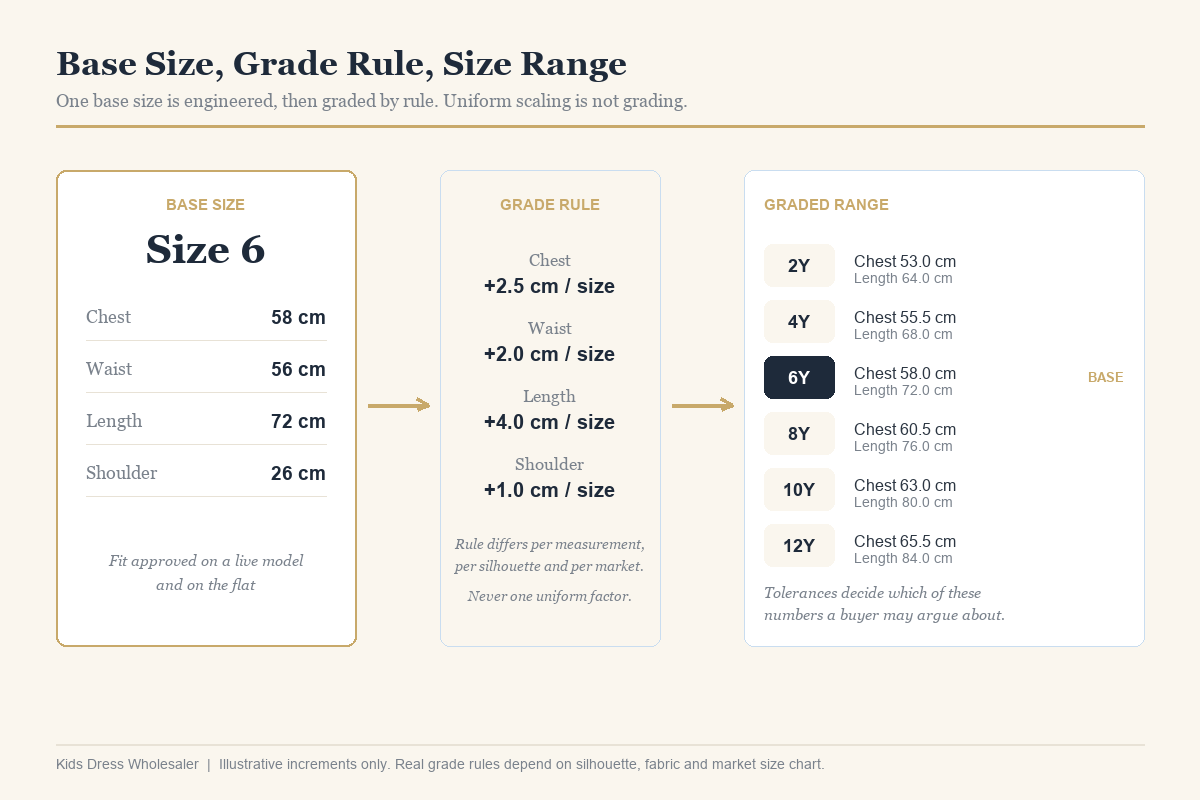
Grading means changing each measurement point by the amount that is right for that point. It does not mean multiplying the whole pattern by a fixed proportion, and it does not mean adding the same increment to everything. Bodies do not grow that way. Between two adjacent child sizes, chest circumference gains one amount, back length gains another, shoulder width gains a third, and the armhole curve changes in a way that is not simply a scaled copy of the smaller curve.
Mechanical scaling fails for a predictable reason. Chest and waist measurements grow roughly together, so a proportional increase there is not far off. Shoulder width grows more slowly than chest girth, so a proportional increase makes the shoulders of larger sizes too wide, and the dress starts sliding off. Back length grows faster than chest width in some parts of the range, so a proportional increase makes larger sizes too short, and the hem rides up. Armhole curves are worse, because the shape of the curve changes rather than just getting bigger. Scale a small armhole curve by a uniform percentage and you get a curve that binds at the underarm on a taller child even though the measurement figure looks correct on paper.
Two visual symptoms tell you that a range was graded by uniform scaling rather than by point. The first is a set of dresses that look like photocopies of each other in a shop photograph, with the smallest silhouette looking identical to the largest. Real size ranges change shape slightly across the range, because proportion shifts as children grow. The second is a pattern of customer feedback that clusters at one end of the range: complaints that the largest sizes run narrow at the shoulder, or that the smallest sizes are long in the body. When feedback clusters by size rather than by style, the grading rule is the suspect.
There is a second grading question that buyers rarely ask and should: is the decoration graded too? On a decorated girls’ dress, a flower or bow sized for the base size sits proportionally differently on the smallest and largest sizes. A decoration that covers a third of the waist on the smallest size can look like a small detail on the largest. Approving decoration placement once for the whole range, rather than per size, is a common source of the feeling that some sizes look cheap.
If you are deciding how many units of each size to order, that is a different question from how the sizes are graded, and it is covered in our guide to planning a girls dress size run for wholesale buyers. That article answers how much of each size to buy. This one answers how each size should be built, and the two decisions are made at different times in the buying cycle. Getting the run right does not fix a grading rule that was wrong, and a perfect grading rule does not rescue a run that was bought in the wrong depth.
④ Why “Age 6” Fails as a Specification
Age labels feel precise and are not.
An age is a statement about time, not about size. Two children of the same age can differ substantially in chest circumference, shoulder width and height, and the spread widens as children get older. Age also means different things in different markets, because the mapping between age and average body size is a matter of local population data, not a global standard. A brand that sells across several countries will find that an Age 6 label describes noticeably different bodies in each one.
The deeper problem is that age gives a factory nothing to cut to. A pattern cannot be drafted from an age. It can be drafted from a chest width, a shoulder width, a back length and an armhole curve. So when a specification says Age 6 and nothing else, the factory substitutes its own house measurements for that age, and those measurements came from the factory’s previous customers. That may be acceptable, and it may be far from what your customer expects. You will not know which until you have goods in hand.
There is also a labelling dimension. In several markets, size labelling for children’s clothing is treated as consumer information that must not mislead, and a garment labelled for an age range that does not correspond to its actual fit can attract complaints from buyers or from a marketplace. Label content is a separate topic and worth reviewing carefully, since label rules and size conventions are not the same thing, and our kids dress size guide covers the market-facing comparison conventions that customers expect to see on a listing.
The practical replacement is a measurement specification with an age label on top of it. The specification does the engineering: it tells the pattern maker what to build. The age label does the marketing: it helps a shopper find the right product without a tape measure. Both can exist on the same garment, and they are answering two different questions. What must not happen is the label being the only statement, because then the engineering has been outsourced to whoever wrote the last size chart the factory used.
If you sell through a marketplace that requires a size chart, build that chart from your own base size values rather than adopting a template. A chart copied from another brand describes that brand’s pattern. Your customers will measure their children against your chart, order the size your chart indicates, and receive a garment built to a different set of numbers.

⑤ What a Fit Session Actually Tests
A fit session is not a dress rehearsal for a photograph. It is a set of functional tests, and each one maps to a measurement point on the base size sheet.
Standing and walking. With the child standing in a relaxed posture, check that the garment hangs level, that the waist seam sits where the design intends, and that the hem clears the feet while walking. A hem that catches underfoot is a length problem, and length is one of the two measurements a parent notices immediately.
Sitting. Have the child sit on a chair. A fitted bodice with a stiff waist seam will pull and ride up when seated if the bodice length is short or the waist seam is placed too high. This test also reveals whether the skirt layers bunch uncomfortably in the lap, which is a comfort defect that shows up in reviews rather than in inspection reports.
Raising both arms. This is the armhole and shoulder test. Raise the arms overhead and check whether the garment lifts off the shoulders, whether the underarm bites, and whether the shoulder seam travels toward the neck. A dress that rides up when a child raises her arms in a ceremony photograph has an armhole or chest width problem, and no amount of adjustment to the hem will fix it.
Reaching across the body. A closure or bodice that restricts a cross-body reach has too little ease through the upper back. Children spend a significant part of a formal occasion reaching for things, and the garment should allow it.
Zipper comfort. Close the closure fully and check that it does not pinch the back or catch on the lining, that the slider sits comfortably at the top when closed, and that a child of the target age can open and close it with assistance. Where the design puts the closure matters here: a centre-back zipper that runs the full length of the bodice is a different proposition on a small child than one that stops at the waist.
Neckline and lining. Check that the neckline does not gape when the child leans forward, that the lining does not show at the armhole, and that nothing scratchy touches the skin at a seam. Lining exposure at the armhole is one of the most common visible defects on a first sample, and it is fixed at pattern stage rather than at finishing.
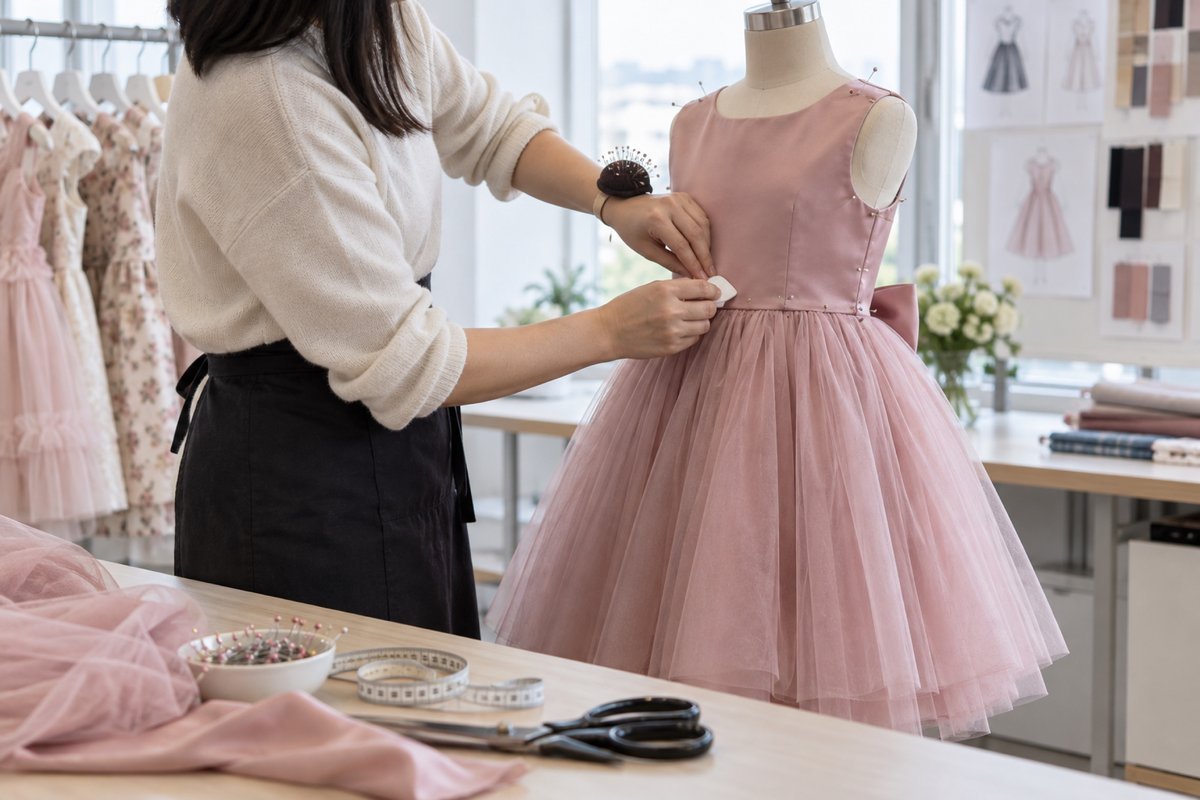
Recording the outcome is as important as running the tests. Each observation should be converted into a measurement instruction with a direction and an amount, applied to the base size sheet, and then carried through grading so that all sizes move together. A comment like “armhole tight” produces a different correction depending on whether the issue is the curve length, the underarm depth, or the chest width. Our checklist of girls dress quality checks covers the inspection-side counterpart to this, since some fit issues are caught at final inspection and some can only be caught on a body.
⑥ Silhouette Decides Where the Tolerance Goes
Two dresses graded to identical chest and waist figures can still fit differently, because silhouette determines where a garment has to be exact and where it can move.
A-line. The chest and shoulder need to be close to specification because they control whether the dress stays on the body. The hem sweep has far more freedom, since a wider or narrower hem changes the look rather than the fit. A tolerant silhouette overall, and the easiest shape to grade across a wide size range.
Princess-seam and panelled styles. These follow the body through vertical seams, so every panel joint becomes a measurement point. The chest, waist and panel seam lengths all need to hold, and a small error in any of them shows as a diagonal drag line rather than as a loose fit. Tolerance has to be tight through the whole bodice.
Fitted bodices with boning or interlining. Where structure is built in, the garment does not adapt to the body, so the body has to match the garment. Chest width and bodice length carry almost all of the fit risk, and there is little room to hide variation.
Full or gathered skirts. The waist seam has to hold its measurement because it is stitched to the bodice, while skirt fullness can vary noticeably without affecting whether the dress is wearable. This is the silhouette where a generous tolerance on hem sweep costs nothing, and where an overly tight tolerance creates unnecessary rework at inspection.
Flower girl and occasion dresses with layered tulle. The bodice is usually fitted while the skirt is voluminous, so the fit risk concentrates in the upper half. Waist placement is the measurement that most affects how the dress reads in photographs, and it also determines overall proportion, which means it deserves a tight tolerance even though it does not affect wearability in the way chest width does.
The working principle is that tolerance should follow function, not symmetry. There is no reason for every measurement on a specification to carry the same tolerance, and applying one uniform figure across the sheet is a sign that the sheet was written to look complete rather than to be used. A hem sweep that is tolerant and a chest width that is not is a correctly designed specification, not an inconsistent one.
⑦ Setting Tolerances Without a Universal Number
Buyers often ask for a single tolerance figure to apply across an order, usually in the form of a question about what is normal. There is no honest single answer, because an acceptable range depends on the measurement, the fabric and the construction. What can be given is a method for deciding, measurement by measurement, and that method is more useful than a number borrowed from another brand’s technical file.
Tolerance is the range within which a garment still fits and functions. Set it too tight and you will reject goods that a customer would never notice, which costs money and slows every order. Set it too wide and you will ship garments that generate returns, which costs more.
The order of decisions is this. First, classify each measurement as critical or non-critical using the test in the next section. Second, set the tolerance for critical measurements narrowly, because a failure there makes the garment unwearable or visibly wrong. Third, set the tolerance for non-critical measurements more generously, because variation there changes appearance, not function. Fourth, agree how the measurement is taken, because a tolerance applied to a differently measured point is meaningless. Fifth, write the whole thing into the specification sheet and onto the inspection record, so that the person measuring the goods is measuring the same point the same way.
Fabric affects the numbers. A stable woven with little stretch holds a measurement predictably, so its tolerance can be tighter than the same garment in a knit or in a bias-cut fabric. A gathered tulle skirt, where the fabric has been pulled into a seam, will always show more variation at the hem than a flat panel, and a tolerance that ignores gathering behaviour will produce rejections on garments that are fine. Grey areas like these are worth discussing with the factory before the specification is frozen, not after the first inspection.
Some measurements should carry no tolerance at all in the sense that they must match the base size sheet, usually because they are set by the pattern and verified by a jig or a template rather than by hand. Decoration placement count is one example. If the approved placement is a set number of elements at defined positions for a given size, that is a pass or fail check, not a range.
Tolerances should also be reviewed when the pattern changes. A specification is not a permanent document, and a sheet written for one construction cannot be carried unchanged onto a redesigned style. Where a pattern is updated, the measurements and tolerances that changed need to be re-circulated to the inspection team, or the goods will be judged against a standard nobody intends any more.
The Decision Rule: Critical and Non-Critical Measurements
Use one question to sort the sheet. If this measurement is wrong, does the garment fail to go on a child, or fail to look correct on the body? If yes, it is critical. If a deviation here would only make the dress slightly wider, slightly narrower or slightly longer without changing whether it can be worn and read correctly, it is non-critical.
Critical measurements, as a rule, are these. Chest width, because it decides whether the closure meets. Waist width and waist placement, because they decide where the dress sits and how it reads. Shoulder width, because too much and the garment slips off. Armhole curve length, because too little and the child cannot move her arms. Garment length, because a hem that is too long is a trip hazard and a hem that is too short fails the design. Closure length and position, because a garment that cannot be reliably closed cannot be sold. Decoration security, because a detachable element on children’s clothing is a safety matter in major destination markets and not a cosmetic one.
Non-critical measurements are usually these. Hem sweep on a full skirt, because a difference there changes fullness rather than wearability. Sleeve opening where the sleeve is loose. Trim width and ribbon depth where they are decorative. Positions of surface detail that sit within a designed band rather than at a single point.
Two refinements make the rule usable in practice.
The first is that criticality is construction-specific, not universal. The same measurement can be critical on one style and not on another. Hem sweep is non-critical on a gathered tulle skirt and much closer to critical on a narrow pencil-shaped skirt where the fit is the design. Waist width is critical on a fitted bodice and far less so on a smocked or elasticated dress that adapts to the body. Re-sort the categories each time the silhouette changes rather than reusing the previous sheet.
The second is that a non-critical classification is a statement about fit, not a licence for poor workmanship. A hem that varies within tolerance and is badly sewn is still a defective hem. Tolerance describes how much measurement variation is acceptable; it says nothing about whether the construction is sound. Those are two separate checks on the inspection record, and they should stay separate.
If you are developing a custom style rather than buying stock, apply this rule before the first sample is made, because the classification determines what the factory is asked to correct after the fit session and what the inspector will measure at final inspection. Our custom girls’ dress development service takes a size specification as the starting document for pattern work, and custom OEM production starts from 200 pcs per style, so the specification is worth getting right before development begins rather than after.
Points of Measure and Where Tolerance Belongs
The table below is the practical output of the decision rule. It is not a universal specification — the columns exist so that you and the factory are arguing about the same cells when a measurement comes back out of range.
| Point of measure | Critical or non-critical | Why it sits there | What a buyer should ask for |
|---|---|---|---|
| Chest width | Critical | Decides whether the closure meets on a real child | Tight tolerance, measured on the flat with the garment relaxed |
| Waist width and placement | Critical | Decides where the dress sits and how the silhouette reads | Tolerance plus a note on whether the waist is defined by a seam or by elastic |
| Shoulder width | Critical | Too much and the garment slips off the shoulder | Tight tolerance, and a stated measuring point |
| Armhole curve length | Critical | Too little and the child cannot move her arms | Tolerance on curve length, not only on a straight-line span |
| Garment length | Critical | Too long is a trip hazard; too short fails the design | Tolerance agreed per silhouette, measured from a named point |
| Skirt sweep and hem depth | Non-critical | Reads as fullness; a small deviation does not change fit | Wider tolerance, and consistency across the lot matters more than the absolute value |
| Decorative element placement | Non-critical | Visual only, unless it affects the closure or the neckline | Tolerance in millimetres from a named landmark, checked against the approved sample |
Getting the grading right settles what each size measures. Deciding how many pieces of each size to buy is a separate exercise, and it is covered in girls dress size run planning for wholesale buyers.
Ready to move forward?
Send us the measurement sheet you are working from, or the size label you currently use, and we will tell you which layer it is specifying and where the ambiguity sits. If you already have a range in production, a flat measurement sheet from two or three sizes is usually enough to show whether the grading is governed by a rule or by habit. Kids dress size conversion guide handles the market-to-market translation. Typical figures as of September 2026, for planning only: ready stock on selected styles from 6 pieces, custom orders from 200 pcs per style, sampling 5–7 days per round, bulk production 25–40 days after sample approval, and pattern or sample development USD 80–150 where no pattern exists. Exact MOQ, development cost and lead time depend on style, fabric, quantity and season.