
A boutique brand sends us one style to develop: a girls’ occasion dress in five sizes, a fitted bodice, a multi-layer tulle skirt, dimensional flowers across the waist, and an invisible zipper down the back. There is a reference image, a colour direction, and a target on-shelf month. What is missing at the start is a pattern, a graded size set, a confirmed fabric and a trim list. Everything the buyer will eventually sell has to be built from that point.
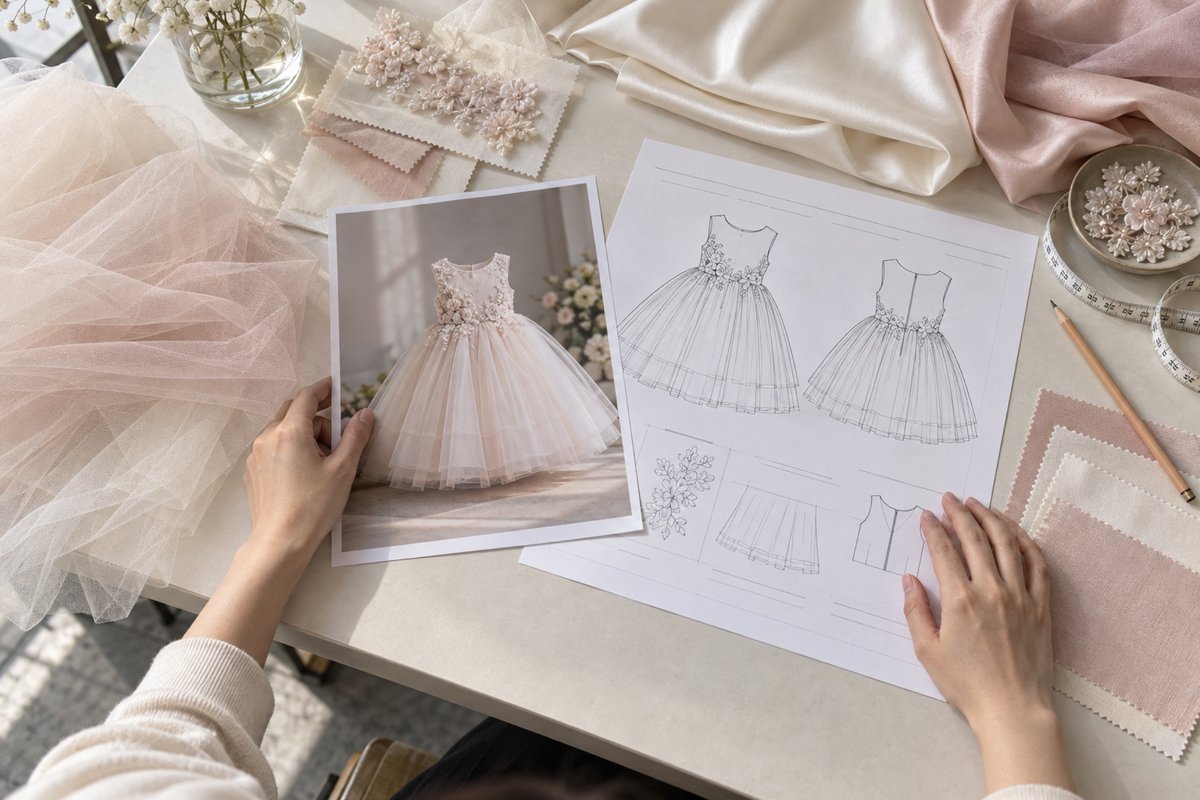
The custom girls dress manufacturing process is easiest to follow through a single garment rather than a diagram. So this article tracks one dress the whole way, from the moment the file lands to the moment the carton is sealed. The sequence follows a representative girls’ occasion-dress order through the same stages a custom development programme runs through, and case details are anonymised to protect buyer confidentiality. At every stage there is a decision that can push a delivery back a week. If you are planning a custom programme of your own, the point is not to memorise the sequence. It is to know where your answers are needed, and what happens to the calendar when those answers arrive late.
Chapter 1: The Design Arrives
Four things can land in our inbox for a new style, and they are not equal. A reference image shows a look. A hand sketch shows a shape. A physical sample shows construction you can open and measure. A tech pack shows all of it plus the numbers. When a buyer sends only a photograph from a marketplace page, we can still develop the dress, but the first two rounds of questions will be spent recovering information that a tech pack would have carried in the first place.
The dress in this case arrived as a reference image plus a written brief, which is the most common starting point for a boutique brand that has a clear look in mind and no technical department behind it. Before anyone opens CAD or pulls fabric off the shelf, the merchandiser reads the file in a fixed order, because each answer changes the next question.
First, silhouette and layer stack. Is the bodice separate from the skirt, and how many tulle layers sit under the top layer? Two layers and four layers are different garments at the waist seam, and they may sit at different price points. Second, closure. Where does the dress open, how far, and can a child be dressed in it without help? Third, decoration. Where do the flowers sit, how large are they, and are they placed on the bodice, at the waist seam, or scattered down the skirt? Fourth, size range. Five sizes can mean five graded patterns, or it can mean a shared block with a shortened run, and that choice has a cost attached. Fifth, destination and labelling. Which market is this sold in, and who applies the care and content labels?
A brief that answers those five points is quick to quote. A brief that answers none of them is not impossible; it just means the sampling clock starts later than the buyer expects. If you have never assembled a technical document for a factory, our walkthrough of what a complete kids dress tech pack should contain is worth twenty minutes before your first email, because it removes most of the round trips that follow.
One commercial note belongs here rather than in a later invoice. When a buyer has no pattern and no existing sample to work from, the pattern and sample development is charged separately, and the figure we quote for it sits in the USD 80–150 range depending on how much engineering the dress needs. This dress, with its graded bodice block and its decoration plan, sat at the upper end of that band. Buyers who already own a workable pattern skip this line entirely.
Chapter 2: Engineering Review Before Anything Is Cut
Engineering review is where a factory decides whether the dress on paper can become a dress on a hanger, and it happens before the first pattern is drafted. This stage is invisible to most buyers, which is exactly why it is worth describing.
The bodice on this style is small relative to the skirt. Four tulle layers, gathered and stitched at the waist seam, add real weight, and that weight pulls downward on a bodice that has to look crisp at the neckline. So the review asked whether the front bodice needs an interlining to hold its shape, and whether the waist seam needs a stay tape to stop the tulle from stretching the seam as the skirt hangs. Both answers were yes. Neither one adds decoration the buyer can see, and both are the reason the bodice does not collapse by the time the dress reaches a shop floor.
Fabric choice was the next question. Tulle comes in different stiffnesses, and the softness of the top layer has to match the intended shape of the skirt. A soft tulle over a stiff net gives a rounded, drooping skirt; a stiff tulle over soft net gives a skirt that holds its own circle. The buyer wanted volume that stayed open in photographs, so the review proposed a stiffer net for the under layers and a softer tulle for the visible layer, which is a construction decision rather than a fabric cost decision.
Lining came next, and it is the part children notice most. Every seam that touches skin has to be enclosed or covered. Tulle edges at a waist seam are scratchy on bare skin, so the lining was specified to sit over the tulle seam at the waist rather than under it, with the raw tulle edge enclosed between lining and bodice. This is a two-minute change at pattern stage and an expensive rework at packing stage.
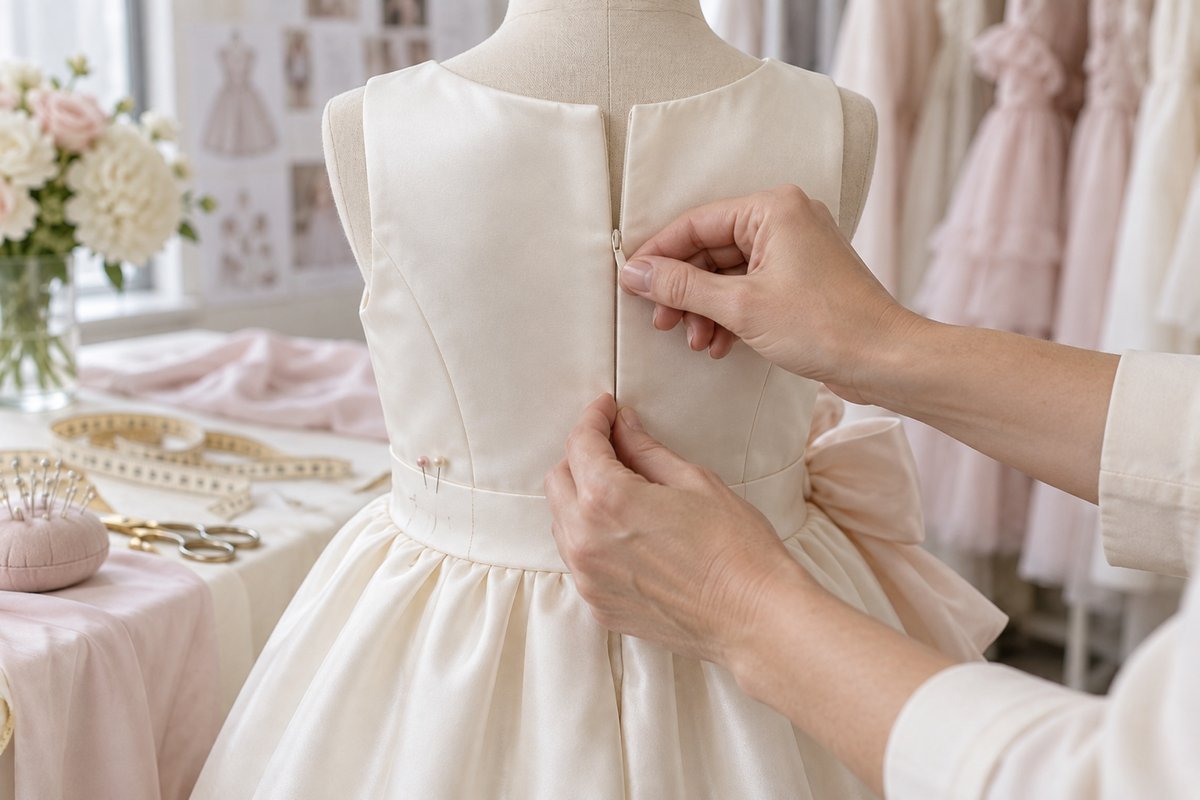
The invisible zipper raised its own question. On a child’s dress, a centre-back zipper runs the full length from neckline to waist or below, and a young wearer cannot always reach it. The review checked whether the zipper could stop at the waist seam and the skirt be fitted over the head, or whether the design required a full-length opening. Because the bodice is fitted, the zipper had to run from the neckline to below the waist, and the buyer agreed to add a small hook above the slider so the top of the zipper stays closed when the dress is worn.
Decoration was assessed for attachment, not appearance. Dimensional flowers at the waist sit on a seam that flexes every time the child sits down. Flowers stitched only to the surface of the tulle would tear loose within a few wears, so the review specified that each flower be stitched through to the bodice layer beneath, with the anchoring stitches hidden inside the flower centre. That single sentence on the production sheet is the whole difference between a dress that lasts and a dress that returns.
Last came child-use scenarios. Where is this dress worn? A flower girl walks down an aisle and stands for a ceremony. She sits in a car seat. She is lifted by adults. She may wear it twice. Each of those situations sets a constraint, and the constraint list went into the file: no exposed sharp trim, hem length that clears a child’s feet when walking, and no bead or flower small enough to detach and be swallowed, since the destination market treats detachable small parts on children’s clothing as a regulated area.
Chapter 3: Pattern Making and the First Sample
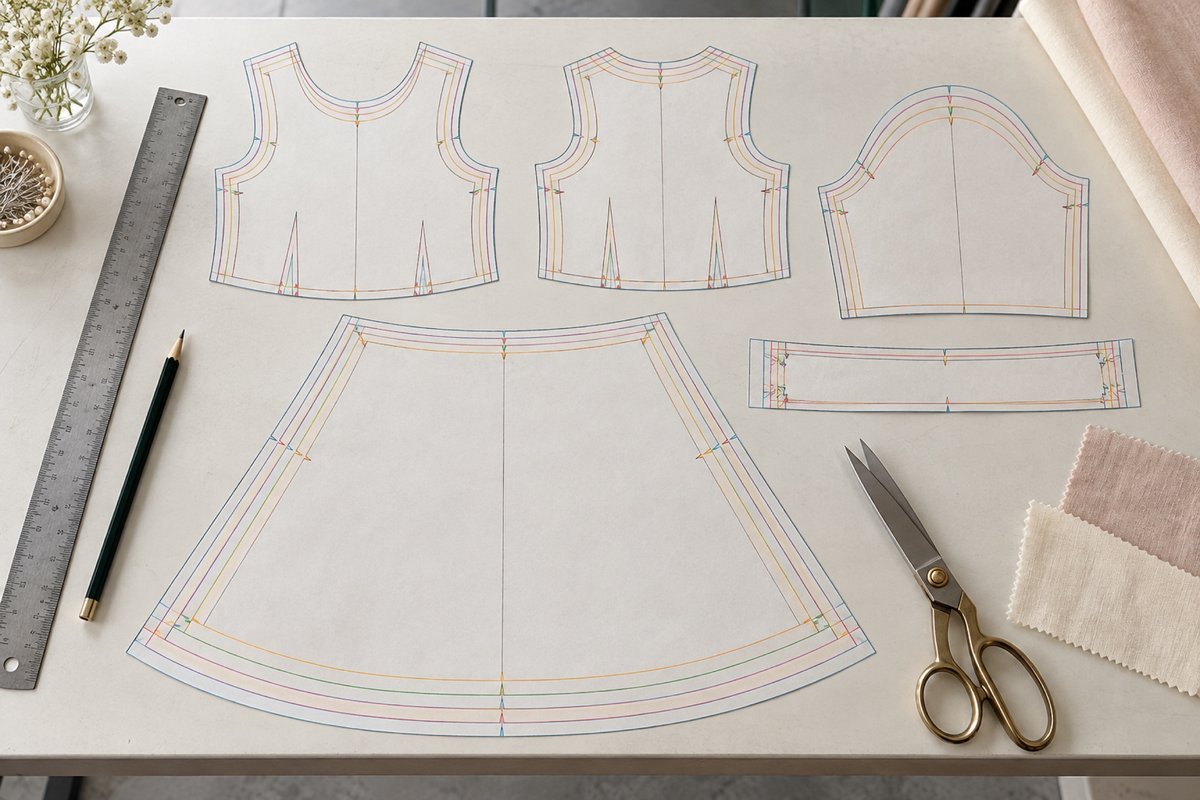
The pattern maker takes the approved construction decisions and turns them into a base pattern. For this dress the base was built at the middle of the size range, because the middle size carries the most representative proportion. From that base, the pattern set for the remaining four sizes is produced by grading, which shifts each measurement point by an amount that suits that point rather than by a single blanket percentage. Whether you are working with us or with another supplier, the pattern is the asset that outlives the order, and it is worth asking who owns it.
Sample making followed, and the standard window is 5–7 days for a style of this complexity, assuming the fabric is in house. That window covers cutting, stitching, decoration placement and finishing on one unit. If the buyer has not yet chosen the final fabric, the sample goes out in a substitute of similar weight so that proportion can be judged, with a clear note that the fabric will be substituted at bulk stage.
The first sample is not meant to be a perfect dress. It is meant to answer four questions: does the proportion read correctly on a child’s body, does the silhouette hold the intended shape, do the layers behave when the child moves, and can this garment be sewn and decorated at a workable rate. A sample that looks beautiful on a hanger but takes an unreasonable number of minutes per unit to decorate is a problem discovered here rather than after bulk cutting.
Every sample that leaves this stage carries a copy of its own measurement sheet. When the buyer reviews it, the conversation should be about numbers and photographs rather than impressions, because “the waist feels a bit high” cannot be graded but “the waist seam sits above the approved placement, by this much” can. Our breakdown of the wider kids dress sampling process covers the sample types a buyer will encounter and what each one is for.
Chapter 4: The Fitting Session
The fitting session is where the dress meets a body. For this order, the buyer reviewed the sample on a fitting model matched to the middle size, and the comments came back in five places.
Armhole. A bodice armhole that is cut too deep exposes the lining and restricts movement; one cut too shallow binds when the child lifts her arms. On this style the sample armhole was judged slightly shallow, and the pattern was opened at the underarm by a measured amount rather than by eye.
Waist placement. The gathered waist seam on a girls’ dress does not always sit at the natural waist, and the buyer wanted it slightly below the natural line so that the bodice reads longer in photographs. That is a legitimate design choice, but it has to be fixed at pattern stage, because it moves the zipper length and the skirt length with it.
Garment length. The buyer specified a finished length from the shoulder point to the hem, measured at the centre back. Length is the measurement most often described as “a bit shorter” or “looks long”, which is useless to a pattern maker. The session converted the comment into a single number on the spec sheet.
Skirt fullness. The tulle layers were checked for how much fabric gathers into the waist seam. Too little and the skirt looks flat; too much and the waist seam becomes bulky and heavy for a small child. Fullness was adjusted by changing the cut width of each layer, keeping the length and the layer count unchanged.
Zipper opening. The session tested whether the dress could be put on and taken off without straining the seam, and whether the zipper pull sat comfortably at the top of the closure. The hook above the slider was confirmed at this point.
Two rounds of comment-and-revise are normal for a new construction. Each round costs a few days, and the calendar impact adds up quickly. The efficient path is to collect every fit comment into one document with marked photographs before replying, rather than sending observations in separate messages over a week.
Chapter 5: Approving Materials
Materials approval runs in parallel with sample development, and it is usually where inexperienced buyers lose the most time, because three different approvals are easy to confuse.
Fabric swatch approval covers handfeel, weight and surface. The buyer approves a physical swatch of the exact cloth that will be cut, and that swatch is retained by both sides as the reference standard. For this dress that meant approving a soft tulle for the outer layer, a stiffer net for the under layers, a bodice fabric, and a lining. A swatch approved from a photograph is not an approval; it is a hope.
Colour approval is separate from fabric approval. Even when the fabric base is confirmed, the shade still has to be matched against the buyer’s colour target, and for a woven or dyed base this is done with a lab dip. A lab dip is a small piece of the actual fabric dyed to the requested shade, and it is judged against a physical standard under controlled light. Buying a colour from a screen is not advisable, and our notes on Pantone colour matching for kids dresses explain why a shade can read correctly on one screen and incorrectly on another.
Trim approval covers everything that is not main fabric: the invisible zipper and its tape colour, thread shade, hook and eye, waist stay tape, interlining, and any ribbon or inner netting. Trim is the item most commonly delayed, because it is ordered after the main fabric and often in small quantities that suppliers do not prioritise. A zipper tape in the wrong shade will show at the neckline of an otherwise perfect dress.
Decoration approval covers the flowers themselves. The buyer approved size, shade, petal shape and placement count across the waist. Placement is approved per size, not once for the whole range, because a flower that covers a third of the waist on the smallest size is proportionally much smaller on the largest. Approved samples of the decoration were sealed and kept by both sides.
Only when fabric, colour, trim and decoration are all approved can the pre-production sample be made in the real materials. That is the next chapter, and it is the one most buyers misunderstand.
Chapter 6: The Pre-Production Sample
A pre-production sample, usually shortened to PPS, is a garment made from the bulk fabric and bulk trims, using the corrected pattern after all fit comments, produced on the same line that will make the order. The buyer reviews it, approves it in writing, and only then does bulk production start.
Here is the part worth pausing on. A buyer often assumes that once a sample is approved, the order is ready to run. That assumption is the single most common cause of disputes later, because an approved sample proves the design works but does not prove the line can reproduce it consistently at volume. The two are related, and they are not the same thing.
| What an approved sample confirms | What it does not confirm |
|---|---|
| The design reads correctly on a body | That every unit will match it within tolerance |
| The materials are acceptable | That the bulk fabric lot matches the sample lot |
| The construction is feasible | That the line can hold that construction at rate |
| The decoration placement is approved | That decoration supply covers the full quantity |
The PPS closes that gap by being made under production conditions. Sample-room hands are slower and more careful than a line, and a sample can be beautiful for reasons the line cannot repeat. When the PPS is built on the line with the bulk fabric lot, at the real operating pace, the factory finds out whether the waist seam can be held straight across hundreds of units, whether the tulle gathers consistently, and whether the flower stitching can be hidden every time.
For this order, the PPS surfaced one issue. The bulk tulle was marginally stiffer than the sample fabric that had been used for the fitting sample, and the skirt read fuller than the approved reference. The buyer had two acceptable options: accept the fuller skirt as the new standard, or return to the softer tulle and absorb the procurement delay. They accepted the fuller version and signed off, which cost nothing but a written confirmation. Had this been discovered after cutting, the same discovery would have required re-cutting the skirt layers for the whole order.
Two things follow. First, treat PPS approval as a decision with a deadline, not a formality. Second, when you approve it, approve in writing and attach the measurement sheet and photographs, because that is the record everyone will refer to if a later delivery is questioned.
Chapter 7: In the Cutting Room
Bulk production opens with the cutting room, and the first task is not cutting but planning. The marker is the layout that places pattern pieces onto the fabric as tightly as possible, and for this order the marker had to work across five sizes in the same colour lot. Sizes with long skirts consume fabric in long continuous lengths, while bodice pieces are small. A marker that spreads sizes efficiently reduces total fabric consumption, and that is where a size breakdown you supply at inquiry stage keeps paying back.
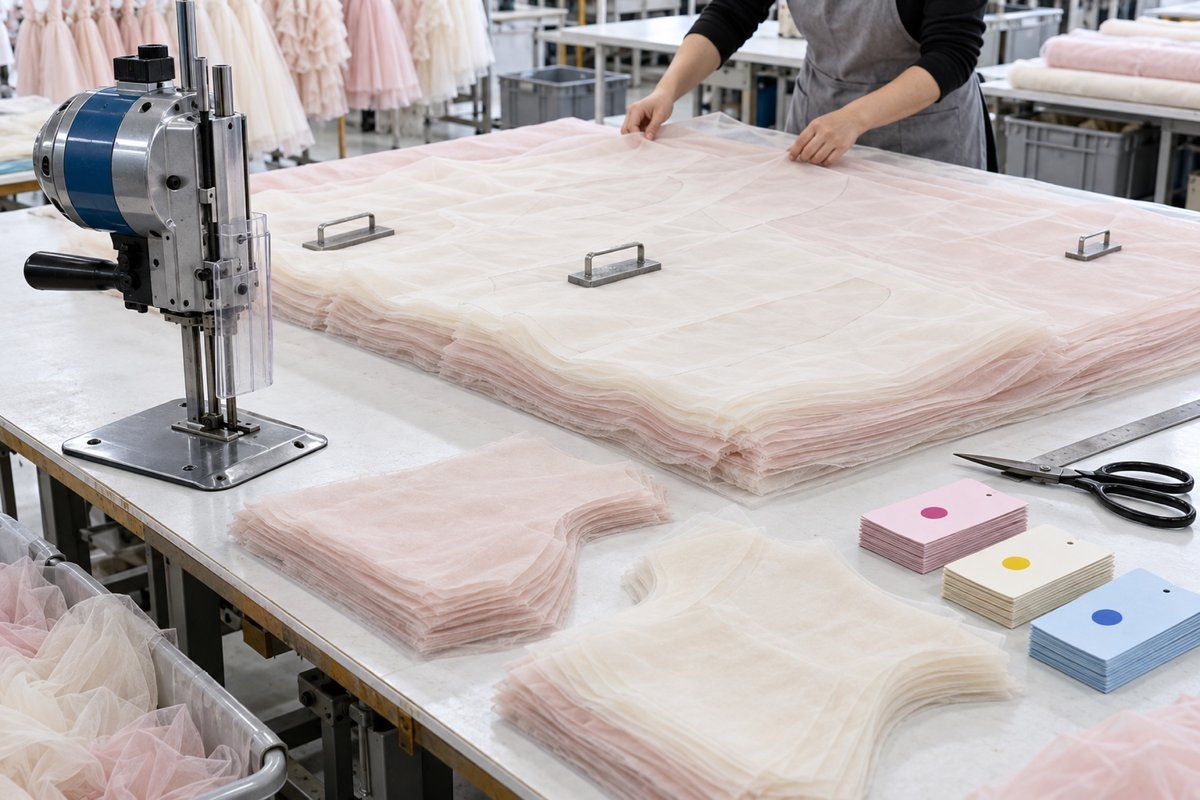
Fabric arrives on a roll or in folded lengths, and it is relaxed before spreading so that any residual shrinkage happens before the cloth is cut rather than after the garment is sewn. The tulle layers are spread in multiple plies, and the shade of each roll is checked against the approved standard and against the other rolls in the same cut. Tulle shade is subtle and unmerciful. Two rolls that look identical in the warehouse can read differently when gathered side by side in a skirt, so rolls are kept within a shade group and separated when they differ.
Cutting tulle is its own skill. The layers slip, and an electric cutter that moves too fast drags the top ply out of alignment with the bottom one. Slow passes, weights along the edges and a sharp blade are what keep the layer edges aligned. Once cut, the parts are numbered and bundled. Each bundle carries a ticket that ties it to one size, one colour and one cut, and the ticket travels with the bundle through every operation until the garment is finished. If a measurement problem appears later, the ticket is how the factory traces which cut it came from.
Bodice pieces are interfaced where the engineering review called for it, using the interlining approved at material stage. Lining pieces are cut from the same marker plan and bundled separately so the sewing floor does not mix them with the shell.
Chapter 8: Sewing and Decoration
Sewing runs as a sequence of operations, and each operator performs a small number of them repeatedly. That structure is why the same dress can be made at a predictable rate, and it is also why the assembly order has to be fixed at PPS stage. Changing the sequence mid-order forces retraining on the floor and slows output.
The bodice went together first. Shell pieces were joined at the shoulder and side seams, then the lining was assembled the same way and the two were joined around the neckline and the armholes, turned, and pressed. The invisible zipper was set into the centre back before the bodice and lining were fully closed, because an invisible zipper applied after the fact almost always shows a ripple along the seam. The waist stay tape was stitched into the waist seam allowance at this point to carry the weight of the skirt.
The skirt came next. Each tulle layer was gathered to a measured width rather than by eye, and the layers were joined to the bodice in a fixed order from the innermost outward. Gathering by measurement is what keeps the waist seam flat across a bulk run; gathering by feel produces a seam that varies from one unit to the next, which is a defect the final inspection will catch and the sewing room then has to repair.
Hem finishing differed by layer. The visible tulle layer was finished with a narrow rolled hem so the edge stays light, while inner net layers were finished with a softer turned edge to avoid scratching. On a girls’ dress, the inside of a hem matters as much as the outside, because the skirt brushes bare legs.
Decoration was the slowest operation. Each flower was positioned to the approved placement drawing for its size, stitched through to the bodice layer as specified in engineering review, and anchored so the work is invisible from the front. Operators worked from a physical placement template cut for each size, which keeps flower positions consistent when the same dress is made again in a later restock.
Finishing followed: trimming loose threads, pressing the bodice without flattening the tulle, and fitting the hook above the zipper slider. Pressing is a controlled step rather than a general tidy-up, because heat that is right for the bodice fabric will melt or distort tulle.
Chapter 9: Inline Inspection
Inline inspection happens while the goods are being made, not after. Its purpose is to catch errors that are systematic, meaning the same mistake repeated across many units, because those are the ones that cannot be fixed by sorting finished goods. If a waist seam is being set at the wrong height, every unit made that morning is wrong, and finding it at noon rather than at the end of the week saves the entire day’s output.
On this order, inline checks ran at four points. First-piece approval at each operation checked that the first unit off a new operation matched the approved PPS. In-process checks at the waist seam verified the finished waist measurement against the spec sheet on a sample of units per bundle. Shade checks compared skirt layers within each bundle against the approved fabric standard. Decoration checks verified that flower count and position matched the placement template for the size being run.
Measurement is the part buyers undervalue most. Visual inspection finds a crooked seam, but it does not find a skirt that is uniformly short across an entire cut. Only measuring does that, and only if the measurement is taken the same way every time, from the same reference points the pattern was built on.
Inline findings are recorded, and recurring findings trigger a line correction before production continues. A factory that reports no inline findings at all on a complex decorated style is not a factory with no problems; it is a factory that is not looking. Our guide to AQL inspection for kids dresses explains how the same logic scales into final inspection.
Chapter 10: Final Inspection
Final inspection is a structured sampling exercise, not a quick look. The order is treated as a lot, a sample size is drawn from that lot according to the inspection standard agreed with the buyer, and each sampled garment is checked against the approved specification.
The check has four parts. Measurement verification confirms the key dimensions on each sampled unit against the spec sheet within the agreed tolerance, with the size matched to the spec it was cut to. Visual inspection covers the construction and appearance points that matter on this dress: waist seam straightness, tulle snags, skipped stitches at the zipper, hem evenness, lining enclosure at the waist, and decoration security. Function checks confirm the zipper runs smoothly through its full length, the hook engages, and the dress can be put on without straining a seam. Packing checks confirm labels, tags and bagging before the goods close.
Decoration security deserves a specific mention. Any attached element on children’s clothing is assessed for whether it can detach under reasonable use, because detachable small parts are a regulated area in major destination markets. Testing and any resulting certification for the destination market is arranged for the order, and where a children’s product certificate is required, that document is issued by the importer, not by the factory. The factory’s role is to produce goods that pass the tests the importer’s market requires and to supply the material and test records needed.
Buyers with a formal quality programme often schedule a third-party inspection at this point, and that is welcome. An inspection agency’s report carries weight with a buying team that has never visited the factory, and it gives the buyer a document independent of the supplier’s own records.
Defects found at final inspection are classified, and the lot decision follows the agreed standard: pass, rework and re-inspect, or reject. Rework is the most common outcome on a first bulk order with a new construction, and it costs days rather than weeks when the defect is finishing-level rather than cutting-level.
Chapter 11: Packing and Shipment
Packing looks like the simplest stage and it is the one most likely to create a delivery argument, because packing specification is often agreed in one sentence and then disputed in three emails.
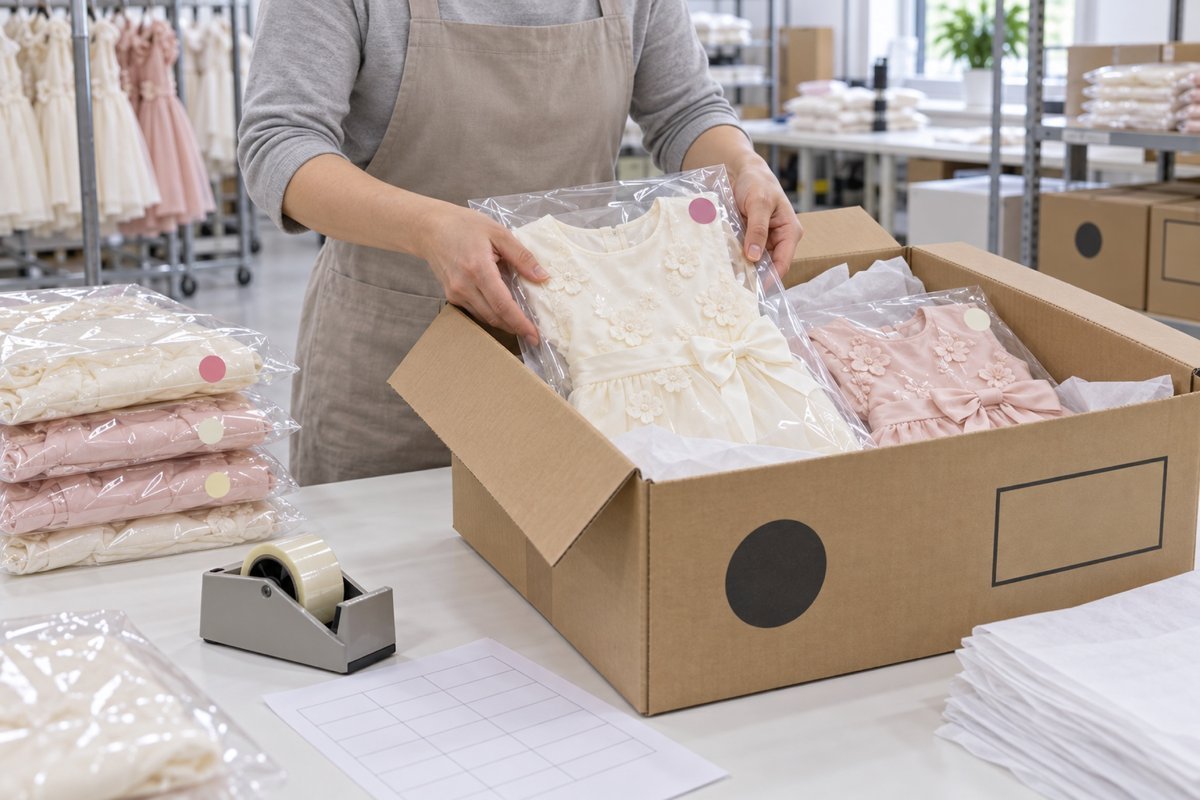
The buyer’s packing brief for this order covered five items. Poly bag with the required suffocation warning for the destination market. Hang tag applied with the buyer’s branding. Size sticker on the bag matching the size of the garment inside, which sounds trivial and matters enormously on a size-graded order. Assortment packing, meaning how sizes and colours are distributed per inner pack. And carton configuration, meaning how many units per carton, carton dimensions, and whether the carton carries the buyer’s shipping marks.
Assortment is where graded orders differ from single-size orders. A buyer who plans to receive goods by size and distribute straight to stores wants cartons packed by size. A buyer who sells online and picks per order may prefer mixed cartons. Neither is wrong, but the choice has to be stated before packing starts, because repacking after the fact is charged time.
Documentation and booking run alongside packing. Commercial invoice, packing list and shipping documents are prepared against the confirmed quantity, and the booking is made against the agreed delivery window. Our note on custom kids dress OEM lead time sets out how the booking and production windows relate, and why the gap between them is where most schedule surprises hide.
On timing, the reference points for this kind of work are the ones stated earlier in this article: sampling, then bulk production, both counted from the confirmed sample and the approved materials. The 25–40 day window is a range rather than a promise because decoration density, fabric arrival and printing or dyeing add to the lower end. If you have completed a custom production with us before, the range narrows, because the pattern and the placement templates already exist. If you are starting from nothing, the range holds and should be built into your launch date honestly rather than optimistically.
For buyers weighing whether to develop a style at all, the useful comparison is between the flexibility of custom work and the speed of stock. Our overview of the custom girls’ dress programme explains what a development order includes, and where the practical floor sits: custom OEM work starts from 200 pcs per style, while selected ready-stock styles start from 6 pieces.
Production Checkpoints: What You Should Be Able to See
Each stage above produces something you can ask for. The point of the table is not surveillance — it is that a checkpoint raised at the right time costs nothing, and the same question raised after the goods are packed costs a rework or a shipment.
| Stage | What the buyer should receive | What to actually check | The date it protects |
|---|---|---|---|
| Engineering review | A written list of construction questions and any cost or timing effect | Whether your answers are recorded, not just discussed on a call | The sampling start date |
| Pattern and first sample | Pattern ownership terms, the sample, and its flat measurement sheet | Fit on a body and on the flat, decoration placement, closure and lining | The revision round |
| Fit session | Consolidated comments, with each point marked critical or non-critical | That no comment contradicts an earlier one you already approved | The second sample |
| Material approval | Retained standard, test record and approved shade reference | That the approved lot number matches the lot being cut | The cutting date |
| Pre-production sample | The PPS in the bulk fabric, with the bulk trim and the final measurement sheet | That it is built from bulk materials, not from leftover sample stock | Everything downstream |
| Cutting | Marker and lay information, plus shade-matched panel groups | That panels for one garment come from one shade group | The sewing start date |
| Sewing and decoration | Inline inspection findings, with the defects named | Attachment security on every decorative element, not a sample of one | The final inspection date |
| Final inspection and packing | Inspection report, packing list and carton marking | Measurements against the approved sheet, then the carton ratio | The sailing date |
If you only ask for two of these, ask for the pre-production sample in bulk materials and the final inspection report matched to the approved measurement sheet. Those two catch the largest share of the failures that reach a customer.
What Can Slow This Order Down
Every stage above has a failure mode, and in practice a delayed delivery is rarely caused by a factory working slowly. It is caused by one of six things stalling the schedule. Knowing them in advance is how a buyer protects a launch date.
Fabric shortage. A tulle or lace in a specific shade and stiffness may need to be woven or dyed to order, and availability changes without notice. Late confirmation of the bulk fabric at material approval stage pushes everything behind it.
Artwork or placement late. Decoration placement drawings, brand labels and hang tag artwork are all buyer-side inputs. When a label design is still under internal review, the order cannot be packed even if the dresses are finished.
Revision after bulk start. Any fit or proportion change requested after cutting cannot be absorbed. It means re-cutting, and the earlier chapters of work repeat. This is the single most expensive delay on the list, and it is entirely avoidable by resolving comments at the fitting and PPS stages.
Trim delay. Zippers, hooks, stay tape and ribbon ordered after the main fabric can arrive after the fabric does. A dress with no zipper is not a dress, so the whole line waits.
Testing not passed. If a chosen fabric or decoration fails a required test for the destination market, the material has to change, and the change flows back through sampling. Addressing test requirements before material approval avoids most of this.
Colour rejected. A lab dip that reads differently under the buyer’s lighting, or a bulk dye lot that sits outside the approved standard, sends the order back to dyeing. Approving colour against a physical standard under agreed light, and retaining sealed samples, is the cheap insurance here.
A buyer can do very little about weather, freight congestion or a mill’s own schedule. They have full control over the last four items, which is why the fit session, the PPS and the material approvals deserve more of your attention than the price negotiation that usually gets it.
Ready to move forward?
If you have a style in development, send the reference image and the construction notes as far as they are settled, and we will come back with the gates that apply to that specific garment rather than a generic schedule. Where no pattern exists we will say so, and where a construction detail is going to cost you a revision round we would rather flag it before sampling than after. Custom girls dresses explains the route this article follows. Typical figures as of September 2026, for planning only: ready stock on selected styles from 6 pieces, custom orders from 200 pcs per style, sampling 5–7 days per round, bulk production 25–40 days after sample approval, and pattern or sample development USD 80–150 where no pattern exists. Exact MOQ, development cost and lead time depend on style, fabric, quantity and season.