
Most packaging advice is written in the order the work happens: prepare the dress, wrap it, choose a carton, seal it, ship it. That sequence describes a process, but it is no help to a buyer standing over a box of flattened bows and pulled tulle. So this page is arranged the other way round. It begins from the ways a wholesale dress actually arrives wrong and works backwards to the control that prevents each one, because girls dress wholesale packaging only earns its cost when it is built against a named failure rather than against a general intention to be careful.

It is written for boutiques, retailers, online stores, private-label brands, importers and professional kidswear buyers. Construction and route decide the pack; nothing here is a market forecast, and no claimed saving or damage rate should be read as a guarantee. Where a route, a market or a product raises a legal question, take qualified advice before the final decision, because the final call belongs to a qualified adviser rather than to a packing guide.
The six failures a carton can deliver
Damage in transit is not random. In practice it arrives in six recognisable forms, and almost every claim a boutique raises can be traced to one of them:
- a three-dimensional detail that was crushed by whatever sat above it;
- a fabric surface abraded or snagged by the embellished dress packed against it;
- a fold line that set hard and would not hang out;
- moisture, odour or colour transfer picked up from the materials the dress rested against;
- a carton that collapsed, distorted or let its contents move;
- a box that arrived identifiable by count but not by content.
Each of these has a symptom the receiving team can see, a cause that is decided long before the shipment leaves, and a control that is either written into the packing specification or missing from it. Read them in that order and the specification starts to write itself, because every control answers something specific. Read them as a checklist and you end up protecting against the risk that is easiest to describe rather than the risk that actually costs money.
Crushed by the weight above it
The symptom is easy to recognise. A bow has flattened. A rosette has taken a set and no longer reads as a flower. The petals of a dimensional appliqué have compressed into one another. A boned or interfaced bodice carries a hard line across it that hanging does not remove, because the crease is not in the fabric surface but in the structure underneath.
The cause is always the same: a raised detail was asked to carry a load it was never designed to carry. Weight arrives from above, from the carton wall beside it, or from a heavier garment stacked on top, and it lands on the part of the dress with the most projection and the least support. A fold decided for convenience rather than for the garment is what converts that load into permanent damage.
The control is a decision per detail, made before the pack is chosen. For each bow, rosette or appliqué, decide whether it is folded flat, left raised under a formed insert, or packed with a light support that carries the load instead of the trim. Put the support behind the detail rather than in front of it, keep the detail away from the carton wall, and make sure nothing heavier rests on top of it. Structured bodices need the same reasoning, since a hard fold across a boned or interfaced panel leaves a line that will not press out. Note the support method on the carton or packing list so the receiving team knows which packages to open without pressing down on them.

Damaged by the dress next to it
The symptom is usually discovered as a defect in the fabric rather than in the embellishment. A bead edge has dragged a run through tulle. A metal hook has pulled a thread in satin. A sequinned panel has left abrasion marks on the smooth skirt it was folded against. The damage frequently cannot be repaired economically, because the pulled loop sits in the middle of a panel.
The cause is the pairing, not the trim. Beads, sequins, hooks and metal trims abrade and pull tulle, lace and satin whenever they are allowed to touch, and embellishment against embellishment is the worst version of the same mistake. The dress is not damaged by handling; it is damaged by its neighbour.
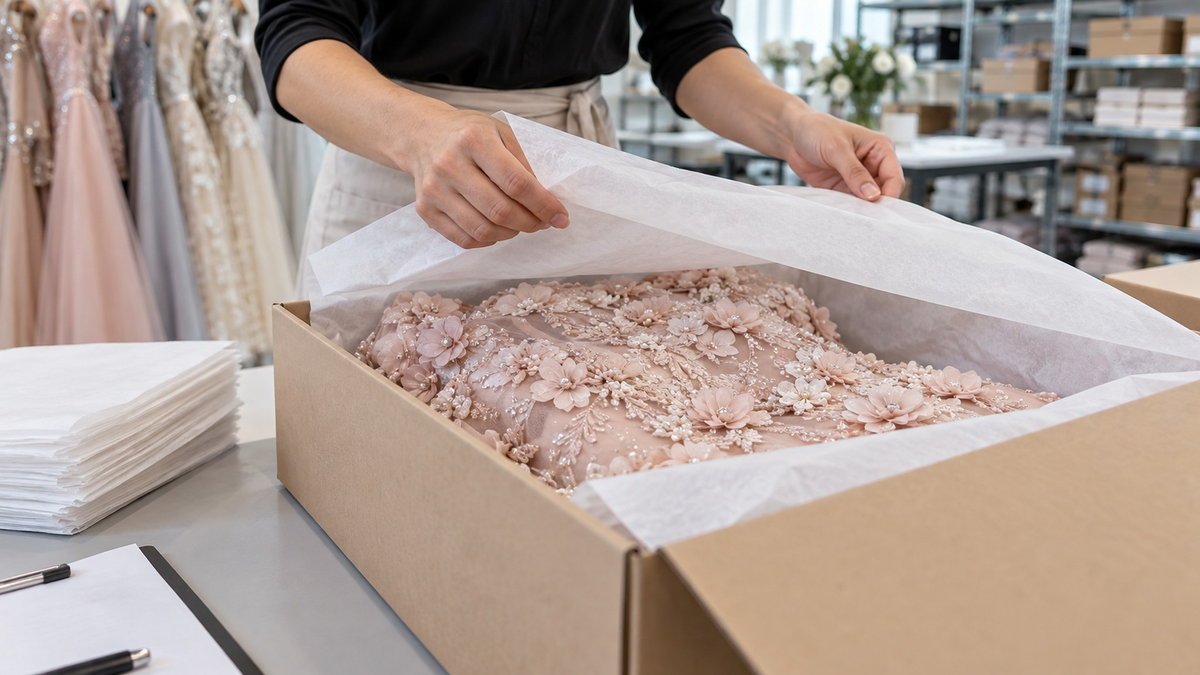
The control is separation, chosen deliberately rather than applied universally. Decide which garments need a separator, which need their own bag, and which can safely face a smooth woven surface. Keep rough against soft, never embellishment against embellishment, and group decorated pieces away from one another in the carton even when they are individually wrapped. Write the snag risk onto the packing list, so the warehouse and the boutique both know which cartons to open slowly and which surfaces to check first.
Creased along a line that will not hang out
The symptom is a crease that survives hanging. Tulle can take a hard set line where the mesh doubles back over a tight edge, and satin marks easily, holding a shine line along a sharp fold that no amount of steaming removes cleanly. The damage is often reported as a pressing problem, but the press usually reveals a folding decision.
The cause is the layout. A skirt folded across its middle rather than along a seam or panel line concentrates the fold where the fabric is least able to recover. Stacking many layers into one narrow fold turns a soft crease into a hard edge, and the tighter the fold, the slower the recovery. Tulle and satin respond differently to the same fold, which is why one layout cannot be applied across a range: our kids dress fabric care reference sets out how these surfaces behave under fold, heat and press, and that behaviour is what the fold layout should follow.
The control is a fold layout chosen style by style. Fold along a seam or a panel line rather than across the middle of a skirt, limit the number of folds to what the garment can genuinely recover from, and avoid compressing many layers into one narrow turn. Then define the expected recovery and the accepted method before packing begins, so both the factory and the boutique judge the same result against the same standard.
Damp, musty or marked by what it touched
The symptom may be a shadow of colour that has migrated onto a pale panel, a grey mark where a metal component rested, a musty smell on opening, or a limp, chilled feel that suggests the carton has been through a damp leg of the journey.
The cause sits in the inner materials and the route. Tissue, bags and wraps sit against the dress for weeks, and anything printed, recycled or unstable can transfer onto pale fabric. Metal components left against a light ground leave marks. Air shipments are short but still meet humid handling, while sea freight spends much longer in containers where condensation and temperature swings are more likely, so the same inner protection can behave differently on two routes.
The control is to define the tissue, bag or wrap by type and grade rather than by appearance, keep printed and recycled materials away from pale fabric, and isolate metal from light colours. Decide which moisture controls apply to which route and record that pairing in the file. Who carries the risk while the goods are in transit also depends on the shipping term, which we set out in FOB, CIF and DDP for kids dress imports — worth settling in writing before a damp shipment becomes an argument rather than a claim.
Collapsed, shifted or opened at the corner
The symptom is visible before the carton is even opened. Corners have gone soft, the box has bellied under stacking, or the contents have moved and settled so the garments are pressed against one another and against the walls. Sometimes a carton opens easily because it was never filled properly in the first place.
The cause is carton design rather than carton cost. An underfilled carton collapses under stacking and lets the contents shift into the space left for them. An overfilled carton presses garments together and against the walls. A box bought to a standard size instead of a packed size, or a board grade chosen without reference to how the shipment will be stacked or palletised, completes the failure.
The control begins with dimensions taken from the packed dress rather than from a standard carton, and continues with the board grade and compression performance specified with the supplier. Fill the box so the contents are held without being compressed: firm under the lid, even across the surface, with no void that lets the load move in transit. Where cartons will be stacked or palletised, the board has to suit that load, not the load of a single box on a shelf.

The carton that arrives as the wrong style
The symptom is administrative until it becomes commercial. A warehouse opens the wrong carton, a fault cannot be traced back to the run that produced it, or a claim has no reference to attach itself to. The dress inside may be perfect, but nobody can prove what it is or where it came from.
The cause is that the marks were never defined. Carton marks, the packing list and the receiving record are three descriptions of the same shipment, and if they use different terms the reconciliation fails quietly — often unnoticed until a repack, a substitution or a mixed carton exposes the gap.
The control is a defined mark and a matching list. Decide what each carton carries: the purchase order or style reference, the size and colour breakdown, the quantity, the batch identifier, the destination and the handling symbols. The marks should let a warehouse pick a carton without opening it and let the receiving team trace a problem back to a packing run. Keep the packing list in the same terms, reconcile the numbers before the shipment leaves, and update both whenever a carton is repacked or a size is substituted. The same discipline that catches a loose thread in the garment applies to the box it travels in, which is where the broader girls dress quality checklist supports this page rather than replacing it.
A control table for the six modes
| Failure mode | What you see on opening | What caused it | Control to write into the pack | Evidence to keep |
|---|---|---|---|---|
| Crushing | flattened bow, set rosette, compressed petals, hard line across a bodice | raised detail carrying the weight of stacked garments or the carton wall | support behind the detail, formed insert or flat-fold decision, nothing heavier on top | approved fold drawing, packed sample, dated photograph |
| Snagging and abrasion | pulled thread or run in tulle, bead drag marks on satin | embellishment packed against embellishment, hard trim against soft fabric | separators or individual bags, rough never against soft, decorated pieces grouped apart | separator specification, packing-list note, physical sample |
| Crease and slow recovery | shine line on satin, hard set where mesh doubled over | fold laid across a skirt panel, too many layers in one narrow fold | fold along a seam or panel line, limited fold count, agreed recovery method | fold layout, recovery instruction, post-hang photograph |
| Moisture and transfer | damp or musty garment, colour migration, metal mark on pale fabric | inner materials holding moisture or dye, condensation and temperature swings in transit | inner materials defined by type and grade, metal isolated, route-specific moisture control | material grade record, route control list |
| Carton collapse or movement | soft corners, bellied box, garments pressed together, contents shifted | carton sized to a standard, underfill or overfill, board grade unsuited to stacking | dimensions taken from the packed dress, board grade and compression specified, firm even fill without voids | carton specification, fill check, stacking assumption |
| Mis-identification at receiving | wrong box opened, fault untraceable, claim without a reference | marks and packing list not aligned, counts not reconciled, repacks not updated | carton marks and packing list in the same terms, reconcile before dispatch, update after any repack | carton mark sample, reconciled packing list, batch reference |
The table is a planning tool, not a purchase ratio. What makes it work is that every control has a stated job and a named owner, and that each one is checked at the point where a correction is still possible — on the packing line for fold, fill and seal, and at receiving for recovery and marks.
Testing the pack against the failures it is meant to stop
Approving a pack is a test, not an impression, and the test should reproduce the specific failure modes above rather than demonstrate that a box exists.
1. Approve a packed sample that represents production, not an empty carton demonstration. The sample has to contain the actual garment, the actual inner protection and the actual fold.
2. Keep it packed for a period that reflects the route, so a short air leg and a long sea leg are not judged by the same standard.
3. Handle and stack it the way the shipment will actually be handled, including the load that will sit above it.
4. Open it using the procedure the boutique will really follow, with the tools and the light the receiving team has.
5. Photograph the dress immediately on opening, again after hanging, and again after the agreed recovery method has been applied.
6. Judge the result against a written pass or fail list covering crushing, creasing, snagging, moisture, odour, soil, trim loss, colour transfer and the readability of the barcode or label.
A visual check at final packing cannot prove how a garment will look after a long sea voyage or repeated handling, which is why the packed-sample test stays the control and the line check stays a confirmation of fold, fill, seal and marks against it. Where the route, the carton or the product demands it, use qualified packaging or logistics specialists rather than assuming a standard carton is sufficient.

Where the cost of a weak pack actually lands
Packaging cost belongs in the landed cost, not in a separate line discovered after the shipment has been written off. The honest comparison includes the inner protection, the bag or wrap, the carton and its board grade, packing labour, inspection, inbound freight, duties and taxes where applicable, and the cost of the damage or rework the pack failed to prevent. A cheaper carton that collapses and crushes a dress is not cheaper once the claims are counted, which is the arithmetic behind the wider landed cost for wholesale dresses calculation.
Model at least a base case, a higher-cost case and a slower-selling case, and replace every illustrative figure with live quotations and your own commercial data. Two assumptions move the result more than the carton price: how many units of a bulky style can share a carton without compressing a detail, and how much pressing or steaming the boutique will need on arrival. Both are pack decisions, and both are visible in the packed-sample test long before they appear in a margin report.
Naming the owner, freezing the version
A control that nobody owns is a sentence in a document. Give every element of the pack an owner: the fold layout, the support method, the inner material, the carton dimensions and grade, the fill standard, the seal, and the carton marks. Freeze the approved version as a dated record, and treat any change made after approval — a different bag, a substituted inner material, a resized carton, a new mark — as a change notice that triggers a fresh packed-sample test rather than an adjustment nobody records.
Receiving is the last stage of packing rather than a separate administrative task. Photograph the cartons before opening when condition matters, match the count against the packing list, and set aside any carton that is crushed, damp or resealed. Open representative packages while the shipment reference is still fresh, compare each dress with the approved packed sample, and judge creasing, crushing, snagging, moisture, soil and trim loss against the agreed list rather than on impression. Then track where the damage appears, because the pattern is diagnostic: a single carton points to handling, one size points to the fold, and a whole shipment points to the inner material or the route.
Give the retail team the recovery method that was approved with the sample, so every dress is prepared the same way before it reaches the shop floor. When a pack does fail, the useful question is not which supplier is cheapest but which of the six modes the evidence points at, and which control was missing from the specification when it should have been written.
Send the dress, the route and the claim history
Send the dress construction and materials, the embellishments that need protection, the order quantity by size and colour, the shipping route and destination, the handling and stacking assumptions, the marks you need, and — if you have them — the damage patterns from previous shipments. We will map them against the six failure modes above and propose a fold, inner protection and carton specification you can test before any bulk packing is committed.
Leave a Reply