

Kids dress OEM lead time is the schedule from an approved tech pack to cartons at your door, and it is the single biggest cause of missed selling seasons for new brands. This guide maps every stage — review, sampling, approval, bulk, inspection, and shipping — with realistic week ranges so you can plan a launch instead of hoping for one.
Quick Answer
A typical kids dress OEM project runs 8–14 weeks from tech pack approval to delivered bulk: about 1 week to review, 2–3 weeks for proto and fit samples, 1 week for pre-production approval, 3–5 weeks for bulk sewing, and 1–2 weeks for inspection and ocean freight (air is faster but costs more). The date that matters is the one you lock at pre-production approval, not the one quoted on day one.
Plan Your Launch Window
Send us your tech pack and target season and we will return a stage-by-stage timeline with a committed bulk-ready date you can build a listing around.
What Buyers Need to Know
Lead time is not one number — it is a chain, and a chain is only as fast as its slowest link. The mistake most first-time buyers make is to ask “how long?” and write down the factory’s optimistic first answer, then watch the real date slip at every handoff. The honest way to plan is to map the chain into stages, put a week range on each, and identify which stages you control. Tech pack quality, sample feedback speed, and order confirmation timing are yours; cutting and sewing speed are the factory’s. When you own your half, the factory’s half becomes predictable. A clean tech pack submitted on Monday saves more calendar time than any phone call chasing the factory in week six.
The second thing to understand is that “lead time” usually excludes shipping unless you say otherwise. A factory can hand you cartons in 10 weeks and still leave you empty-handed for the season if ocean freight adds another four. Always separate production lead time from transit time, and decide the incoterm (FOB, CIF, or DDP) before you commit, because it changes who books freight and who carries the clock. Under FOB you own the shipment from the port and its risk; under DDP the factory delivers to your door and the date you plan around is a single delivered one. For a first order, DDP is often easier to plan because there is one party accountable for the whole journey.
The third thing is that capacity is seasonal, not flat. A dress quoted at four weeks of bulk sewing in February may run six weeks in September, because every other brand is also filling spring lines at the same time. The factory is not slowing down — the queue is longer. This is why a must-arrive date in March needs a tech pack submitted the prior November, not a quote requested in February. Buyers who treat lead time as a constant get surprised every peak season; buyers who treat it as a function of the calendar plan around the queue and avoid it. The wholesale buying guide frames the same seasonality from the ordering side, and the two views should agree before you publish a launch date.
Finally, communication cadence is part of the schedule. A buyer who approves a sample within two days and confirms the deposit within three keeps the line moving; a buyer who sits on the pre-production sample for two weeks has effectively added two weeks, regardless of what the quote said. The factory schedules bulk only after both sign-off and deposit, so the clock you care about starts when you act, not when you ask. Build your internal review into the plan so the factory is never waiting on you at the one stage you control.
Stage-by-Stage Timeline
The table is the planning backbone. Use it to set internal milestones — and to know exactly where to push when a date starts to slip.
| Stage | Typical weeks | Owner | Slippage risk | Best for |
|---|---|---|---|---|
| Tech pack review & fabric lock | 0.5–1 | Buyer + factory | Low | Every order |
| Proto & fit samples | 2–3 | Factory | Medium | New styles |
| Pre-production approval | 0.5–1 | Buyer | Medium | Every order |
| Bulk cutting & sewing | 3–5 | Factory | High | Peak-season orders |
| Inspection & packing | 0.5–1 | Factory + QC | Low | Every order |
| Transit (ocean / air) | 4–6 / 1 | Freight | Medium | Plan by season |
Add the production rows for your bulk-ready date, then add transit separately. Peak season (Aug–Oct for spring lines) shifts bulk sewing to the long end of its range.
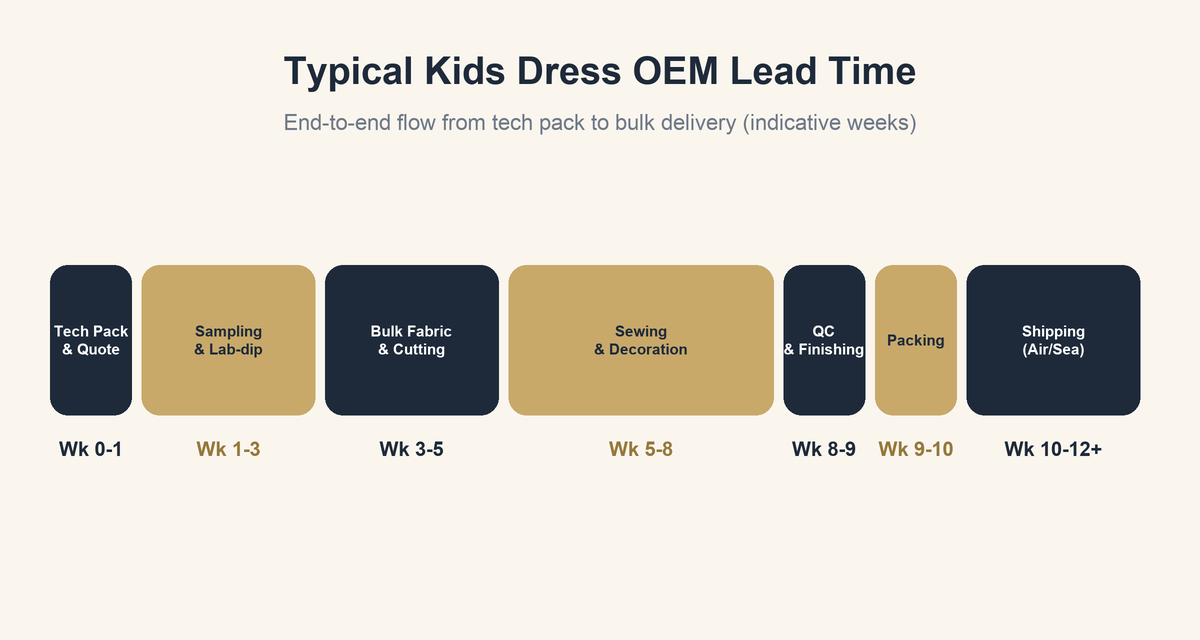
End-to-end OEM lead time from tech pack to delivered bulk, in indicative weeks.
End-to-end OEM lead time from tech pack to delivered bulk, in indicative weeks.
Lock a Committed Date
Tell us your must-arrive date and we will work backward to the tech pack and deposit deadlines — and flag every week you are at risk.
How to Work It Out: A Worked Example
A boutique wants flower girl dresses in stores by March 1. Ocean transit from the port is about five weeks, so cartons must leave the factory by late January. Inspection and packing take one week, so bulk sewing must finish by mid-January. Bulk sewing for this style runs four weeks, so cutting starts in mid-December. Pre-production approval sits one week before that, and the proto plus fit sample round is three weeks before approval — which puts tech pack submission in early November. The buyer who starts the conversation in February is already too late; the one who submits a clean tech pack in early November has a comfortable buffer.
Example: Must-arrive March 1 − 5 weeks ocean − 1 week QC − 4 weeks bulk − 1 week approval − 3 weeks sampling = tech pack due ~early November. Each stage you delay compresses the one after it, so protect the early milestones first.
Buyer Checklist
- Separate production lead time from transit time in every quote you accept.
- Submit a complete tech pack before asking for a date — incomplete packs add a review loop.
- Approve the pre-production sample within a few days; this is the date that locks bulk.
- Confirm fabric and trims are in stock before bulk, or add the sourcing weeks.
- Decide FOB / CIF / DDP up front so freight ownership is clear.
- For peak season, book the slot in writing and confirm a bulk-ready commit, not just a quote.
Common Mistakes (and What They Cost)
Counting only factory weeks
Buyers who plan around the sewing schedule and forget ocean transit routinely miss the season by a month. A four-week transit slip turns a profitable spring launch into clearance stock. Always add transit as its own line, and build from the must-arrive date backward.
Approving the pre-production sample late
Every day between sample delivery and your sign-off pushes bulk sewing into a later (often peak) window where the factory is busiest. A slow approval can add two to three weeks of queue time, not just the days you spent deciding. Review samples on receipt.
Changing the tech pack after bulk starts
A mid-production change stops the line, reopens the pattern, or forces a partial re-cut. Beyond the cost, it breaks the committed date. Treat the approved pre-production sample as the contract; later changes are a new order, not a footnote.
Booking a slot with a verbal quote only
Near peak season, a factory’s capacity is allocated to buyers with written confirmations, not to the person who asked first. A verbal “we can do March” carries no weight against a signed deposit for the same line. Turn the quote into a written bulk-ready commit with the MOQ and deposit stated, so your place in the queue is real. The buyers who ship on time are the ones who confirmed in writing while others were still deciding.
FAQ
What is a realistic first-order lead time?
For a new style with sampling, plan 8–14 weeks to delivered bulk by ocean. A repeat of an approved style can drop to roughly 5–8 weeks because sampling and approval are already done.
How much does air freight save?
Air typically cuts transit from four-to-six weeks to about one week, at a meaningful cost premium per carton. It is worth it for a confirmed best-seller that missed the boat, not for the whole opening order.
Does a higher MOQ take longer?
Usually yes, because more units occupy the sewing line longer. The gain is unit cost, the cost is schedule — which is exactly why a proven style should move to a higher MOQ on the reorder, not the first run.
Can I speed up bulk sewing?
Partly. A clean, approved tech pack and in-stock fabric let the factory start cutting immediately. Beyond that, asking a factory to “rush” often means jumping the queue, which is unreliable near peak season — book the slot early instead.
Who owns the clock under DDP?
Under DDP the factory or its freight partner handles delivery to your door and carries the transit risk, so you plan around a single delivered date. Under FOB you own freight and the clock from the port onward.
When should I book a peak-season slot?
For spring/summer lines, confirm by late autumn of the prior year; for autumn/winter, by early summer. Slots fill on a first-committed basis, and a written bulk-ready date beats a verbal quote.
Leave a Reply