
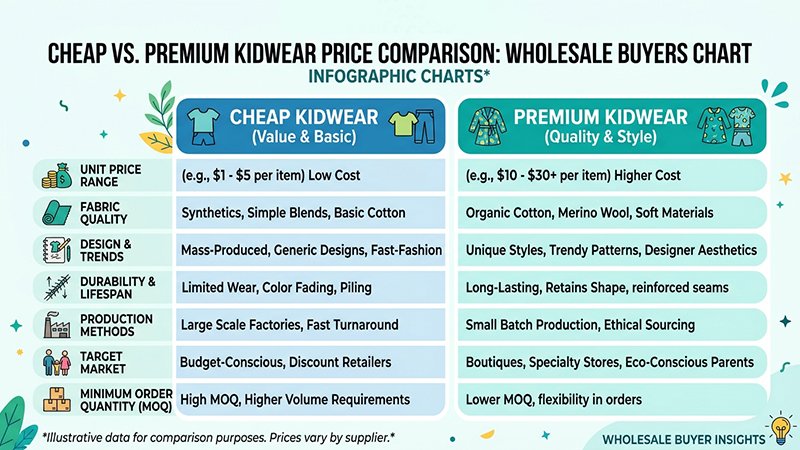
Low-MOQ buying and bulk buying are not competitors — they are two tools for two different jobs. Low minimums are for learning: new styles, new markets, new suppliers, new seasons. Bulk is for earning: proven bestsellers, known demand, stable sizing, healthy margins. The skill is knowing which job you are doing at any moment, and having a clear rule for when to switch. This guide explains the economics of test vs scale in girls’ dress wholesale, with practical decision rules you can apply to your next order.
Start With a Low-Minimum Test Order
Before you commit to a bulk run, test a supplier with ready-stock styles — mixed styles and colours from 6 pieces, so you can judge fabric, stitching and sizing firsthand.
The most expensive order in wholesale is not the biggest one — it is the one placed at the wrong moment. Buy too small on a proven bestseller and you lose margin and sell out; buy too big on an unproven style and you sit on dead stock through the season. Both mistakes come from the same root: treating MOQ as a single strategy instead of a sequence. The buyers who win understand that the minimum order is a dial you turn as evidence accumulates — not a fixed identity of “I’m a low-MOQ buyer” or “I’m a bulk buyer”.
1. What MOQ Really Means (and What It Costs You)
Minimum order quantity is the smallest number of pieces a supplier will produce (or sell) for a given style. It exists because every production run has fixed costs — pattern setup, fabric cutting, line scheduling, quality checks — that must be spread across units. Understanding those fixed costs explains everything else in this guide.
The Two Costs of Every Order
- Fixed costs: setup, pattern, cutting, line scheduling. Paid once per order, regardless of quantity.
- Variable costs: fabric, trims, labour per piece, packaging. Paid per unit.
Because fixed costs are spread over more units, unit price falls as quantity rises — which is why bulk is cheaper per piece. But the total cash committed rises with quantity, and so does the risk if the style does not sell. The real question is never “what’s the lowest unit price?” — it is “what quantity gives me the best balance of unit economics and risk for this specific style, at this specific moment?”
2. When to Test (Low MOQ)
Low minimums — in girls’ dress wholesale, ready stock often starts from about 6 pieces with mix-and-match styles and colours — exist for the moments when you do not yet have evidence. Buy small when any of these is true:
New Style or New Category
You have never sold this style before. No sell-through data, no fit feedback, no reorder history. A small order across a few sizes gives you real product, real photos and real customer reaction for a small cost.
New Market or New Season
Demand patterns change by market and season. A style that sells in one country may stall in another; a style that moves in spring may sit in autumn. Test the new context before committing volume.
Validating a New Supplier
Every supplier is unproven until proven. A small order tests their sampling, quality, communication and documentation with a limited downside — and lets you evaluate the relationship before scaling with them.
Trend Verification
Trends are hypotheses until verified. Buy a small trend position, watch sell-through, and scale only the trends the market actually confirms. This keeps trend risk proportional to evidence.
3. When to Scale (Bulk)
Bulk buying is not for brave decisions — it is for confirmed ones. Scale up when the evidence is in:
Proven Best-Sellers
A style that has sold through once, twice or three times with consistent reorders is a proven bestseller. The market has voted with money. Bulk reorders of proven winners are how wholesalers actually make margin — the fixed costs are amortised, the unit price drops, and demand is known.
Known Demand and Stable Sizing
When sell-through data shows which sizes move and which colours lead, you can bulk-buy with confidence in the size/colour mix. Stable sizing means fewer surprises; known demand means the stock will move.
Seasonal Certainty
Some categories have predictable seasonal peaks — Christmas, wedding season, communion season. When the calendar guarantees demand and you have historical data, bulk buying ahead of the peak is the profitable play, as long as the timing (production + shipping lead time) lines up.
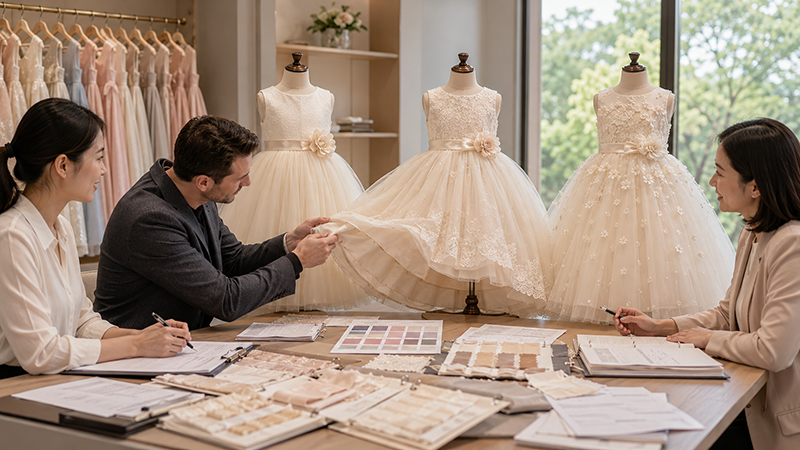
The trade-off is unit price versus risk — and the chart shows the shape.
Here is the trade-off in its clearest form. The numbers are illustrative — the shape is what matters:
| Order size | Unit cost | Total cash | Risk if 50% sells | Best when… |
|---|---|---|---|---|
| Small test (6–20 pcs) | Highest per unit | Low | Very low | No evidence yet |
| Medium (50–150 pcs) | Mid | Medium | Medium | Some evidence, partial confidence |
| Bulk (200+ pcs) | Lowest per unit | High | High if wrong | Proven demand, confirmed data |
Get a Sourcing Quote
Send us your target styles, size run and quantity. We reply with MOQ, unit pricing and sample lead time — no obligation.
The unit price difference between a small test order and a bulk order can be meaningful — sometimes 15–30% or more depending on style and factory. But that saving is only real if the bulk order sells. A 20% unit saving on a style that sells at 50% and ties up cash for a season is not a saving — it is a loss wearing a discount. The decision rule: bulk discounts belong to proven styles, never to experiments.
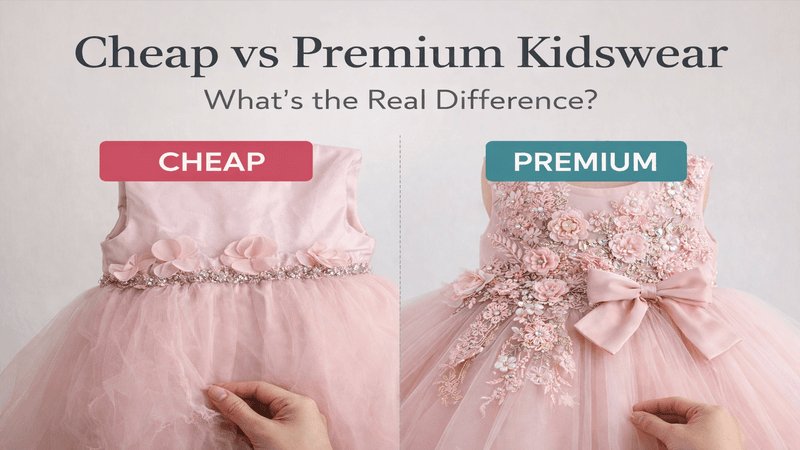
Test the cheap end before you scale; the difference between the two is exactly where returns come from.
Treat your ordering as a sequence of increasing confidence, not a single leap:
- Test (low MOQ): order a small mix across styles and sizes. Measure sell-through, fit feedback, margin.
- Analyse: which styles, colours and sizes moved? What did customers say? What margin did you actually make?
- Reorder winners: place a medium reorder of the styles that sold, in the sizes that moved, before you commit deeper.
- Scale (bulk): once a style has proven itself across at least one full sell-through cycle, move it to bulk or custom production for the best unit economics.
- Repeat: each season, the proven core grows and the test segment stays small — that balance is the engine of wholesale profit.
Mix-and-match turns one small minimum into a broad market test.
Low MOQ becomes dramatically more powerful when the supplier allows mix-and-match — combining multiple styles and colours within one small minimum. Instead of testing one style at 6 pieces, you can test six styles at one piece each within a 6-piece minimum. That is a six-fold increase in learning for the same cash.
- Test breadth cheaply: cover more styles, colours and sizes per order.
- Reduce single-style risk: no style gets more than a fraction of the test budget.
- Gather better data: you learn which styles to drop as well as which to keep.
Always ask suppliers whether mix-and-match is allowed within the minimum — it changes the economics of testing entirely.
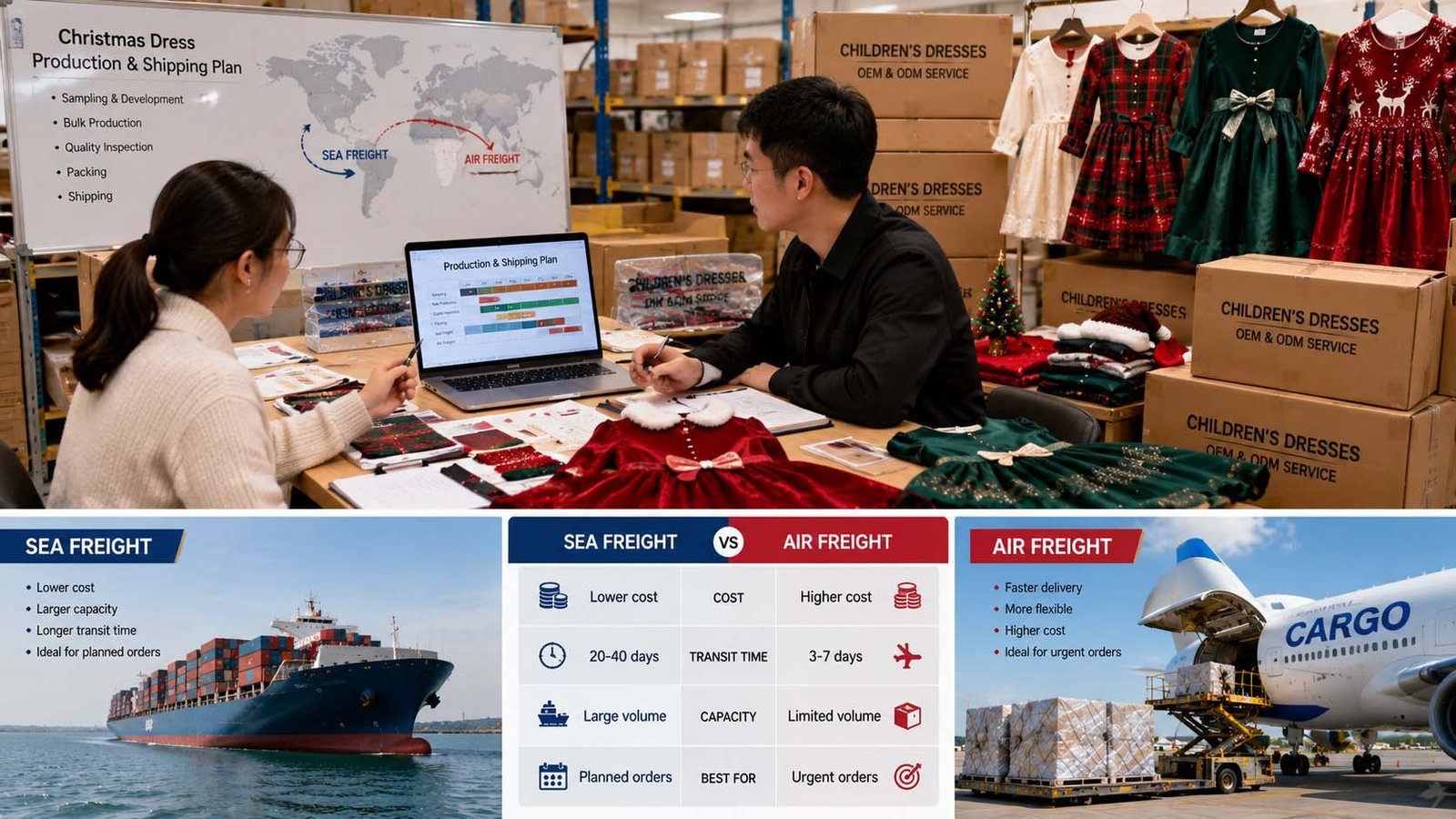
Freight scaling changes the unit cost curve — small orders pay premium freight.
| Mistake | Result | Fix |
|---|---|---|
| Scaling before proof | Dead stock on an unproven style | Scale only after sell-through evidence |
| Never scaling proven winners | Missed margin, constant stockouts | Bulk-buy proven bestsellers |
| Comparing only unit price | Ignores risk and cash tied up | Compare total cash and sell-through risk |
| Ignoring freight scaling | Small orders pay premium freight | Consolidate tests; bulk by sea when proven |
| No reorder trigger | Stockouts or overstock by accident | Set a reorder point per style (e.g. reorder at 30% stock left) |
8. Frequently Asked Questions About MOQ Strategy
What Is a “Low” MOQ in Girls’ Dress Wholesale?
Ready stock in girls’ dresses commonly starts from about 6 pieces with mix-and-match styles and colours. Custom OEM/ODM production typically requires higher minimums — often from about 200 pieces per style — because production lines, pattern setup and fabric purchasing need volume. Both numbers are normal in the trade; the strategy is to use the low end for testing and the higher end for scaling.
Can I Get Samples at Low MOQ?
Yes — sampling and MOQ are separate things. Most suppliers allow 1–2 sample pieces per style before you commit to any order quantity. Sampling is the cheapest research you can buy; never skip it, regardless of how low the MOQ is.
How Many Pieces Should My First Order Be?
As small as the supplier allows while still testing meaningfully — often 6–20 pieces across a few styles and sizes, using mix-and-match. The goal of the first order is information (which styles, colours and sizes sell), not margin. Keep the first order small enough that learning is affordable.
When Should I Move From Ready Stock to Custom Production?
When a style has proven sell-through and you want exclusivity, brand ownership or better unit economics. Custom production (OEM/ODM) brings higher minimums, so it belongs to proven winners — typically after at least one full sell-through cycle with reorder data.
How Do I Handle a Style That Sells Out Too Fast?
Stockouts are the good problem — it means you under-ordered a winner. Capture the sales rate (pieces per week) from the sell-out period, add the reorder lead time, and size the next order so stock covers the full replenishment window. Then keep a reorder trigger so the same mistake does not repeat.
Should I Ever Skip Testing?
Only when you have genuine evidence already: historical sell-through of the same style, a guaranteed seasonal peak with data, or a contract that locks in demand. Without evidence, testing is the cheapest insurance you can buy — skipping it to save a small order is false economy.
9. Building a Monthly Order Rhythm
Rather than deciding each order from scratch, build a rhythm that makes test-vs-scale automatic:
- Monthly review: review sell-through data on the 1st of each month — which styles are at their reorder trigger, which tests are due, which experiments failed.
- Standard test budget: allocate a fixed small share of your buying budget to tests every month (for example 15–20%), so innovation is funded by design, not by accident.
- Standard reorder rule: reorder a style automatically when stock hits a defined level and the style is a proven seller — no debate needed.
- Seasonal reset: before each major season (Christmas, wedding, communion), review the proven core and place bulk orders early enough for production and shipping.
A rhythm turns MOQ strategy from a decision you make under pressure into a system you operate calmly. That is the difference between buyers who manage their orders and orders that manage their buyers.
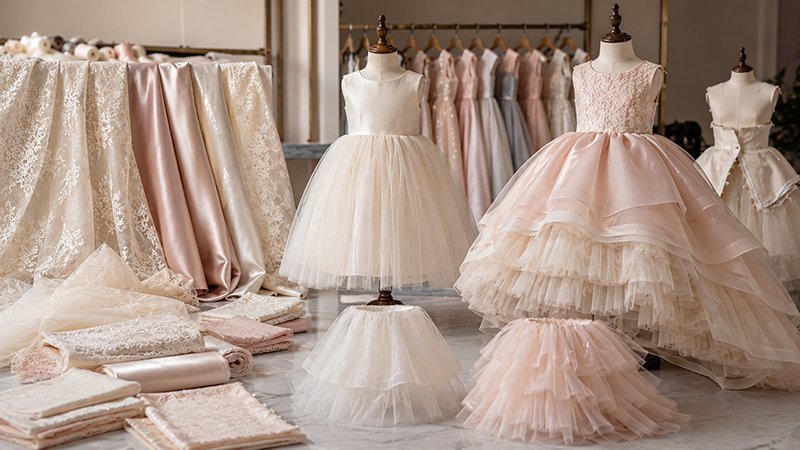
Manage the range as a portfolio — core, growth, experiments each have a role.
The test-to-scale logic also works at the collection level. A healthy wholesale range is a portfolio with a deliberate shape:
| Range share | Role | Buying mode |
|---|---|---|
| 60% proven core | Known sellers, steady demand | Bulk reorders, best unit cost |
| 25% growth candidates | Promising styles with some data | Medium orders, watched closely |
| 15% experiments | New styles, trends, supplier tests | Low MOQ / mix-and-match tests |
Manage the range as a whole and the individual style decisions become easier: the core funds the experiments, the experiments feed the growth candidates, and the growth candidates eventually join the core. Every order has a role in the system, and the system keeps the whole range healthy.
11. Five Questions Before Every Order
Pin this short list where you plan orders. If you can answer all five, the order is probably right:
- What do I already know about this style? — data beats opinions; if there is no data, it is a test.
- What is this order for? — learning (small), growth (medium) or earning (bulk)? The purpose dictates the size.
- What does the margin look like at this quantity? — unit price, freight, duties, and the risk of leftovers, all together.
- When must the stock arrive? — work backwards from the selling window through shipping and production.
- What will I do if it doesn’t sell? — an honest exit plan (markdown, carryover, clearance) keeps cash moving.
Five questions, two minutes, every order. That discipline is what separates profitable wholesalers from those who buy by hope.
Plan your test-to-scale order
Tell us your stage — we confirm ready-stock MOQ (from about 6 pieces, mix and match) and custom minimums, with sample support along the way. WhatsApp us or email luxudress@gmail.com.
Leave a Reply