You cannot open every dress in a bulk order, so you inspect a sample of it — and AQL is the standard that tells you how many pieces to check and how many defects are too many. For a wholesale girls’ dress buyer, understanding AQL is what turns “the order looked fine” into a defensible accept-or-reject decision.
See How We Handle Quality
Inspection checkpoints, defect thresholds and pack-out standards are documented before production starts — so expectations are written down, not assumed.
When a bulk shipment of kids’ dresses arrives with stitching faults, loose sequins or sizing drift, the question is never whether some defects exist — every production run has a few. The question is whether the defect rate is acceptable, and AQL (Acceptable Quality Limit) is the industry-standard way to answer it. It is a statistical sampling method: inspect a defined number of pieces, and accept or reject the lot based on the defect count.
This guide explains how AQL works, what “AQL 2.5” actually means, and how to apply it to children’s dresses. It pairs naturally with our broader quality and compliance overview and the safety rules in our CPSC drawstring compliance checklist.
1. What AQL Actually Means
AQL is expressed as a percentage that represents the maximum acceptable defective rate in a production lot. The most common level in apparel is AQL 2.5 — meaning, in simple terms, that a lot is acceptable if its defective rate stays at or below about 2.5%. A lower number is stricter; a higher number is more lenient.
It is important to be precise about what “defective” means, because not all defects are equal. In practice, inspections split defects into three classes:
- Critical defects — safety hazards that could harm a child. In children’s dresses, the ones that matter most are a sharp or protruding zipper that can scratch, buttons or beads that detach under a pull test (a choking hazard), and over-long drawstrings that violate drawstring safety rules. A single critical defect usually fails the lot outright.
- Major defects — faults that make the dress unsellable or significantly flawed: broken stitching, wrong size, visible stains, loose embellishment that will shed.
- Minor defects — small imperfections that do not stop the dress selling: a slightly loose thread, a minor measurement deviation within tolerance.
Each class gets its own AQL limit. Critical defects have an AQL of essentially zero, major defects typically 2.5, and minor defects typically 4.0. The goal is to catch the defects that actually cost you money — the majors and the criticals.
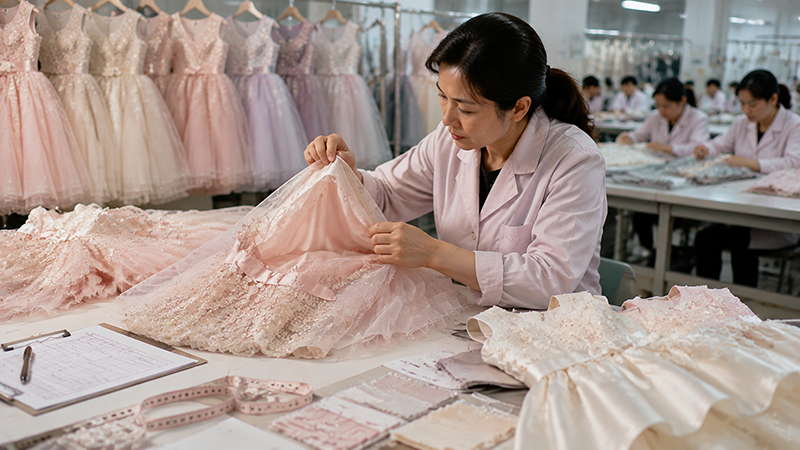
A proper inspection checks construction, lining and embellishment — the places defects actually hide.
2. How the Sampling Works
AQL inspection is statistical, which means you do not check every piece — you check a defined sample based on the total order size. The larger the order, the larger the sample, but the sample does not grow in proportion: you inspect a fraction, not a fixed percentage.
The sample size is set by a standard table (the AQL sampling tables, or ISO 2859-1). Here is an illustrative example of how sample size scales with order size at a common inspection level:
| Order size (pieces) | Illustrative sample size | Notes |
|---|---|---|
| Up to 150 | ~20 | Small orders, small sample |
| 151 – 500 | ~32 – 50 | Typical boutique order |
| 501 – 1,200 | ~80 | Mid-size wholesale order |
| 1,201 – 3,200 | ~125 | Larger volume |
Request an Inspection Report
Ask for the inspection report and defect breakdown from a recent order of the styles you are considering.
Illustrative only — the exact sample size comes from the AQL sampling table, which your inspection company will apply.
The key insight is that the sample is drawn randomly from across the cartons, not from the top of the pile. A sample drawn only from the easiest-to-reach cartons is worthless, because the factory may have packed the best pieces on top.
3. What to Check on a Kids’ Dress
AQL gives you the sampling method; you still have to define what to check. For children’s formalwear, the inspection points that matter most are:
- Measurements — chest, waist, length and sleeve against the size chart, within the agreed tolerance (often ±1–2 cm). Sizing drift is the most common bulk complaint.
- Stitching and seams — no skipped stitches, broken seams, or loose threads; seam strength adequate for a child’s movement.
- Embellishment — sequins, beads and appliqués firmly attached; nothing that will shed or detach into a choking hazard.
- Fabric and color — fabric matches the approved sample; no stains, shading differences or color mismatch within a lot.
- Closures — zippers, buttons and hooks function correctly and are securely attached.
- Symmetry — bows, sleeves and hems are even, not twisted or misaligned.
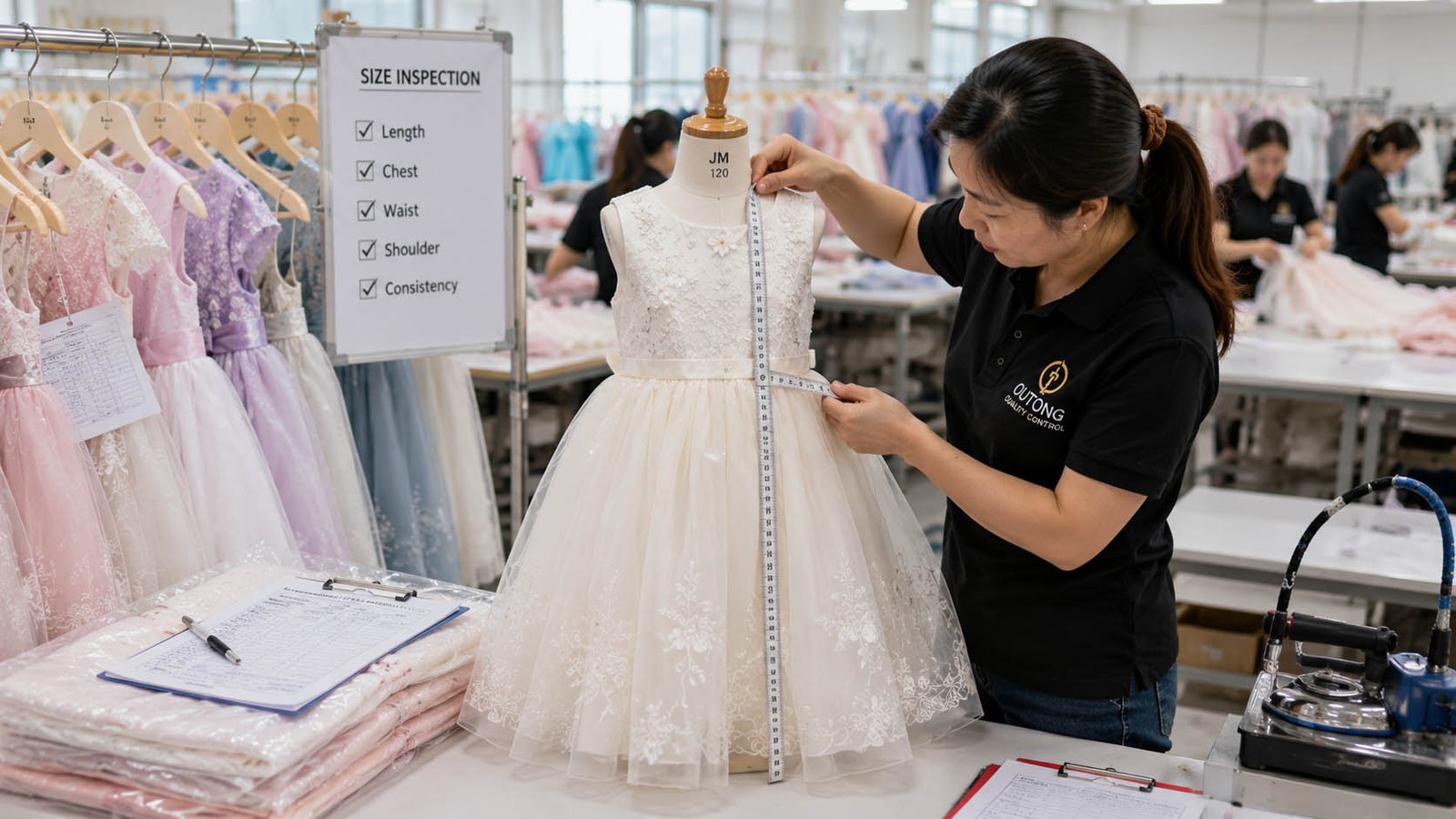
Measurement against the approved size chart is the single most valuable check — it catches sizing drift before it reaches customers.
4. Accept or Reject: Reading the Numbers
Once the sample is inspected and defects counted, you compare the count against the AQL limit. If the number of defective pieces is within the limit, the lot is accepted; if it exceeds the limit, the lot fails.
The practical value of AQL is that it replaces argument with arithmetic. “There are too many bad ones” is a dispute; “12 major defects in an 80-piece sample exceeds the AQL 2.5 limit of 5” is a decision. When you and the factory agree on the AQL level before production, the accept/reject decision is objective on both sides.
5. Who Runs the Inspection
There are two ways to get an AQL inspection, and the difference matters:
- Factory self-inspection — the factory checks its own goods and sends you a report. Useful as a first pass, but not independent.
- Third-party inspection — an independent inspection company draws the sample and produces the report. This is the gold standard for a bulk order.
For a first large order, a third-party pre-shipment inspection is strongly recommended. It is the cheapest form of insurance in sourcing — a few hundred dollars to verify a shipment worth thousands, before it leaves the factory rather than after it arrives at your door.
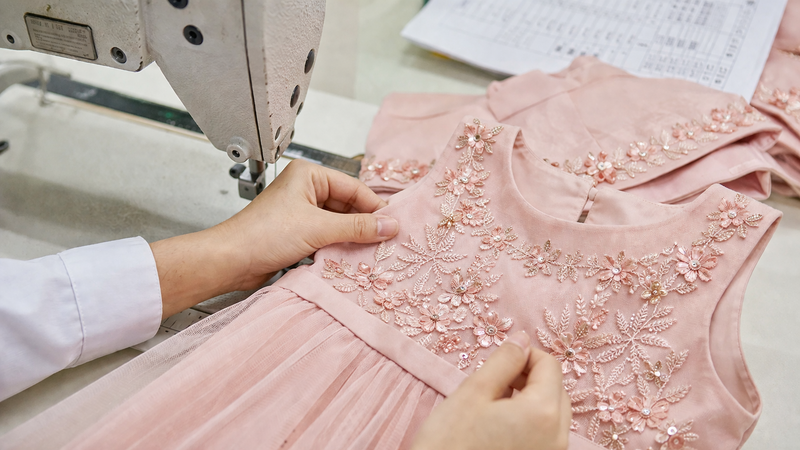
Stitching quality is the single most inspectable signal of a factory’s overall standard.
6. A Practical Inspection Workflow
Put it all together into a repeatable process for every bulk order:
- Agree the AQL level before production — e.g. critical 0, major 2.5, minor 4.0.
- Define the defect list and tolerance for measurements.
- Book a pre-shipment inspection — third-party for large or first orders.
- Review the report — accept, reject, or negotiate a rework based on the numbers.
- Keep the records — inspection reports build a quality history you can use with future orders and suppliers.
A supplier who works this way — documented QC, clear AQL terms, welcome third-party inspection — is the kind of partner worth keeping. When you are ready, we are happy to discuss our own quality control process and how we handle inspection on your orders.
Frequently Asked Questions
What does AQL 2.5 mean?
AQL 2.5 is a quality standard meaning a production lot is acceptable if its defective rate stays at or below about 2.5%. It is the most common level for apparel, applied to major defects, while critical defects have an effective limit of zero.
Do I have to inspect every piece in an order?
No. AQL uses statistical sampling — you inspect a defined number of pieces based on the order size, drawn randomly from across the cartons. The sample is a fraction, not a fixed percentage, of the total.
What is the difference between major and minor defects?
Major defects make a dress unsellable or significantly flawed (broken stitching, wrong size, stains). Minor defects are small imperfections that do not stop it selling (loose thread, tiny measurement deviation). Critical defects are safety hazards and fail the lot outright.
Should I use a third-party inspection?
For a first or large bulk order, yes. A third-party pre-shipment inspection gives you an independent accept/reject decision and costs far less than a rejected container discovered after arrival. We’re happy to share our quality and compliance approach before you book one.
When should the AQL level be agreed?
Before production starts, in the order terms. Agreeing the AQL level up front makes the accept/reject decision objective for both buyer and factory, instead of a dispute after the goods arrive.
What measurements should a kids dress inspection check?
Chest, waist, length and sleeve against the size chart, within an agreed tolerance (often ±1–2 cm). Measurement checks are the most valuable part of the inspection, because sizing drift is the most common bulk complaint.
Inspect with confidence
Tell us your order size and we’ll confirm our AQL standard, defect tolerance and pre-shipment inspection process before you commit.
Leave a Reply