
A dress with embroidery, dimensional flowers, bows or beading is bought from a photograph and manufactured from a document. The photograph says what the buyer liked; the document decides whether the thousandth piece matches the first. Most attachment failures and most consistency complaints trace back to a field that was never written down — a placement described as “roughly above the waist”, an attachment approved as an intention, a colour agreed from a screen. This guide is a specification builder for girls dress embellishments: it walks the fields that belong in the tech pack one at a time, and for each field it separates what to specify from how to verify it.
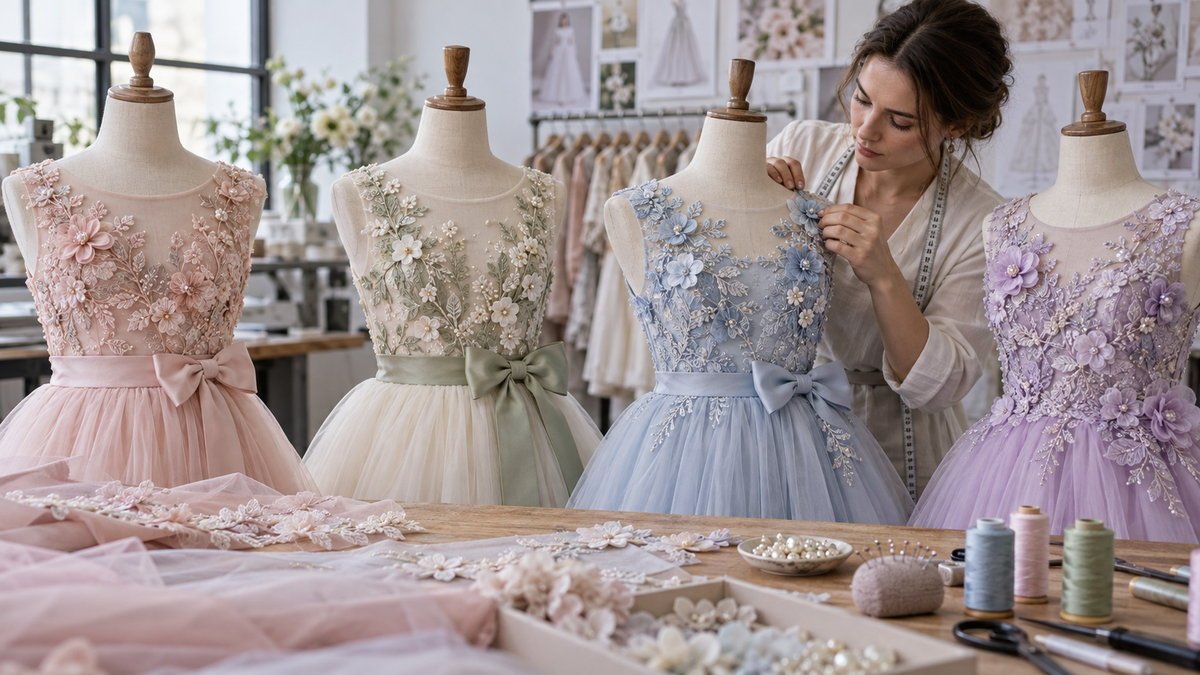
It is written for boutiques, retailers, online stores, private-label brands, importers and professional kidswear buyers working on constructions such as machine embroidery, 3D flowers, bows, beading and appliqué. Nothing here is a forecast, and no illustrative figure should be read as a market result or a guarantee. Whether a particular bead, fastening or component is acceptable depends on the product, the age group, the destination and the law in force, so confirm final safety and compliance decisions with a qualified product-safety professional; this page is a specification workflow, not legal advice.
Writing the detail down instead of photographing it
A reference photograph is not a specification. It shows the design intent clearly enough for a mood board and obscurely enough to be quoted against, because two suppliers can look at the same image and produce two different motifs at two different densities on two different base fabrics. The moment the embellishment has to repeat across a size run, an approved document replaces the picture as the controlling artefact.
The first thing the document has to settle is what the embellishment is doing, because that fixes how much surface the motif should occupy and how much uplift the garment can absorb. The detail may carry the whole visual story at the neckline, act as a repeat accent that lifts a plain bodice, or signal a premium tier. Record the intended role, and the age band it is aimed at, before sampling, so a striking sample cannot quietly rewrite the assortment plan it was meant to serve.
That document needs the fields that make the detail reproducible: motif dimensions, quantity, measured placement, colour reference, material, attachment method, stitch or tack points, backing, edge finish, orientation, grade rule, acceptable variation and packing protection. For a bow, add finished width and height, tail length, interfacing, the symmetry point and the recovery requirement. For 3D flowers, define petal layers, the flower size range, centre construction and whether every unit is sewn, bonded or both. The kids dress tech pack checklist covers the wider pack these fields sit inside; this page is about the lines that the embellishment itself needs.

The fields an embellishment specification has to settle
Six fields carry almost all of the risk, and they are the six that follow. They are listed here so the shape of the document is clear before the detail begins. Match the technique to the age band as these fields are written: younger sizes usually tolerate soft, rounded, securely sewn or bonded detail better than small hard parts, while older girls can carry finer beading and structured bows. That is a specification decision, not a styling preference, because it changes the component, the fastening and the test that the sample has to pass.
The six fields are:
1. Placement, expressed as measurements from a garment datum and carried through the grade rule.
2. Stitch, backing, edge finish and the exact attachment method.
3. Beads, pearls and any detachable detail, treated as a safety and durability question rather than a decorative one.
4. Colour, scale and density, approved on the actual base fabric.
5. Inspection placed during production, where a drifting line can still be corrected.
6. Packing written against the projection of the detail and the risk of snagging.
Each field has a different failure signature, which is why they earn separate lines in the document rather than one sentence about quality. The rest of this guide takes them in turn.
Field one — placement, stated as measurements from a datum
What to specify. Express placement in numbers tied to the garment. Use a measured reference such as distance from the centre front, the neckline seam or the shoulder point, plus the motif’s own width and height and the axis it must sit on. State which edge is the datum and which way the motif faces. Then build the placement into the grade rule, because a motif centred correctly on the sample size can crowd a smaller bodice or sink too low on a larger one.
How to verify it. A dated photograph on a measured card gives the factory an unambiguous reference, but the photograph has to be taken on the measured card rather than on a hanger. Check the placement across the graded sizes rather than only on the sample, since the same coordinates can be correct on one size and visibly wrong on another.
Field two — stitch, backing, edge and attachment method
What to specify. Name the stitch type and density, the backing or stabilizer, the edge finish and the exact attachment. For embroidery, state the digitized file reference, thread type and colour, underlay and any topping, and whether a density change is allowed. For appliqué, state whether the edge is turned, satin-stitched or cut and bonded, and what holds it. For a bow, state finished dimensions, tail length, interfacing, grain direction and the tack points. Approval should name the method rather than the intent, because substituting adhesive for sewing after approval is a change notice, not a finishing decision.
The technique routes differ less in material than in labour pattern and repeatability, and the specification should say which one is being paid for.
| Route | What the spec must name | Where the cost sits | Main risk if unspecified | How to verify it |
|---|---|---|---|---|
| Machine embroidery | digitized file reference, thread type and colour, stitch density, stabilizer, underlay, topping | the file and machine time once digitizing is proven | density drift, puckering, skipped stitches, loose thread, scale that breaks across sizes | inspect puckering, skipped stitches and backing comfort on the line, not only at final |
| Hand finishing | bead or flower component, spacing, tack points, end finish, seconds per piece | skilled seconds per garment, which scales poorly with volume | inconsistency between operators and between lots | record results by component lot and production batch |
| Bonded appliqué | adhesive system, edge treatment, the durability basis for the care method | material and process, with stitch labour removed | adhesion and edge quality, and heat or moisture revealing failures later | compare after the approved care process and after packing, not on a fresh sample |
| Sewn appliqué edge | turned, satin-stitched or cut edge, and what secures it | stitch labour on every piece | raw or insecure edge with poor bond | check the edge finish and confirm the reverse side is clean |
| Engineered bow | finished width and height, tail length, interfacing, grain direction, tack points, symmetry point | forming and tacking time | asymmetry and collapse of the engineered shape | approve symmetry on the physical sample, not on a photograph |
| Detachable bow or pinned corsage | the fastening, the removal method, the age group it suits | fastening component plus per-piece testing | a loose piece a younger child can remove | test the fastening and confirm the intended age group with a qualified product-safety professional |
How to verify it. Substitute nothing silently. If adhesive replaces sewing, or a stabilizer is swapped for a lighter one, the approval no longer covers what is being made, and the correct response is a resubmitted sample rather than a note.
Field three — beads, pearls and anything removable
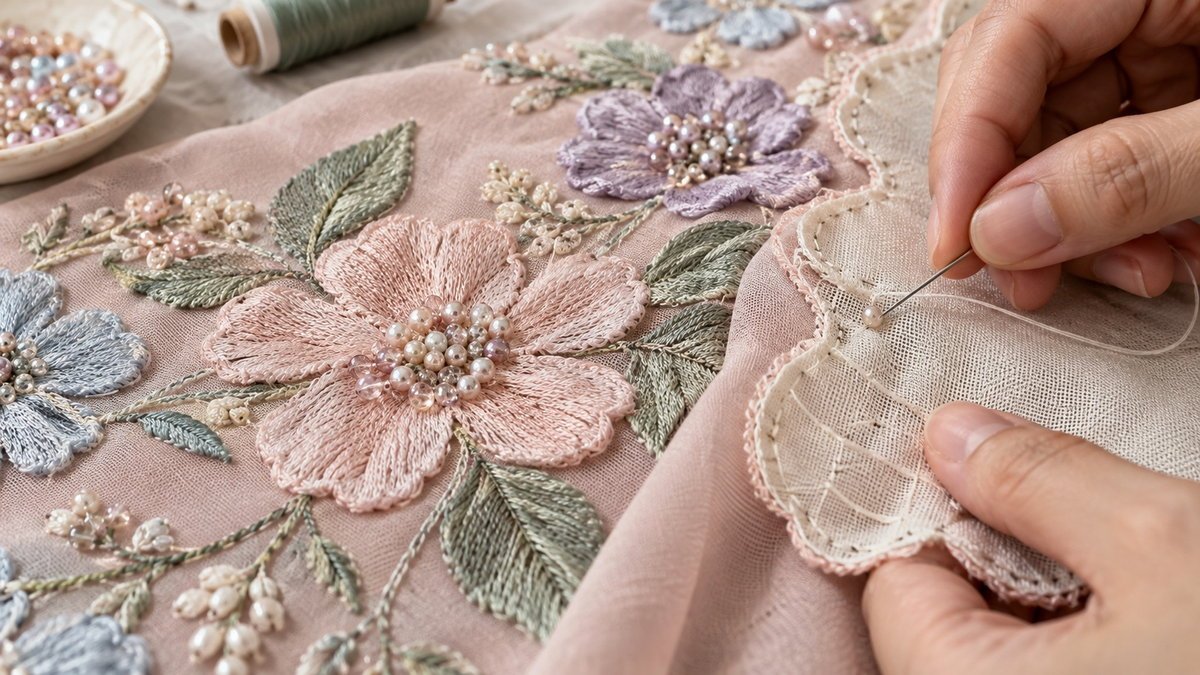
What to specify. Bead size, shank type, the finish of the thread end and the depth of the knot all affect whether a small part stays attached through wear and care, so each belongs in the specification rather than in the supplier’s habit. Add spacing, because a bead that is individually secure can still drift off its marked line across a panel. For detachable bows and pinned corsages, write down what holds the piece on and how it is meant to come off, then state the age group the detail is intended for.
How to verify it. Set the fastening, then test it rather than describing it. One approved panel does not prove that thousands of hand-applied units will be consistent, so durability needs its own control: record attachment strength and end-finish results by component lot and production batch, and check sharp points and the reverse side as well as the face. Where the age group or destination requires it, have the test and its acceptance criteria defined by a qualified product-safety and quality professional, and keep the dated results with the specification so a repeat order is judged against the same standard.
Field four — colour, scale and density on the actual base fabric
What to specify. Approve thread, bead, ribbon and adhesive film colours on the production base fabric, under agreed lighting, against a physical reference. Thread and beads read differently on a pastel ground than on a saturated or textured one, and neither a colour card nor a screen image shows that contrast. Agree the acceptable variation in colour, size and crowding before the fabric is cut, and write the tolerance into the document rather than leaving it to the inspection conversation.
How to verify it. Judge scale in relation to the garment panel rather than on a swatch, because a motif that reads well against a small card can look weak across a full bodice. Density is the variable most often underestimated: it stiffens a light fabric, causes puckering and adds weight a child feels, and it is far easier to correct on paper than on a cut panel. The behaviour of the ground fabric under stitch and press is set out in the girls dress fabrics wholesale guide, which is the right companion reference when the base fabric itself is still being chosen.
Field five — inspection while the line is still running
What to specify. Embellishment fails gradually and unevenly, so a final-only inspection hides the cause and reports the symptom too late to correct it. Write in-line checks at the points where drift appears: after the first motif is sewn or applied, after stitches or beads are attached, and again after any heat or pressing step. State what each check is looking for — placement drift between pieces, a thread or colour-lot change, uneven density, beads that sit off the marked line. Reserve the reverse side for final, because backing that scratches, loose ends and sharp points are seen only from inside, and add a post-packing check for recovery.
How to verify it. Set critical, major and cosmetic levels for each failure mode and check them where they can still be corrected. Placement and attachment belong in line; the reverse side belongs at final; recovery belongs after packing. Keep dated inspection records against the specification version, and treat any change of thread, bead lot or flower construction as a reason to re-sample rather than a minor substitution. The girls dress quality checklist covers the surrounding garment inspection routine; the embellishment checks above sit inside it.

Field six — packing written against projection and snag
What to specify. A raised flower, an engineered bow or a beaded panel has projection, and projection is what gets crushed, bent, snagged or marked before the customer opens the parcel. Specify the pack around the product: a supported bow, a card or tissue separator, and enough room that the detail does not carry the weight of the pack. Then define recovery — how a flattened petal or a bent bow is restored and who performs it, whether the factory before packing or the boutique on receipt — and name the person responsible.
How to verify it. Compare the packed sample after the conditions the shipment will actually meet, because heat, moisture and compression can reveal failures that are invisible on a fresh sample. A close-up photograph of the packed detail, taken before the carton is sealed, is the cheapest evidence you will ever hold when a shipment arrives with a bent bow.
What the specification freezes after approval
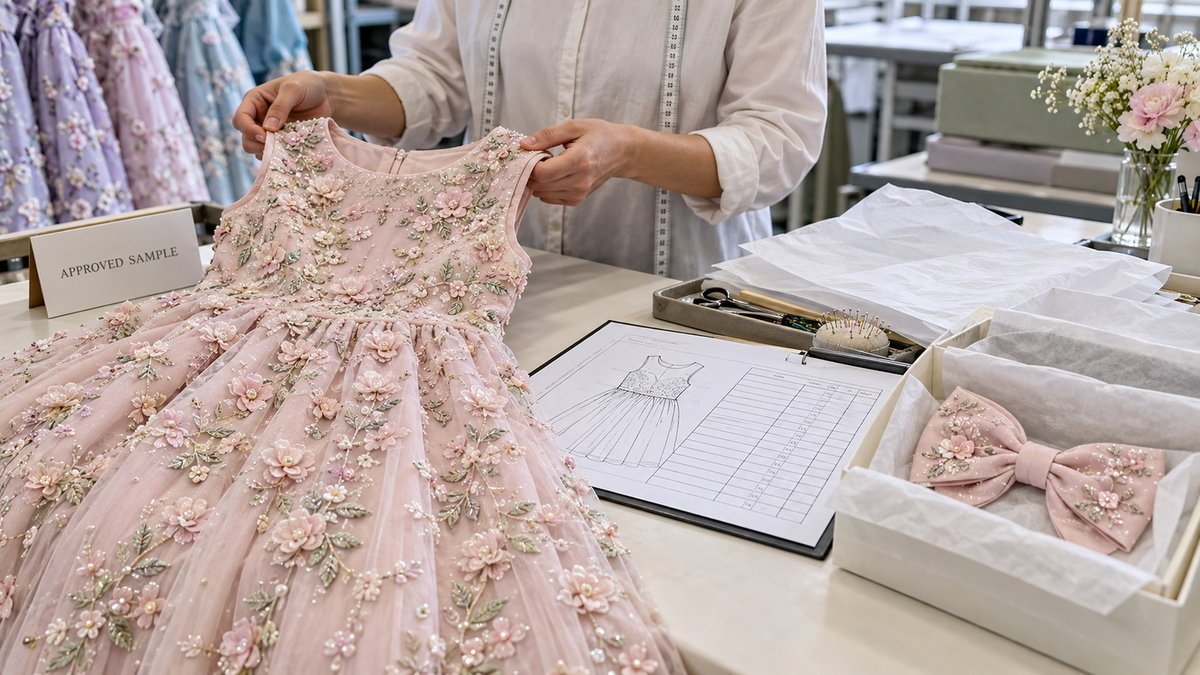
Some fields cannot be recovered once production starts, and those are the ones that earn the sample time and the physical reference. The digitized file, the component lot, the placement coordinates and any custom colour fall into this group: a change to any of them means the approved sample no longer describes the product. Display order, photography and marketing copy can still move later without touching the garment, which is why the freeze list should be written explicitly rather than assumed.
Where the specification is built for a private-label programme rather than adapted from a stock style, the freeze list becomes part of the development plan — the route that gives the most control over motif, placement and finish also carries the longest development time, which is the trade-off set out in the custom girls dresses OEM and ODM overview. On a repeat order, re-check the frozen fields against the new quotation, because a differently sourced thread or bead lot can force a fresh sample.
Reading the sheet back before it leaves your desk
Before the specification is released, read it back as if you were the person on the line who has never seen the photograph. Confirm that every one of these questions has an answer written in a number, a named method or a physical reference rather than an adjective:
1. Is the placement given as a distance from a stated datum, with the motif’s own dimensions and the axis it sits on?
2. Does the grade rule say how the motif behaves on the smallest and the largest size?
3. Is the stitch type and density, backing, edge finish and attachment method named — or only implied?
4. For a bead or a detachable piece, is the fastening specified, tested and matched to an age group?
5. Was colour approved on the production base fabric, against a physical reference, under agreed lighting?
6. Are the in-line inspection points, their criteria and their records actually written into the plan?
7. Does the packing line describe the support, the separator and the recovery step, with an owner?
8. Is it clear which fields may not change after approval, and what a change notice triggers?
Any question answered with an adjective is the field most likely to be quoted back at you in a rejection report. Premium embroidery is not a specification; a defined motif size, stitch density, backing and placement is.
Send the reference and the intended detail
Send the embellishment reference or sketch, the base fabric and its weight, the motif size and measured placement, the technique you have in mind, the attachment and reverse-side finish you need, the target age group and destination, the quantity range, the delivery window and the price position — plus whether you need ready stock, an adaptation of a proven base or full custom development. We will build the specification fields above into a sample brief for review, and tell you which items still need a physical reference before the first piece is made.
Leave a Reply