
A third-party inspection is the cheapest insurance a wholesale children’s clothing buyer can buy, and the one most often booked too late to be useful. This guide explains the four inspection types, what each one actually catches, how to brief an inspector so the report is worth reading, and how to decide whether a shipment is big enough to justify the visit.
Quick Answer
There are four inspection points: pre-production (materials and components before cutting), during production (first pieces off the line), pre-shipment (finished, packed goods against an AQL sample) and container loading (what actually goes into the container). For most wholesale orders of girls’ dresses, the pre-shipment inspection is the one that pays for itself, because it is the last point at which you can still fix a problem before the goods leave. Book it when roughly 80% of the order is packed.
See the Standard Before You Book
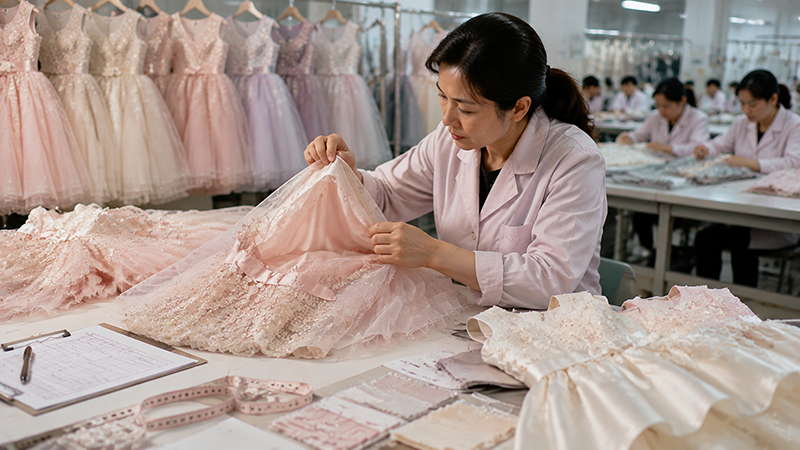
An inspector checking dress construction against the approved sample on site.
An inspection is only as good as the specification it checks against. Send us your tech pack or a reference sample and we will confirm the measurements, tolerances and finishing points an inspector should be checking on your styles.
What Buyers Need to Know
An inspection does not make a garment better. What it does is move the moment of discovery from your warehouse to the factory floor, where the fix is still cheap. That shift is the entire value of the exercise, and it is why the timing matters more than the price of the visit.
The sample size is not arbitrary. Most apparel inspections work to AQL — Acceptable Quality Limit — drawn from ISO 2859-1 or its ANSI equivalent. In plain terms, AQL defines how many defective units are tolerated in a random sample before the whole lot is rejected. A common setting for garments is 0 for critical defects, 2.5 for major defects and 4.0 for minor defects, at General Inspection Level II. Those numbers are not a quality target; they are a threshold for deciding whether to accept the shipment.
The classification of defects is where buyers lose control. A critical defect is one that could harm a child or break the law — a detachable button on a toddler size, a needle left in a garment, a failed flammability classification. A major defect is one a customer would return the dress for — a broken zipper, a visible stain, a measurement outside tolerance. A minor defect is a workmanship issue a customer would probably not notice but a retailer might. If you do not define these for your product, the inspector will use a generic list, and a generic list will pass things you would have rejected.
The Four Inspection Points
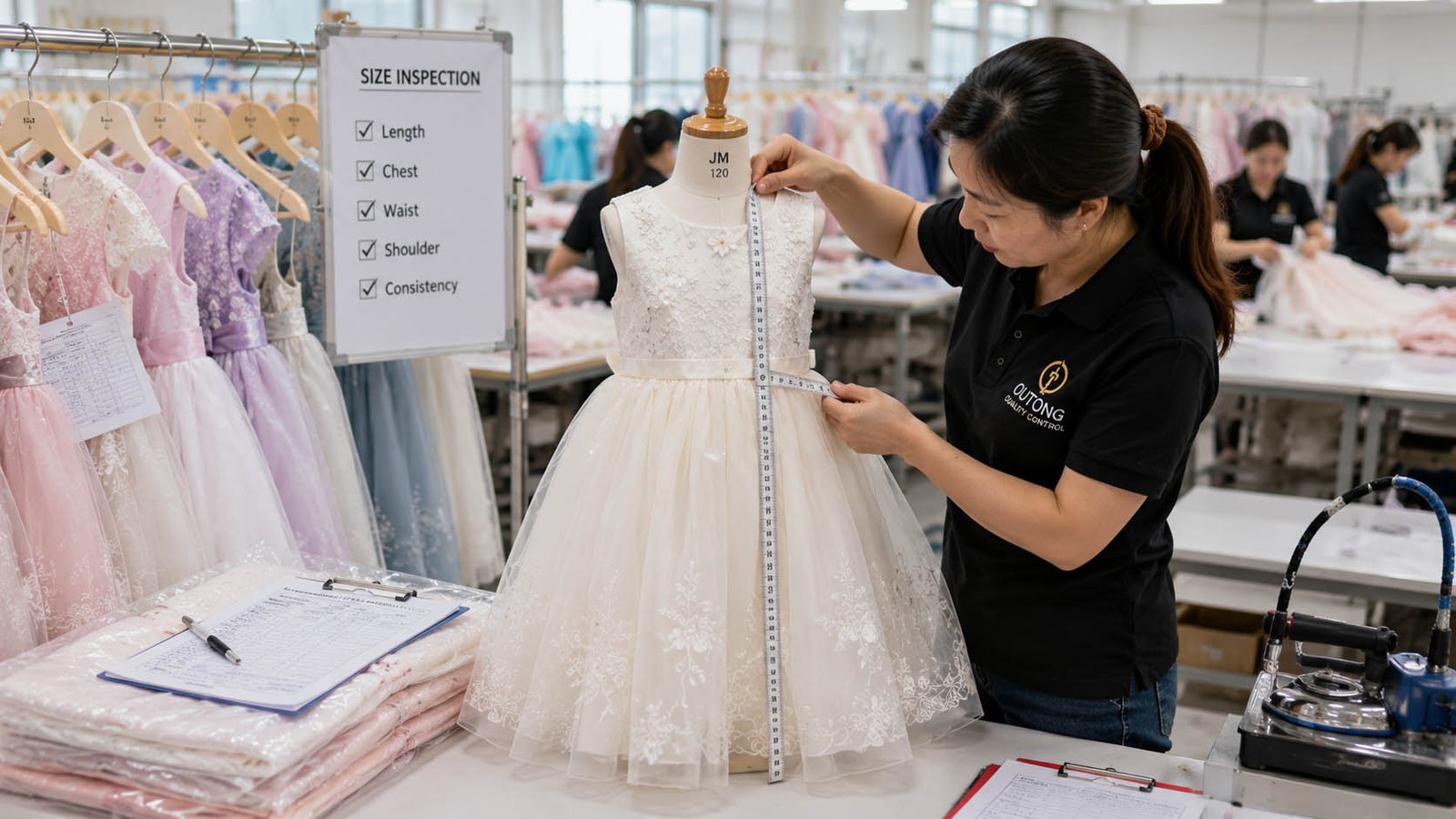
Measuring finished dresses for size consistency is one of the four inspection points.
| Type | When it happens | What it catches | Worth booking when |
|---|---|---|---|
| Pre-production | Before cutting, once bulk materials arrive | Wrong fabric, wrong GSM, wrong trim, wrong colour, missing components | New styles, new fabric, or an order large enough that a wrong fabric is unrecoverable |
| During production | First pieces off the line, usually at 10-20% | Pattern errors, construction mistakes, fit drift, finishing problems | Complex construction, or the first order of a style you plan to repeat |
| Pre-shipment | At roughly 80% packed | Workmanship, measurements, packing, labelling, assortment and quantity | Almost always — this is the default for wholesale orders |
| Container loading | While the container is loaded | Short shipment, wrong cartons, substitution, poor loading and stacking | Large shipments, mixed containers, or a new logistics partner |
Planning a Repeat Programme?
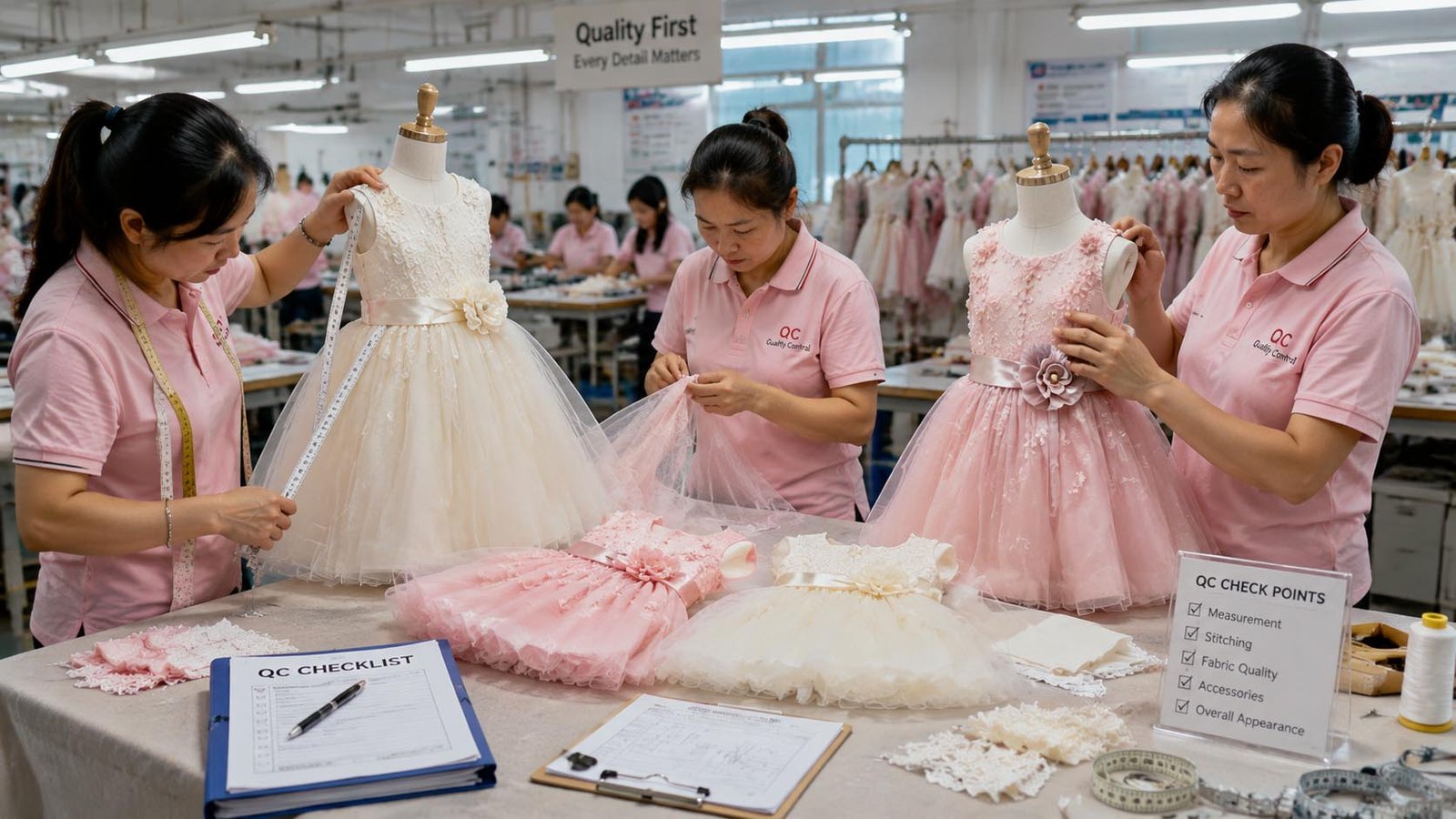
Inspection during manufacturing catches defects while they are still cheap to fix.
On a repeat order, the inspection can be lighter because the specification is already proven — but only if the fabric, trims and factory stay the same. Tell us which styles are repeats and we will flag what is worth re-checking.
How to Brief an Inspector
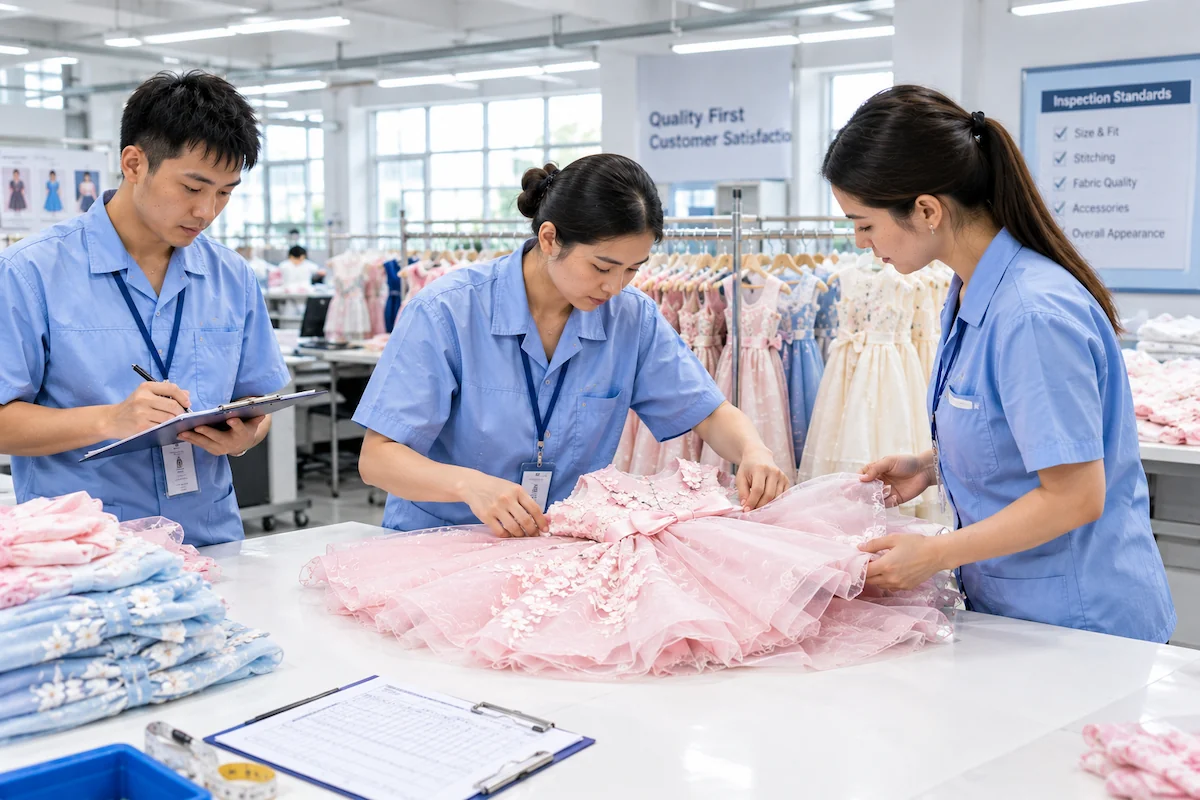
Final garment inspection before the cartons are sealed is the last gate on the order.
A weak brief produces a generic report that says very little. Eight items make the difference.
First, the approved reference sample — the actual sealed sample, not a photograph. Second, the measurement spec with tolerances; “chest 64 cm” without a tolerance is not checkable. Third, the defect classification list you have defined yourself. Fourth, the AQL levels you want applied. Fifth, the packing and labelling requirements, including carton marking, polybag warnings and assortment ratios. Sixth, any market-specific checks you need, such as tracking labels or care label content. Seventh, the quantity and carton count so the inspector can verify the shipment is complete. Eighth, the authority to stop loading if critical defects are found — without that, an inspection is a report rather than a control.
How to Work It Out: A Worked Example
You have 800 girls’ dresses in four styles and six sizes, shipping in one container, from a factory you have used twice before.
The styles are repeats, so a pre-production inspection is probably not worth the fee — the fabric is known. But the order uses a new colourway, which is a real risk: new dye lots are the most common source of shade variation. A pre-production check limited to shade and fabric weight against the approved swatch is cheap insurance.
At around 20% production, a short during-production visit catches the thing that hurts most on dresses: hem and tier alignment on a multi-layer skirt. It is far cheaper to correct at twenty pieces than at eight hundred.
The pre-shipment inspection is the main event. The inspector draws a random sample by carton, checks measurements, workmanship, labelling and packing, and applies your AQL. If major defects exceed the threshold, the lot fails and you negotiate a rework, a sorting pass or a discount before the goods ship.
With one container and 800 pieces, a loading check is marginal. With four containers and a new forwarder, it earns its fee by confirming that what was inspected is what was loaded.
An inspection report is evidence, not a guarantee. It tells you what was in the sample drawn on that day. Combine it with a retained production sample and a written specification, and you have something you can hold a supplier to.
Buyer Checklist
- Send the approved sealed sample to the inspection company or to the factory before the visit.
- Provide measurements with explicit tolerances, not just target values.
- Define critical, major and minor defects for your own product.
- Set your AQL levels in writing, and state the inspection level.
- Specify packing, labelling, assortment and carton marking requirements.
- Confirm the inspector has authority to stop loading if critical defects are found.
- Ask for photographs of every defect found, with a measurement reference.
- Require the report within an agreed window, before the vessel or aircraft departs.
- Keep the report, the reference sample and the tech pack together for reorders.
- Re-book the inspection on every order, even from a factory you trust.
Common Mistakes (and What They Cost)
Booking the inspection after the goods are packed
The inspection needs to happen while there is still time to rework. If the goods are already at the port, a failed report gives you a negotiating position, not a fix.
Using the inspection company’s default defect list
Generic lists are written for generic garments. A sequin trim on a party dress and a drawstring on outerwear are different risks, and only your brief captures that.
Inspecting without an approved sample on site
Without a reference, “acceptable” becomes a matter of opinion. Keep a sealed sample at the factory and one with you.
Treating a pass as proof of compliance
A visual inspection does not test for lead content or flammability. Those are laboratory questions. An inspection pass and a compliance file are two different things.
Skipping the inspection on a trusted factory
Most quality disasters happen on repeat orders, because that is when the brief gets shorter and the assumptions get longer.
FAQ
What does AQL 2.5 mean in practice?
It sets the number of major defects tolerated in a random sample of a given size before the lot is rejected. It is a statistical threshold, not a quality score. Ask your inspection company to state the sample size and the accept and reject numbers for your order quantity.
How much of the order should be packed before a pre-shipment inspection?
Around 80% is the usual working rule. It is enough to be representative and still leaves time to rework before the shipping window closes.
Is an inspection worth it for a small order?
It depends on the consequence of being wrong. A 200-piece order of an untested new style can justify an inspection more than a 2,000-piece reorder of a proven one. The question to ask is what a failure would cost you, not what the visit costs.
Who pays if the inspection fails?
That should be agreed before production starts. In practice, the supplier reworks at its own cost where the defect is its responsibility, and the buyer may need to fund a re-inspection. Put the principle in the order terms rather than negotiating it after the report lands.
Can an inspection check compliance documentation?
It can check that labels are present, legible and correctly worded, and that tracking labels are applied. It cannot verify laboratory results. That part of the file comes from testing.
How do I choose an inspection company?
Look for apparel experience in your product category, inspectors based near your factory, a report format you can actually read, and a turnaround that fits inside your shipping window. Ask for a sample report before you book.
Leave a Reply